Japan passes law protecting property rights in space

Japan’s legislature on June 15th approved a new law designed to protect the ownership of the resources private entities extract for profit in space.

Japan’s legislation is similar to provisions in the Commercial Space Launch Competitiveness Act, passed by the U.S. Congress and signed into law by President Obama in 2015. That law grants U.S. companies rights to resources that they extract, but not property rights to celestial bodies, which would run afoul of the Outer Space Treaty. Luxembourg and the United Arab Emirates have since passed similar legislation.

All four countries are signatories of the Artemis Accords, which endorses the ability to extract and use space resources. “The Signatories affirm that the extraction of space resources does not inherently constitute national appropriation under Article II of the Outer Space Treaty, and that contracts and other legal instruments relating to space resources should be consistent with that Treaty,” the accords state.

Both Russia and China oppose such legislation, as well as the Artemis Accords, which have now been signed by eleven countries.

What this growing alignment of opposing sides means for future space operations by private companies is unclear, though it suggests these two countries will not honor those private property rights, which in turn suggests this legal disagreement is eventually going to lead to physical conflict in space.
4 comments

China and Russia outline long term plans for building joint lunar base

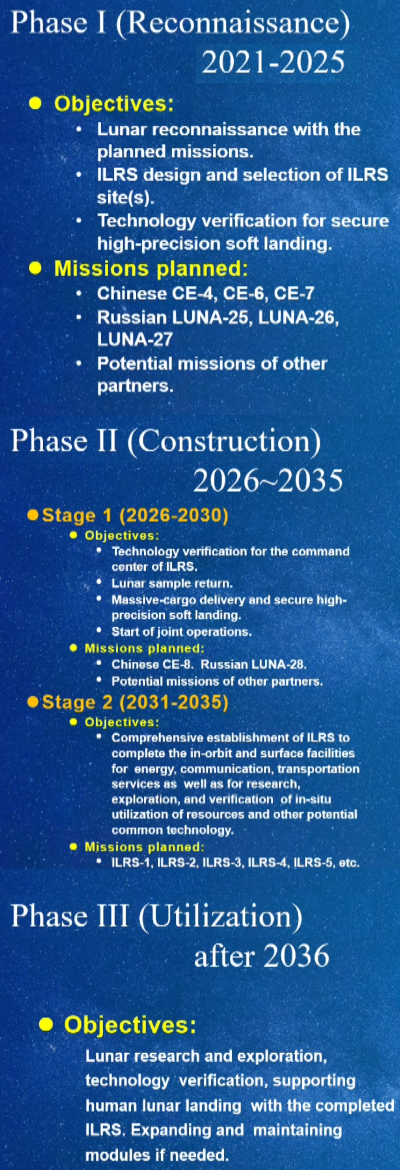
China/Russian Lunar base roadmap

The governments of China and Russia yesterday announced their long term roadmap for building a joint manned lunar base on the Moon, what they have labeled the International Lunar Research Station (ILRS).

The graphic to the right, rearranged by me from the PowerPoint slides released by the two governments, shows the overall plan.

The first phase, starting now and running through ’25, will involve six already planned unmanned missions by both countries, three each. Of the three Chinese unmanned missions, Chang’e-4, Chang’e-6, and Chang’e-7, the first is already operating on the Moon, as it includes the Yutu-2 rover. Based on China’s recent track record, it would be reasonable to expect the other two Chang’e missions to fly as planned.

Of the three Russian missions, Luna 25 is scheduled to launch later this year, making it the first all-Russian-built planetary mission in years and the first back to the Moon since the 1970s. The other two Russian probes are supposedly under development, but based on Russia’s recent track record in the past two decades for promised space projects, we have no guarantee they will fly as scheduled, or even fly at all.

The second phase, running from ’26 to ’35, will begin construction, though the details are vague.

The third phase, when China & Russia say they will begin full operations in ’36, is even more vague, merely stating the objective of human “lunar research and exploration”.

The pace matches well with the typically slow pace of these kind of government programs. It not only matches with the pace that China has shown in its entire manned program, with manned missions sometimes separated by years, it also matches the sluggish long term roadmap that NASA has put forth for its own Artemis program on the Moon. It also fits with Russia’s recent pattern, which is to repeatedly announce big projects and goals, with little actual execution to follow.

At first glance the plan suggests that we are in a new space race between the United States and its national partners in the capitalist west and the authoritarian governments of China and Russia. That may be so, but I think the real race will be between the government programs in China, Russia, and the U.S. and the efforts by private commercial companies aiming to make profits in space. And if you ask me to bet on who will get more accomplished faster for less money, I will hands down put my money on those private companies. The more profit they make, the faster they will push to move forward, and will quickly leave these sedate government programs in the dust.

7 comments

Russia announces it is shifting its manned operations on ISS to yearlong missions

According to Dmitry Rogozin, head of Roscosmos, Russia is changing the standard length of a crew stay at ISS from six months to a full year, beginning with the flight in which the crew will help film a commercial movie on ISS in October.

Then-Head of the Gagarin Cosmonaut Training Center Pavel Vlasov earlier said that two members of the Soyuz MS-18 spacecraft, Pyotr Dubrov and Mark Vande Hei, would stay in orbit longer than six months to help shoot a film Vyzov (Challenge). He also said that crew commander Oleg Novitsky would return to Earth in October aboard the Soyuz MS-18’s descend capsule together with the participants of the Soyuz MS-19 spacecraft’s flight (actress Yulia Peresild and film director Klim Shipenko who would be engaged in the film). Two crewmembers, cosmonaut Dubrov and NASA astronaut Vande Hei, would remain in orbit and return to Earth aboard the Soyuz MS-19 spaceship, he said.

Gaining experience at missions a year or longer, something only the Russians have accomplished, makes sense if one plans to send astronauts to Mars. I suspect however there is a second more practical reason for this change: It will free up seats on Soyuz to sell for commercial tourist flights. Russia clearly wants to compete successfully with the new American commercial manned flights that SpaceX and Axiom will be flying. This change gives them that opportunity.

Rogozin himself likely has personal financial motives. He is a co-producer on that movie, and likely will also pocket personally some of the profits from future tourist flights.

2 comments

Russian astronaut fired for opposing filming of movie on ISS

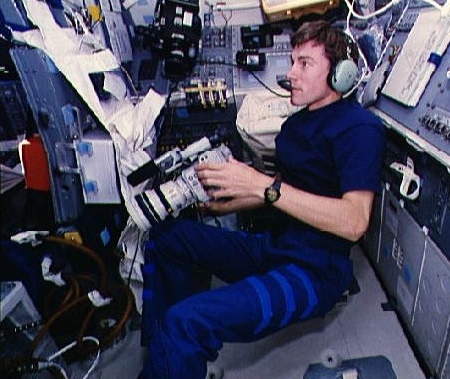
Krikalev on the shuttle to ISS flight in 1998
Sergei Krikalev on the first ISS assembly flight
by the space shuttle Endeavour in 1998.

According to one new story today, Russian astronaut, Sergei Krikalev, 62, was fired from his position in senior management within Roscosmos for opposing its decision to film for profit the first feature film on ISS.

Krikalev did not say why he was against the film but his stance was backed by former colleagues who said that taking a passenger would delay a flight for a cosmonaut. Roscosmos denied that Krikalev had been fired.

Krikalev is one of Russia’s most celebrated astronauts. He was the first person to fly in space who was born after Sputnik, was the first Russian to fly on the space shuttle, and was the first Russian (along with an American) to enter ISS’s first module soon after launch. Overall he has spent more than 800 days in space.

He also became the last Soviet citizen, stranded on Mir when the Soviet Union fell in 1991. When he launched, he was a citizen of the U.S.S.R. When he finally returned, that country didn’t exist, and he was now a citizen of Russia.

I interviewed him extensively for my book, Leaving Earth, because he was fluent in English due to his flights on the shuttle. What I learned was that Krikalev was then and probably still is an ardent communist. On that Mir flight he refused to be filmed in a commercial for Coca-Cola, arranged by Roscosmos to make some money. There was no way he would allow himself to be recorded in such a crass for-profit manner. Thus, I am not surprised he now opposes using Russian space facilities for a commercial movie, for profit.

I also found him to be a very thoughtful and analytical man, which also probably explains his opposition to this quickly arranged commercial flight. The film company is partly owned by Dmitry Rogozin, head of Roscosmos, so there probably is some payoffs and corruption involved. It is also probably interfering with the Russian side of operations, as the story says Krikalev claims. These factors would cause Krikalev to speak his mind and argue against the flight, which likely angered Rogozin, who is apparently pocketing some cash from the film.

I suspect Krikalev is not fired, but has merely been sent to the doghouse for a short while. Roscosmos (and Rogozin) can’t afford the bad publicity of letting him go. It also needs his expertise in their operations.

5 comments

Russia announces new tourist flight options to ISS

Capitalism in space: Russia has announced a range of new tourist flight options to ISS in an effort to compete against the new commercial tourist flights being offered by American companies.

Glavkosmos is offering space tourists the option of performing spacewalks from the International Space Station (ISS) and stays of up to 30 days aboard the orbital laboratory. They can even purchase the Soyuz space capsule that took them to and from the station.

The company, which is part of Roscosmos, recently upgraded its website to provide details of what paying customers can do when they book a trip to the station. The information is available in Russian and English.

You can see the English website here. It does not indicate what the prices are for these services, though it will have to be competitive with what SpaceX is charging in order to compete.

Side note: This story is on Doug Messier’s site Parabolic Arc, which is presently running a fund-raising campaign. Please consider donating. While Doug and I might disagree on many things, his work covering commercial space remains among the best on line.

0 comments

South Korea signs the Artemis Accords

On May 24 South Korea officially signed the Artemis Accords, joining nine other countries in the agreement designed as a work around of the Outer Space Treaty’s provisions in order to protect property rights in space.

By my count, that makes eight signatories, including Japan, United Kingdom, Australia, Canada, Luxembourg, the United Arab Emirates and Italy.

Essentially, the space-faring nations of the world are splitting into two groups, those who will follow these accords, and those who won’t, led by China and Russia. In a sense, we are seeing a renewal of the Cold War in space, with the western powers that believe in private enterprise and freedom aligned against those whose cultures are authoritarian and ruled from above.

8 comments

Roscosmos finally approves ISS module Nauka for launch

After successfully completing its last ground tests, Roscosmos announced today that it has finally approved the launch on July 15th of its next module for ISS, dubbed Nauka.

Nauka’s long road to space began more than a quarter of a century ago, in 1995, with this year’s launch about fourteen years behind schedule. An engineer who started working on Nauka after graduation at the age of 25 would now be a grizzled veteran of 51 and looking forward to retirement in only a few years.

The module will provide the Russian half of ISS a second restroom, greater oxygen and water recycling capacity, and room for a third resident, all necessary additions for the planned two commercial tourist launches Russia has scheduled for the fall.

4 comments

NASA gives an American the seat on Dragon flight that it had been holding for Russian

NASA yesterday announced that it has added an American astronaut to the next manned mission to ISS, set for October.

NASA said that Kayla Barron will join the Crew-3 mission, launching on a SpaceX Crew Dragon spacecraft scheduled for launch no earlier than Oct. 23. Barron joins NASA astronauts Raja Chari and Tom Marshburn, and European Space Agency astronaut Matthias Maurer, who had been assigned to Crew-3 last December.

The Crew-3 mission will relieve the Crew-2 astronauts who arrived at the station on another Crew Dragon spacecraft April 24. The four Crew-3 astronauts will remain on the station for a six-month stay.

The space agency had been holding that seat open for a Russian, as part of its long term barter arrangement whereby in exchange for flying Americans on Soyuz capsules, Russia flies Russians on American spacecraft. That arrangement had been used repeatedly when the shuttle was flying, but since its retirement the U.S. has been forced to buy its seats on Soyuz as it had nothing to offer in exchange.

With the arrival of SpaceX’s Dragon capsule however NASA has been trying to get the Russians to renew that arrangement. And though an American, Mark Vande Hei, flew for free on a Soyuz last month, the Russians have as yet refused to assign their own astronaut to this upcoming October flight, despite months of negotiations. It appears NASA decided it could wait no longer, and filled the seat with its own astronaut.

In fact, the announcement by Roscosmos on May 13th that the next two Soyuz launches to ISS will carry two commercial passengers each means that Vande Hei cannot return on a Soyuz until next year. The seat he would have used to come home now must be used by these tourists, meaning his mission will now be extended to last for as much as a full year or more.

Unless of course NASA decides to bring him home on a Dragon capsule instead.

6 comments

Roscosmos announces two commercial tourist flights to ISS

Capitalism in space: Roscosmos, the government corporation that controls of all of Russia’s space industry, announced today that it will be flying two different commercial tourist flights to ISS, both occurring before the end of this year.

The first will take place in October.

Roscosmos [is] sending an actress and a director to the ISS in October with the aim of making the first feature film in space. The film, whose working title is “Challenge,” is being co-produced by the flamboyant head of Roscosmos, Dmitry Rogozin, and state-run network Channel One.

The second will take place in December, and will fly Japanese billionaire Yusaku Maezawa (the man who has already purchased a Moon mission on SpaceX’s Starship) and his assistant Yozo Hirano in a Soyuz capsule to ISS for twelve days.

Let’s review the upcoming tourist flights now scheduled:
» Read more

17 comments

Eutelsat invests $550 million in OneWeb

Capitalism in space: The long established European communications satellite company Eutelsat has committed $550 million in investment capital in OneWeb and its internet satellite constellation.

Eutelsat, one of the world’s leading satellite operators, will receive a c.24% equity stake in OneWeb and similar governance rights to the U.K. Government and Bharti Global, making it a significant equity partner and joining leading investors including the U.K. Government, Bharti Global and SoftBank. The investment is expected to be completed in the second half of 2021, subject to regulatory approvals.

This investment raises OneWeb’s total funding to $1.9 billion, and puts it in a good position to complete its 648 satellite constellation on schedule, with the first commercial operations beginning when the total in orbit tops 250 in July, after the next two Soyuz-2 launches.

0 comments

The commercial history of Russia’s Proton rocket

Doug Messier at Parabolic Arc today published a detailed launch history of Russia’s Proton rocket, outlining its commercial rise beginning in the 1990s and its fall in the 2010s with the arrival of SpaceX.

The fading of Proton reflected strong competition from SpaceX’s reusable Falcon 9 rocket, which captured an increasing percentage of commercial launches with significantly lower prices.

There was also a global shift away from Proton’s bread and butter, the geosynchronous communications satellite, toward large constellations deployed into low and medium Earth orbits.

Proton’s reputation was also damaged by serious quality control problems that affected the entire Russian launch industry. Proton suffered 9 launch failures and one partial failure in the 10 years between 2006 and 2015. The booster was left grounded for as long as a year at a time. Insurance rates for Proton flights soared.

Proton appears to still have six launches on its manifest, but the shift in Russia to its Angara rocket likely means the end of Proton’s long history, begun at the very beginnings of the space age in the 1960s, is in sight.

3 comments

Soyuz-2 rocket launches 36 more OneWeb satellites

Capitalism in space: Russia’s Soyuz-2 rocket today successfully launched from its Vostochny spaceport another 36 more OneWeb satellites, raising that internet constellation to 182 satellites of a planned 650 satellites.

The constellation will take 20 Soyuz launches to finish, and like other competitor services such as Starlink, is designed to provide high speed, low latency broadband services to areas where such service is unavailable now. Whereas Starlink is being marketed to individuals, OneWeb’s services are designed for enterprise customers, including broadband providers. User terminals can enable 3G, LTE, 5G, and Wi-Fi service over land, sea, and air.

The leaders in the 2021 launch race:

11 SpaceX
8 China
7 Russia
2 Rocket Lab

The U.S. still leads China 15 to 8 in the national rankings. And these numbers will likely see some change as there are four launches scheduled in the next four days. First ULA’s Delta 4 Heavy will launch a spy satellite tomorrow, then the next day Arianespace will do its first launch this year, launching a commercial Airbus Earth observation satellite with a Vega rocket.

On April 28 SpaceX plans to launch another 60 Starlink satellites, followed on April 29th by the launch by China of the first module of its space station, using their Long March 5B rocket.

Things are heating up, and this is only the beginning.

0 comments

China and Russia sign agreement to build moon base

The new colonial movement: Yesterday China and Russia announced that they have signed an agreement to jointly work together to build a base on the Moon.

The link above is from the Chinese state-run press, stating:

In a joint statement issued at the conference, the CNSA and Roscosmos said the moon station will be open to all interested countries, international organizations and partners in terms of planning, design, research, development, implementation and operation at all stages and levels of the project.

The Russian state-run press made a similar announcement.

The new Cold War in space is beginning to shape up. On one side will be free enterprise, led by the United States and the many private companies working independently to make their own profits in space, and on the other side will be the former communist nations whose cultures require all such efforts be controlled from the top by the government.

And like the Cold War of the 20th century, the big question will be the actions of third parties, like Europe, India, Japan, the UAE, and other new space-faring nations. Will they join with the U.S., or join China and Russia to gang up on private enterprise? Right now I will not be surprised if all these countries eventually join the Chinese/Russian effort. Worse, I have great doubts about the U.S. government’s commitment to the capitalist path it is presently taking. If enough pressure was applied by these authoritarian regimes we should not be surprised if our generally authoritarian present government decides to join them as well, using their combined power to squelch freedom and private enterprise in space.

The battle is drawn, but the forces for liberty and freedom are sadly outnumbered.

50 comments

The anti-satellite missile the Soviet Union designed for one of its early space stations

Link here. Apparently a prototype was actually flown in 1975 on the second successful Soviet space station, Salyut 3, a military mission. A more sophisticated version was never flown when the Soviet’s cancelled their military space station program. However, its design was most fascinating:

[L]ittle is known about the specifications and operation of the system, but, according to the Head of Science and Research Center at NPO Mashinostroenia Leonard Smirichevsky, who introduced the weapon, the vehicle’s grenade-like solid propellant charges doubled as engines! RussianSpaceWeb.com’s 3D recreation of the displayed variant established that it held 96 casings with solid propellant arranged in a globular fashion like the petals of a dandelion around a central combustion chamber. Upon their ignition, the chambers/grenades might have fed hot propulsive gas into a single or multiple combustion chambers at the center of the contraption, producing either the main thrust and/or steering the vehicle. When the missile reached the proximity of the target, according to its guiding radar, the entire vehicle would explode and the small solid chambers would eject under their own propulsive force in every direction acting as shrapnel.

The missile had a flight range of about 70 miles, and was designed to destroy any hostile satellite or spacecraft that approached the military station.

5 comments

Russia hands over last rocket engines to ULA

In a ceremony in Russia yesterday, Roscosmos’s Energomash division completed and handed over ownership to ULA six RD-180 engines, to be used in ULA’s Atlas 5 rocket.

These are the last such engines required as part of the contract. They will also likely be the last Russian engines ULA will ever buy. The company is retiring its Atlas 5 rocket, which requires them, and replacing it with its Vulcan rocket, which will instead use Blue Origin’s BE-4 engine.

Furthermore, as of September 1st, 2021 such commercial space contracts with Russia will be difficult to obtain because of new sanctions imposed on Russia by the Biden administration.

7 comments

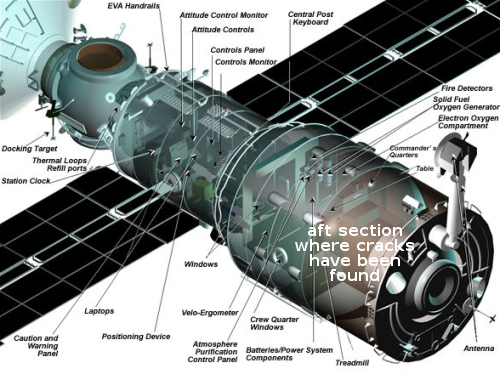
Russia to build own space station; admits Zvezda is failing

Zvezda module of ISS
The Zvezda module, with aft section indicated
where the cracks have been found.

The new colonial movement: On April 12th, the 60th anniversary of the flight of Yuri Gagarin, Russian President Vladimir Putin announced that Russia is going to build its own independent space station, dubbed the Russian Orbital Space Station (ROSS), to replace its half of ISS.

More important however was this carefully worded admission:

In recent years, the ISS has begun to fall apart, with astronauts now frequently discovering cracks. Last week, it was revealed that Russian cosmonauts were still working on plugging a leak first noticed in 2019. The ongoing problems with the international station have prompted Moscow to begin creating a replacement.

What this state-run news article failed to mention is that the cracks and leaks have only been found in Russia’s twenty-year-old Zvezda module, not the rest of ISS. What ISS faces is the failure of the core section of Russia’s half of the station.

This public statement however is the first from Russia that clearly admits that the cracks in Zvezda are likely systemic stress fractures, and the patches to seal them are mere bandaids on a much more fundamental problem that is certain to get worse over time.

The decision to build its own new station is however not really surprising. The American goals in space have been shifting from promoting the government’s program to stimulating the American commercial aerospace industry. International cooperation is no longer the primary goal. The American foreign aid to Russia’s space program from the early days of ISS’s construction has long ago dried up, and Russia is also no longer getting any cash from the U.S. to fly American astronauts to ISS. The incentive to remain a partner has vanished.

If successful this will make three national stations in orbit, ISS, China’s, and Russia’s. In addition, we should start seeing the launch of several private commercial stations sometime this decade.

The competition is going to be glorious, with the results fast-paced and exciting. The moribund days of boring international cooperation where everything was squeezed into a single project, the International Space Station, appear over.

8 comments

Commerce increases sanctions on Russia impacting space commerce and trade

The Commerce Department last month announced that is increasing the level of sanctions against trade with Russia because it had determined that country had violated international law by using chemical weapons against specific dissidents both in and out of Russia.

On March 4, 2018, the Russia Government deployed a Novichok nerve agent in an attack against former Russian military officer Sergei Skripal and his daughter Yulia Skripal in the United Kingdom. In response, the U.S. Government imposed two sets of sanctions against Russia pursuant to the Chemical and Biological Weapons Control and Warfare Elimination Act of 1991 (CBW Act) in August 2018 and August 2019.

On August 20, 2020, the Russian Government again deployed a Novichok nerve agent, this time against Russian opposition figure Aleksey Navalny, warranting a new determination by the Secretary of State and additional sanctions under the CBW Act.

While this ruling will have a negative impact on any space-related U.S./Russian activities, the full ruling specifically included these waivers:
» Read more

1 comment

Soyuz-2 launches three astronauts to ISS

Russia today successfully used its Soyuz-2 rocket to launch three astronauts to ISS.

Because this flight is occurring three days before the 60th anniversary of Yuri Gagarin’s first human flight in space, the Russians gave the Soyuz capsule his name to honor him and the event. The spacecraft docked with ISS only two orbits later.

The crew also included an American, Mark Vande Hei, who is flying as part of the new barter agreement with Russia, whereby Americans fly in Soyuz in exchange for Russians flying in American commercial capsule. This was the first time NASA paid nothing for a flight on Soyuz since the shuttle retired a decade ago.

The return to Earth of Vande Hei and his fellow crew member Pyotr Dubrov will be on the next Soyuz capsule to launch in October, MS-19, in order to accommodate a short visit by a Russian movie director and actress.

Roscosmos will launch Soyuz MS-19 no earlier than October 5 with Commander Anton Shkaplerov and two civilian spaceflight participants. Russian film director Klim Shipenko and a Russian actress, who is yet to be named, will film a movie called “The Challenge” and spend approximately a week aboard the ISS before returning to Earth aboard Soyuz MS-18 with Novitsky.

With this commercial manned flight there will be two such flights in the fall, the Dragon Inspiration4 flight that will not dock with ISS and this Russian one. Both will then be followed by the Axiom commercial tourist flight on a Dragon capsule early in ’22. Expect such commercial manned flights to become somewhat routine in the coming years.

UPDATE: China also launched an Earth observation satellite yesterday, using its Long March 4B rocket
The leaders in the 2021 launch race:

10 SpaceX
8 China
6 Russia
2 Rocket Lab

The U.S. still leads China 14 to 8 in the national rankings.

0 comments
1 19 20 21 22 23 80