Webb and Hubble take a look at Saturn

Astronomers using both the Hubble Space Telescope and the Webb Space Telescope have produced new complementary views of the ringed planet Saturn.
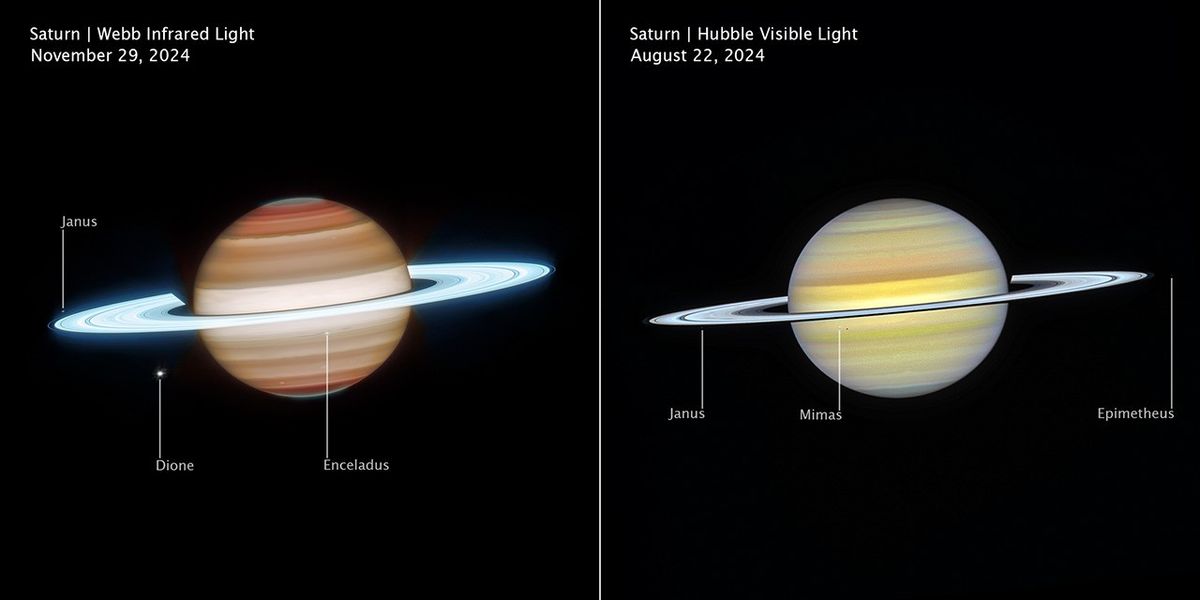
Those photographs are shown above, with Webb’s false-color infrared image to the left and Hubble’s optical image to the right. From the press release:
In the Webb image, a long-lived jet stream known as the “ribbon wave” meanders across the northern mid-latitudes, influenced by otherwise undetectable atmospheric waves. Just below that, a small spot represents a lingering remnant from the “Great Springtime Storm” of 2010 to 2012. Several other storms dotting the southern hemisphere of Saturn are visible in Webb’s image, as well. All these features are shaped by powerful winds and waves beneath the visible cloud deck, making Saturn a natural laboratory for studying fluid dynamics under extreme conditions.
…In Webb’s infrared image, the rings are extremely bright because they are made of highly reflective water ice. In both images, we’re seeing the sunlit face of the rings, a little less so in the Hubble image, hence the shadows visible underneath on the planet.
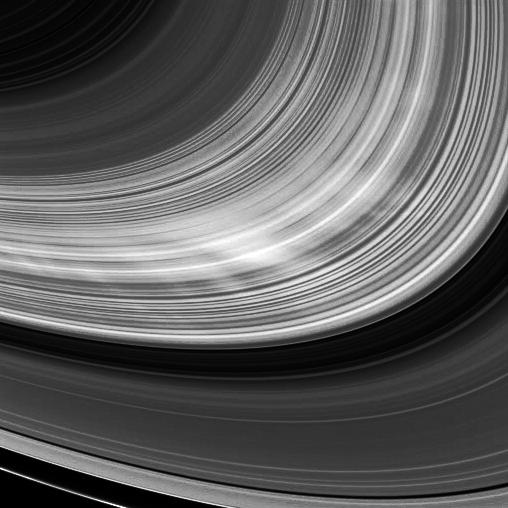
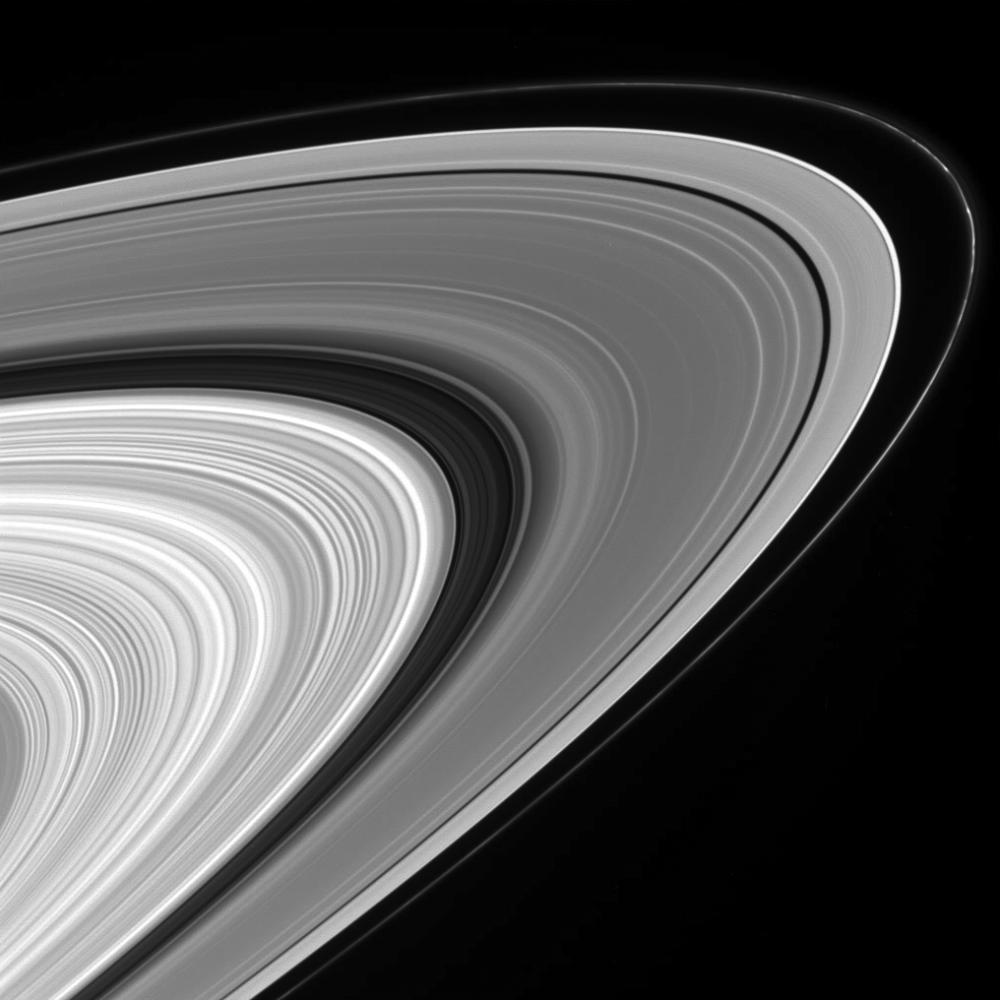
There are also subtle ring features such as spokes and structure in the B ring (the thick central region of the rings) that appear differently between the two observatories. The F ring, the outermost ring, looks thin and crisp in the Webb image, while it only slightly glows in the Hubble image.
The press release says little about the Hubble image, mostly because it shows little new by itself. It however is part of an on-going decade-long survey using Hubble to track Saturn’s changing weather patterns.
While both images are valuable, they also highlight our present limits in observing Saturn. Views from Earth can only see so much. It is like trying to watch a football game from ten miles away, with binoculars. And sadly, no mission is presently planned to return to Saturn.

Astronomers using both the Hubble Space Telescope and the Webb Space Telescope have produced new complementary views of the ringed planet Saturn.
Those photographs are shown above, with Webb’s false-color infrared image to the left and Hubble’s optical image to the right. From the press release:
In the Webb image, a long-lived jet stream known as the “ribbon wave” meanders across the northern mid-latitudes, influenced by otherwise undetectable atmospheric waves. Just below that, a small spot represents a lingering remnant from the “Great Springtime Storm” of 2010 to 2012. Several other storms dotting the southern hemisphere of Saturn are visible in Webb’s image, as well. All these features are shaped by powerful winds and waves beneath the visible cloud deck, making Saturn a natural laboratory for studying fluid dynamics under extreme conditions.
…In Webb’s infrared image, the rings are extremely bright because they are made of highly reflective water ice. In both images, we’re seeing the sunlit face of the rings, a little less so in the Hubble image, hence the shadows visible underneath on the planet.
There are also subtle ring features such as spokes and structure in the B ring (the thick central region of the rings) that appear differently between the two observatories. The F ring, the outermost ring, looks thin and crisp in the Webb image, while it only slightly glows in the Hubble image.
The press release says little about the Hubble image, mostly because it shows little new by itself. It however is part of an on-going decade-long survey using Hubble to track Saturn’s changing weather patterns.
While both images are valuable, they also highlight our present limits in observing Saturn. Views from Earth can only see so much. It is like trying to watch a football game from ten miles away, with binoculars. And sadly, no mission is presently planned to return to Saturn.