A hint of unexpected fresh ice on Enceladus

Two views of Enceladus
Click for full image.

Using data collected by Cassini while it orbited Saturn for thirteen years, scientists have found that there might be more relatively fresh ice on the surface of the moon Enceladus than previously believed.

Cassini scientists discovered in 2005 that Enceladus – which looks like a highly reflective, bright white snowball to the naked eye – shoots out enormous plumes of ice grains and vapor from an ocean that lies under the icy crust. The new spectral map shows that infrared signals clearly correlate with that geologic activity, which is easily seen at the south pole. That’s where the so-called “tiger stripe” gashes blast ice and vapor from the interior ocean.

But some of the same infrared features also appear in the northern hemisphere. That tells scientists not only that the northern area is covered with fresh ice but that the same kind of geologic activity – a resurfacing of the landscape – has occurred in both hemispheres. The resurfacing in the north may be due either to icy jets or to a more gradual movement of ice through fractures in the crust, from the subsurface ocean to the surface.

The image above, cropped, reduced, and rearranged to post here, shows two views of Enceladus. On the left we are looking at one hemisphere, with the south pole at the bottom. On the right we are looking straight down at the south pole. The red areas are where scientists think there is relatively fresh ice. While the new ice is very pronounced at the south pole, where the tiger-striped vents have been found, the northern ice is much less evident, though clearly there.

That northern fresh ice however might not come from the planet’s interior, as suggested by the press release. It might also be new ice deposited from space that came from those very active tiger stripes. At the present time the data doesn’t allow for any solid conclusions.

0 comments

A July 4th Hubble image of Saturn

Saturn as seen by Hubble on July 4, 2020
Click for full image, annotated.

Cool image time! The photo to the right, cropped and reduced to post here, was taken by the Hubble Space Telescope on July 4, 2020, and shows Saturn, its rings, plus several moons, in all their glory.

The dot near the bottom center is Enceladus. The dot at center right is Mimas. If you click on the annotated full image it will show the locations of several other smaller moons much harder to see.

This new Saturn image was taken during summer in the planet’s northern hemisphere.

Hubble found a number of small atmospheric storms. These are transient features that appear to come and go with each yearly Hubble observation. The banding in the northern hemisphere remains pronounced as seen in Hubble’s 2019 observations, with several bands slightly changing color from year to year. The ringed planet’s atmosphere is mostly hydrogen and helium with traces of ammonia, methane, water vapor, and hydrocarbons that give it a yellowish-brown color.

Hubble photographed a slight reddish haze over the northern hemisphere in this color composite. This may be due to heating from increased sunlight, which could either change the atmospheric circulation or perhaps remove ices from aerosols in the atmosphere. Another theory is that the increased sunlight in the summer months is changing the amounts of photochemical haze produced.

The distance across from one end of the rings to the other is about 150,000 miles, about two thirds the distance from the Earth to the Moon.

0 comments

First global geologic map of Titan

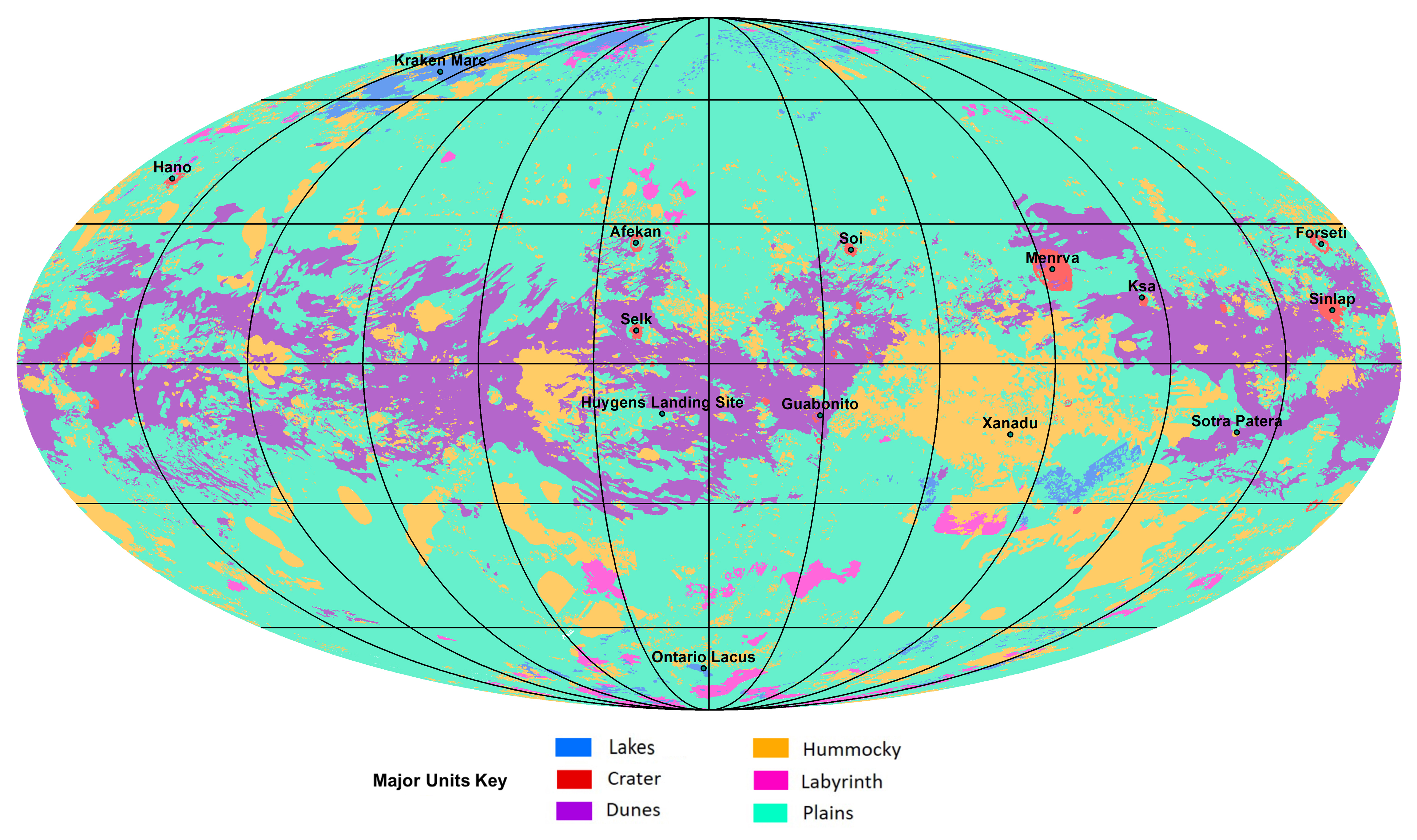
Global geologic map of Titan
Click for full image.

Planetary scientists today released the first global geologic map of the Saturn moon Titan. The image on the right is a reduced version of the full image.

In the annotated figure, the map is labeled with several of the named surface features. Also located is the landing site of the European Space Agency’s (ESA) Huygens Probe, part of NASA’s Cassini mission.

The map legend colors represent the broad types of geologic units found on Titan: plains (broad, relatively flat regions), labyrinth (tectonically disrupted regions often containing fluvial channels), hummocky (hilly, with some mountains), dunes (mostly linear dunes, produced by winds in Titan’s atmosphere), craters (formed by impacts) and lakes (regions now or previously filled with liquid methane or ethane).

To put it mildly, there is a lot of uncertainty here. Nonetheless, this is a first attempt, and it shows us that the distribution of these features is not homogeneous. The dunes favor the equatorial regions, the lakes the polar regions. Also, the small number of craters could be a feature of erosion processes from the planet’s active atmosphere, or simply be because Cassini’s radar data did not have the resolution to see smaller craters. I suspect the former.

0 comments

Storms on Saturn baffle scientists

The uncertainty of science: Scientists have identified a new type of storm on Saturn, and they don’t understand the weather processes that produced it.

Until now, astronomers had seen only two kinds of Saturnian storms: relatively small storms about 2,000 kilometers across that appear as bright clouds for a few days and Great White Spots that are 10 times as large and last for months. The newly spotted weather disturbance was a series of four midsize storms. Each was several thousand kilometers across and lasted between about 1.5 weeks and about seven months.

It appears that these midsize storms don’t fit any of their present theories about the formation of storms on Saturn.

However, for any scientist at this time to suggest that any theory about the storms on gas giants like Jupiter or Saturn can explain things is for that scientist to reveal themselves to be arrogant fools. We simply do not know anything about the deep atmospheres and vast climates of such planets. For example, we have yet to send a satellite to either planet devoted entirely to studying their atmospheres. And considering the size of these planets, such research would require a lot more than one orbiter to get a global picture. And it would require decades of coverage to get a long term picture.

3 comments

Astronomers find 20 more moons orbiting Saturn

Astronomers have discovered an additional twenty moons orbiting Saturn, bringing the total known to 82, three more than the 79 moons known to circle Jupiter.

Each of the newly discovered moons is about five kilometers, or three miles, in diameter. Seventeen of them orbit the planet backwards, or in a retrograde direction, meaning their movement is opposite of the planet’s rotation around its axis. The other three moons orbit in the prograde—the same direction as Saturn rotates.

Two of the prograde moons are closer to the planet and take about two years to travel once around Saturn. The more-distant retrograde moons and one of the prograde moons each take more than three years to complete an orbit.

The astronomers have also created a contest allowing the public to help name these new moons.

I will make one prediction: They are going to find many more.

In fact, Saturn’s rings and its numerous moons raise the question of what defines a moon. At present, a moon is defined as any object orbiting a planet, regardless of size. With Saturn’s rings however we have millions of objects orbiting that planet, many very tiny. It seems we have never put a size limit on the definition of a moon, and really need to.

5 comments

More organics detected in Enceladus’ plumes

Using Cassini archived data scientists have detected evidence of new organic molecules in the water-ice plumes coming from the tiger stripe fissures on Saturn’s moon Enceladus.

Powerful hydrothermal vents eject material from Enceladus’ core, which mixes with water from the moon’s massive subsurface ocean before it is released into space as water vapor and ice grains. The newly discovered molecules, condensed onto the ice grains, were determined to be nitrogen- and oxygen-bearing compounds.

On Earth, similar compounds are part of chemical reactions that produce amino acids, the building blocks of life. Hydrothermal vents on the ocean floor provide the energy that fuels the reactions. Scientists believe Enceladus’ hydrothermal vents may operate in the same way, supplying energy that leads to the production of amino acids.

For clarity I should point out that I am using the term “organics” as chemists do. It refers not to life, but to any molecule that is formed using carbon.

2 comments

The never-ending snowstorm circling Saturn

New data suggests that the water being spewed out of Enceladus’s tiger stripes is depositing so much snow and ice on Saturn’s three inner moons, Mimas, Enceladus and Tethys, that these moons, as well as Enceladus, are about twice as bright in radar than previously thought.

Dr Le Gall and a team of researchers from France and the US have analysed 60 radar observations of Saturn’s inner moons, drawing from the full database of observations taken by the Cassini mission between 2004 and 2017. They found that previous reporting on these observations had underestimated the radar brightness by a factor of two.

Unprotected by any atmospheres, Saturn’s inner moons are bombarded by grains of various origins which alter their surface composition and texture. Cassini radar observations can help assess these effects by giving insights into the purity of the satellites’ water ice.

The extreme radar brightness is most likely related to the geysers that pump water from Enceladus’s internal ocean into the region in which the three moons orbit. Ultra-clean water ice particles fall back onto Enceladus itself and precipitate as snow on the other moons’ surfaces.

Dr Le Gall, of LATMOS-UVSQ, Paris, explained: “The super-bright radar signals that we observe require a snow cover that is at least a few tens of centimetres thick. However, the composition alone cannot explain the extremely bright levels recorded. Radar waves can penetrate transparent ice down to few meters and therefore have more opportunities to bounce off buried structures. The sub-surfaces of Saturn’s inner moons must contain highly efficient retro-reflectors that preferentially backscatter radar waves towards their source.”

While the new results suggest that the surfaces of these moons are much brighter that expected, I find the circumstances they describe far more fascinating: a never-ending snow storm in the orbits around Saturn and landing continually on these moons.

My, isn’t the universe wonderful?

1 comment

New Hubble image of Saturn

Saturn taken by Hubble in 2019
Click for full image.

Astronomers have used the Hubble Space Telescope to snap a new high resolution image of Saturn. That image, cropped and reduced to post here, can be seen on the right.

The image was part of a new Hubble program to obtain regular images of the outer planets, begun in 2018.

[The Saturn images] reveal a planet with a turbulent, dynamic atmosphere. This year’s Hubble offering, for example, shows that a large storm visible in the 2018 Hubble image in the north polar region has vanished. Smaller storms pop into view like popcorn kernels popping in a microwave oven before disappearing just as quickly. Even the planet’s banded structure reveals subtle changes in color.

But the latest image shows plenty that hasn’t changed. The mysterious six-sided pattern, called the “hexagon,” still exists on the north pole. Caused by a high-speed jet stream, the hexagon was first discovered in 1981 by NASA’s Voyager 1 spacecraft.

As beautiful as this Hubble photograph is, I cannot help but be saddened by it. It is now the best image of Saturn we will get until 2036 at the earliest, when a NASA mission to Titan finally arrives.

0 comments

Exploding nitrogen on Titan

A new theory proposes that some of the smaller high rimmed methane lakes on Titan were formed when underground nitrogen warmed and exploded, forming the basin in which the methane ponded.

Most existing models that lay out the origin of Titan’s lakes show liquid methane dissolving the moon’s bedrock of ice and solid organic compounds, carving reservoirs that fill with the liquid. This may be the origin of a type of lake on Titan that has sharp boundaries. On Earth, bodies of water that formed similarly, by dissolving surrounding limestone, are known as karstic lakes.

The new, alternative models for some of the smaller lakes (tens of miles across) turns that theory upside down: It proposes pockets of liquid nitrogen in Titan’s crust warmed, turning into explosive gas that blew out craters, which then filled with liquid methane. The new theory explains why some of the smaller lakes near Titan’s north pole, like Winnipeg Lacus, appear in radar imaging to have very steep rims that tower above sea level – rims difficult to explain with the karstic model.

This is a theory that has merit. It also must be treated with skepticism, as our knowledge of Titan remains at this time very superficial, even with the more detailed information garnered from Cassini.

2 comments

A journey to Saturn’s moon Dione

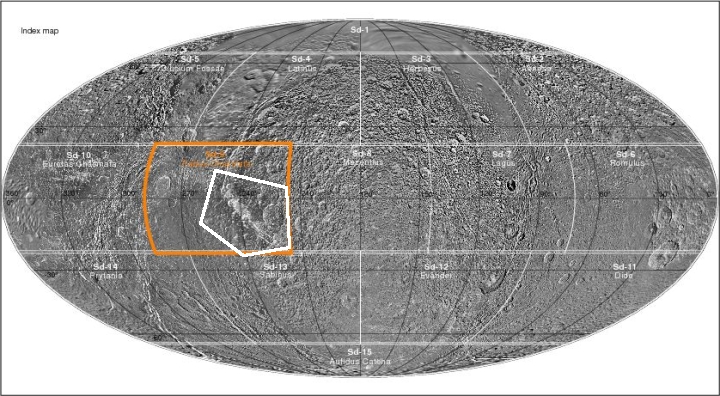
Global Map of Dione

Cool image time! Today, for a change, I decided to spend some time rummaging through the Cassini raw image archive, mainly because I wanted to see some variety. At this time sadly almost all the good images coming from space are limited to Mars images, and I wished to post a cool image from somewhere else in the solar system.

The global map above was compiled from photographs of the Saturn moon Dione taken by Cassini during its thirteen years in orbit around the ringed giant.

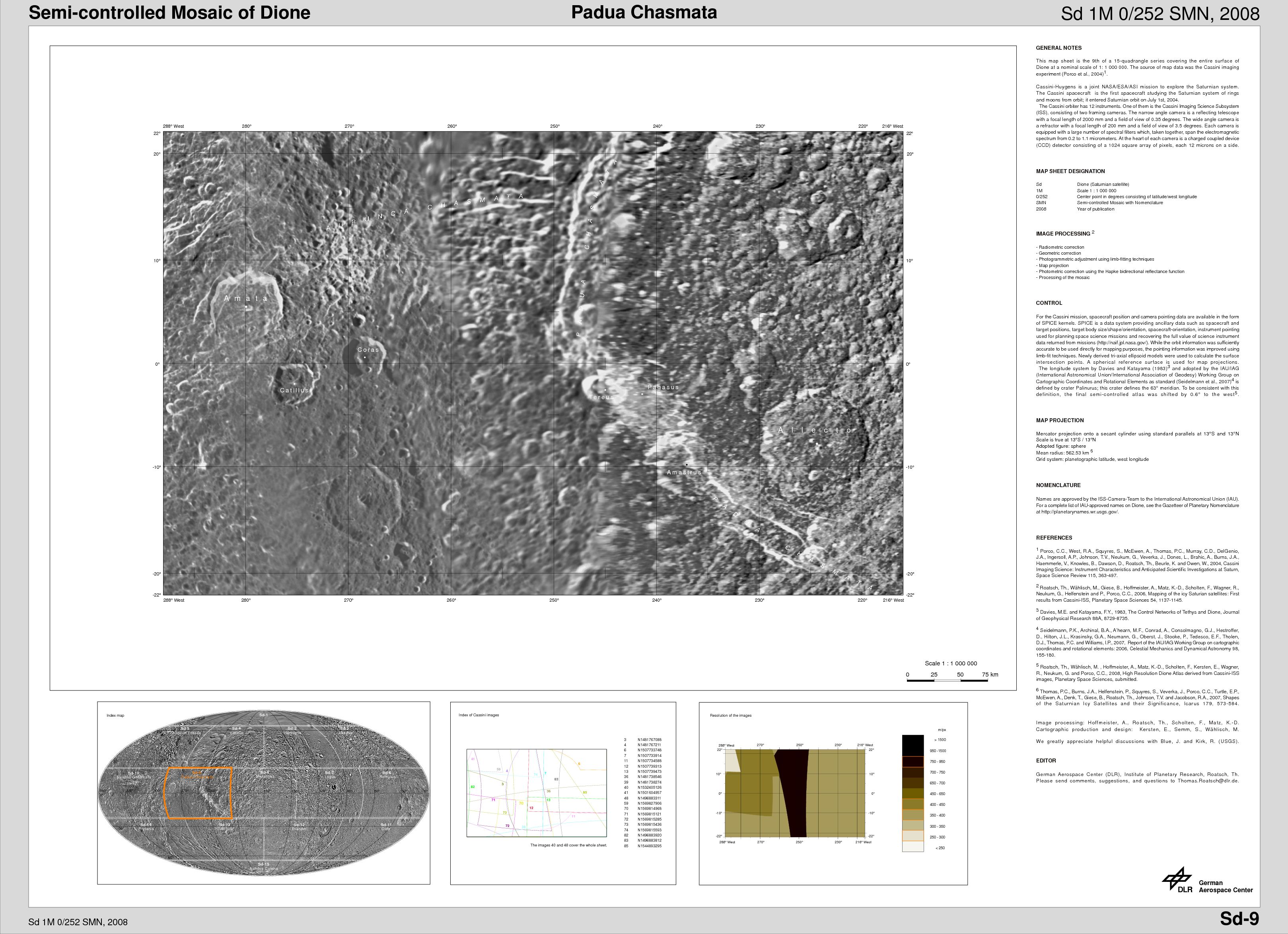
The orange box indicates the sector of interest. The white outline indicates the location of the next photograph below and to the right, taken by Cassini during its first close fly-by of the moon on October 11, 2005, when the spacecraft was approaching the moon.
» Read more

0 comments

Weird minerals discovered in simulated Titan environment

In recreating their best guess as to the conditions and environment of Saturn’s moon Titan, scientists have produced a number of weird never-before-seen minerals.

To create Titan-like conditions in the laboratory, the researchers started with a custom-built cryostat, an apparatus to keep things cold. They filled the cryostat with liquid nitrogen to bring the temperature down. They then warmed the chamber slightly, so the nitrogen turned to gas, which is mostly what Titan’s atmosphere contains. Next, they threw in what abounds on Titan, methane and ethane, as well as other carbon-containing molecules, and looked for what formed.

The first things to drop out of their Titan hydrocarbon soup were benzene crystals. Benzene is perhaps best known as a component of gasoline and is a snowflake-shaped molecule made out of a hexagonal ring of carbon atoms. But Titan benzene held a surprise: The molecules rearranged themselves and allowed ethane molecules inside, creating a co-crystal.

The researchers then discovered the acetylene and butane co-crystal, which is probably a lot more common on Titan than benzene crystals, based on what’s known about the moon’s composition, Cable said.

The scientists think that these crystals might be found on the edge of Titan’s methane lakes, encrusted there like a bathtub ring.

4 comments

Data from Cassini’s last fly-by of Titan

Based on data from Cassini’s last fly-by of Titan, scientists have been able to estimate the depth of some of that planet’s northern lakes while also finding that they were filled mostly with methane.

The depths measured were as much as 300 feet. The data also shows that the geology of one hemisphere in the north was different from the other hemisphere.

On the eastern side of Titan, there are big seas with low elevation, canyons and islands. On the western side: small lakes. And the new measurements show the lakes perched atop big hills and plateaus. The new radar measurements confirm earlier findings that the lakes are far above sea level, but they conjure a new image of landforms – like mesas or buttes – sticking hundreds of feet above the surrounding landscape, with deep liquid lakes on top.

The fact that these western lakes are small – just tens of miles across – but very deep also tells scientists something new about their geology: It’s the best evidence yet that they likely formed when the surrounding bedrock of ice and solid organics chemically dissolved and collapsed. On Earth, similar water lakes are known as karstic lakes. Occurring in in areas like Germany, Croatia and the United States, they form when water dissolves limestone bedrock.

This data also suggests, as has previous data, that Titan could very well have extensive underground cave systems. Unlike the Moon or Mars, however, these are not going to be very hospitable to colonization, considering the presence of methane and the cold temperatures.

0 comments

Saturn’s rings desposit material on its tiny nearest moons

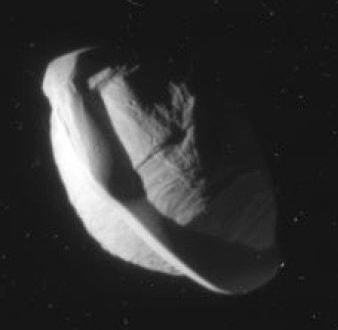
Pan

A new analysis of data from Cassini has confirmed that the tiny moons orbiting close to Saturn’s rings are repeatedly coated by material from those rings.

The new research, from data gathered by six of Cassini’s instruments before its mission ended in 2017, is a clear confirmation that dust and ice from the rings accretes onto the moons embedded within and near the rings.

Scientists also found the moon surfaces to be highly porous, further confirming that they were formed in multiple stages as ring material settled onto denser cores that might be remnants of a larger object that broke apart. The porosity also helps explain their shape: Rather than being spherical, they are blobby and ravioli-like, with material stuck around their equators. “We found these moons are scooping up particles of ice and dust from the rings to form the little skirts around their equators,” Buratti said. “A denser body would be more ball-shaped because gravity would pull the material in.”

This result is not a surprise. It has been hypothesized since the first images of these weirdly shaped moons (as illustrated by the picture of Pan from March 2017 above) were first beamed back by Cassini. This new analysis just helps confirm it.

I will add that searching through Behind the Black for that image of Pan made me realize how much I miss Cassini. I used to post lots of its images, always spectacular and breath-taking. With it gone, the images from Saturn have stopped, and will not resume for decades to come.

0 comments

Scientists calculate length of Saturn’s day

Using Cassini data of the rotation rate of Saturn’s rings, scientists have calculated what they think is the precise rotation rate of the planet itself.

Using new data from NASA’s Cassini spacecraft, researchers believe they have solved a longstanding mystery of solar system science: the length of a day on Saturn. It’s 10 hours, 33 minutes and 38 seconds. The figure has eluded planetary scientists for decades, because the gas giant has no solid surface with landmarks to track as it rotates, and it has an unusual magnetic field that hides the planet’s rotation rate.

The answer, it turned out, was hidden in the rings. During Cassini’s orbits of Saturn, instruments examined the icy, rocky rings in unprecedented detail. Christopher Mankovich, a graduate student in astronomy and astrophysics at UC Santa Cruz, used the data to study wave patterns within the rings. His work determined that the rings respond to vibrations within the planet itself, acting similarly to the seismometers used to measure movement caused by earthquakes. The interior of Saturn vibrates at frequencies that cause variations in its gravitational field. The rings, in turn, detect those movements in the field.

…Mankovich’s research, published Jan. 17 by Astrophysical Journal, describes how he developed models of Saturn’s internal structure that would match the rings’ waves. That allowed him to track the movements of the interior of the planet – and thus, its rotation. [emphasis mine]

This work certainly seems ingenious, clever, and somewhat convincing, but I must admit I laughed when I read their estimate of the day length above, to the second. That is ridiculous. Their margin of error cannot possibly be that small. Mankovich has for sure narrowed the uncertainty in the length of Saturn’s day, but forgive me if I remain skeptical as to the precision claimed.

5 comments

Summer has finally arrived on Titan’s northern hemisphere

The uncertainty of science: In a review of Cassini data from 2016, scientists have finally identified rain in the northern polar regions of Titan, signaling the onset of summer there.

The whole Titan community has been looking forward to seeing clouds and rains on Titan’s north pole, indicating the start of the northern summer, but despite what the climate models had predicted, we weren’t even seeing any clouds,” said Rajani Dhingra, a doctoral student in physics at the University of Idaho in Moscow, and lead author of the new study accepted for publication in Geophysical Research Letters, a journal of the American Geophysical Union. “People called it the curious case of missing clouds.”

Dhingra and her colleagues identified a reflective feature near Titan’s north pole on an image taken June 7, 2016, by Cassini’s near-infrared instrument, the Visual and Infrared Mapping Spectrometer. The reflective feature covered approximately 46,332 square miles, roughly half the size of the Great Lakes, and did not appear on images from previous and subsequent Cassini passes.

Analyses of the short-term reflective feature suggested it likely resulted from sunlight reflecting off a wet surface. The study attributes the reflection to a methane rainfall event, followed by a probable period of evaporation. “It’s like looking at a sunlit wet sidewalk,” Dhingra said.

Though the data somewhat matches their climate models, those models did not predict the rain’s late arrival, which means they need revision. I guarantee that this will not be the last revision, though without an orbiter at Saturn it will probably be decades before we have new data to make that possible.

1 comment

Saturn’s rings are dying

Using new ground-based observations, scientists now predict that Saturn’s rings are dying at the fastest predicted rate, and will disappear within 300 million years, at the most.

Dr Tom Stallard, Associate Professor in Planetary Astronomy at the University of Leicester and Dr James O’Donoghue, who studied for his PhD at the University of Leicester, have found that Saturn’s rings are dying at the maximum rate estimated from Voyager 1 and 2 observations made decades ago.

The rings of ice are being pulled into Saturn by gravity as particles of ice under the influence of Saturn’s magnetic field. Dr O’Donoghue, who now works at NASA’s Goddard Space Flight Center in Greenbelt, Maryland said: “We estimate that this ‘ring rain’ drains the equivalent of an Olympic-sized swimming pool from Saturn’s rings in half an hour. The entire ring system will be gone in 300 million years.”

Dr O’Donoghue believes that the rings could even disappear quicker than this. “Add to this the Cassini-spacecraft detected ring-material falling into Saturn’s equator, and the rings have less than 100 million years to live.”

Over the decades I have read numerous papers by scientists saying that rings this bright and large must be a relatively short-lived event, and that we are lucky to have seen them. This research only reinforces this conclusion.

At the same time, we do not yet know the frequency or the cause of the events that give rise such bright rings. It could be that such rings are short-lived, but happen frequently enough that it is still not rare to see them in any solar system. And we won’t know this until we get a more complete census of many solar systems, seen up-close.

6 comments

Stripes on Dione

Using data produced by Cassini while orbiting Saturn scientists have discovered long narrow stripes on the moon Dione.

Dione’s linear virgae are generally long (10 to 100s of kilometers), narrow (less than 5 kilometers) and brighter than the surrounding terrains. The stripes are parallel, appear to overlie other features and are unaffected by topography, suggesting they are among the youngest surfaces on Dione.

“Their orientation, parallel to the equator, and linearity are unlike anything else we’ve seen in the Solar System,” Patthoff said. “If they are caused by an exogenic source, that could be another means to bring new material to Dione. That material could have implications for the biological potential of Dione’s subsurface ocean.”

That they cut across the topography implies strongly that they were laid down from above, after the surface irregularities were created.

0 comments

Dust storms spotted on Titan

Scientists reviewing Cassini data have identified dust storms for the first time of Saturn’s moon Titan.

When Rodriguez and his team first spotted three unusual equatorial brightenings in infrared images taken by Cassini around the moon’s 2009 northern equinox, they thought they might be the same kind of methane clouds; however, an investigation revealed they were something completely different. “From what we know about cloud formation on Titan, we can say that such methane clouds in this area and in this time of the year are not physically possible,” said Rodriguez. “The convective methane clouds that can develop in this area and during this period of time would contain huge droplets and must be at a very high altitude — much higher than the 6 miles (10 kilometers) that modeling tells us the new features are located.”

The researchers were also able to rule out that the features were actually on the surface of Titan in the form of frozen methane rain or icy lavas. Such surface spots would have a different chemical signature and would remain visible for much longer than the bright features in this study, which were visible for only 11 hours to five weeks.

In addition, modeling showed that the features must be atmospheric but still close to the surface — most likely forming a very thin layer of tiny solid organic particles. Since they were located right over the dune fields around Titan’s equator, the only remaining explanation was that the spots were actually clouds of dust raised from the dunes.

Obviously there are large uncertainties here. Nonetheless, the conclusion is a reasonable one, as it is expected that such dust storms would occur on Titan.

Posted just outside Zion National Park in the town of Springdale.

0 comments

Cassini’s last view of Titan

The Cassini science team today released a mosaic of the last images Cassini took of Titan before it crashed into Saturn’s atmosphere four days layer.

The mosaic shows Titan’s north polar region, and shows seas, lakes, and spotty clouds. The lack of clouds is a puzzle to scientists, as they had expected the north polar region to be cloud-covered at this time as summer arrived there, as had been seen at the south pole.

During Titan’s southern summer, Cassini observed cloud activity over the south pole.

However, typical of observations taken during northern spring and summer, the view here reveals only a few small clouds. They appear as bright features just below the center of the mosaic, including a few above Ligeia Mare. “We expected more symmetry between the southern and northern summer,” said Elizabeth (“Zibi”) Turtle of the Johns Hopkins Applied Physics Lab and the Cassini Imaging Science Subsystem (ISS) team that captured the image. “In fact, atmospheric models predicted summer clouds over the northern latitudes several years ago. So, the fact that they still hadn’t appeared before the end of the mission is telling us something interesting about Titan’s methane cycle and weather.”

The truth is we haven’t the slightest idea whether the clouds over the south pole during its previous summer were normal or an aberration. We have barely seen a full year of seasons at Saturn and Titan. To confidently extrapolate any pattern from this slim data is silly.

1 comment

Saturn’s polar hexagonal vortex might tower high above clouds

The uncertainty of science: A long term analysis of data from the probe Cassini suggests that Saturn’s north polar hexagonal vortex might tower many miles high above the planet’s clouds.

A new long-term study has now spotted the first glimpses of a northern polar vortex forming high in the atmosphere as Saturn’s northern hemisphere approached summertime. This warm vortex sits hundreds of kilometres above the clouds, in a layer of atmosphere known as the stratosphere, and reveals an unexpected surprise. “The edges of this newly-found vortex appear to be hexagonal, precisely matching a famous and bizarre hexagonal cloud pattern we see deeper down in Saturn’s atmosphere,” says Leigh Fletcher of the University of Leicester, UK, lead author of the new study.

“While we did expect to see a vortex of some kind at Saturn’s north pole as it grew warmer, its shape is really surprising. Either a hexagon has spawned spontaneously and identically at two different altitudes, one lower in the clouds and one high in the stratosphere, or the hexagon is in fact a towering structure spanning a vertical range of several hundred kilometres.”

There are many uncertainties here. For one thing, we have not yet even observed Saturn from up close through a complete year. We might be seeing random weather events having nothing to do with the gas giants overall planetary weather patterns.

0 comments
1 2 3 4 5 12