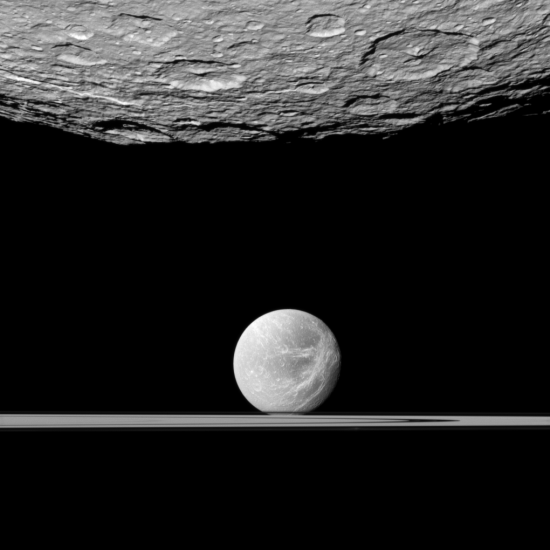
Cassini looks past one Saturn moon to another

The image below was taken on January 11, 2011 by the space probe Cassini, in orbit around Saturn. First we see the southern polar regions of the moon Rhea, 949 miles in diameter. Beyond is the moon Dione, 698 miles across, appearing to sit on the rings of Saturn.

As far as I am concerned, this image, as well as almost every other image from Cassini, proves that any hotel built in orbit around Saturn is unquestionably going to be one of the hottest tourist spots in the solar system.

Looking past Rhea to Dione and Saturn's rings

2 comments

Cassini directly samples the plumes from Enceladus and finds an ocean-like Spray

Cassini has directly sampled the plumes from Enceladus and discovered a salty ocean-like spray.

The new paper analyzes three Enceladus flybys in 2008 and 2009 with the same instrument, focusing on the composition of freshly ejected plume grains. The icy particles hit the detector target at speeds between 15,000 and 39,000 mph (23,000 and 63,000 kilometers per hour), vaporizing instantly. Electrical fields inside the cosmic dust analyzer separated the various constituents of the impact cloud.

The data suggest a layer of water between the moon’s rocky core and its icy mantle, possibly as deep as about 50 miles (80 kilometers) beneath the surface. As this water washes against the rocks, it dissolves salt compounds and rises through fractures in the overlying ice to form reserves nearer the surface. If the outermost layer cracks open, the decrease in pressure from these reserves to space causes a plume to shoot out. Roughly 400 pounds (200 kilograms) of water vapor is lost every second in the plumes, with smaller amounts being lost as ice grains. The team calculates the water reserves must have large evaporating surfaces, or they would freeze easily and stop the plumes.

0 comments

A Fizzy Ocean on Enceladus

A fizzy ocean on Enceladus? Key quote:

[Scientists believe] that gasses dissolved in water deep below the surface [of Enceladus] form bubbles. Since the density of the resulting “sparkling water” is less than that of the ice, the liquid ascends quickly up through the ice to the surface. “Most of the water spreads out sideways and ‘warms’ a thin surface ice lid, which is about 300 feet thick,” explains Matson. “But some of it collects in subsurface chambers, builds up pressure, and then blasts out through small holes in the ground, like soda spewing out of that can you opened.”

0 comments

Cassini Spots Potential Ice Volcano on Saturn Moon

Scientists have used data from Cassini to identify what they think are ice volcanoes on Titan. The two volcanoes, each about 3000 feet high, are located near the equator and appear to resemble the volcanoes on Earth, with a central crater on top of cone-like peak and finger-like flows coming down the sides from the crater. The lava here, however, is not molten rock, but water.

0 comments

Saturn moon has thin oxygen and carbon dioxide atmosphere

Saturn moon has a thin oxygen and carbon dioxide atmosphere. Key quote:

“The major implication of this finding at Rhea is that oxygen atmospheres at icy moons, until now only detected at Europa and Ganymede, may in fact be commonplace around those irradiated icy moons throughout the universe with sufficient mass to hold an atmosphere,” said study leader Ben Teolis of the Southwest Research Institute in San Antonio, Texas.

0 comments
1 9 10 11 12