Study suggests low dose radiation reduces severe knee pain

A new study suggests that exposing patients with advanced osteoarthritis (OA) to low doses of radiation reduced their pain significantly.

The trial included 114 people with primary knee OA, diagnosed by moderate damage visible on X-rays, and significant pain with walking. They were randomly assigned to one of three groups: very low-dose radiation (0.3 Gy total, spread over six sessions of 0.05 Gy), low-dose radiation (3 Gy total, spread over six sessions of 0.5 Gy), or a sham treatment that did not deliver radiation.

…Each treatment in this trial was 500 mGy, which works out to be 5,000 times the radiation dose of a chest X-ray and around 70 times the dose of a chest CT scan. However, while this sounds like a lot, the treatment delivered in the study is still considered to be low-dose. For radiotherapy cancer treatment, for example, total doses are usually 50 to 70 Gy – so a total of 3 Gy is roughly one-twentieth or less of that.

…Trial participants couldn’t take regular pain meds during the first four months, other than occasional “rescue” meds if needed. No second round of radiation was allowed. The main treatment outcome was how many participants showed significant improvement after four months, as measured by assessments of pain and function.

The 3 Gy group did significantly better than the sham group. About 70% improved vs 42% in the sham group. Over half (57%) of people in the 3 Gy group had a clinically meaningful improvement in joint pain and function scores vs about 31% in the sham group. The 0.3 Gy group didn’t show a statistically significant improvement; about 58% improved. No meaningful differences were seen in blood markers of inflammation or in the amount of pain medication people used. The treatment was deemed to be safe, with no side effects or toxicity reported.

If this result is confirmed, it suggests strongly that especially for the older population there is now a viable treatment for knee pain that avoids surgery and could be far more reliable.

26 comments

Modeling suggests Uranus’s moon Ariel needed underground oceans to shape its known surface

Ariel as seen by Voyager-2 in 1986
Ariel as seen by Voyager-2 in 1986.
Click for original image.

The uncertainty of science: Using computer modeling based on our scant data of the surface features of the Uranus moon Ariel, scientists now posit that underground oceans, some of gigantic depth as much as 100 miles deep, were required to shape those features.

“First, we mapped out the larger structures that we see on the surface, then we used a computer program to model the tidal stresses on the surface, which result from distortion of Ariel from soccer ball-shaped to slight football-shaped and back as it moves closer and farther from Uranus during its orbit,” Patthoff said. “By combining the model with what we see on the surface, we can make inferences about Ariel’s past eccentricity and how thick the ocean might have been.”

The team found that, in the past, Ariel needed to have an eccentricity of about 0.04 [to create those surface structures]. This is about 40 times larger than its current value. While 0.04 may not sound dramatic, eccentricity can strengthen the effects of tidal stresses, and Ariel’s orbit would have been four times more eccentric than that of Jupiter’s moon Europa, which is wracked by the tidal forces that push and pull it to create its cracked and broken surface. Yet, to the eye, the orbit will still resemble a circle.

“In order to create those fractures, you have to have either a really thin ice on a really big ocean, or a higher eccentricity and a smaller ocean,” Patthoff said. “But either way, we need an ocean to be able to create the fractures that we are seeing on Ariel’s surface.”

This result does not prove an underground ocean now exists, or even if one existed in the past. The data is based on the few fly-by images taken by Voyager-2 when it passed close to Uranus in 1986. Coverage of the entire surface of Ariel was not complete, nor did the images have much resolution. The data is suggestive of this conclusion, but not conclusive by any means.

2 comments

Webb: Accretion disk surrounding exoplanet rich in carbon molecules

Using the Webb Space Telescope, scientists have detected a host of carbon molecules inside an accretion disk that surrounds an exoplanet circling a baby star 625 light years away.

Infrared observations of CT Cha b were made with Webb’s MIRI (Mid-Infrared Instrument) using its medium resolution spectrograph. An initial look into Webb’s archival data revealed signs of molecules within the circumplanetary disk, which motivated a deeper dive into the data.

…Ultimately, the team discovered seven carbon-bearing molecules within the planet’s disk, including acetylene (C2H2) and benzene (C6H6). This carbon-rich chemistry is in stark contrast to the chemistry seen in the disk around the host star, where the researchers found water but no carbon. The difference between the two disks offers evidence for their rapid chemical evolution over only than 2 million years.

You can read the original paper here [pdf]. The exoplanet itself is thought to have a mass 14 to 24 times that of Jupiter, making it almost a brown dwarf star. The NASA makes a big deal claiming this disk is forming a moon around the exoplanet, but that is not what the paper finds. This research did not find any evidence of a new moon exoplanet.

Instead, the paper found an accretion disk rich in carbon molecules, a finding that is significant on its own. It also found that that the accretion disk around the central star, while lacking carbon molecules, appears rich in water.

In other words, this baby solar system is packed with the right material for eventually producing life. Moreover, in this system’s relatively short life, two million years, these materials were able to sort themselves out so that the star has one concentration of material while the exoplanet has another. Both facts suggest that organic chemistry is common in the universe, and can evolve fast.

That is the important discovery here.

0 comments

New study finds ice is better at dissolving iron than liquid water

In a result that could have a direct bearing on trying to understand the inexplicable geology of Mars, a new study has found that ice actually does a better job at releasing iron from mineral deposits than liquid water.

It was once believed that when iron-rich mineral deposits were locked in ice, the iron would stay put, but a new study from Sweden’s Umeå University shows that the ice itself is actually working better than permafrost melt to release the iron. The study showed that ice at -10 °C (14 °F) releases more iron from mineral deposits than liquid water at 4 °C (39.2 °F). “It may sound counterintuitive, but ice is not a passive frozen block,” says study co-author Jean-François Boily. “Freezing creates microscopic pockets of liquid water between ice crystals. These act like chemical reactors, where compounds become concentrated and extremely acidic. This means they can react with iron minerals even at temperatures as low as minus 30 degrees Celsius.”

The researchers also found that the seasonal freeze/thaw cycle helped this process, and that brackish fresh water did better in dissolving the iron than seawater.

The significance for Mars geology is that this suggests glacial ice in the alien Mars climate might be the catalyst for creating its meandering canyons that so much resemble features on Earth produced by liquid water. On Mars however no model yet has been convincingly successful in creating past conditions where liquid water could flow on the surface. Mars has either been is too cold or its atmosphere too thin to allow it.

This study suggests ice however could do the work. It also fits with other Martian data that suggests the same, that at the base of the Martian glaciers pockets of liquid water could exist that act to shape the canyons.

All of this is speculation on my part, but it seems that the planetary scientists who are studying Mars should take a close look at this research.

0 comments

Astronomers detect the spiral motion of the accretion disk surrounding a star 515 light years away

The changes to the spiral over seven years
Click for movie.

A team of Japanese astronomers have used the Atacama Large Millimeter/submillimeter Array (ALMA) in Chile to detect for the first time the rotation of the spiral accretion disk that surrounds a young star, rotation that showed the spiral was in the process of forming new planets.

Observations have revealed a spiral pattern in the disk of gas and dust around the young star IM Lup located 515 light-years away in the direction of the constellation Lupus. Spiral patterns are thought to be one of the signs that a new planet will form soon, but other things, such as an already formed planet, can also form spirals. These different types of spirals cannot be distinguished by visual inspection, but they are expected to move differently over time.

To determine the origin of the spirals around IM Lup, an international research team led by Tomohiro Yoshida, a graduate student at The Graduate University for Advanced Studies, SOKENDAI and the National Astronomical Observatory of Japan (NAOJ), created a stop-motion animation of the spiral pattern using four observations taken by ALMA over the course of seven years. The motion of the spirals in the stop-motion animation shows that they were not caused by an already formed planet, and instead the spirals might be helping to form a new planet.

The two images to the right, taken from the movie, show the spiral’s shift over seven years. I have added the vertical line down the center to help highlight that change.

This discovery once again illustrates the increasing sophistication of our astronomical tools, able to observe such changes at such a great distance.

0 comments

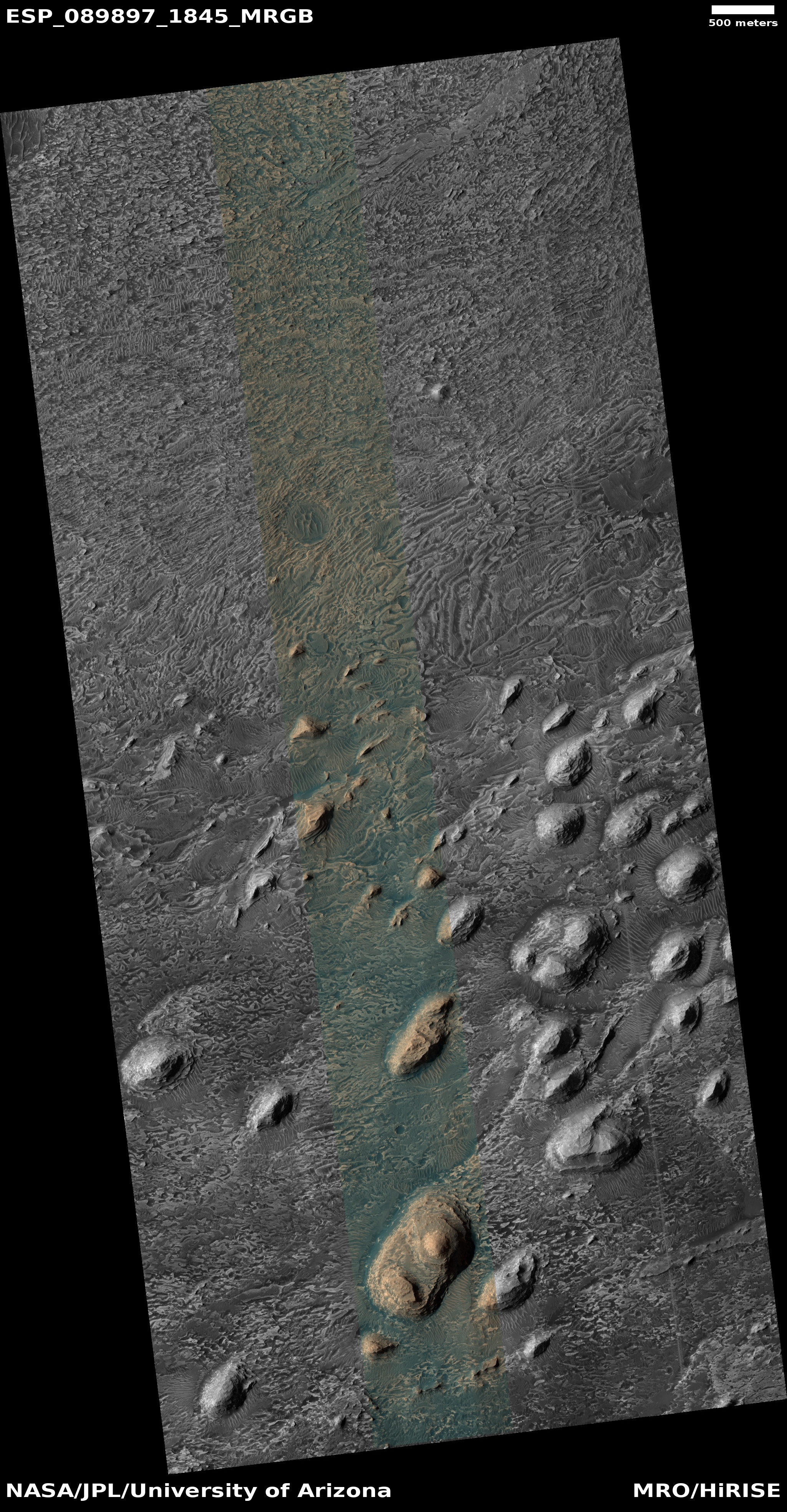
A Martian landscape of volcanic pimples

A Martian landscape of volcanic pimples
Click for original image.

Cool image time! The picture to the right, cropped, reduced, and sharpened to post here, was taken by the high resolution camera on Mars Reconnaissance Orbiter (MRO) and downloaded on August 3, 2025. Labeled as a “terrain sample,” such images are usually taken not as part of any specific research request but because the camera team needs to fill a gap in the camera’s schedule so as to maintain its proper temperature. When they do this, they always try to pick interesting targets within the time window, and usually succeed.

In this case, the camera team picked a location in the middle of Isidis Planitia, one of Mars’ four biggest basins thought to have been formed from a major impact several billion years ago, focusing on an area covered with these strange knobs that have craterlike depressions at their peaks.

According research published in 2010 [pdf], it is believed these cones — all of which are only a few feet high — are the result of volcanic activity following the impact that formed Isidis four billion years ago. In a sense, they are leftover pimples from that impact and the subsequent volcanic activity within that melted basin.
» Read more

1 comment

European engineers develop a tumbling rover design moved by the Martian wind

Tumbleweed being tested on sandy ground
Tumbleweed being tested on sandy ground. Click for video.

European engineers at Aarhus University in Denmark have now developed and tested a tumbling rover design that is propelled solely by the Martian wind. You can read their most recent paper here.

Not surprisingly, they call it “Tumbleweed.” The screen capture to the right comes from a video of a wind tunnel test proving the Martian atmosphere could move a prototype on sandy ground. The engineers also did similar tests successfully on rocky and coarse ground.

In July 2025, Team Tumbleweed conducted a week-long experimental campaign, supported by Europlanet, at Aarhus University’s Planetary Environment Facility. Using scaled prototypes with 30-, 40- and 50-centimetre diameters, the team carried out static and dynamic tests in a wind tunnel with a variety of wind speeds and ground surfaces under a low atmospheric pressure of 17 millibars.

Results showed that wind speeds of 9-10 metres per second were sufficient to set the rover in motion over a range of Mars-like terrains including smooth and rough surfaces, sand, pebbles and boulder fields. Onboard instruments successfully recorded data during tumbling and the rover’s behaviour matched fluid-dynamics modelling, validating simulations. The scale-model prototypes were able to climb up a slope of 11.5 degrees in the chamber – equivalent to approximately 30 degrees on Mars – demonstrating that the rover could traverse even unfavourable slopes.

Their concept is to send a swarm of Tumbleweeds to Mars, where they could cheaply document prevailing wind and speeds globally. More sophisticated versions could act as full weather stations, as well as provide in situ data about the landscapes they traverse.

The concept is still in its development stage. The next stage of testing will see if Tumbleweed will work with some science sensors attached.

8 comments

NASA awards orbital servicing startup Katalyst contract to save the Gehrels Swift space telescope

Katalyst's proposed Swift rescue mission
Katalyst’s proposed Swift rescue mission.
Click for original image.

NASA today announced that it has awarded the orbital servicing startup Katalyst a $30 million contract to use a robotic servicing satellite to rendezvous and attach itself to the Gehrels Swift space telescope and raise its orbit.

Right now the telescope’s orbit is decaying, and it will burn up sometime in 2029 if something isn’t done. As one of the most successful low-cost astronomy space telescopes ever launched — central to the study of gamma ray bursts — spending this small amount to save Gehrels seems a no-brainer. In mid-August NASA had awarded Katalyst and a second company small contracts to study whether they could do this mission. Today’s announcement means NASA liked Katalyst’s proposal.

Whether this startup can do it however remains unknown. It appears from its own press release today describing this contract award that the company decided to add Gehrels to its already planned first demo servicing mission planned for next year.

The schedule is also unprecedented: while satellite servicing typically takes years to plan, Katalyst must be ready to launch in eight months, with docking operations scheduled for mid-2026, to save Swift before it burns up.

…Katalyst was already on schedule for an in-space demonstration of its rendezvous, proximity operations, and docking technology for June 2026. The demonstration would buy down technical risk ahead of the planned launch of Katalyst’s multi-mission robotic spacecraft, NEXUS, in 2027. When NASA raised the alarm about Swift, Katalyst seized the opportunity to pivot to a live rescue operation which would demonstrate similar capabilities.

The mission is even further risky in that Swift has no grapple or docking port for Katalyst’s satellite to attach to. Instead, it “will rely on a custom-built robotic capture mechanism that will attach to a feature on the satellite’s main structure–without damaging sensitive instruments.”

0 comments

Two launches by China and SpaceX

Both China and SpaceX completed launches today. First, China launched another 11 satellites for its Geely internet-of-things constellation, its Smart Dragon-3 rocket lifting off from a ocean platform off the nation’s eastern coast.

This was the sixth launch for this constellation, bringing the number of satellites in orbit to 64, out of a planned 240. The constellation is designed to provide positioning and communications for trucking and other ground-based businesses.

Next, SpaceX successfully placed three government science satellites into orbit (two for NASA and one for NOAA), its Falcon 9 rocket lifting off from the Kennedy Space Center in Florida. The first stage completed its second flight, landing on a drone ship in the Atlantic. The two fairings both completed their first flight.

The two NASA satellites were the Interstellar Mapping and Acceleration Probe (IMAP) to study the Sun’s heliosphere at the edge of the solar system and the Carruthers Geocorona Observatory to study the exosphere, the outermost layer of the atmosphere. The NOAA probe, Space Weather Follow On – Lagrange 1 (SWFO-L1), will observe the Sun from one million miles from Earth, providing advance knowledge of strong solar flares and eruptions so that utility companies can shield the electric grid appropriately.

The leaders in the 2025 launch race:

123 SpaceX
55 China
13 Russia
12 Rocket Lab

SpaceX now leads the rest of the world in successful launches, 123 to 94.

0 comments

Blobby Martian crater filled with ice

Overview map

A blobby Martian crater filled with ice
Click for original image.

Cool image time! The picture to the right, rotated, cropped, reduced, and sharpened to post here, was taken on August 4, 2025 by the high resolution camera on Mars Reconnaissance Orbiter (MRO).

The science team labels this a “concentric fill crater,” a term used by planetary scientists for Martian craters that appear to be filled with glacial material. That certainly appears to be the case, but this 3.5-mile-wide unnamed crater also appears to have been warped by the ice that impregnates the ground all around it.

The overview map above explains why. The white dot marks the location, on the eastern end of the 2,000-mile-long northern mid-latitude strip that I label glacier country, because almost every image in this region shows similar glacial features. Though it is hard to tell from the inset, all the craters here have similar glacial material within them, and the ground surrounding them also appears glacial in nature.

This particular location is at 40 degrees north latitude. While it might be difficult to establish a colony here, on ground that appears so unstable, going 700 to 800 miles to the southeast would put you in what is considered one of Mars’ prime mining regions. Thus, with the right equipment mining operations would have accessible water not that far away.

2 comments

A galaxy sunnyside up

A galaxy sunnyside up
Click for original image.

Cool image time! The picture to the right, cropped, reduced, and sharpened to post here, is the Hubble picture of the week. It shows a strange galaxy that defies categorization. From the caption:

The galaxy in question is NGC 2775, which lies 67 million light-years away in the constellation Cancer (The Crab). NGC 2775 sports a smooth, featureless centre that is devoid of gas, resembling an elliptical galaxy. It also has a dusty ring with patchy star clusters, like a spiral galaxy. Which is it, then: spiral or elliptical — or neither?

Because we can only view NGC [2775 from one angle, it’s difficult to say for sure. Some researchers have classified NGC 2775 as a spiral galaxy because of its feathery ring of stars and dust, while others have classified it as a lenticular galaxy. Lenticular galaxies have features common to both spiral and elliptical galaxies. It’s not yet known exactly how lenticular galaxies come to be, and they might form in a variety of ways.

To me, the galaxy most resembles a fried egg, sunnyside up, though I very strongly doubt that was the process that formed it. The bright center however suggests that something there has in the past emitted a lot of energy and radiation, thus clearing out the gas and dust from that center.

1 comment

Blue Origin wins contract to bring NASA’s Viper rover to the Moon

NASA yesterday awarded Blue Origin a contract to use its Blue Moon lunar lander to transport the agency’s troubled Viper rover to the Moon’s south pole region.

The CLPS task order has a total potential value of $190 million. This is the second CLPS lunar delivery awarded to Blue Origin. Their first delivery – using their Blue Moon Mark 1 (MK1) robotic lander – is targeted for launch later this year to deliver NASA’s Stereo Cameras for Lunar-Plume Surface Studies and Laser Retroreflective Array payloads to the Moon’s South Pole region.

With this new award, Blue Origin will deliver VIPER to the lunar surface in late 2027, using a second Blue Moon MK1 lander, which is in production. NASA previously canceled the VIPER project and has since explored alternative approaches to achieve the agency’s goals of mapping potential off-planet resources, like water.

The contract does not guarantee this mission. NASA has several options along the way to shut things down, depending on the milestones Blue Origin achieves. The first of course is the success of that first lunar lander.

The announcement does not make clear how NASA is going to pay for the work needed to finish Viper. VIPER was originally budgeted at $250 million. When cancelled in 2024 its budget had ballooned to over $600 million, and that wasn’t enough to complete the rover for launch. Moreover, after getting eleven proposals from the private sector companies to finish and launch Viper, in May 2025 NASA canceled that solicitation.

It is very likely Blue Origin is picking up the tab, but if so the press release does not say so.

10 comments

Inexplicable very large patterns found in Saturn’s upper atmosphere

Beads and arms in Saturn's upper atmosphere
Click for original image.

Using the Webb Space Telescope’s infrared capabilities, scientists have detected several different and inexplicable large atmospheric structures linked somehow to the gas giant’s north pole aurora.

The two images to the right, cropped, reduced, and annotated to post here, show both types of newly discovered features.

The international team of researchers, comprising 23 scientists from institutions across the UK, US and France, made the discoveries during a continuous 10-hour observation period on 29 November 2024, as Saturn rotated beneath JWST’s view. The team focused on detecting infrared emissions by a positively charged molecular form of hydrogen, H3+, which plays a key role in reactions in Saturn’s atmosphere and so can provide valuable insights into the chemical and physical processes at work. JWST’s Near Infrared Spectrograph allowed the team to simultaneously observe H₃⁺ ions from the ionosphere, 1,100 kilometres above Saturn’s nominal surface, and methane molecules in the underlying stratosphere, at an altitude of 600 kilometres.

In the electrically-charged plasma of the ionosphere, the team observed a series of dark, bead-like features embedded in bright auroral halos. [top picture] These structures remained stable over hours but appeared to drift slowly over longer periods.

Around 500 kilometres lower, in Saturn’s stratosphere, the team discovered an asymmetric star-shaped feature [bottom picture]. This unusual structure extended out from Saturn’s north pole towards the equator. Only four of the star’s six arms were visible, with two mysteriously missing, creating a lopsided pattern.

A more accurate word for the “beads” I think would be “patches”, as they are not small but major dark regions that appear to rotate with the planet, as do the arms. Both also seem to be related to each other as their rotations match, though one sits about 300 miles lower in the atmosphere. As noted in the press release, “the processes that are driving the patterns may influence a column stretching right through Saturn’s atmosphere.”

All guesses. All we have at this point is a truly intriguing observation.

1 comment

Japan closes down its Akatsuki Venus orbiter mission

japan’s space agency JAXA today announced that it has shut down down operations on its Akatsuki orbiter, in orbit around Venus since 2015.

Communication with “Akatsuki” was lost during operations near the end of April 2024, triggered by an incident in a control mode of lower-precision attitude maintenance for a prolonged period. Although recovery operations were conducted to restore communication, there has been no luck so far. Considering the fact that the spacecraft has aged, well exceeding its designed lifetime, and was already in the late-stage operation phase, it has been decided to terminate operations.

Akatsuki has a interesting history. Launched in 2010, it failed to enter Venus orbit as planned in two attempts in 2010 and 2011 because of a failure in its main engine. Engineers then improvised and — after orbiting the Sun for several years — were able to get it into Venus orbit in 2015 using only its attitude thrusters. Its primary mission ended in 2018, but it continued to study Venus’ atmosphere since.

3 comments

Russia’s Bion-2 capsule returns to Earth after a month in space

After a month in space carrying a cargo of biological samples, including 1,500 fruit flies and 75 mice, Russia’s Bion-2 capsule was successfully recovered today after landing in southern Russia.

Following the landing, some mice was [sic] to be dissected at the site, followed by further dissections on the 1st, 5th, 15th and 30th days after landing to study the effects of space conditions on live organisms.

While resembling the commercial private returnable capsules, such as Varda’s, that are being developed, the difference is significant. Russia has been flying these capsules for decades, which is actually an upgrade from the very first Vostok capsule which it flew Yuri Gagarin in 1961. However, the research has always been focused not on producing a product for sale on Earth but related to Russia’s manned program. Thus, the results has always been somewhat dead end. Expect the same here.

1 comment

Astronomers refine the spin and size of Hayabusa-2’s next target asteroid

Using a number of ground-based telescopes, astronomers have determined that asteroid 1998 KY26, which Japan’s Hayabusa-2 probe will visit in 2031, spins much faster and is much smaller than previously estimated.

The new observations, combined with previous radar data, have revealed that the asteroid, 1998 KY26, is just 11 meters wide. It is also spinning about twice as fast as previously thought: “One day on this asteroid lasts only five minutes!” he says. Previous data indicated that the asteroid was around 30 meters in diameter and completed a rotation in approximately 10 minutes. The smaller size and faster rotation will make the spacecraft’s touchdown maneuver more difficult to perform than anticipated.

The observations also found that 1998 KY26 is bright, suggesting it is a solid object, not a rubble pile. Its fast rotation adds weight to this conclusion.

4 comments

Perseverance data suggests multiple past wet periods occurred in Jezero Crater

Perseverance's travels inside Jezero Crater
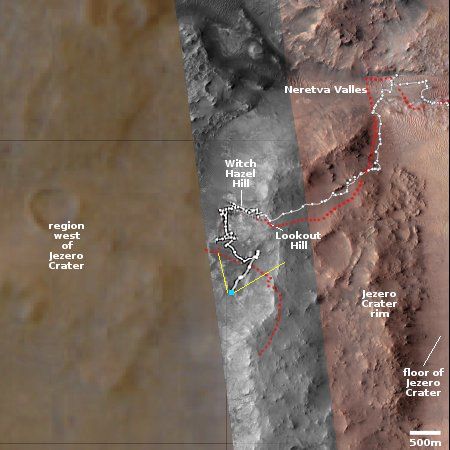
Figure 1 of the paper, showing Perseverance’s travels inside Jezero Crater. PIXL is an instrument on the rover. The numbers indicate the Martian days since landing. The Three Forks Depot is where Perseverance placed its first cache of sample cores. Click for original.

Scientists analyzing data taken by the Mars rover Perseverance while it traversed the floor and delta inside Jezero Crater strongly suggests that the landscape there experienced multiple past wet periods.

In Jezero, the 24 mineral species reveal the volcanic nature of Mars’ surface and its interactions with water over time. The water chemically weathers the rocks and creates salts or clay minerals, and the specific minerals that form depend on environmental conditions. The identified minerals in Jezero reveal three types of fluid interactions, each with different implications for habitability.

The first suite of minerals — including greenalite, hisingerite and ferroaluminoceladonite — indicate localized high-temperature acidic fluids that were only found in rocks on the crater floor, which are interpreted as some of the oldest rocks included in this study. The water involved in this episode is considered the least habitable for life, since research on Earth has shown high temperatures and low pH can damage biological structures.

…The second suite of minerals reflects moderate, neutral fluids that support more favorable conditions for life and were present over a larger area. Minerals like minnesotaite and clinoptilolite formed at lower temperatures and neutral pH with minnesotaite detected in both the crater floor and the upper fan region, while clinoptilolite was restricted to the crater floor.

Finally, the third category represents low-temperature, alkaline fluids and is considered quite habitable from our modern Earth perspective. Sepiolite, a common alteration mineral on Earth, formed under moderate temperatures and alkaline conditions and was found widely distributed across all units the rover has explored. The presence of sepiolite in all of these units reveals a widespread episode of liquid water creating habitable conditions in Jezero crater and infilling sediments.

You can read the peer-reviewed paper here. The uncertainty of these results is important to note. The analysis did not actually look at real samples. It took data obtained by Perseverance and used computer models and AI to analyze it. The research also assumes the minerals formed based on our understanding of such geological processes on Earth. On Mars conditions are very alien, and could result from chemistry we as yet do not understand, or are unaware even exists.

1 comment

ISS research suggests weightlessness accelerates aging in stem cells

According to a study that flew stem cells on four separate missions to ISS ranging in length from 32 to 45 days, weightlessness appears to age stem cells significantly.

Researchers from University of California San Diego Sanford Stem Cell Institute have discovered that spaceflight accelerates the aging of human hematopoietic stem and progenitor cells (HSPCs), which are vital for blood and immune system health. In a study published in Cell Stem Cell, the team used automated artificial intelligence (AI)-driven stem cell-tracking nanobioreactor systems in four SpaceX Commercial Resupply Services missions to the International Space Station (ISS) to track stem cell changes in real time. The findings show that the cells lost some of their ability to make healthy new cells, became more prone to DNA damage and showed signs of faster aging at the ends of their chromosomes after spaceflight — all signs of accelerated aging.

Upon return to Earth the study also found the cells recovered somewhat.

You can read the peer-reviewed paper here.

In a sense, this study confirms what numerous other research has found, that weightlessness mimics the conditions of old age, and causes the same physical decline seen in the elderly. It also shows that much of that damage in weightlessness is transient, recovering upon return to Earth.

This research once again highlights the imperative need to study the impact on various levels of artificial gravity on the human body. Will producing a 10% g environment — using centrifugal force — mitigate these negative impacts? Or will we have to simulate a full 1 g environment? Or something in between?

The first option is much easier in terms of engineering. The last will be complex and take time to develop.

At the moment almost no research has been done in this area. And it needs to happen soon, if people intend to go to Mars in the near future. Such journeys, six months minimum in weightlessness, are likely to leave the passengers somewhat debilitated upon arrival, no matter how much they exercise along the way. And being debilitated is not a good condition for a pioneer trying to build a new civilization on an alien world.

10 comments

Monitoring the largest recent impact detected by InSight’s seismometer

Overview

Cool image time! On December 24, 2021 the seismometer of the Mars lander InSight detected a four magnitude earthquake, the largest detected up until then. Because its nature suggested that it had been caused by an impact, not an internal shifting, the science team for Mars Reconnaissance Orbiter (MRO) immediately started searching for new impact craters in the area of Mars where the data suggested the quake came from.

Two months later they found it, in the northern lowland plains just south of the prime landing zone chosen by SpaceX for its Starship spacecraft. The black cross on the overview map to the right indicates the position. The four red spots are the prime Starship landing sites. The white dots indicate other locations considered. The black dots were images taken for a proposed Dragon landing. This impact is thus only about 100 miles away from the nearest possible Starship landing spot.
» Read more

7 comments

Strange unexplained polarization shifts in M87’s supermassive black hole

The changing magnetic field of M87
Click for original image.

Using the Event Horizon Telescope (EHT), astronomers have detected unexpected and so far unexplained polarization shifts in the supermassive black hole that resides at the center of the galaxy M87, located 55 million light years away.

That black hole is estimated to have a mass six billion times that of our Sun, and was the first ever imaged by EHT. By using observations made in 2017, 2018, and 2021, as shown in the images to the right, found its magnetic field changing in unexpected ways.

Between 2017 and 2021, the polarization pattern flipped direction. In 2017, the magnetic fields appeared to spiral one way; by 2018, they settled; and in 2021, they reversed, spiraling the opposite direction. Some of these apparent changes in the polarization’s rotational direction may be influenced by a combination of internal magnetic structure and external effects, such as a Faraday screen. The cumulative effects of how this polarization changes over time suggests an evolving, turbulent environment where magnetic fields play a vital role in governing how matter falls into the black hole and how energy is launched outward.

The changes were more puzzling in that the size of the black hole’s event horizon, the ring surrounding it, did not change. According to the scientists, this suggests “magnetized plasma swirling near the event horizon is far from static; it’s dynamic and complex, pushing our theoretical models to the limit.”

That the magnetic field flipped polarity however should not be surprising to scientists. Consider the same polarity flips we see in our own Sun every eleven years. It should be expected that the magnetic field around a super massive black hole would be equally variable, if not more so.

The problem is that there remains no understanding about why such changes happen. We know the magnetic field exists. We know it flips polarity. With the Sun we know it does so regularly every eleven years. Why it does so however remains unknown, though there are theories. With M87 the data is far less certain.

Tracking the changes at M87 however should help us build our knowledge base so that someday we might finally grasp those fundamentals.

1 comment
1 13 14 15 16 17 438