Digitizing Venice’s 1,000-year-old archives

Link here. The article describes an ambitious effort to make this archive, much of which has never been read, easily accessible and searchable using modern digital technology.

As Venice’s empire grew, it developed administrative systems that recorded vast amounts of information: who lived where, the details of every boat that entered or left the harbour, every alteration made to buildings or canals. Modern banking was invented in the Rialto, one of Venice’s oldest quarters, and notaries there recorded all trading exchanges and financial transactions.

Crucially, those records survived through turbulent centuries. While the rest of Europe was roiled by its perpetually warring monarchs, from the eighth century onwards Venice began to develop into a stable republic that provided the peace and order required for trade to flourish. In many ways it was a model democracy. The people elected a leader — the doge — supported by various councils, whose members were also usually elected. Governance was secular, but for the most part co-existed tolerantly with religion.

French emperor Napoleon Bonaparte put an end to the Serene Republic in 1797. En route to Vienna during his attempt to conquer the Austro-Hungarian Empire, he declared Venice’s secular and democratic governance to be a form of autocracy, and the city to be an enemy of the revolution. He forced the republic to dissolve itself. In 1815, the old Frari was turned into the State Archives of Venice. Over the next decades, all state administrative documents, including death registers, were transferred there, along with medical records, notary records, maps and architectural plans, patent registers and a miscellany of other documentation, some from elsewhere in Italy. Particularly significant are ambassadors’ reports from wider Europe and the Ottoman Empire, providing a unique source of detailed information about daily life. “Venetian ambassadors were the most observant travellers, trained to find out things like what was being unloaded at the docks, or what a prince or other high-up was like as a person,” says Daston. “Their reports were full of gossip and intrigue.”

Most of the archive, predominantly written in Latin or the Venetian dialect, has never been read by modern historians. Now it will all be systematically fed into the Venice Time Machine, along with more unconventional sources of data, such as paintings and travellers’ logs.

Venice is a particularly important component of European history, as in many ways it was the last remnant of the Roman Empire, founded by Romans even as their empire was collapsing around them. It then lasted almost a thousand years, and became throughout the Middle Ages a powerful and important center of European trade. Moreover, the growth of this strange city in a bog is in many ways a mystery. This archive will actually allow researchers and historians to finally begin to understand how these events unfolded.

5 comments

China launches X-ray space telescope

China today launched the Hard X-ray Modulation Telescope (HXMT), also dubbed Insight by Chinese news sources.

The HXMT carries three x-ray telescopes observing at energies ranging from 20 to 200 kilo-electron volts as well as an instrument to monitor the space environment, according to its designers. While orbiting 550 kilometers above the planet, the HXMT will perform an all-sky survey that is expected to discover a thousand new x-ray sources. Over an expected operating lifetime of 4 years, it will also conduct focused observations of black holes, neutron stars, and gamma ray bursts.

More here. This is China’s first home-grown X-ray space telescope, and its launch once again illustrates that, for at least the next few decades, China intends to be a major player in the exploration of the solar system.

0 comments

A new map of Mimas

Global map of Mimas

The Cassini science team has released what will be the best map of Saturn’s moon Mimas for many decades to come. A reduced resolution version is above, and was updated after the most recent fly-bys in November 2016 and February 2017.

The moon’s large, distinguishing crater, Herschel, is seen on the map at left. The map is an equidistant (simple cylindrical) projection and has a scale of 710 feet (216 meters) per pixel at the equator. The mean radius of Mimas used for projection of this map is 123.2 miles (198.2 kilometers). The resolution of the map is 16 pixels per degree.

Since Cassini is in its final orbits and will crash into Saturn in September, and no other Saturn mission is even being planned, do not expect a better map for a very long time.

1 comment

China to attempt to grow potatoes on Moon

China’s Chang’e-4 lunar rover/lander, set to launch in 2018, will include a small experiment that will attempt to grow potatoes from seeds.

Note that I have just realized that I have been confusing Chang’e-5 with Chang’e-4. Chang’e-5 is a sample return mission that they hope to launch this year. It does not include a rover. Chang’e-4 is a lander/rover mission that is planned for 2018.

14 comments

Worm grows 2 heads on ISS

The uncertainty of science: For reasons that are not yet understood, a flatworm fragment flown to ISS in a microgravity experiment regenerated with two heads.

But the most dramatic difference was a type of regeneration observed in one of the 15 worm fragments sent to the ISS. That worm returned to the scientists with two heads (one on each end of its body), a type of regeneration so rare as to be practically unheard of — “normal flatworms in water never do this,” Levin told Live Science. When the researchers snipped both heads off back on Earth, the middle portion regenerated into a two-headed worm again.

“And these differences persist well over a year after return to Earth!” Levin said. “Those could have been caused by loss of the geomagnetic field, loss of gravity, and the stress of takeoff and landing — all components of any space-travel experience for living systems going to space in the future,” he said.

The flatworms that flew in space showed other significant differences from the control group that stayed on Earth, further suggesting that for flatworms at least the environment of weightlessness causes more problems that were expected.

6 comments

Sunspot update for May 2017

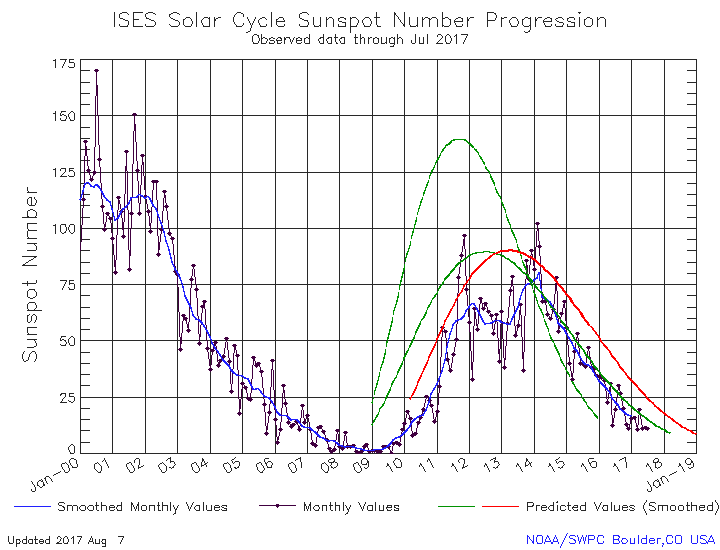
Last week NOAA posted its monthly update of the solar cycle, covering sunspot activity for May. Unfortunately, there appeared to be a problem with their posting software. Though the date of the image changed, the graph itself was not updated. I contacted NOAA, and Ann Newman, IT Specialist at NOAA’s
Space Weather Prediction Center, took a look and quickly fixed the problem.

The corrected graph is posted below, with annotations, as I have done now every month since 2010.

May 2017 Solar Cycle graph

The graph above has been modified to show the predictions of the solar science community. The green curves show the community’s two original predictions from April 2007, with half the scientists predicting a very strong maximum and half predicting a weak one. The red curve is their revised May 2009 prediction.

The decline in sunspot activity resumed in May, putting the trend back below the 2007 low prediction. Overall, the trend continues to suggest that this very weak solar maximum will end much earlier than predicted, and will make it an unprecedented short but weak cycle. As the Sun is at this moment blank, and has been for several days, I expect that June will end up with low numbers as well, continuing this trend.

As I have repeatedly said now monthly for six years, if history is any guide, the Sun’s low activity should correspond with cooler temperatures here on Earth. Why this happens is not yet understood, though there are theories.

3 comments

Using math to protect the Washington power structure

What could possible go wrong? A group of mathematicians have written software designed to prevent the gerrymandering of congressional districts, and are offering that software as a weapon for the courts to force states to revise the districts, even though those districts were created by fairly elected state legislatures.

Leaning back in his chair, Jonathan Mattingly swings his legs up onto his desk, presses a key on his laptop and changes the results of the 2012 elections in North Carolina. On the screen, flickering lines and dots outline a map of the state’s 13 congressional districts, each of which chooses one person to send to the US House of Representatives. By tweaking the borders of those election districts, but not changing a single vote, Mattingly’s maps show candidates from the Democratic Party winning six, seven or even eight seats in the race. In reality, they won only four — despite earning a majority of votes overall.

Mattingly’s election simulations can’t rewrite history, but he hopes they will help to support democracy in the future — in his state and the nation as a whole. The mathematician, at Duke University in Durham, North Carolina, has designed an algorithm that pumps out random alternative versions of the state’s election maps — he’s created more than 24,000 so far — as part of an attempt to quantify the extent and impact of gerrymandering: when voting districts are drawn to favour or disfavour certain candidates or political parties.

There are numerous problems here, all of which center on my basic disbelief in the non-partisan objectivity of these scientists and their work.

First, note the first example used. Mattingly proudly shows how his software demonstrates that Democrats could have won more districts in North Carolina. In fact, if you read the article, he claims that the district revisions produced by his software (producing more victorious Democrats) creates fairer districts than the districts created by the state’s fairly elected Republican legislature. Moreover, it was the Republican redistricting that prompted this mathematician to write the software.

Funny how he never felt compelled to do this when it was Democrats controlling the legislatures and gerrymandering the congressional districts to their benefit.

Second, he has offered this software to the courts as evidence to overrule the redistricting done by fairly elected legislatures. In other words, this software will be used to justify letting unelected experts decide how congressional districts should be shaped, not elected officials picked by voters.

Third, note who has expressed interest in using this mathematician as a witness to win its lawsuits:
» Read more

22 comments

T Rex fossils suggest it was covered with scales, not feathers

The uncertainty of science: The only known fossils of a T Rex’s skin suggest that the dinosaur was covered with scales, not feathers as recent research has theorized.

[I]f these large tyrannosaurs had any feathers at all, says the team, their fluff would have been limited to their backs—the only body part for which they were lacking fossil impressions. Because their earlier cousins did have feathers, it’s likely that the large tyrannosaurs lost them somewhere along the way, the team suggests.

3 comments

Astronomers confirm that comet caused Wow! signal, not aliens

Astronomers have confirmed that the Wow! signal, thought to be the most promising detection by SETI of alien life, was actually caused by a comet.

Last year, a group of researchers from the Center of Planetary Science proposed a new hypothesis that argued a comet might be the culprit. The frequency could be caused by the hydrogen cloud they carry, and the fact that they move accounts for why it seemingly disappeared. Two comets, named 266/P Christensen and P/2008 Y2 (Gibbs), happened to be transiting through that region of space when the Wow! signal was detected, but they weren’t discovered until after 2006.

To test the hypothesis, the team made 200 radio spectrum observations between November 2016 and February 2017. Sure enough, 266/P Christensen was found to emit radio waves at a frequency of 1,420 MHz, and to double check, the researchers moved their radio telescope by one degree. As expected, the signal vanished, and only returned when the telescope was trained back on the comet.

This story demonstrates once again why, in science, it is very dangerous to jump to any conclusions. The data we receive is a mystery. We must keep an open mind to solve that mystery.

5 comments

Climate scientists increasingly show no warming in peer review papers

The uncertainty of science: Climate scientists are increasingly publishing papers that show no clear temperature global trend.

Last year there were at least 60 peer-reviewed papers published in scientific journals demonstrating that Today’s Warming Isn’t Global, Unprecedented, Or Remarkable.

.
Just within the last 5 months, 58 more papers and 80 new graphs have been published that continue to undermine the popularized conception of a slowly cooling Earth temperature history followed by a dramatic hockey-stick-shaped uptick, or an especially unusual global-scale warming during modern times.
.
Yes, some regions of the Earth have been warming in recent decades or at some point in the last 100 years. Some regions have been cooling for decades at a time. And many regions have shown no significant net changes or trends in either direction relative to the last few hundred to thousands of years.
.
Succinctly, then, scientists publishing in peer-reviewed journals have increasingly affirmed that there is nothing historically unprecedented or remarkable about today’s climate when viewed in the context of long-term natural variability. [emphasis in original]

At the link are 80 graphs from the most recent papers. Take a look. If you are convinced that the climate is warming than you must come up with an explanation for this data. Or you can put your fingers in your ears, cover your eyes, and chant “La-la-la-la-la-la-la-la-la-la-la-la-la-la-la-la!” as loud as you can so that you don’t have to deal with it.

13 comments

Jupiter gets two more moons

Astronomers using ground-based telescopes have identified two more moon circling Jupiter, bringing its total now to 69.

Both of these discoveries, as with the vast majority of Jupiter’s moons, occupy retrograde orbits, with inclinations greater than 90°, meaning that they move in directions opposite that of the planet’s spin. These distant, irregular orbits imply that these bodies formed elsewhere in the outer solar system and were captured while passing by early in the planet’s history.

A number of the moons recently discovered have since been lost because their orbits were too poorly constrained. However, some of these lost moons have also be recovered.

9 comments

Jupiter’s cloud-tops, up close

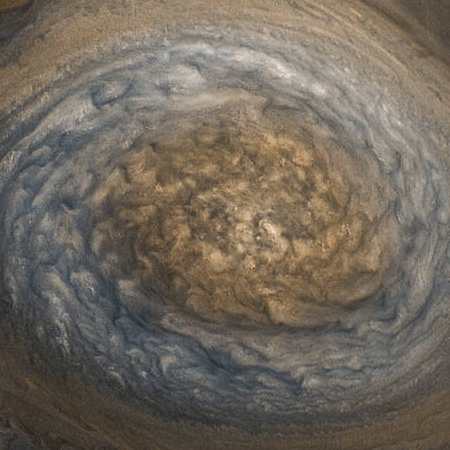
Jupiter's cloud tops

Cool image time! On the right is a cropped and reduced resolution section from this image from Juno. It shows the top of some of Jupiter’s clouds, swirling about chaotically.

What I find most fascinating is how this image reveals the different elevations of some of these cloud belts. The swirling clouds on the left and bottom of the image are clearly higher than the dark areas to the top and right. They are in fact casting their shadows on those lower cloud-tops.

To really understand the interactions taking place here, however, will require satellites capable of continually tracking these clouds over time. Unfortunately, Juno cannot do this. Though it will provide us periodic snapshots of specific areas, its long 53-day orbit means that it will not return to view the same areas very frequently. Making movies of the evolution of these clouds will be difficult, if not impossible.

2 comments

More near Earth objects found by WISE

NASA’s Wide-Field Infrared Explorer (WISE) has released its third year of survey data, including the discovery of 97 previously unknown objects.

Of those, 28 were near-Earth objects, 64 were main belt asteroids and five were comets. The spacecraft has now characterized a total of 693 near-Earth objects since the mission was re-started in December 2013.

For reasons that baffle me, NASA added “Near-Earth Object” to the telescope’s name when they restarted the mission, making its official name now NEOWISE.

4 comments

Cumulative data from Curiosity shows Gale Crater lake stratified

The cumulative data from Curiosity since its arrival on Mars three and a half years ago shows that the lake that once filled Gale Crater lake had had a stratified chemical make-up.

Previous work had revealed the presence of a lake more than three billion years ago in Mars’ Gale Crater. This study defines the chemical conditions that existed in the lake and uses Curiosity’s powerful payload to determine that the lake was stratified. Stratified bodies of water exhibit sharp chemical or physical differences between deep water and shallow water. In Gale’s lake, the shallow water was richer in oxidants than deeper water was.

“These were very different, co-existing environments in the same lake,” said Joel Hurowitz of Stony Brook University, Stony Brook, New York, lead author of a report of the findings in the June 2 edition of the journal Science. “This type of oxidant stratification is a common feature of lakes on Earth, and now we’ve found it on Mars. The diversity of environments in this Martian lake would have provided multiple opportunities for different types of microbes to survive, including those that thrive in oxidant-rich conditions, those that thrive in oxidant-poor conditions, and those that inhabit the interface between those settings.”

While what Hurowitz says above is true, remember that this discovery provides zero evidence of past life on Mars. All it has done is teach us something about the different conditions in the lake at different depths.

0 comments

LIGO detects its third gravitational wave

LIGO scientists today revealed that the detector had spotted its third gravitational wave in January.

Researchers estimate that the bodies in the latest collision were slightly lighter than those in the first event: one had the mass of 31 Suns and the other 19. (The black holes in the second discovery were even more lightweight, at 14 and 8 solar masses.) But the latest merger is the most distant detected so far. The gravitational waves it produced took somewhere between 1.6 billion and 4.3 billion years to reach Earth — most probably around 2.8 billion years.

This new field of astronomy should get even more interesting in the next year or two, as new detectors come on line in Italy and Japan.

1 comment

Frost on the Moon?

A new analysis of Lunar Reconnaissance Orbiter data suggests that the coldest spots at the Moon’s south pole are also its brightest, even though they are generally in shadow, suggesting that the surface there might have a thin layer of water frost.

These are also the areas where hydrogen has been detected, which strengthens the theory that this is water.

However, the result is not a positive one for future colonists as it suggests that the amount of water on the Moon is far less than hoped. First, there is this:

The icy deposits appear to be patchy and thin, and it’s possible that they are mixed in with the surface layer of soil, dust and small rocks called the regolith. The researchers say they are not seeing expanses of ice similar to a frozen pond or skating rink. Instead, they are seeing signs of surface frost.

Second, they have not detected this same pattern at the north pole, which strongly suggests that the permanently shadowed areas there do not even have frost.

Overall, this result suggests that the Moon might have water on its surface, but not in great quantities.

3 comments

NASA names next solar mission after pioneer solar scientist Eugene Parker

NASA has named its next solar mission, which will fly closer to the Sun than any previous mission, after pioneer solar scientist Eugene Parker, who in the 1950s predicted the existence of the solar wind.

The new moniker honors pioneering University of Chicago astrophysicist Eugene Parker, who predicted the existence of the solar wind — the stream of charged particles flowing constantly from the sun — back in 1958. [Solar Quiz: How Well Do You Know Our Sun?]

NASA has named about 20 space missions after people; the Hubble Space Telescope is perhaps the most famous example. But the 89-year-old Parker is the first researcher to be celebrated in this manner while still alive, agency officials said.

Parker deserves it, for sure, and it is really nice to honor him while he is still alive to appreciate it.

The spacecraft is scheduled to launch at the end of July.

7 comments

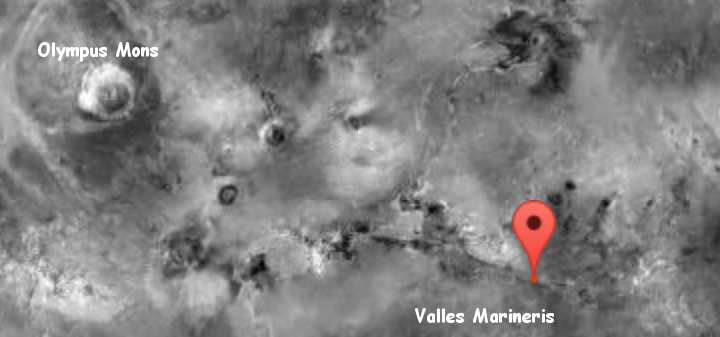
Near the Martian south pole

Near the Martian south pole

Cool image time! The image above, reduced and cropped to show here, shows an area at 87 degrees south latitude, not far from the south pole of Mars and in the region at the edge of its icecap of dry ice.

It is late summer in the Southern hemisphere, so the Sun is low in the sky and subtle topography is accentuated in orbital images.

We see many shallow pits in the bright residual cap of carbon dioxide ice (also called “Swiss cheese terrain”). There is also a deeper, circular formation that penetrates through the ice and dust. This might be an impact crater or it could be a collapse pit.

Because of the low Sun angle the bottom of the deep pit is poorly lit, making it hard to determine the pit’s nature. What can be seen at its bottom however are some patches of carbon dioxide ice, melting in the same manner as the dry ice in the surrounding terrain. Also, the dust pattern surrounding the pit indicates the prevailing winds at this location, consistently blowing to the northeast.

I am certain there will be additional photos taken of this pit, when the Sun is higher in the sky and its floor is thus better illuminated.

5 comments

Astronomers find star with giant ringed planet

Astronomers now think that a sunlike star about 1,000 light years away dips in brightness every 2.5 years because an orbiting ringed planet or ringed dwarf star blocks the star’s light.

They discovered that every two and a half years, the light from this distant star – PDS 110 in the Orion constellation, which is same temperature and slightly larger than our sun – is reduced to thirty percent for about two to three weeks. Two notable eclipses observed were in November 2008 and January 2011. “What’s exciting is that during both eclipses we see the light from the star change rapidly, and that suggests that there are rings in the eclipsing object, but these rings are many times larger than the rings around Saturn,” says Leiden astronomer Matthew Kenworthy.

Assuming the dips in starlight are coming from an orbiting planet, the next eclipse is predicted to take place in September this year – and the star is bright enough that amateur astronomers all over the world will be able to witness it and gather new data. Only then will we be certain what is causing the mysterious eclipses.

If confirmed in September, PDS 110 will be the first giant ring system that has a known orbital period. [emphasis in original]

Just so no one is confused, this is not Tabby’s Star. There, the dips in light are seemingly random and follow no pattern, other than an overall dimming for the past century.

2 comments

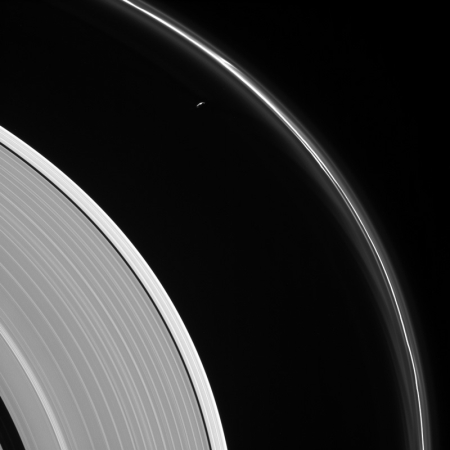
Pole of Saturn’s moon Enceladus shifted 55 degrees in the past

Data from Cassini now suggests that the moon Enceladus shifted its pole as much as 55 degrees sometime in the past, possibly due to an impact.

Whether it was caused by an impact or some other process, Tajeddine and colleagues think the disruption and creation of the tiger-stripe terrain [at south pole] caused some of Enceladus’ mass to be redistributed, making the moon’s rotation unsteady and wobbly. The rotation would have eventually stabilized, likely taking more than a million years. By the time the rotation settled down, the north-south axis would have reoriented to pass through different points on the surface — a mechanism researchers call “true polar wander.”

0 comments
1 233 234 235 236 237 438