Jupiter’s southern jet streams

Jupiter's southern jet streams
Click for full image.

Cool image time! The photo to the right, rotated and reduced slightly to post here, shows the southern jet streams in Jupiter’s atmosphere. From the press release:

The storm known as the Great Red Spot is also visible on the horizon, nearly rotated out of view as Juno sped away from Jupiter at about 30 miles per second (48 kilometers per second), which is more than 100,000 mph (160,900 kilometers per hour).

Citizen scientist Tanya Oleksuik created this color-enhanced image using data from the JunoCam camera. The original image was taken on Dec. 30, 2020 as the Juno spacecraft performed its 31st close flyby of Jupiter. At the time, the spacecraft was about 31,000 miles (about 50,000 kilometers) from the planet’s cloud tops, at a latitude of about 50 degrees South.

According to data obtained by Juno, these bands of storms extend about 1,800 miles into Jupiter’s interior, much deeper than expected.

The Great Red Spot is at about 22 degrees south latitude, so this tells us that this picture covers Jupiter’s southern hemisphere from about the equator down to about 80 degrees.

2 comments

Turkey to do lunar mission, send astronaut into space

The new colonial movement: Turkey’s leader, Tayyip Erdogan, announced yesterday a new space exploration initiative that will include sending an unmanned probe to the Moon as well as flying an astronaut into space.

“The first rough landing will be made on the moon with our national and authentic hybrid rocket that shall be launched into orbit in the end of 2023 through international cooperation,” Erdogan said, detailing a two-phase mission. Erdogan did not elaborate further on the cooperation. Last month, Erdogan spoke to Tesla and SpaceX boss Elon Musk on possible cooperation in space technologies with Turkish companies.

Speaking in an event in Ankara, Erdogan announced a programme with 10 strategic goals including sending a Turkish citizen to a scientific mission in space.

The manned mission will not be flown by Turkey, but will be purchased from someone else, either Russia or SpaceX or Boeing maybe even China.

The timing of this announcement, the same day the UAE’s Al-Amal probe entered Mars’ orbit, suggests it was prompted by that success, and is an example of keeping up with the Joneses. Whether there is any reality to these proposals however remains to be seen.

2 comments

China’s Tienwen-1 enters Mars orbit

The new colonial movement: China’s Tienwen-1, carrying an as-yet-unnamed lander/rover, successfully inserted itself into orbit around Mars early today.

With a successful Mars Orbit Insertion, the craft has entered a highly eccentric, equatorial capture orbit of the planet, and controllers will now spend two months undertaking initial activations and checkouts in Martian orbit for the primary science mission while altering the craft’s orbit from equatorial to polar.

In April 2021, the lander, with the rover inside, will detach from the orbiter and prepare for Entry, Descent, and Landing. Prior to launch, 23 April 2021 was given as the target landing date.

The landing location is within Utopia Planitia and will — if the orbit insertion burn is completed successfully — utilize a combination of aerobraking, parachute descent, retrorocket firing, and airbag deployments to achieve a soft touchdown on the Martian surface. After landing, the rover will be deployed — ideally on the same day — to begin a planned 90 Sol (Martian day) mission to categorize the local environment.

The suspected landing site in Utopia Planitia is at about 25 degrees north latitude. Though it is in the northern lowland plains, this latitude places it south of the latitudes (greater than 30) that scientists now believe ample ice likely exists underground but accessible. The lander/rover carries radar equipment capable of detecting evidence of underground ice, and will look nonetheless. If it finds any, this will be a significant discovery.

Two down, one to go. Next week, on February 18th, the American rover Perseverance will attempt its landing in Jezero crater.

2 comments

Another “What the heck?!” image on Mars

A
Click for full image.

Today’s cool image, taken on September 2, 2020 by the high resolution camera on Mars Reconnaissance Orbiter (MRO) and cropped and reduced to post here, is one that I will make very little attempt to explain. It falls into a category I call “What the heck?!” The uncaptioned website labels this “Ringed Ridges in Kasei Valles”, which merely describes what we see.

This isn’t an impact crater. The rings don’t fit any morphology I’ve ever seen for such features.

Could we be looking at some type of glacial feature? The latitude, 29 degrees north, makes this unlikely but possible. Even so, it sure doesn’t look like it. The ripples in the center and between the ridges are sand dunes, not glacial features.

Might this be a volcanic vent, with the concentric ridges marking multiple eruptions? Maybe, but if so I’ve never seen any volcanic vent or caldera that looked quite like this.

The overview map below gives some context, but hardly explains anything.
» Read more

9 comments

Sunspot update: January activity returns to expected levels

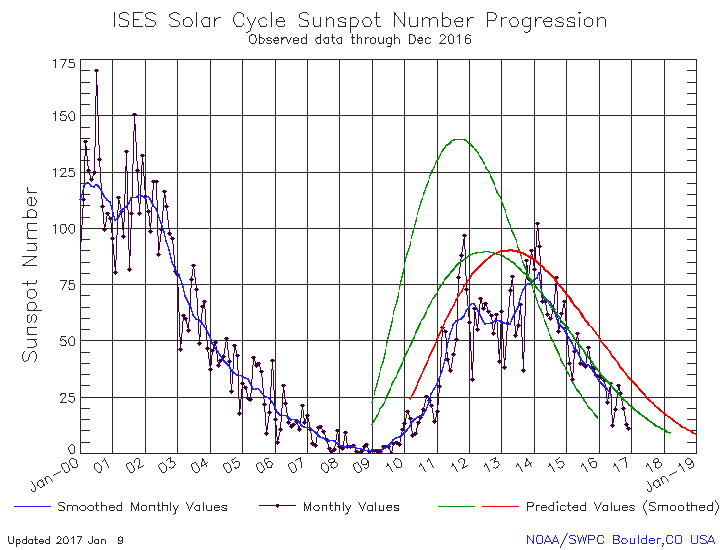
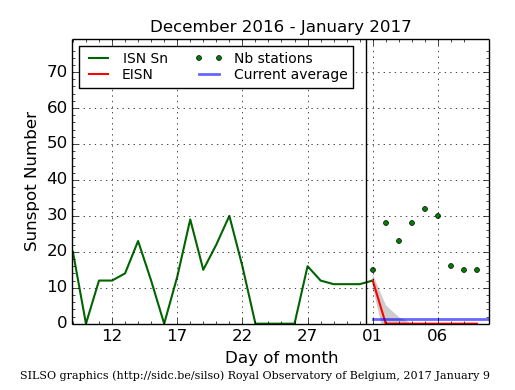
Though I am a bit late this month, it is once again time provide my monthly update of the Sun’s on-going sunspot cycle. Below is NOAA’s February 1, 2021 monthly graph, showing the Sun’s monthly sunspot activity. I have, as I do each month, annotated it to show the previous solar cycle predictions.

After two months of relatively high activity, activity that was very high so early in the ramp up to solar maximum, the number of sunspots in January dropped down to closely match the predicted value. It was still higher, but not by much.

» Read more

3 comments

Fiftieth anniversary of Apollo 14 lunar landing

Apollo 14 as seen by LRO
Click for full image.

In honor of the fiftieth anniversary today of the landing of Apollo 14 on the Moon, the Lunar Reconnaissance Orbiter (LRO) science team has used images from the spacecraft to map out what the astronauts did on the surface, as shown in the reduced image to the right. The orange and teal lines indicate the routes followed during the two EVAs, with the pink triangles indicating stopping points along the way.

Unlike Apollo 11 and 12, which focused on engineering goals such as landing precisely on the Moon, Apollo 14 focused on addressing science goals. Antares (lunar module) landed in the Fra Mauro highlands, the original destination of the failed Apollo 13 mission, essentially taking on that mission’s objectives. This was the first crewed landing in the lunar highlands and not in the mare.

The Apollo 14 astronauts who landed on the Moon, Alan Shepard (Commander) and Edgar Mitchell (Lunar Module Pilot), completed two extra-vehicular activities (EVAs) while on the surface. They spent a total of 9 hours and 22 minutes setting up equipment, taking photographs, collecting samples, and exploring.

This was the last mission where the astronauts had to walk. The next three Apollo missions brought a rover with them, so that they could drive to their research sites.

5 comments

Musk: Starlink to go public once operational

Capitalism in space: According to a tweet by SpaceX founder Elon Musk, once the Starlink internet satellite constellation is operational and has a “reasonable well” cash flow it will issue and IPO and become a publicly traded stock.

“SpaceX needs to pass through a deep chasm of negative cash flow over the next year or so to make Starlink financially viable,” Musk wrote in another tweet. “Every new satellite constellation in history has gone bankrupt. We hope to be the first that does not.”

Based on the company’s pace of launching satellites and rolling out service, this moment could occur as early as late this year. More likely it will occur in mid-22.

I would also expect that stock to quickly rise in value, and based on the history of all of Musk’s companies, will continue to rise thereafter. Expect also that a significant portion of the investment capital that Starlink will raise will be used to finance the development of Starship and Super Heavy, because Starlink will need that larger rocket to maintain its satellite constellation.

9 comments

UAE’s Hope or Al-Amal Mars Orbiter orbital insertion

UPDATE: The probe has apparently achieved orbit.

The new colonial movement: The United Arab Emirates’ (UAE) Mars orbiter, Hope, or Al-Amal in Arabic, is about to insert itself into orbit around the red planet, with that insertion to be confirmed by 11:08 (Eastern).

If you want to watch, I have embedded the live stream below the fold. A warning: The insertion is a relatively interesting event to watch, as the orbiter works autonomously and the signal confirming it happened arrives after the event. Most of the stream is propaganda for the UAE.
» Read more

2 comments

OSIRIS-REx has begun its return to Bennu

On January 14th the OSIRIS-REx team fired the spacecraft’s engines to halt its drift away from the asteroid Bennu and begin its return for one last reconnaissance before heading to Earth with its samples.

OSIRIS-REx executed the first maneuver on Jan. 14, which acted as a braking burn and put the spacecraft on a trajectory to rendezvous with the asteroid one last time. Since October’s sample collection event, the spacecraft has been slowly drifting away from the asteroid, and ended up approximately 1,635 miles (2,200 km) from Bennu. After the braking burn, the spacecraft is now slowly approaching the asteroid and will perform a second approach maneuver on Mar. 6, when it is approximately 155 miles (250 km) from Bennu. OSIRIS-REx will then execute three subsequent maneuvers, which are required to place the spacecraft on a precise trajectory for the final flyby on Apr. 7.

OSIRIS-REx is scheduled to depart Bennu on May 10 and begin its two-year journey back to Earth. The spacecraft will deliver the samples of Bennu to the Utah Test and Training Range on Sep. 24, 2023.

While they will gather images of the whole asteroid, their number one goal will be to get high resolution photos of the sample-grab site Nightingale to see how it was changed by that sample grab. The spacecraft pushed into the asteroid’s rubble pile about 1.6 feet, and that act certainly disturbed both the interior and surface. By comparing the before and after pictures scientists can garner a lot of information about the asteroid’s make-up, density, and structure. It will also teach future engineers what to expect when next they try to touch another rubble-pile asteroid.

0 comments

The Icy Surface of Mars

The extent of ice on Mars

Two newly published science papers in the past few days have once again reinforced the growing evidence that much of Mars from 30 degrees latitude to its poles is very icy, with much of that ice found close to the surface.

The map above, adapted and annotated by me from figures 4 and 12 of one of those papers (“Widespread Exposures of Extensive Clean Shallow Ice in the Mid‐Latitudes of Mars”), show the areas on Mars where the evidence suggests ample and easily accessible ice, underground but close to the surface.

The red dots and diamonds indicate recent impact craters that temporarily exposed the underground ice layer that would normally not be visible. The white dots and diamonds indicate ice scarps with visible ice layers in their cliff faces. The size of these locations is greatly exaggerated.

The two hatched lines at 30 degrees latitude, north and south, indicate the closest to the equator that scientists have detected evidence of glacial ice. It is also the closest to the equator that the second new paper, “Water Ice Resources Identified in Martian Northern Hemisphere “, has found evidence of underground ice in the north. From the abstract of this second paper:
» Read more

4 comments

Hydrazine on the surface of Saturn’s moon Rhea?

The uncertainty of science: Scientists using data from several Cassini flyby’s of the Saturn moon Rhea now think that hydrazine, a very toxic chemical routinely used by spacecraft as fuel, might exist on its surface.

Their effort was an attempt to identify an unknown spectroscopy absorption feature at a specific wavelength.

In comparison to chloromethane, the production of hydrazine monohydrate was easier to explain due to chemical reactions involving water-ice and ammonia or delivery from Titan’s nitrogen rich atmosphere. Elowitz et al. considered the possibility of contamination of the UVIS data by a hydrazine propellant from the Cassini spacecraft, although it was highly unlikely since the hydrazine thrusters were not used during icy satellite flybys.

The team confirmed the specific signature of a 184-nm feature on Rhea’s surface using the UV spectrometer observations made by the Cassini spacecraft. In addition to that, the irradiation of ammonia by charged particles from Saturn’s magnetosphere induced the dissociation of ammonia molecules to form diazene and hydrazine. The source of ammonia on Rhea could be primordial, incorporated into its interior during formation and brought to the surface within a period of endogenic activity, as evident in Cassini ISS imagery, although ammonia was unlikely to survive indefinitely on the surface. The team suggest further analysis to understand the potential for satellite-to-satellite transfer of materials across Titan’s atmosphere to explain the presence of hydrazine monohydrate on Rhea.

Though useful as a fuel, its poisonous nature will make any exploration of these moons very hazardous, and will also likely make its usefulness difficult initially in that exploration

2 comments

Betelgeuse is closer and smaller than previously thought

Betelgeuse's fading
Images taken by Europe’s
Very Large Telescope in Chile

The uncertainty of science: A new analysis by scientists of Betelgeuse, triggered by its dip in brightness in 2020, has concluded that the red giant star is both closer and smaller than previously estimated.

Their analysis reported a present-day mass of 16.5 to 19 solar mass—which is slightly lower than the most recent estimates. The study also revealed how big Betelgeuse is, as well as its distance from Earth. The star’s actual size has been a bit of a mystery: earlier studies, for instance, suggested it could be bigger than the orbit of Jupiter. However, the team’s results showed Betelgeuse only extends out to two-thirds of that, with a radius 750 times the radius of the sun. Once the physical size of the star is known, it will be possible to determine its distance from Earth. Thus far, the team’s results show it is a mere 530 light years from us, or 25 percent closer than previously thought.

The research also suggested that the star is in the initial stages of burning helium rather than hydrogen, and so it likely more than 100,000 years from going supernova.

As for the dimming, the scientists concluded (as other have) that the dimming in ’20 was due to the passage of a dust cloud in front of the star.

5 comments
1 243 244 245 246 247 729