Sixty science papers retracted

The uncertainty of peer review: An internal investigation has caused the retraction of sixty peer-reviewed scientific papers that were published by a single journal, the Journal of Vibration and Control (JVC).

The network of JVC papers that emerged was incestuous, with the same small group of authors reviewing each other’s work and appearing together as co-authors. By the end of the year, the investigators had a list of 130 e-mail addresses associated with 60 papers, with one scientist as co-author on all of them: Chen-Yuan Chen of NPUE, who goes by “Peter.” When SAGE sent an e-mail to all 130 e-mail addresses requesting that the authors confirm their identity, none responded. “The authors were contacted again by SAGE in May 2014 to inform them that their papers would be retracted in the July 2014 issue,” says Sherman, but again none responded. According to SAGE’s official statement, Chen resigned from NPUE in February. Neither Chen nor officials at NPUE responded to e-mails from ScienceInsider

How was it possible for a scientist to become the sole reviewer on dozens of his own papers? The answer appears to be that Chen was allowed to nominate his own reviewers, who were not vetted by JVC,

Chen apparently created fake gmail accounts for both real and non-existing scientists and then chose these scientists both as his co-authors as well as his peer-reviewers.

0 comments

The darkest material ever made

Scientists have developed a material so dark it is difficult to discern the shape of any object it coats.

The material absorbs all but 0.035 per cent of light, a new world record, and is so dark the human eye struggles to discern its shape and dimension, giving the appearance of a black hole. Named Vantablack, or super black, it also conducts heat seven and half times more effectively than copper, and is ten times stronger than steel. It is created by Surrey NanoSystems using carbon nanotubes, which are 10,000 thinner than human hair and so miniscule that light cannot get in but can pass into the gaps in between.

The pictures at the website are especially amazing. They coated half of a sheet of aluminum foil with the material and then crinkled the foil. You can see the crinkles in the uncoated material, but the coated material just looks black.

This will be very useful for astronomical instruments, as well as many other technical applications. For example, if you coat the body of your telescope with this material it will help eliminate stray light, which means that you will increase the efficiency of your observations.

5 comments

CDC suspends shipments of dangerous pathogens

Due to a series of recent errors and mishaps in the shipment of dangerous pathogens such as anthrax and influenza, the Centers for Disease Control (CDC) has suspended future shipments while it conducts an investigation.

After news of the anthrax exposure broke on 19 June, the CDC began investigating why its lab workers did not follow proper procedure to inactivate Bacillus anthracis spores before shipping them to another lab on the agency’s Atlanta campus. The receiving lab was not equipped to handle the pathogen, and once the mistake was discovered, more than 70 people were pre-emptively treated for anthrax infection. The CDC now says that the lab never needed to work with B. anthracis in the first place; another bacterium would have sufficed to test the diagnostic equipment that the lab was evaluating. The good news, Frieden says, is that the CDC now does not believe that anyone was actually exposed to anthrax spores.

But the agency’s ongoing investigation has revealed more bad news: on 12–13 March, the CDC’s influenza lab contaminated a harmless flu strain with the highly dangerous H5N1 variety, and sent it to a laboratory operated by the US Department of Agriculture (USDA) in Athens, Georgia. The mistake was discovered on 23 May, but Frieden says that he was not notified until 9 July. “Why it took six weeks for that to be made apparent, I can think of no valid explanation,” he says. The USDA lab was equipped to handle highly infectious agents, and the agency is confident that there were no exposures.

1 comment

Venus Express is coming up for less air

After spending a month dropping down deep into Venus’s atmosphere, engineers are now raising Venus Express’s orbit.

Thus routine science operations concluded on 15 May, and the spacecraft’s altitude was allowed to drop naturally from the effect of gravity, culminating in a month ‘surfing’ between 131 km and 135 km above the surface. Additional small thruster burns were used to drop the spacecraft to lower altitudes, reaching 130.2 km earlier this week. Tomorrow, it is expected to dip to 129.1 km.

After eight years orbiting Venus, the mission is finally ending. They will use the spacecraft’s thrusters to lift it back up to almost 500 kilometers, where they will then allow its orbit to naturally decay, eventually ending the mission when it burns up in the atmosphere. There is also the chance they will run out of fuel during these last burns, ending the mission slightly sooner.

0 comments

Dry ice evaporation creates the fresh gullies on Mars

New data from Mars Reconnaissance Orbiter shows that the fresh gullies that have been seen on the Red Planet are caused by dry ice evaporation, not liquid water as had been hoped.

Dundas and collaborators used the High Resolution Imaging Science Experiment (HiRISE) camera on MRO to examine gullies at 356 sites on Mars, beginning in 2006. Thirty-eight of the sites showed active gully formation, such as new channel segments and increased deposits at the downhill end of some gullies.

Using dated before-and-after images, researchers determined the timing of this activity coincided with seasonal carbon-dioxide frost and temperatures that would not have allowed for liquid water.

Frozen carbon dioxide, commonly called dry ice, does not exist naturally on Earth, but is plentiful on Mars. It has been linked to active processes on Mars such as carbon dioxide gas geysers and lines on sand dunes plowed by blocks of dry ice. One mechanism by which carbon-dioxide frost might drive gully flows is by gas that is sublimating from the frost providing lubrication for dry material to flow. Another may be slides due to the accumulating weight of seasonal frost buildup on steep slopes.

The findings in this latest report suggest all of the fresh-appearing gullies seen on Mars can be attributed to processes currently underway, whereas earlier hypotheses suggested they formed thousands to millions of years ago when climate conditions were possibly conducive to liquid water on Mars.

0 comments

The sun continues its ramp down

On Monday NOAA posted its monthly update of the solar cycle, showing the sunspot activity for the Sun in June. As I do every month, I am posting it here, below the fold, with annotations to give it context.

The decline in sunspots continued for the fourth month in a row, increasing the likelihood that the peak of solar maximum has finally come and gone and that we now seeing the beginning of the ramp down to solar minimum. This resulting solar maximum comes close to matching the science community’s final prediction (indicated by the red line), though that prediction was not detailed enough to include the distinct and unusual double peak for this maximum.
» Read more

5 comments

The effort to resurrect ISEE-3’s is over

The private effort to resurrect the 1980s research probe ISEE-3 has been stymied by a non-working propulsion system.

Before the July 9 attempt, the ISEE-3 Reboot Project thought it had a chance of completing its planned trajectory correction maneuver. The spacecraft’s small hydrazine thrusters were spun up July 3, and systems appeared nominal, Cowing said. On July 8, the spacecraft even managed to perform one of the six multipulse burns that would have set it up for a return to the orbit into which it was launched in 1978.

But further attempts to activate the thrusters July 8 proved unsuccessful, as were all attempts the following day. After eliminating a malfunctioning valve as the cause of the problem, the ISEE-3 Reboot Project was forced to conclude that the satellite’s hydrazine fuel simply was not being pushed through its plumbing at the right pressure to conduct a burn.

The spacecraft is in science mode and will gather data as long as it is in communication range, which will only be for another three months.

0 comments

Fast radio pulses exist, come from outside the galaxy, and no one knows what they are

A new astronomical mystery: The Arecibo radio telescope has confirmed the existence of fast radio pulses.

Fast radio bursts (FRBs) are bright flashes of radio waves that last only a few thousandths of a second. Scientists using the Parkes Observatory in Australia have recorded such events for the first time, but the lack of any similar findings by other facilities led to speculation that the Australian instrument might have been picking up signals originating from sources on or near Earth. The discovery at Arecibo is the first detection of a fast radio burst using an instrument other than the Parkes radio telescope. The position of the radio burst is in the direction of the constellation Auriga in the Northern sky. …

“Our result is important because it eliminates any doubt that these radio bursts are truly of cosmic origin,” continues Victoria Kaspi, an astrophysics professor at McGill University in Montreal and Principal Investigator for the pulsar-survey project that detected this fast radio burst. “The radio waves show every sign of having come from far outside our galaxy – a really exciting prospect.”

Exactly what may be causing such radio bursts represents a major new enigma for astrophysicists. Possibilities include a range of exotic astrophysical objects, such as evaporating black holes, mergers of neutron stars, or flares from magnetars — a type of neutron star with extremely powerful magnetic fields.

Be warned: All of the above theories could also be wrong. These fast radio flashes could just as easily turn out to be something entirely unpredicted.

0 comments

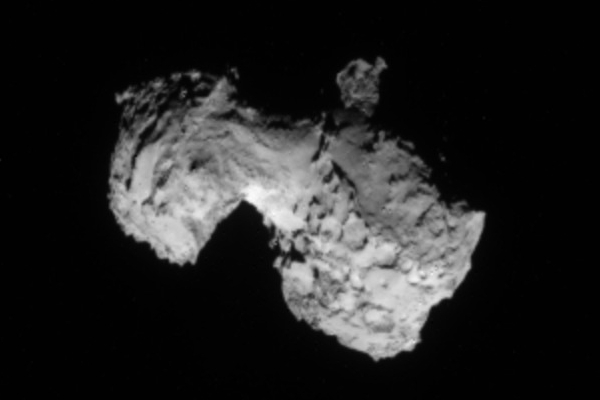
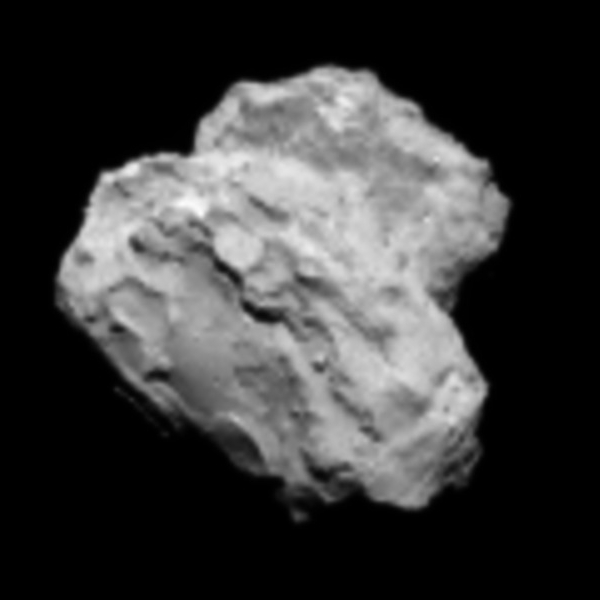
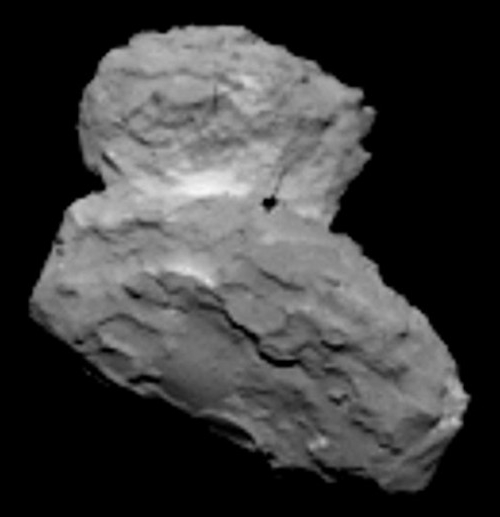
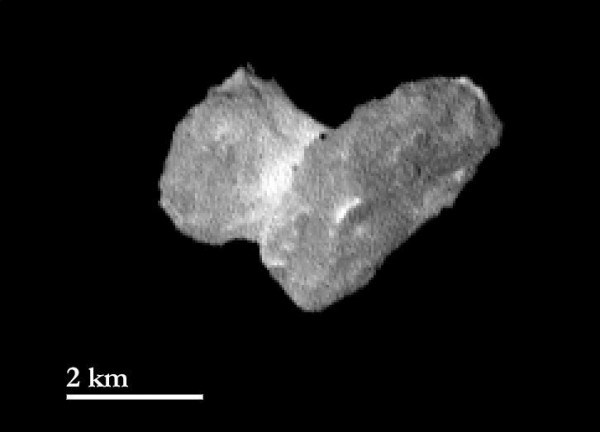
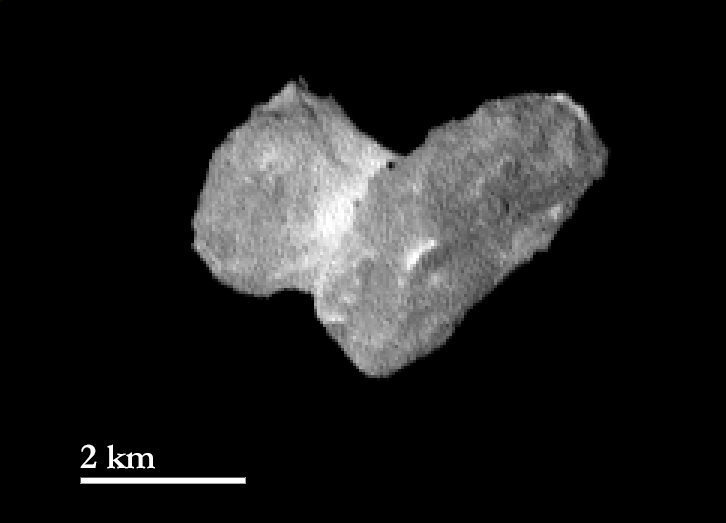
Rosetta snaps more comet pictures

rotating comet nucleus

Rosetta’s new images of Comet 67P/Churyumov-Gerasimenko show the very irregular shape and rotation of its nucleus.

These images were taken on July 4 from a distance of only 23,000 miles. The rendezvous is expected in early August, with the touchdown of Rosetta’s landing probe Philae sometime in November after they have done a reconnaissance of the nucleus to pick a landing spot.

0 comments

ISEE-3 effort aborted?

The engineers trying to resurrect ISEE-3 think their engine burn yesterday ended prematurely because the spacecraft’s supply of nitrogen needed for such a burn has been depleted.

They have still not given up hope, but it sounds like it is increasingly unlikely that they will be able to shift the spacecraft’s orbit as needed.

3 comments

Mapping the inside of Mt St. Helens

A new array of seismometers, combined with a series of planned explosions, will be used to map the interior of the Mt. St. Helens volcano to a depth of eighty kilometers or fifty miles.

To get the job done, starting next week roughly 65 people will fan out across the mountain to deploy 3,500 small seismometers along roads and back-country trails. They will drill 24 holes some 25 metres deep, drop in industrial explosives used for quarrying, and refill the holes (see ‘Under the dome’). The plan is to detonate the explosives in separate shots over four nights. Each blast will shake the ground as much as a magnitude-2 earthquake.

Results from the active blasts will be combined with the passive seismic part of the experiment, which is already under way: 70 larger seis­mometers around the mountain are measuring how long waves from natural earthquakes take to travel through the ground. Their data can be used to probe as far as 80 kilo­metres down, says Vidale.

3 comments

ISEE-3 engine burn

The major course correction burn for ISEE-3 was only partially successful today.

We managed to conduct the first segment (composed of 63 thruster pulses) but encountered problems with the second and halted the remainder of segment firings. Today’s burn was supposed to be 7.32987 m/s. We’re looking at data and formulating a plan for tomorrow. Our window tomorrow (Wednesday) at Arecibo opens at 12:39 pm EDT and extends to 3:26 pm EDT.

6 comments

A source for the most powerful cosmic rays?

Astronomers think they have discovered a region in the sky, within or near the Milky Way, which might be the source of the most energetic cosmic rays

Nobody knows how ultra–high-energy cosmic rays—mainly protons or heavier atomic nuclei—acquire energies millions of times higher than have been achieved with humanmade particle accelerators. (Physicists dubbed one of the first ones observed the “Oh-My-God particle.”) Lower energy cosmic rays are thought to spring from the lingering remnants of stellar explosions called supernovas. But such clouds are far too small to produce the highest energy cosmic rays. Instead, theorists generally expect that the most energetic cosmic rays rev up over millions of years in unidentified accelerators the size of galaxies.

The Telescope Array aims to help solve that mystery. When a high-energy cosmic array strikes the atmosphere, it disappears in an avalanche of lower energy particles. Those particles trigger the detectors in the array, enabling researchers to deduce the direction and energy of the original cosmic ray. From 2008 to 2013, researchers spotted 72 cosmic rays with energies above 57 exaelectron volts—15 million times the highest energy achieved with a particle accelerator. And 19 of them appear to cluster in a hotspot in the sky about 20° in radius, as Hiroyuki Sagawa, a co-representative for the Telescope Array team from the University of Tokyo, reported today in a press conference at the university. [emphasis mine]

The low number of detections, 19 out of 72 total, that seem to come from this wide 20 degree region, suggests that this report falls most certainly under the heading of “the uncertainty of science.” I would not be surprised at all if this conclusion does not stand up after further research.

Nonetheless, the article is worth reading because it outlines nicely this astronomical mystery. Something out there accelerates these particles to these high energies, and astronomers do not yet know what that something is.

0 comments

ISEE-3 engine burn tomorrow

The private effort to resurrect the 1970’s sun-observing space probe ISEE-3’s will attempt its first full engine burn on July 8.

They hope to get the spacecraft back into one of the Earth-Sun Lagrangian points where it can be controlled reliably from Earth and can thus resume its study the solar wind, as originally designed. They have most of July to make the burn that will shift the orbit appropriately, so if this first attempt fails they can still make it happen.

3 comments

Problems with the European Gaia space telescope

Shades of Hubble: The first data from Europe’s Gaia space telescope, launched to map a billion Milky Way stars, will be delayed 9 months while engineers grapple with several problems.

Gaia managers started taking test images early this year, but soon noticed three issues. For one, more light than anticipated is bending around the 10-metre sunshield and entering the telescope.

Small amounts of water trapped in the spacecraft before launch are being released now that the telescope is in the vacuum of space, and more ice than calculated is accumulating on the telescope’s mirrors. In addition, the telescope itself is expanding and contracting by a few dozen nanometres more than expected because of thermal variations.

Mission managers say the number of stars detected will remain the same even if these complications remain untreated, but the accuracy in measurements of the fainter stars will suffer.

Unlike Hubble, however, there is no way to send a shuttle and a team of astronauts to Gaia to fix it. And it sounds like these issues will have an impact on the telescope’s abilities to gather its intended data.

This story raises my hackles for another reason. Gaia was a very technically challenging space telescope to build, but it was far easier and less cutting edge than the James Webb Space Telescope. It also cost far less. What will happen when Webb gets launched later this decade? How likely is it to have similar issues? Based on a story I just completed for Sky & Telescope on the difficulties of building ground-based telescopes, I’d say Webb is very likely to have similar problems, with no way to fix them. The American astronomy community could then be faced with the loss of two decades of research because they had put all the eggs into Webb’s basket, and thus had no money to build anything else.

15 comments
1 304 305 306 307 308 438