
A new study has found that the trends of stream temperatures have no correlation with climate trends.
The uncertainty of science: A new study has found that the trends of stream temperatures have no correlation with climate trends.
The uncertainty of science: A new study has found that the trends of stream temperatures have no correlation with climate trends.
A microscopic algae-eater that lives in a Norway lake has now been identified as one of the Earth’s oldest living organisms.
The elusive, single-cell creature evolved about a billion years ago and did not fit in any of the known categories of living organisms – it was not an animal, plant, parasite, fungus or alga, they say.
Another new breathtaking Hubble image of the Egg Nebula.
The image combines data taken in both optical and infrared wavelengths.
Coiling lava found on Mars.
Three new Earthlike exoplanets, orbiting M dwarf stars in the habitable zone, have been identified by astronomers using Kepler data.
Duck! New data suggests that the giant ancient asteroid barrage during the early solar system may have lasted much longer than previously thought.
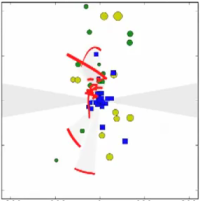
A new study by astronomers has found a vast structure of satellite galaxies and star clusters aligned perpendicular to the Milky Way and extending outward above and below the galaxy’s nucleus by as much as a million light years.
In their effort to understand exactly what surrounds our Galaxy, the scientists used a range of sources from twentieth century photographic plates to images from the robotic telescope of the Sloan Deep Sky Survey. Using all these data they assembled a picture that includes bright ‘classical’ satellite galaxies, more recently detected fainter satellites and the younger globular clusters.
“Once we had completed our analysis, a new picture of our cosmic neighbourhood emerged”, says Pawlowski. The astronomers found that all the different objects are distributed in a plane at right angles to the galactic disk. The newly-discovered structure is huge, extending from as close as 33,000 light years to as far away as one million light years from the centre of the Galaxy.
An animation illustrating this galactic distribution is posted below the fold. You can read the actual preprint paper here.
The problem with this polar alignment with the Milky Way’s core is that the theories for explaining the distribution of dark matter do not predict it.
» Read more
Cryosat has released its first seasonal variation map, tracking the growth of the Arctic icecap for the winter of 2010-2011.
The video at the link is quite interesting to watch. Note however that the press information says nothing about whether the icecap was larger or smaller than expected, something that probably is not surprising. It will probably take decades of further work to get the true context of these results.
Wrong again: The Great Lakes are not drying up, as predicted by global warming advocates.
The global warming advocate who invented the concept of “Gaia” now admits he was wrong about global warming.
“The problem is we don’t know what the climate is doing. We thought we knew 20 years ago. That led to some alarmist books – mine included – because it looked clear-cut, but it hasn’t happened,” Lovelock said. “The climate is doing its usual tricks. There’s nothing much really happening yet. We were supposed to be halfway toward a frying world now,” he said.
“The world has not warmed up very much since the millennium. Twelve years is a reasonable time… it (the temperature) has stayed almost constant, whereas it should have been rising — carbon dioxide is rising, no question about that,” he added.
Scientists studying Cassini images have spotted the trails of objects as they punch through one of Saturn’s rings.
Good news: Data now suggests that the bats are showing signs of recovery in the first caves hit by white nose syndrome in New York. More here. Plus here’s a link describing some of the research being done on this subject.
Note that the death toll listed in these stories is nothing more than an arbitrary exaggeration by government officials. The National Speleological Society estimates that the numbers are probably far less, and based on my own caving experience, I agree.
Mexico has passed its own very strict climate change law.
The new law contains many sweeping provisions to mitigate climate change, including a mandate to reduce emissions of carbon dioxide by 30% below business-as-usual levels by 2020, and by 50% below 2000 levels by 2050. Furthermore, it stipulates that 35% of the country’s energy should come from renewable sources by 2024, and requires mandatory emissions reporting by the country’s largest polluters.
Some predictions:
» Read more
The uncertainty of science: New data from a neutrino telescope in Antarctica has found that cosmic rays don’t come from gamma ray bursts, as had been believed by astronomers. You can read the paper here. [pdf]
Which means that astronomers at this moment have no idea what produces these high energy cosmic rays.
Dawn’s mission at Vesta has been extended for forty days, while still allowing the spacecraft to reach Ceres as scheduled.
“Our spaceships to fly from here to Abu Dhabi to New Mexico in no more than an hour.”
The suggestion from this story is that not only will Virgin Galactic fly suborbital tourism flights out of Abu Dhabi, but the deal includes an effort to turn SpaceShipTwo into a transportation vehicle as well. Most interesting.
Caving for science! A bacteria, naturally resistant to all antibiotics, has been found in Lechuguilla Cave in New Mexico.
The uncertainty of science: A new study has found no evidence of dark matter within 13,000 light years of the Sun, something that had not been expected.
According to widely accepted theories, the solar neighborhood was expected to be filled with dark matter, a mysterious invisible substance that can only be detected indirectly by the gravitational force it exerts. But a new study by a team of astronomers in Chile has found that these theories just do not fit the observational facts. This may mean that attempts to directly detect dark matter particles on Earth are unlikely to be successful.
These findings will be as controversial as the now abandoned faster-than-light neutrino results last fall. Here, however, the new data is likely going to be more robust, which will cause the entire astrophysical community some real conniptions.
» Read more
You can’t make this stuff up: A mathematical journal has retracted a paper because “the article contains no scientific content.”