NASA: Perseverance observed the first visible-light aurora in March 2024

According to a NASA/JPL press release today, Perseverance successfully observed the first visible-light aurora on another world when in March 2024 it photographed a faint aurora overhead, caused by a strong solar flare.

The images at the link are quite unexciting, so much so that I don’t see a reason to include it here. The aurora observed is barely noticeable. Moreover, this is not really a new discovery. Previous observations in the ultraviolet had determined that Mars does have a weak aurora. That in rare circumstances a strong solar event can have it also appear in visible wavelengths is hardly news.

Normally I would have considered this story unimportant enough to list merely as a quick link at the end of the day, but I post it now because of how the mainstream propaganda press has latched onto it as if it is a big deal. The New York Times, the Washington Post, and the Associated Press all posted stories, giving it far more play than it deserves.

My impression from all these articles is that their reporters know almost nothing about Mars and the research that is going on there, and were easily bamboozled by the press people at NASA and JPL to report this relatively minor story loudly. They no longer have anyone who covers science and space on a regular basis and thus understand the larger context, so therefore their coverage is often shaped entirely by the public relations departments at NASA.

More proof that in today’s internet world, if you want good information the last place you should go is the old dinosaur press.

5 comments

Engineers reactivate thrusters on Voyager-1 that have been out of commission since 2004

The Voyager missions
The routes the Voyager spacecraft have
taken since launch. Not to scale.

Because of an anticipated pause in communications due to upgrade work on the antennas of NASA’s Deep Space Network — used to communicate with interplanetary missions — the engineers operating the two Voyager spacecraft that are now in interstellar space after almost a half century of travel have improvised a repair that reactivated thrusters on Voyager-1 that were deemed inoperable in 2004.

Since then the spacecraft had been dependent solely on its backup thrusters. The engineers wanted the spacecraft to have two sets of thrusters again in case something went wrong during that pause in communications, running from May 2025 to February 2026.

The repair required getting two heaters switched back on, and carried with it the risk of an explosion that would destroy Voyager-1. The command to reactivate the heaters was sent on March 20, 2025, and two days later (after the command traveled at the speed of light for 23 hours to reach Voyager-1 and then 23 hours to return) the spacecraft signaled that all was well and that the heaters and thrusters were now working again.

Both Voyagers are expected to run out of power sometime in the next two years. The goal now is try to make both last at least until 2027, so that they will mark a full half century of operation since their launch in 1977.

7 comments

Astronomers observe cloud changes above the northern polar lakes of Titan

Changes seen in Titan's atmosphere
Click for full resolution image.

Using data from both ground- and space-based telescopes, astronomers have now observed clouds rising in the thick atmosphere of the Saturn moon Titan.

The team observed Titan in November 2022 and July 2023 using both Keck Observatory and the James Webb Space Telescope. Those observations not only showed clouds in the mid and high northern latitudes on Titan — the hemisphere where it is currently summer — but also showed those clouds apparently rising to higher altitudes over time. While previous studies have observed cloud convection at southern latitudes, this is the first time evidence for such convection has been seen in the north. This is significant because most of Titan’s lakes and seas are located in its northern hemisphere and evaporation from lakes is a major potential methane source. Their total area is similar to that of the Great Lakes in North America.

The image to the right shows these methane clouds, indicated by the arrows, as seen by Webb on July 11, 2023 and then three days later by Keck. The clouds appear to have shifted downward during these observations.

The data suggests we are seeing one small aspect of Titan’s atmospheric methane cycle, where the liquid methane in the lakes evaporates to form clouds, which later than condense to rain back down. Though superficially similar to the water cycle here on Earth, the details suggest it will be very different on Titan.

0 comments

The global distribution of dust devils on Mars

Global map of dust devils on Mars
Click for original image.

Scientists reviewing the dust devil tracks in orbital images produced by Mars Reconnaissance Orbiter (MRO) have now created a global map that also provides insight into the ground conditions that cause the dust devils to form. From the abstract:

In the first global study of these tracks using high-resolution satellite images from 2014 to 2018, we find tracks in 4% of the images, mostly near 60° north and south latitudes. These tracks are more common during local summers, especially in the southern hemisphere, coinciding with the peak of Mars’ dust storm season, when active dust devils are also more common. Surprisingly, dust devil track (DDT) formation does not depend on elevation, indicating it is not related to the ambient atmospheric pressure. Instead, they occur in darker areas where surface dust covers coarser material, which is revealed as the dust devil moves past.

The white dots on the map above, figure 5 of the paper, shows those MRO images where dust devil tracks were seen. The redish-orange regions are where the data suggests more dust devils should occur, while the blue areas of regions of few dust devils.

The map also notes the locations where Spirit, Opportunity, and InSight landed. Opportunity clearly landed in a region that had more dust devil activity, which explains why its solar panels were cleaned off so regularly by wind. Spirit did not land in such a region, but somehow it was lucky in getting wind events that cleared its panels of dust. InSight had no such luck, and having landed in a region with little dust devil activity, its panels steadily became covered with dust, eventually forcing the end of the mission.

As the paper notes, “To maximize mission lifetimes, future solar powered assets should favor regions where we have identified numerous [dust devil tracks] and where many active [dust devils] are present.” This proposal makes sense, for many reasons. For one, it shifts missions to higher latitudes where many glacial and near-surface ice features are found. Up until now the science community has sent all the landers and rovers to the Martian dry tropics, which has no such near surface ice. For future colonies it is imperative we begin studying Mars’ wetter regions.

This study provides another practical reason for doing so.

3 comments

Scientists: Martian gullies formed by CO2 frost, not water flows

Frost on Martian hillside
Dry ice frost on Martian cliffs. From a 2020 post.
Click for full image.

A new analysis of the gullies found on cliffs on Mars, usually on the interior rims of craters, has concluded that carbon dioxide frost is the cause of the erosion, not ancient flows of water.

This conclusion eliminates the need for liquid flowing water in the Martian past, at least in conjunction with gullies. From the paper’s conclusion:

These results show that CO2 frost is capable of producing Martian gully morphologies. Since flows powered by this process are known to be ongoing and capable of transporting the necessary volume of material, it is the simplest explanation for their formation. Variations in the frequency and fluidity of flows could have occurred over time due to variations in the CO2 cycle. CO2-driven gully formation would indicate that there was not necessarily regular, recurring meltwater during high-obliquity periods. This removes a constraint on recent climate, and also addresses a paradox: if obliquity regularly exceeds the current value as generally thought, and if gullies formed via snow melting at high obliquity, the Late Amazonian Epoch should have included regular snowmelt and widespread aqueous processes. Gully formation by CO2 frost processes is consistent with a cold-desert Late Amazonian with rare or small amounts of liquid water and little aqueous weathering, consistent with the observed mineralogy.

…Gullies, one of the most-discussed lines of evidence for liquid water on Mars, may in fact have no direct connection to H2O. CO2 frost-fluidized gully formation also has broader implications for geomorphology, widening an emerging field of new landform types and processes without Earth analogs. Similar processes could occur on other worlds with erodible substrates on steep slopes and volatile ices at their frost point, although we currently lack the high-resolution images needed to test this hypothesis. Such ices include N2 on Pluto and Triton, and SO2 on Io. [emphasis mine]

In other words, though the gullies appear at first glance to our Earth eyes to have been caused by water flowing downhill, in fact the data now suggests the annual CO2 frost cycle of Mars is the prime cause, even in the distant past. No surface water was required. And since no one has yet come up with a good model for liquid surface water even existing in the Martian past (the atmosphere being too cold and thin), this conclusion helps eliminate this conflict.

The paper also notes the lack of water likely eliminates the need for any planetary protection efforts at these gullies, as the lack of water makes the likelihood of any microbiology nil.

As these conclusions are based on lab work and analysis of images, there remains great uncertainty. Nonetheless, the results help reinforce the arguments that the geological features we see on Mars were formed not by flowing liquid water but by other processes, such as glaciers of ice.

4 comments

NASA releases thermal image of Mars taken by Europa Clipper

Mars as seen by Europa Clipper in thermal
Click for original image.

NASA yesterday released a thermal image of Mars taken by during Europa Clipper’s March 1, 2025 fly-by of the red planet on its way to Jupiter. From the caption:

This picture of Mars is a composite of several images captured by Europa Clipper’s thermal imager on March 1. Bright regions are relatively warm, with temperatures of about 32 degrees Fahrenheit (0 degrees Celsius). Darker areas are colder. The darkest region at the top is the northern polar cap and is about minus 190 F (minus 125 C).

The press release doesn’t identify the bullseye feature on the left. I think the bright area inside the bullseye might be the shield volcano Syrtis Major, with the dark area to the right Isidis Basin, which means this is also a snapshot of Perseverance, sitting on the basin’s western perimeter. The dark feature on the right edge of the image might be the giant volcano Elysium Mons. These however are total guesses and likely wrong.

The mission team used this fly-by to test the spacecraft’s science instruments, and have so far found all to be working as expected.

Europa Clipper will do one more fly-by of Earth in December 2026, allowing it to reach Jupiter in April 2030.

0 comments

Crash prediction for Venera failed lander now reduced to four hours

Venera reentry prediction
Click for original image.

UPDATE: According to several reports today such as this one, the spacecraft ended up burning up over the Indian Ocean west of Indonesia at 2:24 am (Eastern) on May 10, 2025. It remains unclear whether it can be salvaged in any way.
————————-

The Aerospace Corporation’s prediction for the final uncontrolled re-entry of the Soviet Union’s 1972 failed Venus lander Venera has now been reduced to four hours, centered above the Indian Ocean near Indonesia, as shown on the map to the right, at around 1:29 pm Eastern.

This prediction however has great uncertainty, and will change in the next few hours. However, based on the orbits depicted, there is a good chance the lander will come down over either Europe or Asia.

As it was designed to survive the very thick and very hot atmosphere of Venus, there is also a good chance it will survive its uncontrolled re-entry through Earth’s atmosphere. Since Russia inherited all the assets of the Soviet Union, it will be responsible for any damage the lander does, as per the Outer Space Treaty.

4 comments

Academics in space community scheme to continue their racist DEI policies

USRA logo

A letter sent out yesterday by the Universities Space Research Association (USRA) clearly illustrated the bigoted desire of our modern Marxist academic community to continue its racist Diversity, Equity, and Inclusion (DEI) policies in hiring by hiding or renaming them so that the Trump administration might not notice.

USRA is one of several university consortiums that manage a variety of space, science, and astronomical operations for the government. In USRA’s case, it manages the Lunar Planetary Institute (LPI) for NASA.

The letter purported to announce how the organization was complying with Trump’s executive orders banning such race-based programs, but instead revealed its desire to continue them, but to do so under the table where no one could monitor them.
» Read more

5 comments

Crash prediction for Soviet-era Venus probe narrows

May 9, 2025 morning prediction
Click for original image.

The prediction for when and where a 1972 Soviet-era failed Venus lander will crash back on Earth has now narrowed to an eight hour period on May 10, 2025, centered at 1:54 pm (Eastern).

The map to the right, from the Aerospace Corporation, shows the orbital path of the lander for the Venera lander, covering its last six orbits. Though the center of the prediction would have the lander come down over the Atlantic, that orbit has it crossing parts of South America, all of Europe, much of Asia and India, and Australia.

The lander failed to leave Earth orbit when it was launched in 1972, and has been circling the Earth since. As it was designed to survive the very thick and hot atmosphere of Venus, it is likely to survive re-entry through Earth’s more benign atmosphere.

This prediction will narrow continuously for the rest of the day. I will post an update this evening.

8 comments

Bright material on the high points of a Martian mountain

Bright material on top of a Martian mountain
Click for original image.

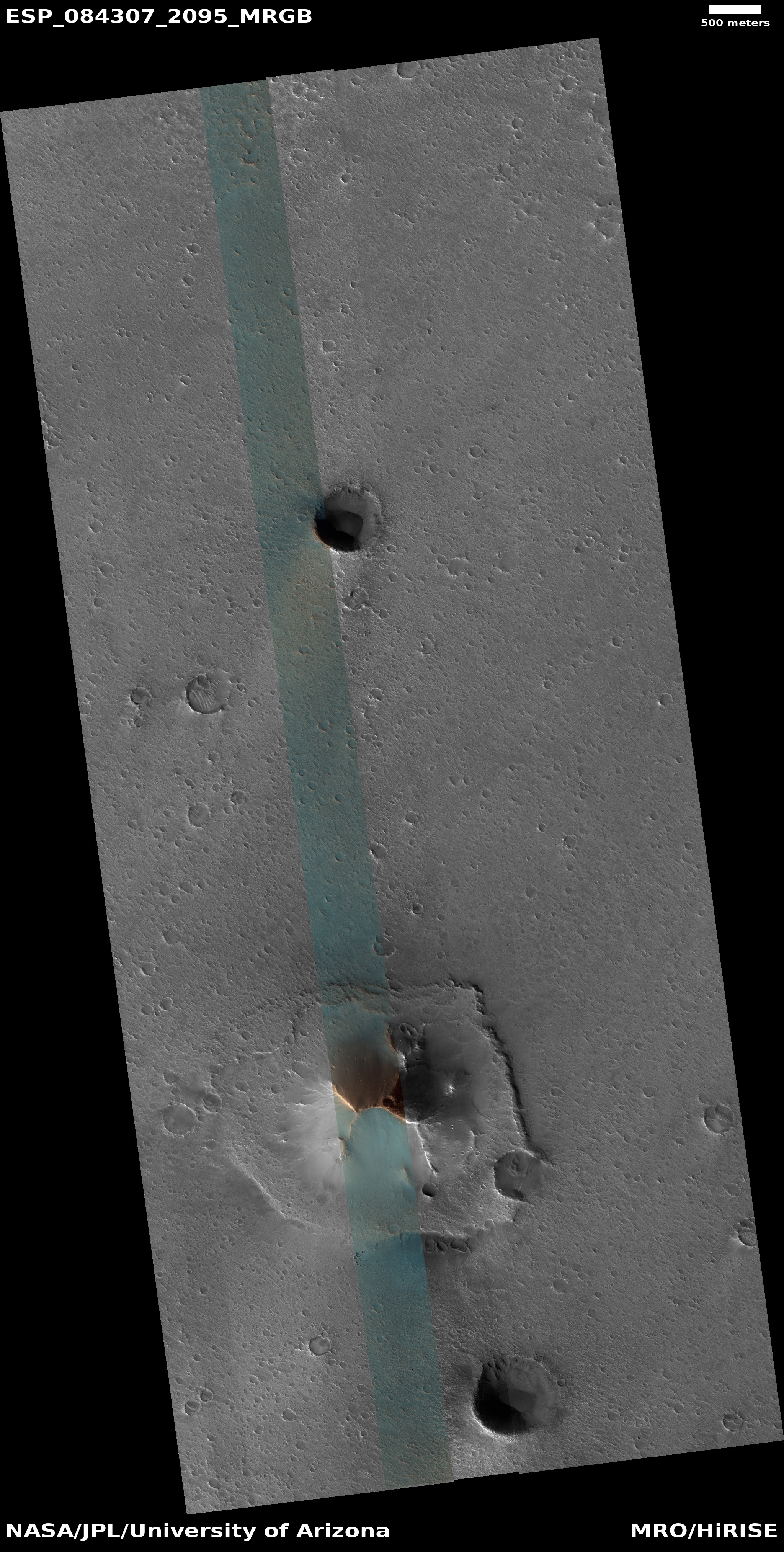
Today’s cool image is mostly an example of the present unknowns of Mars. The picture to the right, cropped, reduced, and sharpened to post here, was taken on April 2, 2025 by the high resolution camera on Mars Reconnaissance Orbiter (MRO).

The science team quite rightly labels this vaguely as “bright materials,” referring to the bright rim of that crater as well as the scattered bright patches on the surrounding plain. This vagueness tells us that the scientists don’t have enough data yet to definitively identify this stuff, though they know it is distinctly unique because of its inexplicable bright albedo compared to everything around it.

That the crater rim (as well as all the crater rims in the full picture) exhibit this same brightness suggests this material was excavated from below when the impacts hit. The surrounding patches suggest that erosion has exposed this buried material at these points.
» Read more

0 comments

Seepage coming from under an ancient Martian flood lava flow?

Seepage at edge of lava flow?
Click for original image.

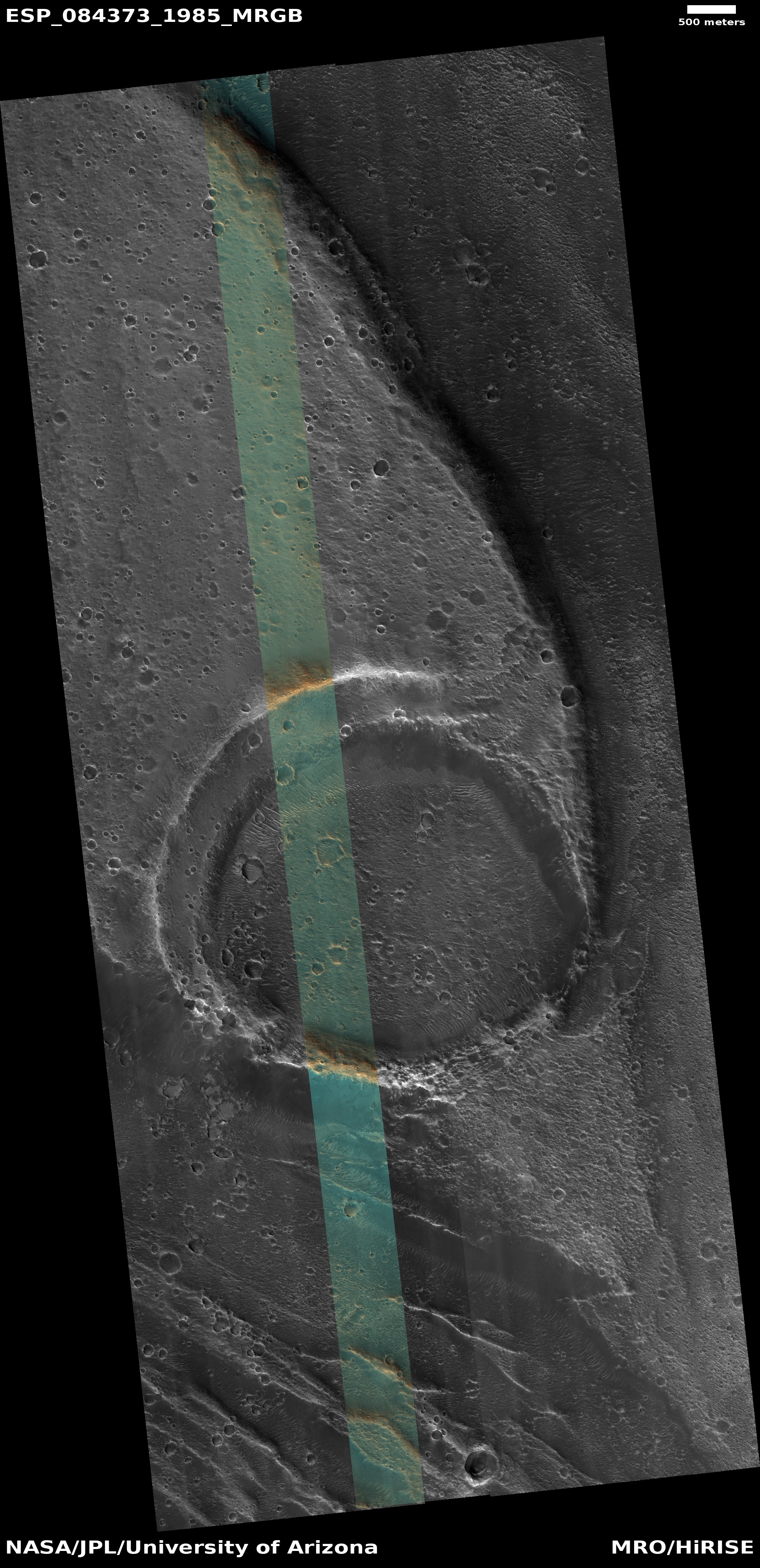
Cool image time! The picture to the right, cropped, reduced, and enhanced to post here, was taken on April 3, 2025 by the high resolution camera on Mars Reconnaissance Orbiter (MRO).

I have enhanced the image to make it easier to see the details. It appears we are looking at three layers. At the base (on the left side of the picture) is a relatively smooth bottom layer with the highest number of scattered craters. On the top (on the right side of the picture) is a somewhat rough layer with fewer craters.

In between is a middle layer that appears to be seeping out from under the top layer.

The science team seems to agree with my last guess, as they label this image “Possible basal seepage at flow boundary.” The flow boundary is the edge of a lava flood that scientists believe covered a distance of about 1,400 miles at speeds ranging from 10 to 45 miles per hour.
» Read more

0 comments

Ispace’s Resilience lander successfully enters lunar orbit

Map of lunar landing sites
Landing sites for both Firefly’s Blue Ghost and
Ispace’s Resilience

Ispace today announced that its lunar lander Resilience, launched in January by SpaceX, has now been successfully inserted into lunar orbit,

Ispace engineers performed the injection maneuver from the Mission Control Center in Nihonbashi, Tokyo, Japan in accordance with the mission operation plan. The orbital maneuver required a main thruster burn lasting approximately 9 minutes, the longest to date during Mission 2. RESILIENCE is now maintaining a stable attitude in its planned orbit above the lunar surface. Mission operations specialists are now preparing for final orbit maneuvers after reaffirming Ispace’s ability to deliver spacecraft and payloads into lunar orbit. A lunar landing is scheduled for no earlier than June 5, 2025 (UTC) (June 6, 2025, JST).

If all goes right, Resilience will touch down in Mare Frigoris in the northern latitudes of the Moon’s near side, as shown on the map to the right.

This is Ispace’s second attempt to soft land on the Moon. Its first attempt, Hakuto-R1, got within three kilometers of the surface in Atlas Crater (also shown on the map), but then its software mistook its altitude, thinking it was only a few feet above the surface and shut down the engines prematurely, causing it to crash.

This second landing is critical for the company’s future. It has contracts for future landers from both NASA and Japan, but a failure now might cause both governments to reconsider those deals.

0 comments
1 36 37 38 39 40 729