The new hockey stick

Steven Hayward at Powerline has noted a new hockey stick graph, produced by scientists and described in detail by the journal Nature. This one is not specifically about climate, but about the reliability of science and the peer-review process itself. To quote the Nature article:

[Retraction] notices [of science papers] are increasing rapidly. In the early 2000s, only about 30 retraction notices appeared annually. This year, the Web of Science is on track to index more than 400 (see ‘Rise of the retractions’) — even though the total number of papers published has risen by only 44% over the past decade.

Below is the graph from the Nature paper. As Hayward says, “Lo and behold, it looks like a hockey stick! (Heh.)”
» Read more

1 comment

Astronomers have found a dozen supernovae taking place closer to the Big Bang than ever detected.

Astronomers have found a dozen supernovae taking place only a few billion years after the Big Bang.

[The results suggest that these types of supernovae] were exploding about five times more frequently 10 billion years ago than they are today. These supernovas are a major source of iron in the universe, the main component of the Earth’s core and an essential ingredient of the blood in our bodies.

0 comments

The sun’s activity goes boom

Today NOAA’s Space Weather Prediction Center released its monthly graph of the Sun’s solar cycle sunspot activity. Posted below, it shows the Sun’s activity finally leaping upward in September, after several months of less than expected performance.

It is interesting to see how the sun’s rising sunspot activity for the past year has followed a consistent fluctuating pattern, whereby a sudden monthly jump in sunspots is then followed by several months of decline. If this pattern repeats itself again, we should expect to see the numbers ease off again in October and November.

Regardless, the higher sunspot counts for September are more in line with past predictions. In fact, the solar scientists at the Marshall Space Flight Center have increased their prediction for the time and intensity for the peak of the sun’s maximum. Last month they had called for a peak in May 2013 with a sunspot number of 70. Now, they are predicting the peak will come in April 2013 with a number of 77. They note however that even this higher number will result in the weakest maximum in more than a hundred years.

September sunspot graph

1 comment

A summary of Messenger’s first six months in orbit around Mercury

A summary of Messenger’s first six months in orbit around Mercury.

Though packed with lots of results, this strikes me as the most interesting discovery so far:

Orbital data reveal that Mercury’s magnetic field is offset far to the north of the planet’s center, by nearly 20% of Mercury’s radius. Relative to the planet’s size, this offset is much more than in any other planet, and accounting for it will pose a challenge to theoretical explanations of the field. . . . This finding has several implications for other aspects of Mercury, says Anderson, who co-authored several of the presentations in the MESSENGER session. “This means that the magnetic field in the southern hemisphere should be a lot weaker than it is in the north. At the north geographic pole, the magnetic field should be about 3.5 times stronger than it is at the south geographic pole.

0 comments

The 2011 Nobel Prize for Physics has been awarded

The 2011 Nobel Prize for Physics has been awarded to the astronomers who discovered dark energy.

Saul Perlmutter from the Lawrence Berkeley National Laboratory and University of California, Berkeley, has been awarded half of this year’s prize for his work on the Supernova Cosmology Project, with the other half awarded to Brian P. Schmidt from the Australian National University and Adam G. Riess from the Johns Hopkins University and Space Telescope Science Institute, Baltimore, for their work on the High-z Supernova Search Team.

0 comments

The strange hollows on the mountain tops of Mercury

hollows on Mercury

Another spectacular planetary science image, this time from Messenger orbiting Mercury. This close-up image of the hollows of Mercury only illustrates their mystery. The insert shows the context of the close-up image. These irregular sinks are here found on the mountain top ridge of an inner crater rim. Also, some but not all of the hollows have bright interiors.

Scientists have proposed that some form of impact melt process caused these hollows. At impact, the ground literally rippled like water when you toss a stone into a pool. Here, however, the molten ripples quickly froze, creating the inner and outer crater rim rings. To my untrained eye, the hollows look like collapse features where the surface hardened first, then collapsed when the molten inner material drained away as it became solid.

Why some hollows are bright, however, is not yet understood.

0 comments

The red cliffs of Mars

Red cliffs on Mars

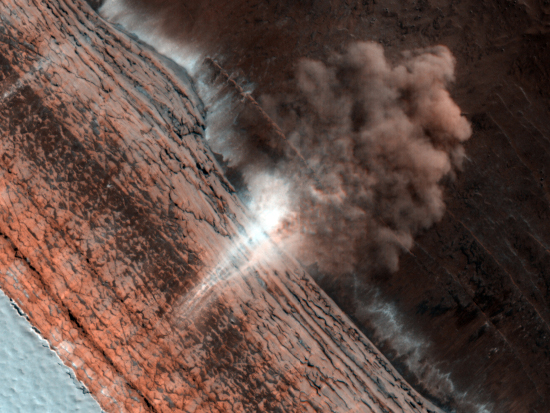
Last week the Mars Reconnaissance Orbiter team released this beautiful image of what they call “layered yardangs” on Mars.

What creates these sharp ridges? This layered terrain has been sculpted by the wind. The aligned ridges are called yardangs, which are formed in areas where the dominant erosional force is the wind. Yardangs are also found on Earth, usually in very dry areas.

What I see are majestic red cliffs rising out of a aqua-colored sand desert. What a place to visit!

0 comments

Scientist proposes that the superluminal neutrinos are merely measuring the true speed of light

On Thursday physicist Susan Gardner of the University of Kentucky proposed in a preprint on the Los Alamos astro-ph website that the neutrinos measured at CERN that appeared to be going faster than light were merely giving us a much more accurate measure of the speed of light.

This is only one of a plethora of papers published this last week on astro-ph discussing and attacking the CERN neutrino results. I expect the scientists will solve this mystery before too long.

0 comments

Arctic ozone loss at record level

The ozone levels over the Arctic this past year were the lowest on record, caused by unusually cold temperatures.

No records for low temperature were set this year, but the air remained at its coldest for an unusually long period of time, and covered an unusually large area. In addition, the polar vortex was stronger than usual. Here, winds circulate around the edge of the Arctic region, somewhat isolating it from the main world weather systems.

“Why [all this] occurred will take years of detailed study,” said Dr. [Michelle] Santee [from NASA’s Jet Propulsion Laboratory]. “It was continuously cold from December through April, and that has never happened before in the Arctic in the instrumental record.”

0 comments
1 382 383 384 385 386 438