Buried peaks in a sea of Martian sand

Buried peaks in a sea of sand
Click for original image.

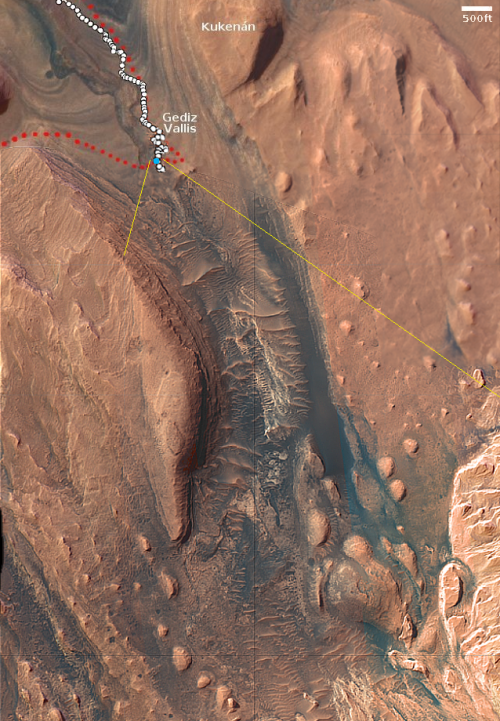
Cool image time! The picture to the right, rotated, cropped, reduced, and sharpened to post here, was taken on April 13, 2024 by the high resolution camera on Mars Reconnaissance Orbiter (MRO). It shows what the MRO science team labels as “streamlined features”, though that doesn’t seem to me to be the best description.

Granted, the prevailing winds, from the northeast to the southwest, appear to pushing the sand dune fields to the southwest. The dark line — created recently by a dust devil — indicates the wind direction. The mesas, from 100 to 200 feet high, do not however appear very streamlined. Instead, they simply look like they are poking up through this sea of sand and dunes, with the wind able over time to successfully push that sand uphill a hundred-plus feet into the saddle between the mesas.

The overview map below provides some context and possibly an explanation, though not a very conclusive one.
» Read more

0 comments

More bad journalism, this time about a hypothesized “underground ocean” on Mars

How today's journalists analyze potential stories
How today’s journalists analyze potential stories

Today’s example of modern bad journalism from our dismal mainstream press concerns a paper published yesterday in the journal of the National Academy of Sciences describing the possibility of liquid water in the Martian “mid-crust,” based on InSight seismological data and computer modeling.

I read the paper yesterday and decided that there really wasn’t much there. While the data suggests a lot of liquid water might be saturated within the fractured rocks of this deep underground crustal layer six to twelve miles down, the paper was based on many assumptions and had many uncertainties. It is also not confirmed by other researchers, and remains nothing more than educated speculation at this point.

Not surprisingly, our ignorant mainstream press today has immediately declared the discovery of a vast underground ocean on Mars, ready for the taking and possibly harboring life!
» Read more

12 comments

The strange carbon dioxide ice cap of Mars’ south pole

The strange carbon dioxide cap of Mars
Click for original image.

Cool image time! The picture to the right, cropped to post here, was taken on July 1, 2024 by the high resolution camera on Mars Reconnaissance Orbiter (MRO). The image is labeled simply as a “terrain sample,” which usually means it was taken not as part of any specific research project but to fill a gap in the picture-taking schedule in order to maintain the camera’s proper temperate. When the camera team needs to do this, they try to picture interesting features availabe at that time slot. Sometimes the image is boring. Sometimes it is surprisingly interesting.

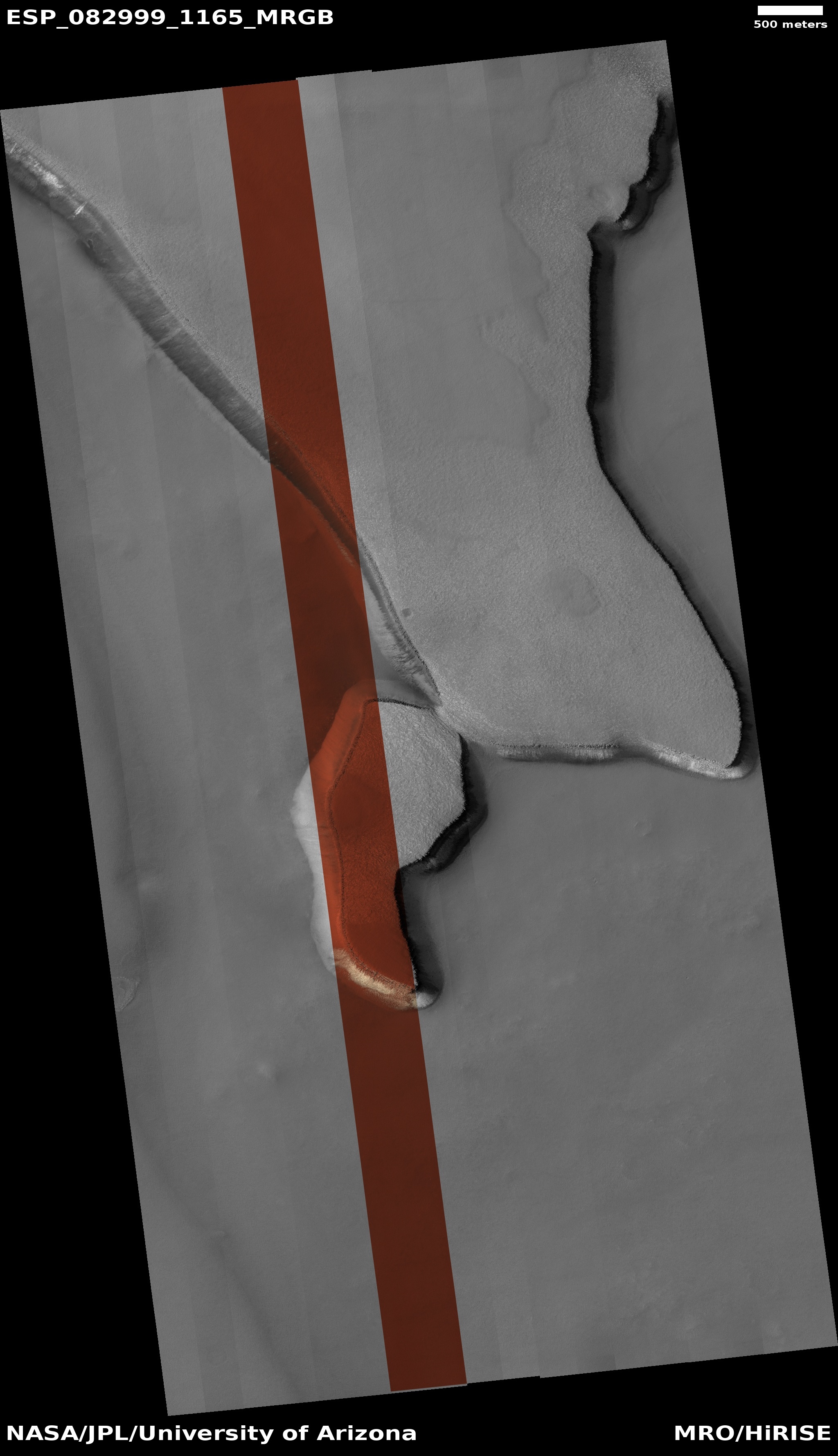
In this case the picture is the latter, and certainly quite alien. The curly parallel dark lines appear to be grooves, and seem to have ripple dunes within them, as if the only dust here got trapped in those low spots. It is also possible that the dunes are frozen and ancient, and are only being revealed as the top layer in each groove goes away.

What could possibly explain what we are looking at? The overview map below gives only a clue.
» Read more

1 comment

A galaxy with a ring

A galaxy with a ring
Click for full image.

Cool image time! The photo to the right, cropped, reduced, and sharpened to post here, was taken by the Hubble Space Telescope, and appears part of a long term survey of nearby ringed galaxies. From the caption:

MCG+07-07-072 has quite an unusual shape, for a spiral galaxy, with thin arms emerging from the ends of its barred core to draw a near-circle around its disc. It is classified, using a common extension of the basic Hubble scheme, as an SBc(r) galaxy: the c denotes that its two spiral arms are loosely wound, each only performing a half-turn around the galaxy, and the (r) is for the ring-like structure they create. Rings in galaxies come in quite a few forms, from merely uncommon, to rare and astrophysically important!

Lenticular galaxies are a type that sit between elliptical and spiral galaxies. They feature a large disc, unlike an elliptical galaxy, but lack any spiral arms. Lenticular means lens-shaped, and these galaxies often feature ring-like shapes in their discs. Meanwhile, the classification of “ring galaxy” is reserved for peculiar galaxies with a round ring of gas and star formation, much like spiral arms look, but completely disconnected from the galactic nucleus – or even without any visible nucleus! They’re thought to be formed in galactic collisions.

This galaxy is about 320 million light years away, and is also known as Abell 426. Though astronomers think that these various shapes of galaxies, from barred to lenticular to ringed, are formed from a variety of galactic collusions and interactions with each galaxy’s nucleus, that remains nothing more than an educated guess. The complexity of galaxy evolution, involving billions of years and millions of stars, is barely in its infancy, and requires a lot of assumptions because our observations only involves a mere nanosecond in that grand history.

2 comments

Are these Martian terraced mesas or pits?

Are these Martian pits or mesas?
Click for original image.

Cool image time! The picture to the right, cropped, reduced, and enhanced to post here, was taken on July 2, 2024 by the high resolution camera on Mars Reconnaissance Orbiter (MRO). I have purposely enhanced the contrast to bring out the strangely shaped and terraced features.

What I cannot figure out from any data available to me is whether these terraced features are mesas rising up, or pits descending down. The resolution in the global mosiac of Mars created both from MRO’s context camera and its elevation data is simply not good enough. It suggests these are pits, but the sunlight is coming from the west, which based on the shadows suggest these could be pits or mesas.

In fact, the dark lines that appear to distinguish the terraces might not be shadows at all, but simply darker material that contrasts with the lighter material on each side.
» Read more

4 comments

Crazily eroded rock on Mars

Overview map
Click for interactive map.

A crazily eroded rock in Jezero crater
Click for original image.

Cool image time! The picture to the right, cropped, reduced, and sharpened to post here, was taken today by the Perseverance Mars rover, using its SHERLOC-WATSON close-up camera at the end of its robot arm.

The size of this rock is tiny, no more than a few inches across. The many holes remind me of surface limestone on Earth. When it rains, the water dissolves the limestone, and so holes will develop and grow over time. You can see this process if you spray very hot water on top of a block of ice.

The problem is that it doesn’t rain on Mars. Lava can sometimes freeze and look this way, but is it lava? The blue dot on the overview map above shows where Perseverance was two days earlier. The rover team has not updated that map so it is not known exactly where the rover was when it snapped this picture today. Nor has the science team posted an update on their activities since June 27th.

These strange features however mirror somewhat the same surface features seen back in June, when the rover was on the north side of Neretva Vallis, so it is likely this rock was produced by the same geological processes. I will however not guess what those processes were.

1 comment

WISE/NEOWISE space telescope mission ends after fourteen years

Comet NEOWISE, photographed by the Hubble Space Telescope
Click for full image.

Launched in 2009, the Wide-field Infrared Survey Explorer (WISE) was shut down today after almost fourteen years of successful observations, with its first years dedicated to creating an infrared survey of the sky. In 2013, after two years of hibernation, it was reactivated and renamed NEOWISE (for reasons that I have always found absurd), with the goal over the next thirteen years of mapping the sky for near Earth objects.

By repeatedly observing the sky from low Earth orbit, NEOWISE created all-sky maps featuring 1.45 million infrared measurements of more than 44,000 solar system objects. Of the 3,000-plus near-Earth objects it detected, 215 were first spotted by NEOWISE. The mission also discovered 25 new comets, including the famed comet C/2020 F3 NEOWISE that streaked across the night sky in the summer of 2020.

A Hubble image of that comet is to the right.

The mission was ended because the telescope’s orbit is now too low to provide good data. It is expected to re-enter the atmosphere and burn up before the end of the year.

2 comments

Scientists propose much more efficient method for warming Mars to habitable temperatures

Global map of ice scarps on Mars
Global map of known exposed scarps of ice on Mars. North and south of the
white hatched lines, near surface ice and glaciers are common.

Scientists have now proposed much more efficient method for warming the climate of the planet Mars by as much 50 degrees Fahrenheit, enough to melt much of the near-surface ice in the middle latitudes and thus make the planet habitable.

This new method, using engineered dust particles released to the atmosphere, could potentially warm the Red Planet by more than 50 degrees Fahrenheit, to temperatures suitable for microbial life—a crucial first step towards making Mars habitable.

The proposed method is over 5,000 times more efficient than previous schemes to globally warm Mars, representing a significant leap forward in our ability to modify the Martian environment. What sets this approach apart is its use of resources readily available on Mars, making it far more feasible than earlier proposals that relied on importing materials from Earth or mining rare Martian resources.

You can read the paper here. From the abstract:
» Read more

19 comments

Gaia space telescope identifies more than 350 asteroids with candidate moons

Using the Gaia space telescope, astronomers have identified 352 asteroids that the data suggests have smaller satellite asteroids in orbit around them.

In its data release 3, Gaia precisely pinpointed the positions and motions of 150 000+ asteroids — so precisely that scientists could dig deeper and hunt for asteroids displaying the characteristic ‘wobble’ caused by the tug of an orbiting companion (the same mechanism as displayed here for a binary star). Gaia also gathered data on asteroid chemistry, compiling the largest ever collection of asteroid ‘reflectance spectra’ (light curves that reveal an object’s colour and composition).

These results need to be confirmed by direct observation, as this method does involve some assumptions and uncertainties. If these numbers are confirmed however it will give planetary scientists a better census on the percentage of asteroids with moons, which in turn can be used to create better models of the formation of the solar system as well as the evolution of asteroids over time. At the moment scientists predict about one out of every six asteroids will have a moon. This data suggests that number might be high.

0 comments

Another “what the heck?” image from Mars

What the heck is this?
Click for original image.

Cool image time! The picture to the right, cropped, reduced, and sharpened to post here, was taken on April 14, 2024 by the high resolution camera on Mars Reconnaissance Orbiter (MRO), and shows what the scientists simply label as “exposed crater floor materials.”

I label it as another one of my “what the heck?” images, showing features that in some ways defy understanding or explanation. The picture shows a small area of the floor of an unnamed 14-mile-wide crater, with its rim indicated. Though clearly visible in orbital photos, the crater is nonetheless heavily eroded and even appears partly buried, possibly by flood lava.

The complex floor features however are not anything usually seen in flood lava terrains. The terrain colored blue in the color strip likely indicates coarse material like sand or rocks or rough bedrock, while the reddish terrain suggests the surface is heavily coated with dust.
» Read more

3 comments

A supernova overpowers a spiral galaxy

A supernova overwhelms a small galaxy

Cool image time! The picture to the right, cropped, reduced, and sharpened to post here, was taken in early 2023 by the Hubble Space Telescope because a ground-based automated sky survey had detected a new supernovae in late 2022 in this galaxy. The spiral galaxy is dubbed LEDA 857074, and is interesting because of its bright central bar and dim and broken spiral arms.

That supernova is the bright spot inside the galaxy’s central bar. It is so bright that it almost looks like someone accidently pasted a white dot there using a graphics program. From the caption:

Astronomers have catalogued millions of galaxies, so while today tens of thousands of supernovae are detected annually, the chance that one is spotted in any particular galaxy is slim. We also do not know how actively LEDA 857074 is forming stars, and therefore how often it might host a supernova. This galaxy is therefore an unlikely and lucky target of Hubble, thanks to this supernova shining a spotlight on it! It now joins the ranks of many more famous celestial objects, with its own Hubble image.

The galaxy itself had been studied by almost no one until this supernova was discovered in it.

1 comment

Sunspot update: In July the Sun produced the most sunspots in almost a quarter century

Every month since this website began fourteen years ago, when NOAA posts its update of its monthly graph tracking the number of sunspots on the Sun’s Earth-facing hemisphere, I post my own analysis, adding some details to provide the larger context.

Of all those updates — numbering about 168 — this month’s is possibly the most significant. Since around 2008, the Sun began a long period where it was unusually quiet, with the solar maximum that occurred in 2014 possibly the weakest in two hundred years. Before that weak maximum begun, half the solar science community predicted it would be a very powerful maximum, while half predicted a weak maximum. Both got it wrong, though the weak prediction was closer though still too high.

When it came time to predict the next solar maximum, expected around 2025, that same solar science community was once again in disagreement. Most approved a NOAA science panel prediction in April 2020 calling for another weak minimum, similar to the one in 2014. A few dissented, however, and instead predicted in June 2020 that the maximum would be one of the strongest ever. In April 2023 however those dissenters chickened out, and revised their prediction downward, still forecasting a peak higher than the NOAA prediction but no longer anywhere as intense.

Based on what happened on the Sun in July, they should have had more faith in their earlier prediction.
» Read more

9 comments

A frozen bubbly caldron on Mars

A frozen bubbly caldron on Mars
Click for original image.

Cool image time! The picture to the right, rotated, cropped, reduced, and sharpened to post here, was taken on April 11, 2024 by the high resolution camera on Mars Reconnaissance Orbiter (MRO). It shows a nice collection of what the scientists label “irregular ring structures,” interspersed with clusters of small mesas ranging in heights from 13 to 75 feet.

The location is at 27 degrees north latitude, so the presence of near surface ice, which might explain these strange rings, is less likely though not impossible. The stipled nature of the flat ground suggests that near surface ice might be here, resulting in sublimation of that ice and leaving behind a flat but rough surface.

The location however suggests another possibility, which though vastly different in some ways, is almost identical in others.
» Read more

1 comment

Chinese scientists discover thin-layered graphene in Chang’e-5 lunar samples

Chinese scientists analyzing one of the lunar samples brought back in 2021 by Chang’e-5 from the Moon’s near side have detected for the first time what they call “natural few-layered graphene.”

You can read the paper here. The samples from Chang’e-5 came from some of what are believed are some of the youngest lava on the Moon. This discovery confirms that conclusion. From the paper:

The identification of graphene in the core–shell structure suggests a bottom-up synthesis process rather than exfoliation, which generally involves a high-temperature catalytic reaction. Therefore, a formation mechanism of few-layer graphene and graphitic carbon is proposed here.

Volcanic eruption, a typical high-temperature process, occurred on the Moon. Lunar soil can be stirred up by solar wind and high-temperature plasma discharge can be generated on the Moon’s surface. … [T]he Fe-bearing mineral particles, such as olivine and pyroxene, in lunar soil might catalyse the conversion of carbon-containing gas molecules in the solar wind or polycyclic aromatic hydrocarbons into graphitic carbon of different thicknesses and morphologies on their surfaces, including few-layer graphene flakes and carbon shells.

These graphene flakes are likely to disappear over time, so its existence reinforces the belief that this lava is young.

Unlike too many American planetary scientists recently — who have repeatedly implied that finding anything even remotely related to life processes suggests the possibility of life on Venus and Mars — the Chinese scientists don’t make the additional absurd claim that finding carbon on the Moon suggests the existence of life. It doesn’t. Kudos to them for being good scientists.

As a result, expect American mainstream media to pay no attention to this result, despite its intriguing and unprecedented nature.

0 comments

Inspector General: Roman Space Telescope is meeting the budget overruns and schedule delays NASA predicted

According to the twisted language in a new NASA inspector general report [pdf] describing the present status of the Roman Space Telescope, the project is on schedule and on budget because NASA decided to predict ahead of time how much it would behind schedule and over budget at this moment. From its executive summary:

[A]s of March 2024, Roman was meeting its cost obligations and schedule to launch by May 2027. Roman was on track to launch despite encountering contractor performance issues and cost overruns related to hardware anomalies, under scoping of work, and inadequate oversight of subcontractors. Roman remains on schedule because Science Mission Directorate officials conducted a replan in May 2021 to mitigate the expected cost and schedule growth caused by COVID-19, increasing the life-cycle cost estimate from $3.9 billion to $4.3 billion. This replan also included delaying the launch readiness date from October 2026 to May 2027. As of March 2024, Roman was tracking its project reserves and potential delays with L3Harris as its top risks. Roman has been using its project reserves to mitigate cost growth related to L3Harris’s performance challenges. Despite these contract value increases, Roman is still within its life-cycle cost estimate because the project’s reserves cover these extra costs.

The insulting nature of this inspector general report is astonishing. The administrative state really does think the American public is too stupid to notice this. I wonder if they are right.

The report further notes issues with the telescope’s two subcontractors, BAE Systems and L3Harris, as well as warning of insufficient ground-based antenna capacity for downloading the data that Roman will produce.

[A]s of April 2024, the NSN [Near Space Network] did not have adequate capacity to support Roman’s mission requirements without planned upgrades to the White Sands antenna and lacked the funding to implement the necessary upgrades by the mission’s launch readiness date.

In other words, more money will be needed to build more ground antennas, something that NASA conveniently forgot to mention when it first proposed Roman to Congress. How interesting, but completely par for the course.

Hat tip stringer Jay.

3 comments

Research from DART impact mission determines approximate ages of the asteroid Didymos and its moon Dimorphos

Computer simulation of formation of Dimorphos
Click for full animation

A release this week of new research papers based on data obtained during the impact mission of DART on the asteroid Dimorphos in 2022 has determined the approximate ages of both Dimorphos and the larger asteroid Didumos that it orbits.

Analysis suggested that both Didymos and Dimorphos have weak surface characteristics, which led the team to posit that Didymos has a surface age 40–130 times older than Dimorphos, with the former estimated to be 12.5 million years and the latter less than 300,000 years old.

This research also did a computer simulation that suggests Dimorphos was formed because of Didymos’ fast rotation rate, the fastest asteroid rotation rate so far measured. The spin caused first the development of a ridge on the equator of Didymos, which later literally threw material into space which later coalesced to form the satellite Dimorphus. The graphic to the right is from that simulation.

Other research studied the boulder distribution of Dimorphos, and structural nature of both asteroids.

A European mission, Hera, is scheduled to launch in October 2024 and rendezvous with Didymos and Dimorphos in 2026, obtaining close-up data following the DART 2022 impact.

0 comments

Meandering Martian ridges flowing down from crater rim

Meandering Martian ridges
Click for original image.

Cool image time! The picture to the right, rotated, cropped, reduced, and enhanced to post here, was taken on February 9, 2024 by the high resolution camera on Mars Reconnaissance Orbiter (MRO). It shows a good example of the typically rough region inside the southern cratered highlands of Mars.

Note the ripple dunes that fill the low areas. The volcanic ash from Mars’ past volcanic history has become trapped here, with those ripple dunes suggesting the direction of the prevailing winds to the southeast.

The bright areas also suggest there is interesting mineralogy just below the surface. The 100-foot-high mesa near the picture’s top suggests a lot of erosion has occurred here, with its top suggesting the elevation of the surface a long time ago.

The most interesting feature however is the meandering ridge that starts at the lower right and weaves to the upper left.
» Read more

3 comments

Perseverance finds intriguing geology, and the press goes crazy

Intriguing Martian rock
Click for original image.

A press release from JPL yesterday described an intriguing rock (image to the right) that the Mars rover Perseverance science team has recently been studying, and in doing so repeatedly hinted that its features suggest the possibility of past Martian life. From its first two paragraphs:

A vein-filled rock is catching the eye of the science team of NASA’s Perseverance rover. Nicknamed “Cheyava Falls” by the team, the arrowhead-shaped rock contains fascinating traits that may bear on the question of whether Mars was home to microscopic life in the distant past.

Analysis by instruments aboard the rover indicates the rock possesses qualities that fit the definition of a possible indicator of ancient life. The rock exhibits chemical signatures and structures that could possibly have been formed by life billions of years ago when the area being explored by the rover contained running water. Other explanations for the observed features are being considered by the science team, and future research steps will be required to determine whether ancient life is a valid explanation.

Not surprisingly the press immediately went crazy. Here are just a few headlines:
» Read more

4 comments

Do Kepler’s sunspot drawings tell us the length of the solar cycle in the 17th century?

Kepler's first sunspot drawing
Click for original image.

The uncertainty of science: Scientists have done a new analysis of Johannes Kepler’s three drawings of sunspots on the Sun in 1607, and have concluded that the solar cycle at that time — just before the start of the Maunder grand minimum of no sunspots for decades — was about the same length, 11 years, that has been measured since the 1700s onward.

You can read the peer-reviewed paper here. The drawing to the right is figure 1 in that paper, and shows Kepler’s first drawing of the Sun’s surface showing sunspots. From the paper’s conclusion:

In combination with sunspot drawings in the 1610s–1620s, it is reasonable to suppose that the duration of the Solar Cycle −13 was between 11 and 14 yr. This does not support Miyahara et al.’s claim of anomalously long/short durations for Solar Cycle −13 (16 yr) and Solar Cycle −14 (5 yr) but supports Usoskin et al.’s reconstruction of regular durations of Solar Cycle −13 (11 yr) and Solar Cycle −14 (14 yr).

In other words, the solar cycle prior to the sixty-plus yearlong Maunder Minimum, when few to none sunpots occurred, was about eleven years long, like now, and not five years or sixteen years long, as some scientists have theorized. Knowing the length and nature of the cycle before the Maunder grand minimum would help scientists predict when the next minimum might occur. It would also help them better document the Sun’s long term behavior.

There is however great uncertainty in this result, since there really is so little data about sunspots prior to the Maunder Minimum. Before Galileo’s first use of the telescope in astronomy in 1609, such observations like Kepler’s were rare and very difficult. The conclusions here are intriguing, but hardly convincing.

In fact, it is really impossible to get a defiinitive answer from this data. We really won’t know how the Sun behaves just prior to a grand minimum until it happens again and scientists can use modern technology to observe it.

0 comments

Zebra layering in the Martian high southern latitudes

Zebra layering in the Martian high southern latitudes
Click for original image.

Cool image time! The picture to the right, rotated, cropped, reduced, and sharpened to post here, was taken on May 16, 2024 by the high resolution camera on Mars Reconnaissance Orbiter (MRO). The science team labeled it simple as a “terrain sample,” which usually indicates a picture not taken as part of any specific request or research project, but to fill a gap in the photography schedule in order to maintain the camera’s proper temperature.

When such pictures are necessary, the camera team tries to target the most interesting features that will be below MRO during the required time period. In this case they aimed for a north-facing slope, about 340 feet high, made up of a series of terraced layers, distinguished by the sharply contrasting bright flat benches and very dark cliff-faces.

While the cliffs are dark partly because of the sun is coming from the west, putting them in shadow, it is not entirely the cause. Note how the cliffs on the west side of the mound are also dark, suggesting that the darkness is a fundamental feature of the ground itself.
» Read more

0 comments
1 41 42 43 44 45 439