
Rosetta spots its own shadow
Cool image time! During Rosetta’s February 14 close fly-by of Comet 67P/C-G the spacecraft’s high resolution camera captured an image showing the spacecraft’s shadow on the surface of the comet nucleus.
Cool image time! During Rosetta’s February 14 close fly-by of Comet 67P/C-G the spacecraft’s high resolution camera captured an image showing the spacecraft’s shadow on the surface of the comet nucleus.
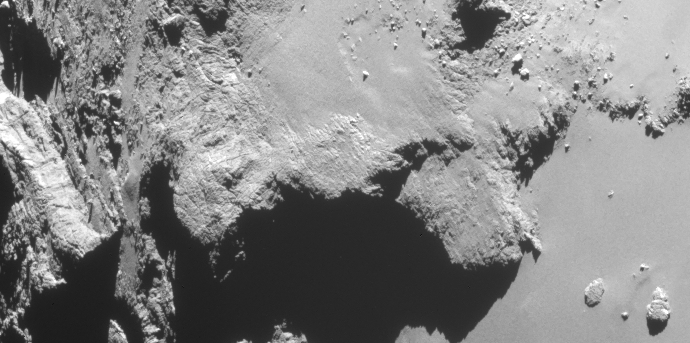
More cool images! Rosetta’s navigation camera has taken another very amazing close-up of Comet 67P/C-G, snapped during the February 14 fly-by.
The cropped section above focuses on the transition between two regions, the generally smooth area called Imhotep on the right and the more mountainous and rugged area called Khepry on the left. Go to the link for the full image, which also includes an interesting description of the engineering problems of doing these close fly-bys.
The uncertainty of science: Curiosity has confirmed the presence, and fluctuation, of methane in the local Martian atmosphere.
SAM [Sample Analysis at Mars, one of Curiosity’s instruments] has been detecting basal levels of methane concentration of around 0,7 ppbv, and has confirmed an event of episodic increase of up to ten times this value during a period of sixty soles (Martian days), i.e., of about 7 ppvb. The new data are based on observations during almost one Martian year (almost two Earth years), included in the initial prediction for the duration of the mission (nominal mission), during which Curiosity has surveyed about 8 kms in the basin of the Gale crater.
Since methane has a short life expectancy, something must be doing something to generate it.
The uncertainty of science: Global warming scientists have concocted another explanation among dozens for the refusal of the climate to warm since 1998: a cold Pacific!
Where’s the heat? Greenhouse gases, particularly carbon dioxide, continue to be pumped into the atmosphere, but sometime around 1998, the rise in Earth’s average temperatures slowed, deviating from the rates predicted by models. Scientists have proposed that what some call “the pause” could be the result of a number of factors, including heat storage in deep ocean waters to unexpectedly high amounts of aerosols in the stratosphere helping deflect solar rays back into space. Now, a new study suggests that natural cycles in the Pacific Ocean are the culprit.
Since the end of last El Niño warming event of 1997 to 1998, the tropical Pacific Ocean has been in a relatively cool phase—strong enough to offset the warming created by greenhouse gas emissions. But, this is just a temporary balm: When the switch flips and the waters turn warm again, the researchers say, Earth will likely continue warming.
“What this study addresses is what’s better described as a false pause, or slowdown,” rather than a hiatus in warming, says climate scientist Michael Mann of Pennsylvania State University, University Park. Some climate change deniers have taken encouragement from the pause, saying they show warming predictions are flawed, but Mann, a co-author on the study, notes that “there have been various explanations for why [the slowdown is happening], none of which involve climate models being fundamentally wrong.” [emphasis mine]
Does no one at the journal Science notice the outright stupidity of the first two paragraphs above? In the first it is posited that all the climate heat we haven’t been seeing could be stored in the oceans. In the second it is posited that a cold Pacific Ocean has offset the warming, thus causing the lack of climate warming.
If the oceans are storing the extra heat, how is it possible for the Pacific to be unusually cold?
We should not be surprised by this stupidity, however. The third paragraph shows that Science is depending on Michael Mann for its climate expertise, a global warming activist who was exposed as a fake scientist, a fraud, and a dishonest corrupter of data in the climategate emails. That this journal still goes to him for his opinions tells us quite a lot about the lack of objectivity at Science. Their use of the word “denier” for scientists who raise questions about global warming also tells us that the journal hasn’t the faintest idea how science works. The very heart of the scientific method demands skepticism. To instead equate skeptics with those who deny the genocide committed by the Nazis suggests that much of the so-called science published by Science is not science but propaganda.
Research and actual experience has found that adjusting to the slightly longer Martian day is not as easy as you would think.
If you’re on Mars, or at least work by a Mars clock, you have to figure out how to put up with the exhausting challenge of those extra 40 minutes. To be exact, the Martian day is 24 hours, 39 minutes, and 35 seconds long, a length of day that doesn’t coincide with the human body’s natural rhythms. Scientists, Mars rover drivers, and everyone else in the space community call the Martian day a “sol” to differentiate it from an Earth day. While it doesn’t seem like a big difference, that extra time adds up pretty quickly. It’s like heading west by two time zones every three days. Call it “rocket lag.”
Link here.
What you might not know is that the moon is not the Earth’s only natural satellite. As recently as 1997, we discovered that another body, 3753 Cruithne, is what’s called a quasi-orbital satellite of Earth. This simply means that Cruithne doesn’t loop around the Earth in a nice ellipse in the same way as the moon, or indeed the artificial satellites we loft into orbit. Instead, Cruithne scuttles around the inner solar system in what’s called a “horseshoe” orbit.
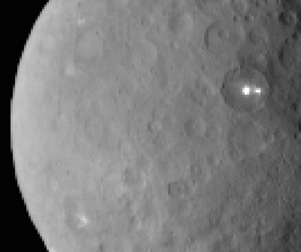
Cool images! Dawn’s newest images have revealed that the brightest spot on Ceres, shown on the right in a cropped version of the full image, has a dimmer companion.
“Ceres’ bright spot can now be seen to have a companion of lesser brightness, but apparently in the same basin. This may be pointing to a volcano-like origin of the spots, but we will have to wait for better resolution before we can make such geologic interpretations,” said Chris Russell, principal investigator for the Dawn mission, based at the University of California, Los Angeles.
The spots are still too small for Dawn’s camera to resolve. That they are inside what looks like a crater is very puzzling. If they are water-ice, why are they so bright and distinct? One one think the ice would pile up along the crater wall, but then, that’s what we think based on our experience here on Earth with wind, rain, and our heavy gravity. Ceres is cold, has no atmosphere, and a tiny gravitational field. Every geological process will proceed in a different manner.
Two stories today today illustrate how the field of climate science is being destroyed by politics.
In the first, a leading climate skeptic chortles over the resignation of Rajendra Pachauri, the man who has headed the IPCC since 2002, who has stepped down because of allegations of sexual harassment by an employee at the institute he heads in New Delhi. In the second, Willie Wei-Hock Soon, a scientist who has published numerous peer-reviewed papers raising questions about global warming science, is attacked for not fully disclosing the sources of his income.
In both cases, the two sides in the global warming debate are using these allegations as ammunition to attack the believability of each side’s stance on the scientific question of global warming. And in both cases, the stories raise literally no questions about the science itself that each man advocated.
I admit that I have attacked Pachauri numerous times in the past, but each time it was because he demonstrated outright ignorance of the field of climate science or had been caught making significant scientific errors. His resignation here however has nothing to do with the science published in IPCC reports, and should not be used as fodder to criticize the theory of human-caused global warming.
Similarly, none of the articles in the mainstream science press about the allegations against Soon have raised a single question about his actual results. All they have done is attack him for not revealing all of his funding sources. His research itself still appears valid. That the largest science journals, Science and Nature, have published articles attacking Soon, with the Smithsonian now piling on as well, without presenting any evidence that he had falsified any of his work, illustrates how corrupt this field has become. The science for these major science journals no longer matters. All that matters is destroying someone who was apparently successful in bursting the balloon on some global warming science.
Until everyone stops playing this game and focuses instead on the data itself and what that data is really telling us, we will get no closer to truly understanding the climate of the Earth. And tragically, I see far too little effort in the climate field to do this.
The competition heats up: Two Google Lunar X-Prize contestants have teamed up to use the same rocket to get to the Moon together, where they will literally race head to head to see who travels the 500 meter distance first to win the prize.
At a press conference in Tokyo on Monday, the leaders of two Lunar X PRIZE teams—Astrobotic and HAKUTO—announced a plan in which the two teams’ robotic rovers will travel to the moon together and touch down on the lunar surface at the same time. They will then race each other to cover the 500 meters required to win the first place prize of $20 million.
John Thornton, head of Pittsburgh-based Astrobotic (a Carnegie Mellon University spin-off), said in a call with reporters that the partnership with HAKUTO (a spin-off from Tokyo University) represented the first step in realizing his team’s goal of turning robotic moon missions into a viable business. That mission won’t stop with this single partnership. He said the team was in talks with more than half of the other 16 GLXP competitors to carry their rovers to the moon, too, in exchange for sharing the cost of getting there and splitting prize money.
If this happens as they propose, we could be watching as many as ten rovers line up for the race.
Engineers have found that to properly drill on Mars, Curiosity need only use its lowest power settings.
The new drilling procedures essentially call for the rover to use its lowest energy setting right from the beginning, rather than starting with a setting a few levels up. Curiosity has six settings on its drill that have a nearly 20-fold range in energy. The drill has only been used three times before Curiosity reached Mount Sharp (Aeolis Mons), its ultimate science goal, late last year.
On those three occasions and when the drill was used once at Mount Sharp, Curiosity began its investigations at the drill’s Level 4. The first rock probed at Mount Sharp broke under this pressure. The new algorithm instead starts at Level 1 and only progresses upwards if drilling proves too slow.
The engineers have found that the rocks they have drilled into on Mars have been more fragile that expected, which actually shouldn’t be a surprise, due to the lower gravity. In fact, this one simple fact probably reveals a great deal of important information to geologists about the geology of Mars and how it formed.
Link here.
A superb essay. I have written about this myself numerable times, but sadly our modern elite intellectual society finds it somehow impossible to get the point, which Shaw sums up very well in his last paragraph:
The point of all this is simply to say that scientific conclusions change over the ages. Complicated things take time. But when you come out and start lecturing us – or worse, start telling us how the government should orient policy – based on your own favorite theory of the day while not yet proving it to a satisfactory degree (even to we simpletons) then you can expect some of us to push back and demand you show your work. And it’s not because the pastor told us to think that way on Sunday.
Read it all. It also illustrates quite well why increasingly the public does not trust scientists or journalists when it comes to hot button issues like climate change.
Mars One, the company that just this week announced the 100 finalists in its competition to send 24 people on a one-way trip to Mars, has quietly suspended all work on two robotic missions heralded as precursors to that manned mission.
These facts just add weight to my conviction that the Mars One competition is at the moment nothing more than a reality television show. It is a cool idea for a television show, but journalists should stop selling it as anything more than that.