Drill design flaw source of short circuit on Curiosity

NASA engineers have confirmed that the rover’s drill is the source of the intermittent short circuit that forced them to shut down Curiosity temporarily.

“The most likely cause is an intermittent short in the percussion mechanism of the drill,” Erickson said in a statement. (Curiosity’s drill doesn’t simply rotate; it hammers into rock, via that percussion mechansism, as well.) “After further analysis to confirm that diagnosis, we will be analyzing how to adjust for that in future drilling.” A brief short occurred during a test on Thursday (March 5) that used the drill’s percussive action, NASA officials explained.

This is not a surprise, as it has been known since before launch that a design flaw in the drill could cause short circuits, possibly serious enough to permanently shut down the rover. They have thus used the drill much less than they had originally planned, and with great care.

Once they get a handle on the specifics causing this short, they say that Curiosity will go back into operation. However, I suspect that they may no longer use the drill, or if they do, they will use it under very very very limited circumstances.
4 comments

El Niño has finally arrived, far weaker than predicted

The uncertainty of science: The periodic warm weather pattern called El Niño has finally arrived in the mid-equatorial Pacific Ocean, more than a year late and far weaker than predicted by scientists.

The announcement comes a year after forecasters first predicted that a major El Niño could be in the works. At the time, NOAA predicted a 50% chance that an El Niño could develop in the latter half of 2014. The agency also said the wind patterns that were driving water east across the Pacific were similar to those that occurred in the months leading up to the epic El Niño of 1997, which caught scientists by surprise and contributed to flooding, droughts and fires across multiple continents.

In the end, last year’s forecasts came up short, in part because the winds that were driving the system petered out. Researchers, who have been working to improve their forecasting models since 1997, are trying to figure out precisely what happened last year and why their models failed to capture it.

But remember, these same climate scientists are absolutely sure that their climate models can predict the temperature rise of the climate to within a degree one century hence. Yet, they have no idea why this El Niño turned out weak and late, even though it exhibited the same early features as the epic 1997 El Niño.

3 comments

New images from Mangalyaan

Arsia Mons

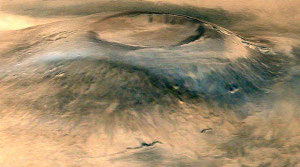
Indian scientists have released a new set of color images taken by their Mars orbiter, Mangalyaan.

The image on the right is of Arsia Mons, one of the three giant volcanoes to the east of Mars’ biggest volcano, Olympus Mons. Arsia Mons is important for future manned colonization, as there are known caves on its western flanks. In addition, those western flanks show solid evidence of past glaciers, which means that it is very likely that those caves will harbor significant quantities of water-ice, making settlement much easier.

1 comment

The oceans that Mars lost

The lost oceans of Mars

New data from a six year study of the water in the modern Martian atmosphere have allowed scientists to estimate the amount of water Mars once had.

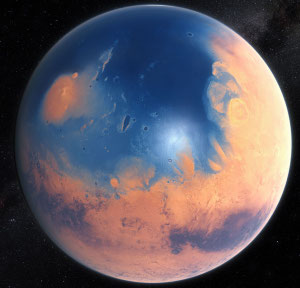
About four billion years ago, the young planet would have had enough water to cover its entire surface in a liquid layer about 140 metres deep, but it is more likely that the liquid would have pooled to form an ocean occupying almost half of Mars’s northern hemisphere, and in some regions reaching depths greater than 1.6 kilometres. “Our study provides a solid estimate of how much water Mars once had, by determining how much water was lost to space,” said Geronimo Villanueva, a scientist working at NASA’s Goddard Space Flight Center in Greenbelt, Maryland, USA, and lead author of the new paper.

The image on the right is an artist’s conception of the oceans that would have existed on Mars, based on modern elevation data.

I must note that this conclusion, the size of the lost Martian ocean, is based on the assumption that the isotope ratios of Martian water started out the same as the Earth’s. While this is a reasonable assumption, it does not have to be true. Nonetheless, these conclusions, using ground-based telescopes, do match up with similar data obtained by Curiosity.

4 comments

NASA picks landing site for next Mars lander

NASA scientists have chosen a specific region of Mars, Elysium Planitia, to land its next Mars science probe.

The landing-site selection process evaluated four candidate locations selected in 2014. The quartet is within the flat-lying “Elysium Planitia,” less than five degrees north of the equator, and all four appear safe for InSight’s landing. The single site will continue to be analyzed in coming months for final selection later this year. If unexpected problems with this site are found, one of the others would be imaged and could be selected. The favored site is centered at about four degrees north latitude and 136 degrees east longitude.

InSight launches next year.

0 comments

Obama threatens veto of House bill to limit EPA use of unpublished data

Here we go again: The House is about to vote on a Republican bill to require EPA to use only publicly available data.

The bills, introduced by a mostly Republican cast of sponsors in both the House and the Senate, would require that EPA use only publicly available, reproducible data in writing regulations and seek to remake the membership and procedures of the agency’s science advisory panels. Supporters, including industry groups such as the U.S. Chamber of Commerce, argue that the legislation would improve the transparency and soundness of how EPA uses science, making regulations less costly and more effective.

Opponents, however, are calling the bills wolves in sheep’s clothing. “I cannot support legislation that makes it easier for industry to implement their destructive playbook, because risking the health of the American people is not a game that I’m willing to play,” said Representative Paul Tonko (D–NY) at a 25 February committee meeting on the bills.

The White House has issued statements saying Obama will veto the bill. How hard to do you think John Boehner and Mitch McConnell will fight for this legislation?

2 comments

NASA considering ion engines for next Mars orbiter

Rather than using conventional chemical thrusters for a Mars orbiter planned for the 2020s, NASA managers are considering using ion engines instead.

Worried its fleet of Mars orbiter is aging, NASA intends to dispatch the spacecraft to the red planet in September 2022 to link ground controllers with rovers and extend mapping capabilities expected to be lost when the Mars Reconnaissance Orbiter stops functioning.

Engineers also want to add ion engines to the orbiter and fly the efficient electrically-powered thruster system to Mars for the first time, testing out a solar-electric propulsion package that officials say will be needed when astronauts visit the red planet. Ion engines produce just a whisper of thrust, using electric power to ionize atoms of a neutral gas and spit out the particles at high speed. While the drive given by the thrusters is barely noticeable in one instant, they can operate for months or years, burning scant fuel compared to traditional chemical rockets.

That this decision requires long-winded and extended high level negotiations at NASA illustrates the slow and lumbering nature of government. Private enterprise is embracing ion engines now, and NASA itself is seeing its own spectacular ion engine success with Dawn. The decision should be a no-brainer, especially because the benefits of ion engines (low weight, more power, greater flexibility) are so obvious.

3 comments

The race to map the space around the supermassive black hole at the center of our galaxy

The uncertainty of science: Using a new generation of telescopes, in space and on the ground, astronomers hope to better confine Einstein’s General Theory of Relativity by studying the distortion in light and energy produced by the powerful gravitational field surrounding Sagittarius A* (pronounced A-star), the 4 million solar mass black hole at the center of the Milky Way.

This is an excellent article explaining both the limits of our ability to study black holes as well as what we do know about Sagittarius A*.

Correction: Thanks to commenter Mike Nelson for noticing that I had mistakenly written “billion” instead of “million” for the mass of Sagittarius A* above.

3 comments

Dawn bears down on Ceres

Ceres' cratered surface

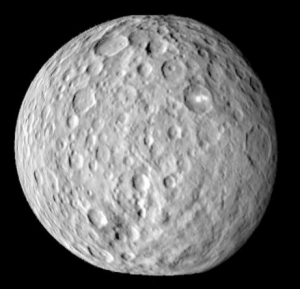
More cool images! As Dawn moves in on Ceres and prepares to enter orbit on March 6, it has managed to assemble enough images to produce a global map of the almost spheroid-shaped giant asteroid.

The bright spots however remain a mystery which cannot be answered until we get higher resolution images from much closer. Hopefully, Dawn will be able to do this once it is in orbit.

0 comments
1 477 478 479 480 481 729