Ganymede’s underground salt water ocean

By measuring the interaction of Jupiter and Ganymede’s magnetic fields, scientists have been able to estimate the size of the salt water ocean in Ganymede’s interior.

A team of scientists led by Joachim Saur of the University of Cologne in Germany came up with the idea of using Hubble to learn more about the inside of the moon. “I was always brainstorming how we could use a telescope in other ways,” said Saur. “Is there a way you could use a telescope to look inside a planetary body? Then I thought, the aurorae! Because aurorae are controlled by the magnetic field, if you observe the aurorae in an appropriate way, you learn something about the magnetic field. If you know the magnetic field, then you know something about the moon’s interior.”

If a saltwater ocean were present, Jupiter’s magnetic field would create a secondary magnetic field in the ocean that would counter Jupiter’s field. This “magnetic friction” would suppress the rocking of the aurorae. This ocean fights Jupiter’s magnetic field so strongly that it reduces the rocking of the aurorae to 2 degrees, instead of 6 degrees if the ocean were not present. Scientists estimate the ocean is 60 miles (100 kilometers) thick โ€” 10 times deeper than Earth’s oceans โ€” and is buried under a 95-mile (150-kilometer) crust of mostly ice.

That’s more water than contained in all of Earth’s oceans.

1 comment

Tiny grains from the interior ocean of Enceladus

Using Cassini scientists have detected tiny grains of rock orbiting Saturn that they think were formed on the floor of the interior ocean of Enceladus and then spewed out its vents into space.

They believe that these silicon-rich grains originate on the seafloor of Enceladus, where hydrothermal processes are at work. On the seafloor, hot water at a temperature of at least 90 degrees Celsius dissolves minerals from the moonโ€™s rocky interior. The origin of this energy is not well understood, but likely includes a combination of tidal heating as Enceladus orbits Saturn, radioactive decay in the core and chemical reactions.

As the hot water travels upward, it comes into contact with cooler water, causing the minerals to condense out and form nano-grains of โ€˜silicaโ€™ floating in the water. To avoid growing too large, these silica grains must spend a few months to several years at most rising from the seafloor to the surface of the ocean, before being incorporated into larger ice grains in the vents that connect the ocean to the surface of Enceladus. After being ejected into space via the moonโ€™s geysers, the ice grains erode, liberating the tiny rocky inclusions subsequently detected by Cassini.

Additional data suggest that the interior of Enceladus is very porous, which means that interior ocean might not be one large bubble but a complex liquid-filled cave.

2 comments

The Milky Way is like ripples in a pond

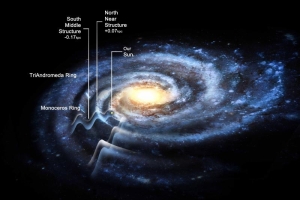
Milky Way ripples

The uncertainty of science: New survey data of the stars in the Milky Way suggest that the galaxy is not only corrugated with concentric ripples — like you’d see if you dropped a stone in a pond — it is also about 50% larger than previous estimates.

I have watched the size of the Milky Way fluctuate up and down depending on the research for the past forty years. Sometimes it is larger than expected. Sometimes smaller. Without doubt we are getting a better idea of its actual size, but don’t be surprised if the numbers continue to bounce about for decades, even centuries, to come.

The confirmation that the spiral arms are the equivalent of ripples in a pond is also not surprising, as it confirms the intuitive conclusion of anyone who looks at a whirlpool-shaped spiral galaxy: It is a whirlpool spiraling into the gravity well at its center.

1 comment

Two astronauts gear up for one year in space

The final preparations are under way for sending two astronauts, one American and one Russian, to ISS for a full year.

Their launch is scheduled for March 27 in a Soyuz capsule.

One other cool aspect of this long mission: The American astronaut, Scott Kelly, has a twin brother, Mark Kelly, who is also an astronaut, though retired. Mark will be duplicating some of Scott’s in-space activities during the mission. Doctors will also compare how Scott’s body changes in weightlessness over time, in comparison to his brother here on Earth.

0 comments

More evidence NOAA has tampered with climate data

More global-warming fraud: Scientists have uncovered more tampering by NOAA of its climate temperature data to create the illusion that the climate is warming.

When Dr. Roy Spencer looked up summer temperature data for the U.S. Corn Belt, it showed no warming trend for over a century. But that was before temperatures were โ€œadjustedโ€ by National Oceanic and Atmospheric Administration climate scientists. Now the same data shows a significant warming trend.

Spencer, a climate scientist at the University of Alabama in Huntsville, said that the National Climatic Data Center made large adjustments to past summer temperatures for the U.S. Corn Belt, lowering past temperatures to make them cooler. Adjusting past temperatures downward creates a significant warming trend in the data that didnโ€™t exist before. โ€œI was updating a U.S. Corn Belt summer temperature and precipitation dataset from the NCDC website, and all of a sudden the no-warming-trend-since-1900 turned into a significant warming trend,โ€ Spencer wrote on his blog, adding that NCDCโ€™s โ€œadjustmentsโ€ made the warming trend for the region increase from just 0.2 degrees Fahrenheit per century to 0.6 degrees per century.

As Spencer notes, correcting the data for errors would normally cause adjustments in both directions. NOAA’s adjustments, however, are always in one direction: from cooler to warmer. This suggests manipulation and fraud, not an effort to improve the data. And that they have consistently refused to explain their adjustments in detail further reinforces this conclusion.

7 comments

Monitoring for a signal from Philae to begin this week

Beginning on Thursday Rosetta engineers will start searching for a signal from their lander Philae, hidden somewhere on the surface of Comet 67P/C-G.

The likelihood of getting an answer this soon is not high, but the lander is now getting about twice as much sunlight as it did when it landed in November. There is a chance it will warm up enough and get enough stored power to come to life.

0 comments

Sunspots crash in February


NOAA today posted its monthly update of the solar cycle, showing the sunspot activity for the Sun in February. As I have done monthly for the past five years, I am posting it here below the fold, with annotations to give it context.

In the past two months I have noted how the ramp down from solar maximum has closely tracked the 2009 prediction of the solar scientist community (indicated by the red curve).

In February, however, that close tracking ended, with sunspots plunging far below the prediction. Note also that sunspot activity in March has also been weak.

» Read more

2 comments

Americans demand mandatory food labels for DNA

We are doomed: A new survey has found that more than 80 percent of Americans support the idea of requiring labels on any foods that contain DNA.

If the government does impose mandatory labeling on foods containing DNA, perhaps the label might look something like this: “WARNING: This product contains deoxyribonucleic acid (DNA). The Surgeon General has determined that DNA is linked to a variety of diseases in both animals and humans. In some configurations, it is a risk factor for cancer and heart disease. Pregnant women are at very high risk of passing on DNA to their children.”

I truly fear for the future, not so much because so many people haven’t the slightest idea what DNA is, but because so many people are so eager to force food labeling (or any other regulation you can think of) on others at the slightest whim.

22 comments
1 476 477 478 479 480 729