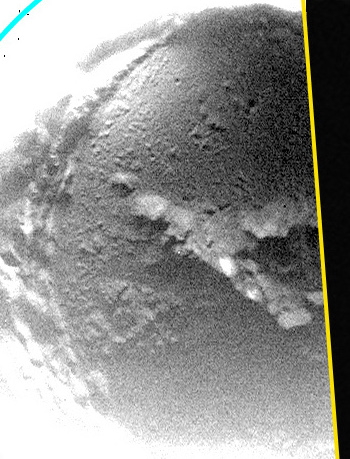
Mars Reconnaissance Orbiter photographs Comet Siding Spring

During Comet Siding Spring’s flyby of Mars on Sunday Mars Reconnaissance Orbiter was able to capture an image of the comet’s nucleus.

Prior to its arrival near Mars astronomers estimated the nucleus or comet’s core diameter at around 0.6 mile (1 km). Based on these images, where the brightest feature is only 2-3 pixels across, its true size is shy of 1/3 mile or 0.5 km.

0 comments

Snowcaps of metal on Venus?

A new look at old data of Venus has added weight to the theory that the planet’s higher elevations are coated with a frost of heavy metals.

The research not only confirmed a radar brightening at higher altitudes, thus suggesting a frost coating of some kind, it also showed many dark spots whose cause remains completely unknown. As the article notes,

Years ago it was proposed that some sort of ferro-electric compound might be the cause of the brightening and the dark spots, but so far no specific compound has been identified which does the trick. Then again, with the surface of Venus being at almost 900 °F (500 °C) under more than 90 times the air pressure of Earth’s atmosphere at sea level, with occasional showers of acid, it’s not easy to test the properties of materials under Venusian conditions. “No one knows what explains the sudden darkness,” said Harrington, who will be presenting the work at the meeting of the Geological Society of America in Vancouver, B.C., on Monday, Oct. 20.

0 comments

Ebola’s rate of growth

The journal Science provides a detailed analysis of the infection rate of ebola, as well a reasonable estimate of the present and future number of cases.

The article makes two key points. First, the trends “…clearly show that the number of cases has roughly doubled every 3 to 4 weeks and that this trend is continuing. If underreporting gets worse, however, it may be even more difficult to discern such trends.”

Second, there is some good news in the worst effected countries.

The number of new cases in some areas at the epicenter of the outbreak– Kenema and Kailahun districts in Sierra Leone and Liberia’s Lofa county–has been dropping, and that’s not a result of underreporting, says Dye. “It has happened for a sufficiently large number of weeks now that we are confident that it’s a real reduction in incidence on the ground, probably related to control measures,” he says. “Our colleagues working on the ground believe it is too.”

One important factor has been the increase in safe burials, Dye says. (The bodies of Ebola victims are very infections.) People in the affected areas have resisted abandoning traditional burial practices that carry a high risk of infection, but in these three areas, local leaders, supported by WHO and others, have come to advocate a change. If that happens elsewhere, says Dye, “we expect to be able to cut out a substantial amount of infection in the community.”

0 comments

Comet 67P/C-G at 2 feet per pixel

New images from Rosetta, now about 6 miles from the surface of Comet 67P/C-G, show details as small as 2 feet across.

Go to the link to see some images. If you were hiking there, these images would see you.

In related news, the Rosetta team is asking the public to help name the landing site for its Philae lander.

As the location of the first soft landing of a human-made object on a comet, the site, currently identified as Site J, deserves a meaningful and memorable name that captures the significance of the occasion. The rules are simple: any name can be proposed, but it must not be the name of a person. The name must be accompanied by a short description (up to 200 words) explaining why this would make the ideal name for such an historic location. A jury comprising members of the Philae Steering Committee will select the best name from the entries, and the winning proposer will be invited to follow the landing in person from ESA’s mission control centre in Darmstadt, Germany on 12 November.

2 comments

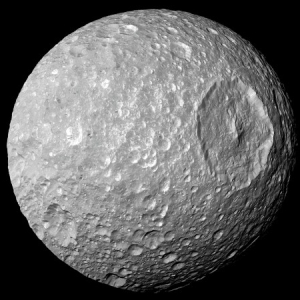
The mysterious interior of Saturn’s moon Mimas

Mimas

The uncertainty of science: Using data from Cassini scientists have found that Saturn’s weird moon Mimas might have either an underground ocean or a misshapen inner core.

Tajeddine and his team relied on pictures taken by NASA’s Cassini spacecraft, which has been exploring the Saturn system since 2004. They built a 3D model of the moon and found that it rotates with an extra wobble, like a misshapen top spinning slightly askew. Because Mimas is nearly spherical, the wobble hinted that something lumpy, or perhaps sloshy, lay beneath the surface. The scientists tested several models of the moon’s interior to see what might give rise to the observed wobble.

It could be the core is lumpy and not spherical. It could be that there is a liquid ocean under the crust that sloshes about as the moon moves through space. Or it could be that a massive impact, the one that produced Mimas’s Death Star look with its one gigantic single crater, could have caused the wobble.

At the moment the data is not sufficient to favor any of these theories. I guess we will just have to go there to find out.

0 comments

G2 survives fly-by of Milky Way’s supermassive black hole

The uncertainty of science: The mysterious object G2, thought by astronomers to be either a cloud or a star, has survived its close fly-by of Sagittarius A* (pronounced A-star), the supermassive black hole at the center of the Milky Way, without telling scientists whether it is a cloud or a star.

Not only do astronomers still not know clearly what G2 is, the Milky Way’s supermassive black hole continues to behave in ways that baffle them.

0 comments

Three potential post-Pluto targets for New Horizons

After completing a deep search using the Hubble Space Telescope, scientists have identified three Kuiper Belt Objects (KBO) that New Horizons can actually reach after it flies past Pluto next year.

The KBOs Hubble found are each about 10 times larger than typical comets, but only about 1-2 percent of the size of Pluto. Unlike asteroids, KBOs have not been heated by the sun and are thought to represent a pristine, well preserved deep-freeze sample of what the outer solar system was like following its birth 4.6 billion years ago. The KBOs found in the Hubble data are thought to be the building blocks of dwarf planets such as Pluto.

I think it remarkable that in the vastness beyond Pluto they were able to find any objects that also happen to be within the narrow path that New Horizons must fly after it passes Pluto in July.

1 comment

Democrats oppose an ebola travel ban

Incompetence: Congressional Democrats have expressed strong opposition to any travel bans from ebola infected countries.

Remember, these are the same people who conceived, wrote, and passed Obamacare, without really reading it or even considering the concerns expressed by many people about the law (all of which have turned out to be true). Thus, it is not surprising they don’t have the brains now to recognize that a quarantine is exactly the right approach to handle ebola at this time, We have a very infectious disease that hasn’t yet broken out into the general populace which we can still keep confined to a small area, where we can more effectively fight it. A quarantine, enforced by a travel ban, will accomplish this.

But these Democrats care! So what they don’t have the ability to think? Let’s vote for them again!

5 comments

A reviving solar maximum

Last week NOAA posted its monthly update of the solar cycle, showing the sunspot activity for the Sun in September. As I do every month, I am posting it here, below the fold, with annotations to give it context.

As much as I am always willing to point out the errors and foibles of scientists when they get something wrong or overstate their conclusions, I also believe it right to give credit when credit is due. I have been saying for several years now that the prediction of the solar scientist community, indicated by the red curve in the graph below the fold, had seriously overstated the Sun’s sunspot production during this solar maximum.

Well, it now appears that, as the solar cycle continues to run its course, that their May 2009 prediction is becoming increasingly correct.
» Read more

0 comments

Ice photographed in Mercury’s permanently shadowed craters?

Kandinsky Crater on Mercury

Using Messenger, scientists think they have obtained optical images of the ice that is thought to exist in the permanently shadowed craters of Mercury.

Although the polar deposits are in permanent shadow, through many refinements in the imaging, the WAC [Messenger’s camera] was able to obtain images of the surfaces of the deposits by leveraging very low levels of light scattered from illuminated crater walls. “It worked in spectacular fashion,” said Chabot.

The team zeroed in on Prokofiev, the largest crater in Mercury’s north polar region found to host radar-bright material. “Those images show extensive regions with distinctive reflectance properties,” Chabot said. “A location interpreted as hosting widespread surface water ice exhibits a cratered texture indicating that the ice was emplaced more recently than any of the underlying craters.” In other areas, water ice is present, she said, “but it is covered by a thin layer of dark material inferred to consist of frozen organic-rich compounds.” In the images of those areas, the dark deposits display sharp boundaries. “This result was a little surprising, because sharp boundaries indicate that the volatile deposits at Mercury’s poles are geologically young, relative to the time scale for lateral mixing by impacts,” said Chabot. [emphasis mine]

The image on the right is of the crater Kandinsky, and shows a very intriguing bright area on the crater’s central peak.

I highlighted that one word in the the scientist’s quote above to emphasize how preliminary these conclusions are. The images are intriguing, but I would not at this time bet a lot of money on these conclusions. Ice might be the best explanation for this data, at this time, but I would not be surprised at all if later research finds this conclusion to be false.

0 comments
1 493 494 495 496 497 729