LADEE impact site located

Lunar Reconnaissance Orbiter has spotted the impact crater formed when engineers sent the probe LADEE crashing into the lunar surface in April 2014.

Compared with asteroid and meteoroid impacts on the moon, LADEE was actually traveling pretty slow, ‘only’ 3,800 miles per hour (1,700 meters per second). That combined with the relatively low mass and density of the spacecraft, a fairly neat crater of only 10 feet (3 meters) across was created. The crater barely registered in LROC’s image resolution, making it a very difficult task to identify the fresh man-made divot.

0 comments

Sierra Nevada announces an X-37B version of Dream Chaser

The competition heats up: In a press release today, Sierra Nevada has announced plans to build a version of Dream Chaser optimized for science research.

The Dream Chaser for Science, or DC4Science, spacecraft is designed to fly independently for short and extended durations to provide customers in such fields as biotech and pharmaceuticals, biology and life science, and material and fluid science with a flexible and evolvable vehicle easily suited for individual mission requirements.

More details here.

I call this version of Dream Chaser a variation of the X-37B because that is essentially what it would be, an unmanned reusable robot vehicle capable of taking experiments into space for periods of time and then bringing them safely back to Earth on a runway.

What Sierra Nevada is doing by announcing this now, shortly after the landing of the X-37B, is selling the concept in an effort to drum up customers who will then invest in the vehicle and thus help fund its construction.

1 comment

Comet 67P/C-G smells!

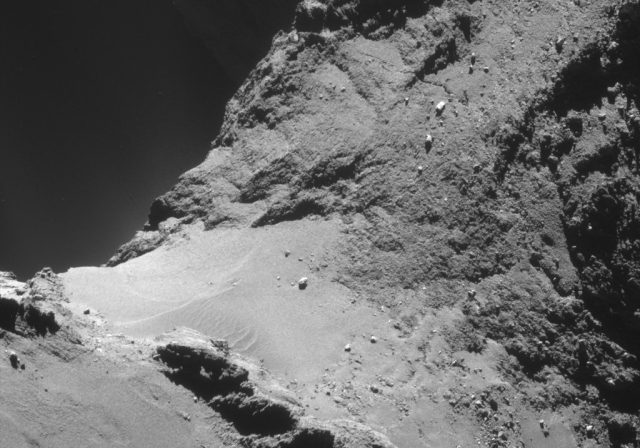
Instruments on Rosetta have determined that the various molecules coming off Comet 67P/C-G have a strong aroma.

You might expect a rock that spends all its time in a vacuum to be fairly inoffensive, but in fact exposure to sunlight is causing it to give off quite an aroma: hydrogen sulfide, ammonia, formaldehyde, hydrogen cyanide, and other caustic gases would make it smell “suffocating,” like a cross between a filthy barn, an embalming room, and a rotten egg.

0 comments

Problems at the National Weather Service?

According to this news report, since Tuesday the National Weather Service has lost access to some of its satellite data.

The story is very unclear and might not be accurate. For example, it does not state where the problem is. Has a specific satellite failed? Or is the problem on the ground, preventing the NWS from processing data from any of its satellites? It also seems puzzling for such a significant failure to occur on Tuesday and only now on Thursday does anyone notice. I have seen no other news stories about this outage.

1 comment

Increasing activity at Comet 67P/C-G

Data from Rosetta in the past month has been showing a steady and gradual increase in dust emissions from the surface.

While images obtained a few months ago showed distinct jets of dust leaving the comet, these were limited to the ‘neck’ region. More recently, images obtained by Rosetta’s scientific imaging system, OSIRIS, show that dust is being emitted along almost the whole body of the comet. Jets have also been detected on the smaller lobe of the comet. “At this point, we believe that a large fraction of the illuminated comet’s surface is displaying some level of activity,” says OSIRIS scientist Jean-Baptiste Vincent from the Max Planck Institute for Solar System Research (MPS) in Germany.

The last two images at the link compare the same location with one image overexposed to make the jets visible. What is interesting is that the source of the jet is not evident in the other normally exposed image. It is almost as if surface material is simply heating up and then using that extra energy to simply throw itself off the surface. Why that then forms jets however is puzzling.

More info here.

0 comments

Titan’s atmosphere is unexpectedly unbalanced

The uncertainty of science: New data from the ground-based telescope ALMA suggest that certain organic molecules in Titan’s atmosphere are not evenly distributed through the atmosphere as expected.

At the highest altitudes, the pockets of organic molecules were shifted away from the poles. These off-pole concentrations are unexpected because the fast-moving, east-west winds in Titan’s middle atmosphere should thoroughly mix the molecules formed there. The researchers do not have an obvious explanation for these findings yet.

I would not take these results too seriously, as the data are very sketchy. With better data many of these questions will vanish, replaced by new questions that are better based on reality.

0 comments

India begins tests of larger rocket engine

The competition heats up: Indian engineers have successfully completed their first tests of a new more powerful upper stage engine for their biggest launch rocket.

Taking a big step forward in the development of bigger and more powerful locally-built rocket engines, the Liquid Propulsion Systems Centre (LPSC) on Monday successfully conducted the first ‘cold flow test’ on the CE-20 cryogenic engine, which will power the upper stage of the Geosynchronous Satellite Launch Vehicle-Mk III (GSLV-Mk III). “It’s a milestone,” LPSC director Dr K Sivan told ‘Express’ here on Tuesday, confirming that the test had gone as planned at the LPSC facility in Mahendragiri, Tamil Nadu. The first ‘hot test’ – where the engine will be fired for a few seconds- will be performed in three weeks’ time, Sivan said.

In a cold test, the propellants are not ignited. On Monday, the fuel, Liquid Hydrogen (LH2), and the oxidiser, Liquid Oxygen (LOX), were injected into the chambers for the checking of various parameters.

In related news, Mangalyaan has taken another global view of Mars.

0 comments

China to launch two payloads to the Moon

The competition heats up: On Thursday China plans to send a capsule on a mission around the Moon and back to Earth to test its heat shield.

The rocket’s upper stage, which will also round the Moon but not return to Earth, will also carry a privately funded cubesat designed to study the radiation levels during the entire journey.

Twenty minutes after launch on October 23, (at 1:59 p.m. U.S. Eastern time), the Long March’s upper stage will separate from the test capsule, and both will continue on a trajectory that takes them around the moon. The capsule will return to re-enter Earth’s atmosphere on October 31. In early discussions with the Chinese, LuxSpace was told that the upper stage [carrying the private cubesat] would re-enter the atmosphere as well, but it’s now expected to enter a wide, looping orbit around Earth. The main battery is only designed to last 10 days, although it may go longer.

Radio receivers on Earth will be able to tune in to 4M’s signal shortly after separation, and will be able to follow it as it rounds the moon, coming as close as 7,500 miles to the surface. The payload also includes a radiation sensor that will take measurements throughout the journey into Earth-moon space. Anyone with the proper equipment will be able to receive the compressed radiation data and decode it.

Though this private mission is definitely breaking new ground by sending a small payload to lunar space for very little money, the article is incorrect when it states that this is the first privately funded Moon mission. In 1997-1998 HGS 1, a Hughes commercial communications satellite that was placed in an incorrect orbit by a Russian rocket, was sent on a wide elliptical orbit to fly past the Moon twice and thus use this sling shot effect to get the satellite into a usable orbit.

0 comments
1 492 493 494 495 496 729