First results back from the U.S. MAVEN Mars probe

Scientists have released the first results from NASA’s MAVEN probe orbiting Mars, designed to study that planet’s upper atmosphere.

As expected, the spacecraft has quickly found evidence of the Martian atmosphere leaking away into space.

Hydrogen appears to be leaving the planet’s atmosphere in clumps and streams that reach about 10 Mars radii into space, said Mike Chaffin, a MAVEN scientist also at the University of Colorado, who discussed the results at a 14 October news briefing. The hydrogen comes from water vapour that breaks apart in the upper atmosphere; because hydrogen is so much lighter than oxygen, it escapes into space relatively easily. “That’s effectively removing water from the Martian atmosphere,” says Chaffin.

Other images show oxygen and carbon drifting away from the planet, although these heavier atoms cluster closer to Mars than hydrogen. Deep within the atmosphere, oxygen forms ozone molecules that accumulate near Mars’s south pole.

0 comments

Finding a meteorite 20 years after it hit the ground

By reanalyzing the data that had recorded the fireball twenty years ago, a team of meteorite hunters in the Czech Republic have finally located the remains of a meteorite that landed in 1991 but could not be found.

What is most interesting scientifically about their find is that the pieces they found were from different types of meteorites.

[T]hese four meteorites are of three different mineralogical types. This means that the Benešov meteoroid was heterogeneous and contained at least three different types of material. After the Almahata Sitta fall, this is the second time that such a heterogeneous composition has been found. It raises the possibility that a significant fraction of all asteroids are heterogeneous and that they were strongly reprocessed by collisions with other asteroids in the main belt.

In other words, the meteorite had been a conglomerate of different geological types, which were created in different environments and were later smashed together to form this one rock.

0 comments

Recent volcanism on the Moon

New data from Lunar Reconnaissance Orbiter suggests that lunar volcanism petered out slowly and occurred more recently that previously believed.

NASA’s Lunar Reconnaissance Orbiter (LRO) has provided researchers strong evidence the moon’s volcanic activity slowed gradually instead of stopping abruptly a billion years ago. Scores of distinctive rock deposits observed by LRO are estimated to be less than 100 million years old. This time period corresponds to Earth’s Cretaceous period, the heyday of dinosaurs. Some areas may be less than 50 million years old. Details of the study are published online in Sunday’s edition of Nature Geoscience. “This finding is the kind of science that is literally going to make geologists rewrite the textbooks about the moon,” said John Keller, LRO project scientist at NASA’s Goddard Space Flight Center in Greenbelt, Maryland.

In a way, this new conclusion is an example of science discovering the obvious. It seems to me quite unlikely that volcanic activity on the Moon would have “stopped abruptly” under any conditions. That’s not how these things work.

2 comments

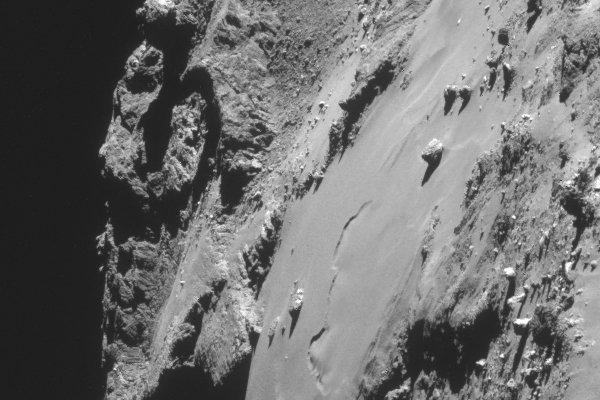
Giant boulders on Comet 67P/C-G

Giant boulders on Comet 67P/C-G

As Rosetta has moved in on Comet 67P/C-G, engineers have focused in on its most interesting surface features, such as the nucleus’s neck as well as a collection of very large boulders on a relatively smooth area on the nucleus’s larger lobe. The biggest boulder, seen as the middlemost rock in the photo above, they have named Cheops. It is estimated to be 150 feet across with a height of about 80 feet.

It should be emphasized that calling these features boulders might actually be premature at this time.
» Read more

3 comments

New measurements cut dark matter in Milky Way by half

The uncertainty of science: New more robust measurements by Australian astronomers has shown that the amount of dark matter in the Milky Way galaxy is about half of what previous measurements had estimated.

Without doubt something is causing the outer stars in galaxies to orbit their galaxies at much greater speeds than they should. The answer that astronomers have posited since the late 1950s is that there is additional unidentified mass, dubbed dark matter, lurking as a halo around each galaxy, pulling on those outer stars and making them move faster.

The problem remains that no one has as yet detected this unidentified dark matter. Moreover, there are enormous uncertainties in the measurements of the motions of stars. This result helps narrow those uncertainties.

8 comments

A pulsar that’s eating a galaxy

The uncertainty of science: Astronomers have discovered a pulsar emitting energy at a rate far greater than ever predicted and which is believed caused by the very fast in-fall of matter into the neutron star.

Astronomers have found a pulsating, dead star beaming with the energy of about 10 million suns. This is the brightest pulsar – a dense stellar remnant left over from a supernova explosion – ever recorded. The discovery was made with NASA’s Nuclear Spectroscopic Telescope Array, or NuSTAR. “You might think of this pulsar as the ‘Mighty Mouse’ of stellar remnants,” said Fiona Harrison, the NuSTAR principal investigator at the California Institute of Technology in Pasadena, California. “It has all the power of a black hole, but with much less mass.”

More here. The galaxy where this pulsar resides, M82, has been known for decades to be one of the most interesting, with evidence of vast explosions tearing it apart. This pulsar is at its center, and appears to be sucking in matter at a rate previously believed impossible, suggesting that the supermassive black holes found at the center of many galaxies could form much faster that any theory predicted.

0 comments

Ground-breaking ceremony for Thirty Meter Telescope cancelled because of protesters

A ground-breaking ceremony on Mauna Kea, which would have included a blessing from native Hawaiians, was cancelled Tuesday when protesters showed up trying to block the telescope’s construction.

There were also small numbers of protesters at other locations that are also connected to the telescope project.

With previous similar protests of other telescope projects, the protesters seem to always disappear when the projects agree to give them money. Makes me wonder if their religious fervor is much shallower than the news stories of this protest would lead us to believe.

2 comments
1 494 495 496 497 498 729