
A giant black hole in a tiny galaxy

The uncertainty of science: Astronomers have unexpectedly discovered a supermassive black hole in the center of a nearby tiny galaxy, comprising almost 18% of the galaxy’s entire mass.

To weigh the beast, the researchers measured the velocity of stars whipping about the galaxy’s centre using an infrared spectrometer on the Gemini North telescope atop Mauna Kea in Hawaii. The high velocity of the stars is best explained by a central black hole that tips the scales at 21 million times the Sun’s mass, concluded Seth’s team. That is more than five times heavier than the black hole at the centre of the Milky Way — even though M60-UCD1 has an estimated diameter of about one-six-hundredth that of our home galaxy.

Previously astronomers had believed that the size of a galaxy would predict the size of its central black hole, and that a galaxy this small would not house such a supermassive object. This find upsets those theories.
1 comment

Dawn’s arrival at Ceres delayed one month

Though engineers have solved the problems caused when a radiation blast disabled Dawn’s ion engine and put it into safe mode for a week, the fix will cause a one month delay in its arrival at the asteroid Ceres.

Controllers discovered Dawn was in safe mode Sept. 11 after radiation disabled its ion engine, which uses electrical fields to “push” the spacecraft along. The radiation stopped all engine thrusting activities. The thrusting resumed Monday (Sept. 15) after controllers identified and fixed the problem, but then they found another anomaly troubling the spacecraft.

Dawn’s main antenna was also disabled, forcing the spacecraft to send signals to Earth (a 53-minute roundtrip by light speed) through a weaker secondary antenna and slowing communications. The cause of this problem hasn’t been figured out yet, but controllers suspect radiation affected the computer’s software. A computer reset has solved the issue, NASA added. The spacecraft is now functioning normally.

1 comment

Neil deGrasse Tyson under attack for fabricating quotes

A series of recent articles have attacked Neil deGrasse Tyson for fabricating quotes and other facts in this lectures and presentations. This article provides a good summary.

The article also notes how Tyson’s behavior is quite typical for too many modern scientists, especially those who have been touting human-caused global warming these past two decades.

In related news, climate scientist Judith Curry gave a talk at the National Press Club this week in which she outlined very cogently the real scientific debate and how politics is distorting that process. Unlike Tyson, Curry does not mince words about the data, and considers the fabrication of information to be a terrible thing for scientists to do.

And then there’s this: The Lonesomest Mann in Town.

11 comments

Death Valley’s moving rocks

An evening pause: The detective story that solved the mystery of the moving rocks of Death Valley.

For a century, these eerie rocks and their long, graceful trails have stumped visitors and scientists. The boulders of black dolomite appear to move on their own, sliding uphill across the playa’s flat lakebed. The trails are the only evidence the rocks move. No one has ever seen them set sail.


0 comments

Philae’s landing site chosen

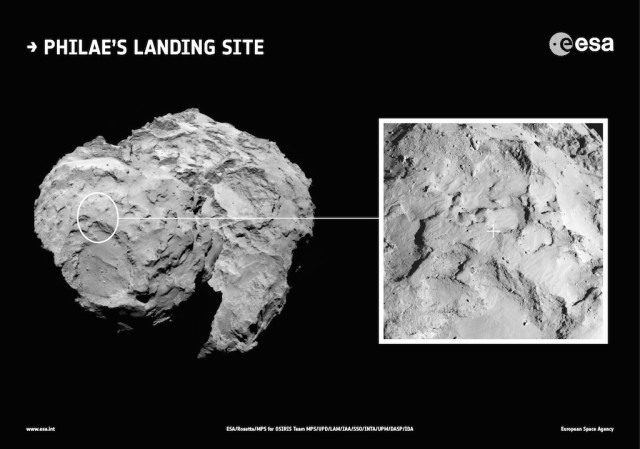
Philae's primary landing site

The Rosetta science team has chosen the primary landing site on Comet 67P/C-G for its Philae probe.

Site J is on the ‘head’ of the comet, an irregular shaped world that is just over 4 km across at its widest point. The decision to select Site J as the primary site was unanimous. The backup, Site C, is located on the ‘body’ of the comet. The 100 kg lander is planned to reach the surface on 11 November, where it will perform indepth measurements to characterise the nucleus in situ, in a totally unprecedented way.

This site is, located in the outside center of the nucleus’s smaller lobe, was picked unanimously because it appears to be the easiest to reach while also providing good science.

The descent to the comet is passive and it is only possible to predict that the landing point will place within a ‘landing ellipse’ typically a few hundred metres in size.

A one square kilometre area was assessed for each candidate site. At Site J, the majority of slopes are less than 30º relative to the local vertical, reducing the chances of Philae toppling over during touchdown. Site J also appears to have relatively few boulders, and receives sufficient daily illumination to recharge Philae and continue science operations on the surface beyond the initial battery-powered phase.

Provisional assessment of the trajectory to Site J found that the descent time of Philae to the surface would be about seven hours, a length that does not compromise the on-comet observations by using up too much of the battery during the descent.

I have put a close-up of the landing site below the fold.
» Read more

0 comments

Philae’s mission at Comet 67P/C-G

With the decision to pick a landing site for their Philae lander coming up this weekend, the Rosetta science team today released a press announcement describing in detail the lander’s mission.

The details are fascinating. Not only will Philae take images from the surface as well as get data of the surface and its surrounding environment, the probe will also literally pound the surface to measure its temperature as well as get seismic readings.

The MUPUS hammer is released and embeds itself into the ground so that it can measure the temperature at various depths in the subsurface. The acoustic signals of the vibrations of the hammer action will be detected by acoustic sensors in the feet of SESAME/CASSE and will be used to measure the mechanical properties of the nucleus.

If all goes well, they hope that Philae will remain operational on the surface through March.

2 comments

Playing with today’s Rosetta image of Comet 67P/C-G

Adjusted comet image

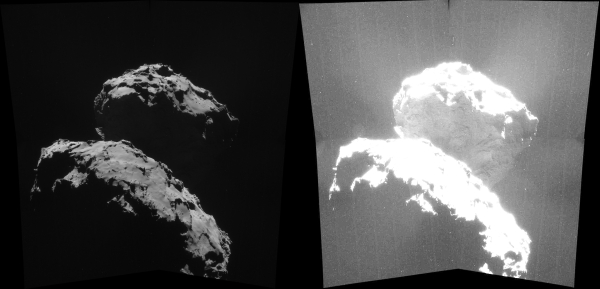
In releasing Wednesday’s image of Comet 67P/C-G, the Rosetta science team suggested that readers download it and play with the brightness and contrast settings to bring out some interesting details.

[I]f you adjust the contrast of the image you will see that there is a lot of ‘noise’ in the background. Some of this is simply detector noise and cosmic rays, but there seem to be a few bright objects that may be dust/ice particles between Rosetta and the comet.

In previous NAVCAM and OSIRIS images, we’ve already seen jets of gas laced with dust streaming away from the comet, and the instruments COSIMA and GIADA have started detecting dust, so it would be no surprise if these objects were also found to originate from the comet. In any case, it is a phenomenon that will clearly be studied in great detail at 67P/C-G over the coming weeks and months.

Another nice observation you might like to make while playing around with the contrast settings is that faint details can be brought out in the ‘neck’ region of 67P/C-G, which on first look is seemingly obscured by shadows. It appears as though the neck is being illuminated by the reflection of sunlight off the main body of the comet below.

The image on the left above is the image as released. The image on the right I have brightened considerably to bring out additional details. As they noted, you can see topographical details in the shadowed neck area. Also, the entire nucleus seems to be surrounded by faint dust streaming away in all directions.

It is going to be a great deal of fun to watch this comet change over the next year as it makes its journey around the Sun.

1 comment

The first of two coronal mass ejectors from a solar flare has arrived.

An alert has been issued so that the electrical grids can been properly prepared to avoid damage by the impact of these two coronal mass ejections (CME) against the Earth’s magnetic field.

The first of the two CMEs predicted to arrive today made its appearance right on time. G1 ((Minor) geomagnetic storming is expected to begin within the next few hours with a maximum projected level of G2 (Moderate) storms for September 12th. A G3 (Strong) Geomagnetic Storm Watch is still in effect for September 13th due to the combined influence of this CME and the one projected to arrive late on the 12th. G1 (Minor) storming is likely to continue into September 14th. In addition, the S1 (Minor) solar radiation storm that is in progress as a result of the eruption on September 10th is expected to persist for the next few days with a possible slight increase with the arrival of the CMEs. Keep in mind that the forecast periods listed are in Universal Time so aurora watchers in the northern U.S. should be looking for possible activity tonight through Saturday night.

While there has been a lot of fear-mongering about these two CMEs, I expect that the only consequences we will see from both, the biggest to hit the Earth during this solar maximum, will be the possibility that the northern lights might be visible in places farther south than normal.

0 comments

The solar maximum lingers on

On Monday NOAA posted its monthly update of the solar cycle, showing the sunspot activity for the Sun in August. As I do every month, I am posting it here, below the fold, with annotations to give it context.

The sunspot activity of the Sun in August hovered at the same levels seen in July. Though the month had seen periods of little activity, these were interspersed with many violent flaring sunspots, including one that only yesterday unleashed a powerful X-class flare that is expected to send a coronal mass ejection directly at the Earth and should impact the Earth’s magnetic field on September 12. Expect spectacular auroras!
» Read more

6 comments
1 497 498 499 500 501 729