One Martian ridge among many

One Martian ridge among many
Click for original image.

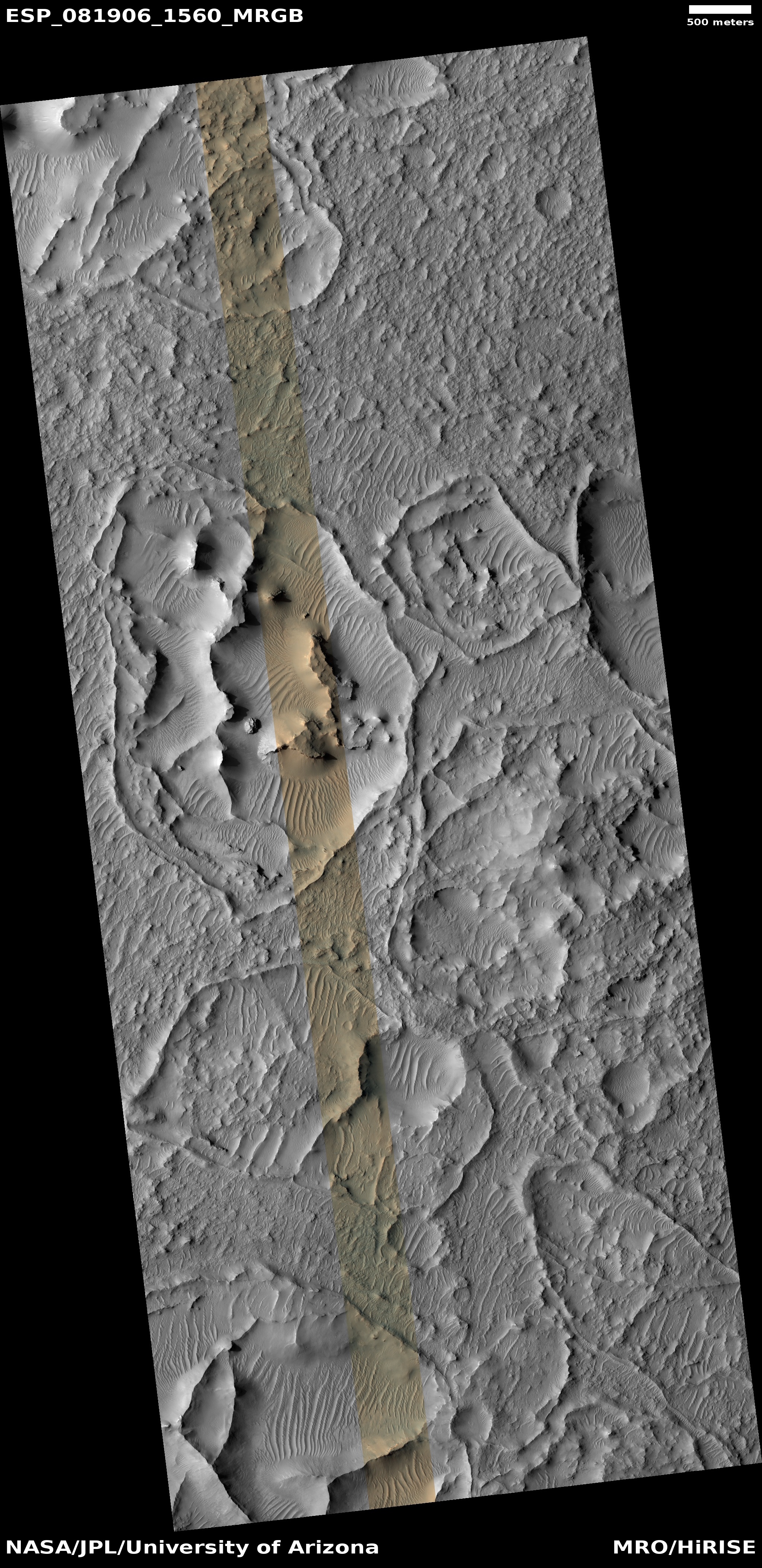
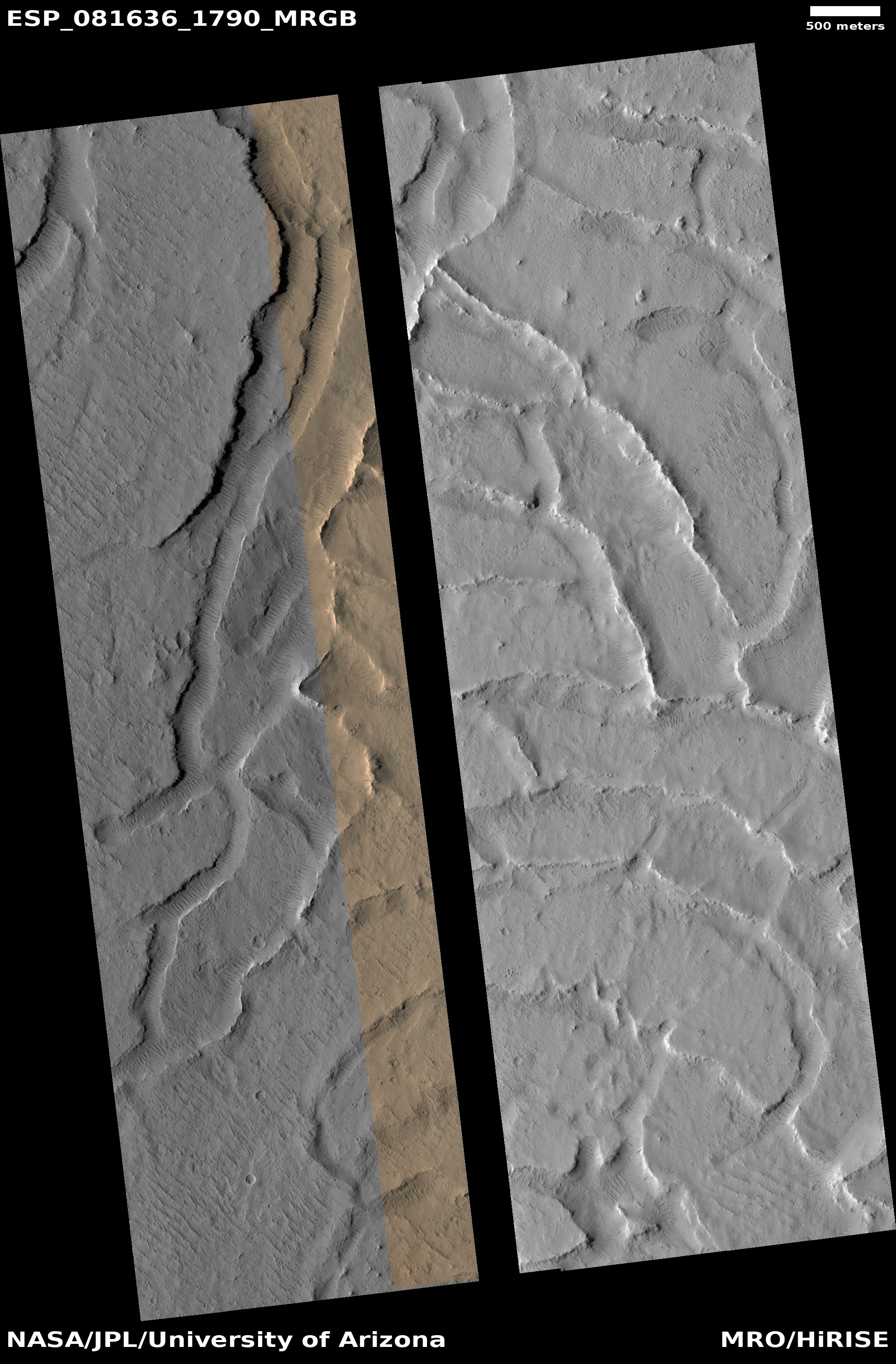
Cool image time! The picture to the right, cropped, reduced, and sharpened to post here, was taken on August 30, 2024 by the high resolution camera on Mars Reconnaissance Orbiter (MRO). It is labeled as a “terrain sample,” so it was likely taken not as part of any specific research project but to fill a gap in the camera’s schedule.

The subject this time was a series of parallel ridges. I have cropped the image to focus on the most distinct, which stands at its highest about 600 feet below the dune-filled hollows to the north and south. The streaks on its flanks are likely slope streaks, a phenomenon unique to Mars that is presently not entirely understood. Streaks appear like avalanches, but they do not change the topography at all, and in fact in some cases go up and over rises. It is believed they are related to dust events, but this is not yet confirmed.

Why focus on this ridge however? It isn’t as if this is the most stunning geology on Mars.
» Read more

0 comments

Blue Ghost operating as expected on its way to the Moon

Blue Ghost selfie
Blue Ghost selfie. Click for original.

Firefly has announced that all is well with its Blue Ghost lunar lander, now in an ever expanding Earth orbit on its way to the Moon. Engineers have acquired signal and completed its on-orbit commissioning.

With a target landing date of March 2, 2025, Firefly’s 60-day mission is now underway, including approximately 45 days on-orbit and 14 days of lunar surface operations with 10 instruments as part of NASA’s Commercial Lunar Payload Services (CLPS) initiative.

…Firefly’s Blue Ghost will spend approximately 25 days in Earth orbit, four days in lunar transit, and 16 days in lunar orbit, enabling the team to conduct robust health checks on each subsystem, calibrate the propulsion system in preparation for critical maneuvers, and begin payload science operations.

NASA today released the first picture downloaded from the spacecraft, shown to the right. The view looks across the top deck of the lander, with two NASA science instruments on the horizon.

Once it lands it is designed to operate for about two weeks, during the lunar day. It will attempt to further gather some data during the long two-week long lunar night, but is not expected to survive to the next day.

0 comments

Bursting ice sheets on Mars

Ice sheets on Mars
Click for original image.

Cool image time! The picture to the right, cropped, reduced, and sharpened to post here, was taken on July 31, 2024 by the high resolution camera on Mars Reconnaissance Orbiter (MRO). Labeled simply as a “terrain sample” by the camera team, it was likely taken not as part of any specific research project but to fill a gap in the camera’s schedule in order to maintain its proper operating temperature.

In this case the camera team picked a spot in the northern lowland plains at 39 degrees north latitude. What they got was another great piece of evidence of the existence of a lot of near surface ice on Mars, so much so at this location that the craters have become distorted and blobby. The ice in the ground is unstable enough that nothing here can really hold its shape from season to season and from decade to decade.

As I have noted repeatedly in the past six years, MRO data is proving that Mars is not a dry desert like the Sahara, but an icy desert like Antarctica. Except for the planet’s dry tropics below 30 degrees latitude, Mars appears to have a lot of frozen water available relatively near the surface.
» Read more

0 comments

JPL survives LA fires

Though nothing is certain yet as the fires still rage, it appears that the facilities of JPL, including its Deep Space Network mission control that manages communications with all of America’s interplanetary probes have survived the Los Angeles fires that have destroy large swaths of that city.

The fires required a full evacuation of the facility, leaving that mission control unoccupied for the first time in sixty years. It appears however that the organization used work-arounds to maintain contact and operations with those probes.

How long the facility will remain in this state remains unclear. Some of the fires remain uncontrolled, and until that happens, there can be no return to any sense of normalcy in LA.

11 comments

SpaceX successfully launches two commercial lunar landers

Map of lunar landing sites
Landing sites for both Firefly’s Blue Ghost and
Ispace’s Resilience

SpaceX tonight successfully launched two different private commercial lunar landers, its Falcon 9 rocket lifting off from the Kennedy Space Center in Florida.

The prime payload was Firefly’s Blue Ghost lunar lander, flying ten science payloads to the Moon for NASA. It will take about six weeks to get to lunar orbit. The second payload was Resilience or Hakuto-R2, built by the Japanese startup Ispace on that company’s second attempt to land on the Moon. It is taking a longer route to the Moon, 4 to 5 months. The map to the right shows the landing locations for both landers. It also shows the first landing zone for Ispace’s first lander, Hakuto-R1, inside Atlas Crater. In that case the software misread the spacecraft’s altitude. It was still three kilometers above the ground when that software thought it was just off the surface and shut down its engines. The spacecraft thus crashed.

For context, the map also shows the landing sites of three Apollo missions.

Both spacecraft were correctly deployed into their planned orbits.

The first stage successfully completed its fifth flight, landing on a drone ship in the Atlantic.

The 2025 launch race:

8 SpaceX
2 China

Right now SpaceX’s launch pace exceeds once every two days. If it can even come close to maintaining that pace, it will easily match its goal of 180 launches in 2025.

1 comment

Is China’s Yutu-2 lunar rover dead?

According to monthly images taken by Lunar Reconnaissance Orbiter (LRO) of China’s Yutu-2 lunar rover on the far side of the Moon, it has not moved since March 2024, suggesting it is no longer functioning.

“Up to about February 2023 the rover was moving about 7 or 8 metres every drive and typically about 40 m per lunar day. Suddenly the drives dropped to about 3 or 4 m each and only about 8 or 10 m per lunar day,” Stooke said in an email.

“That lasted until about October 2023, and then drives dropped to only 1 or 2 m each. In March 2024 Yutu 2 was resting just southwest of a 10 m diameter crater, and it’s been there ever since, as revealed by LRO images,” Stooke added.

It is possible the rover is not entirely dead, but there is no way to be sure. China is not generally forthcoming when things fail. For example, it has never acknowledged the shut down of its Zhurong Mars rover, which it had hoped would survive its first Martian winter. When that winter ended however no reports from Zhurong were released by China, which suggested it was no longer functioning. China however did not report this. It simply made believe the rover no longer existed.

It could be China is now doing the same with Yutu-2.

5 comments

Mars geology at its strangest

Strange Martian geology
Click for original image.

Cool image time! The picture to the right, cropped and reduced to post here, was taken on July 29, 2024 by the high resolution camera on Mars Reconnaissance Orbiter (MRO). It shows the northeast quadrant of a weirdly distorted unnamed 3-mile-wide crater in the northern lowland plains of Mars. The crater rim is the ridgeline that enters from picture’s left edge to curve down to exit at bottom right.

The geological feature of interest however is the strange mound to the left of that rim, inside the crater. It certainly appears, based on shadows, that the top of this mound popped off at some time in the past, leaving behind that sharp-edged hollow.

Note however that there is no eruption debris. When a volcano erupts, the debris covers the nearby mountainside. Here we see no evidence of anything that was flung out from this small eruption.
» Read more

0 comments

Hubble captures a nice example of intergalactic microlensing

Micro-lensing at is most distinct
Click for original image.

Cool image time! The picture to the right, cropped to post here, was taken by the Hubble Space Telescope and released this week. I have specifically cropped it to focus on this ringlike feature, as it one of the nicest examples of micro-lensing I have seen. From the caption:

This curious configuration is the result of gravitational lensing, in which the light from a distant object is warped and magnified by the gravity of a massive foreground object, like a galaxy or a cluster of galaxies. Einstein predicted the curving of spacetime by matter in his general theory of relativity, and galaxies seemingly stretched into rings like the one in this image are called Einstein rings.

The lensed galaxy, whose image we see as the ring, lies incredibly far away from Earth: we are seeing it as it was when the Universe was just 2.5 billion years old. The galaxy acting as the gravitational lens itself is likely much closer. A nearly perfect alignment of the two galaxies is necessary to give us this rare kind of glimpse into galactic life in the early days of the Universe.

I am generally a very big skeptic of most astronomical studies that rely on micro-lensing. I don’t deny it happens and has been detected, as in this case. The uncertainties — such as the unknown distance to intervening galaxy that is causing the lensing — always require too many assumptions that make any reliable conclusions difficult.

Nonetheless, this object illustrates the phenomenon perfectly. The light from the distant galaxy is bent around the intervening nearer galaxy so that we that distant galaxy as a ring.

2 comments

The mysteries buried in the Martian south pole ice cap

The mysterious layers in Mars' south pole ice cap
Click for original image.

Cool image time! The picture to the right, cropped and color-enhanced to post here, was taken on November 3, 2024 by the high resolution camera on Mars Reconnaissance Orbiter (MRO).

The picture is labeled as a “terrain sample,” which means it was likely taken not as part of any specific research project, but to fill a gap in the camera schedule in order to maintain the camera’s proper temperature. In this case the camera team tries to choose interesting features, though sometimes they can’t due to timing.

In this case they were able to target a nice piece of geology, a layered 2,000 foot cliff on the outer edge of the south pole ice cap. The color strip illustrates the possibilities within those layers. I have significantly enhanced the colors to bring out the differences. The orange suggests dust, the aqua-blue water ice, though these colors could also indicate interesting mineralogies.
» Read more

0 comments

ESA releases three images taken by BepiColombo during its Mercury fly-by yesterday

BepiColombo image from January 8, 2025 fly-by of Mercury
Click for original image. For the annotated version
click here.

The European Space Agency (ESA) today released what it called the three best images taken by the ESA/JAXA joint mission BepiColombo to Mercury in its closest fly-by of the planet yesterday.

The image to the right, cropped, reduced, and sharpened to post here, shows the north polar regions of Mercury. The probe’s solar array is visible to the right.

Flying over the ‘terminator’ – the boundary between day and night – the spacecraft got a unique opportunity to peer directly down into the forever-shadowed craters at planet’s north pole.

The rims of craters Prokofiev, Kandinsky, Tolkien and Gordimer [the four craters in a line at the terminator] cast permanent shadows on their floors. This makes these unlit craters some of the coldest places in the Solar System, despite Mercury being the closest planet to the Sun!

Excitingly, there is existing evidence that these dark craters contain frozen water. Whether there is really water on Mercury is one of the key Mercury mysteries that BepiColombo will investigate once it is in orbit around the planet.

This was BepiColombo’s last slingshot maneuver. It is now set to enter Mercury orbit in late 2026, where it will split into two separate orbiters, one build by ESA and the other by Japan’s space agency JAXA.

0 comments

Graceful beauty found within the mid-latitude glaciers of Mars

Overview map

Graceful beauty found within the glacial mid-latitudes of Mars
Click for original image.

Cool image time! The picture to the right, rotated, cropped, reduced, and sharpened to post here, was taken on October 27, 2024 by the high resolution camera on Mars Reconnaissance Orbiter (MRO).

The red dot on the overview map above marks the location, about 35 miles southwest of the rim of 80-mile-wide Moreau Crater. This location is also deep within the 2,000-mile-long northern mid-latitude strip I label glacier country, as almost every high resolution picture from MRO shows glacial features.

This picture is no different, in that it shows the typical lineated parallel grooves seen on the surface of glaciers both on Earth and Mars, and especially found on glaciers flowing within a narrow canyon, as this glacier is. The parallel grooves are caused by the waxing and waning of the glacier. Each layer represents a past period when ice was being deposited on the surface, with the grooves indicates times when that ice was sublimating away. The graceful curves of the grooves is due to the drift of the glacier itself downhill.

This canyon is about seven miles wide at this point, formed from the confluence of two southerly tributaries to the south. The downward grade is to the north, but the low point is not where you would expect, out into the northern lowland plains. Instead, I have marked the low point in the inset with a white dot, inside the canyon itself. It appears this glacier drains into this low spot, but then this debris-covered ice appears to vanish.

It can’t really vanish, but there is a geological mystery here that involves the alien nature of Mars. For some reason the glacier dies at this point, its material sublimating away. Is there a drainage here that sends the ice to the north by underground passages? Your guess is as good as mine.

The lineated nature of this glacial flow however is no mystery in one respect. It is quite beautiful, as seen from space.

0 comments
1 50 51 52 53 54 729