
Images of asteroid by Rosetta
The European Space Agency has released some new data, including images and animations, of the asteroid Lutetia, which the spacecraft Rosetta flew past on July 10, 2010.
The European Space Agency has released some new data, including images and animations, of the asteroid Lutetia, which the spacecraft Rosetta flew past on July 10, 2010.
China has launched its second unmanned lunar probe, designed to photograph the Moon from an orbit altitude of 9 miles.
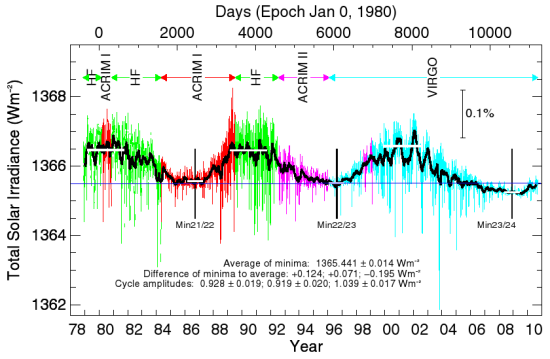
Time to update the state of the Sun, as seen by satellite data (the last update was in July). The graph below, posted today by Physikalisch- Meteorologisches Observatorium Davos (PMOD), shows the variation in the Sun’s Total Solar Irradiance since 1978. I have added a blue horizontal line to show that even now, two years after the Sun reached the lowest point in its most recent solar minimum, it has still not brightened enough to equal the lowest point in the two previous minimums. (Note that if we included the minimum from 1976, the Sun would still be below that as well.)
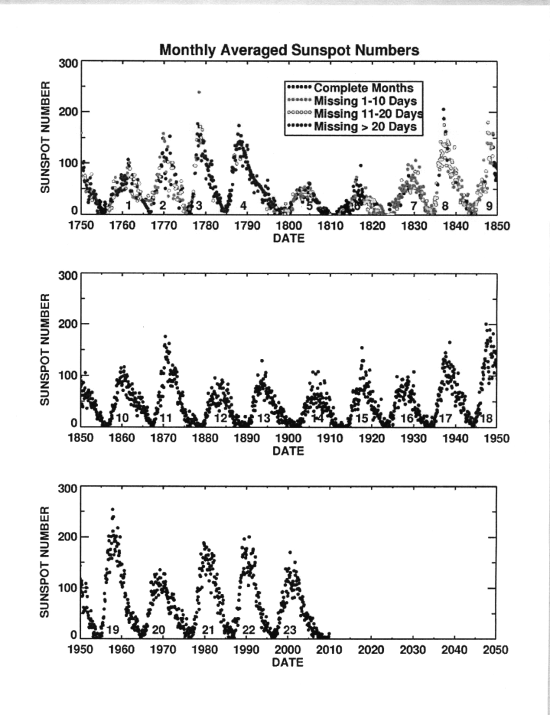
Once again, the evidence is building that the Sun might be heading towards the weakest maximum seen to two centuries. And when that happened, things got very cold on Earth.
Big news! Scientists have discovered the first rocky terrestrial planet orbiting its sun at a distance where life as we know it could form. The planet itself has a mass three to four times Earth, so no matter what, conditions on its surface would be very different than here. Nonetheless, this is a major discovery, and is only the first of many. Key quote:
The discovery suggests habitable planets must be common, with 10 to 20 per cent of red dwarfs and sun-like stars boasting them, the team says. That’s because Gliese 581 is one of just nine stars out to its distance that have been searched with high enough precision to reveal a planet in the habitable zone.
We won’t know if the Japanese probe Hayabusa actually brought asteroid materials back to Earth until spring 2011. Key quote from the project scientist:
Kawaguchi said his science team found “tens of particles” in Chamber A of the canister. The tiny particles are being removed one-by-one in an extraction process that is stretching longer than anticipated.
Note that they still have not opened Chamber B, which is thought to have had a better chance of capturing asteroid material because it was the chamber in contact with the asteroid Itokawa.
Back from the dead! A new study has found that scientists are significantly over-estimating the number of animal extinctions, with approximately one third of the so-called “extinct” species turning up alive. This quote makes one wonder if politics have been a factor:
The mistakes cannot be blamed on primitive technology or old fashioned scientific methods. “Mammals missing in the 20th century were nearly three times as likely to be rediscovered as those that disappeared in the 19th century.”
NASA climate scientist James Hansen was arrested yesterday in a Washington, D.C. protest against mountaintop mining.
The launch of China’s next lunar probe, Chang’e 2, could occur as soon as this Friday.
Volcanic activity in northwest Saudia Arabia.
A new survey telescope, designed to scan the entire available sky approximately three times every month, has discovered its first potentially hazardous asteroid (PHO) , 150 feet in diameter and set to speed past the Earth at a distance of 4 million miles in mid-October. Key quote:
Most of the largest PHOs have already been catalogued, but scientists suspect that there are many more under a mile across that have not yet been discovered. These could cause devastation on a regional scale if they ever hit our planet. Such impacts are estimated to occur once every few thousand years.
How most popular press science articles are written.
A new study suggests that the glacier ice loss in Antarctica and Greenland is less than originally thought.