Space Force awards SpaceX a $4.16 billion satellite contract, the second this week

The Space Force yesterday awarded SpaceX a $4.16 billion contract to build a satellite constellation to track all flying objects, in addition to the $2.29 billion contract it awarded the company earlier in the week for a different data/communications constellation.

The $4.16 billion Other Transaction Authority agreement is for the Space-Based Airborne Moving Target Indicator (SB-AMTI) program, which aims to develop and field a network of satellites carrying sensors that can continuously detect and follow airborne targets. The deal will allow the Space Force to field an AMTI constellation by 2028, Space Systems Command said in a press release.

Space Force officials also noted that this contract is only the first, and that it does not intend to rely just on SpaceX for this tracking constellation. It intends to use “a highly diversified pool of traditional and non-traditional vendors, each bringing various capabilities” to the system.

Regardless, SpaceX’s satellite division this week won two Pentagon contracts worth more than $6 billion. Not bad work if you can get it.

10 comments

Space Force awards SpaceX $2.29 billion contract for military data constellation

In what is intended as an upgrade to the Starshield military variation of SpaceX’s Starlink constellation, the Space Force yesterday awarded SpaceX a $2.29 billion contract to launch a “data transport constellation in low Earth orbit (LEO) for the Space Data Network (SDN), which the service is developing as its central communications network to link sensors to shooters.”

Under the Other Transaction Authority agreement, the company is to deliver “a fully operational prototype capability by the end of 2027,” Space Systems Command (SSC) said in a press release.

The SDN Backbone, formerly known as MILNET and based on SpaceX’s Starshield militarized variant of its commercial Starlink constellation, will serve as the backhaul data transport layer for the broader SDN. While the award to SpaceX is thus not a surprise, the size of the contract is.

It appears that the Pentagon has been so satisfied with its use of both Starlink and Starshield that it was quite willing to give SpaceX this new larger contract.

The good part of this story is that SpaceX is providing good service to the American people, through the Pentagon. The bad part of this story is that it is getting so little competition from the rest of the aerospace industry. This was work that Amazon could have won, had its Leo constellation been operational and competitive. It is not, as yet, and so it loses business. As the saying goes, “He who hesitates is lost.” And sadly a lot of old and even new aerospace companies have been hesitating.

9 comments

Rocket Lab wins $90 million Space Force contract to build two geostationary satellites

Rocket Lab yesterday announced it has been awarded a $90 million contract by the Space Force to build two geostationary satellites for the military’s “space doman awareness” constellation.

Though Rocket Lab has built and launched a number of low Earth orbit (LEO) satellites for both commercial and military customers, these two satellites will be the first in geosynchronous orbit.

Rocket Lab will serve as prime contractor and end-to-end mission provider, responsible for spacecraft design and manufacture, integration of the in-house Heimdall optical payload produced by Rocket Lab Optical Systems, launch integration onto a government-furnished launch vehicle, and on-orbit operations for up to five years following commissioning. The two satellites will be built on Rocket Lab’s Lightning bus, adapted for the thermal, radiation, propulsion, and station-keeping demands of GEO.

Though Rocket Lab is mostly considered a rocket company, it has done an excellent job diversifying its capabilities so as to sell aerospace products across a range of areas. This contract continues that successful trend.

0 comments

Space Force study says it needs a third spaceport besides Cape Canaveral and Vandenberg

According to the head of Air Force at a House hearing yesterday, the Space Force is about to complete a study that concluded the military will need a third spaceport besides Cape Canaveral and Vandenberg to accomplish its future space goals.

Air Force Secretary Troy Meink highlighted the finding during a May 20 House Armed Services Committee hearing, noting that the study is still moving through the approval process. The Space Force operates the nation’s busiest spaceports at Cape Canaveral Space Force Station, Fla., and Vandenberg Space Force Station, Calif.—both of which are running out of room. “At a high level, what it says is we probably need another site that’s capable of heavy and super heavy launch capability, both from a resiliency perspective and just, even at the Cape, limitations on how much space we’ve got,” Meink said.

He didn’t expand any further on the findings of the study, which was mandated by Congress in the Fiscal 2026 National Defense Authorization Act, and it’s not clear what locations the service is considering.

It is expected that both the Florida and California spaceports will be able to handle as many as 700 launches per year by the mid-2030s — based on all projections by all the private launch providers — but Meink indicated this will not meet the expected needs of the military, which expects to launch far more than that as part of its Golden Dome implementation. Though it hopes to meet some of this additional demand from other state- and privately-run spaceports, he implied even that will be insufficient.

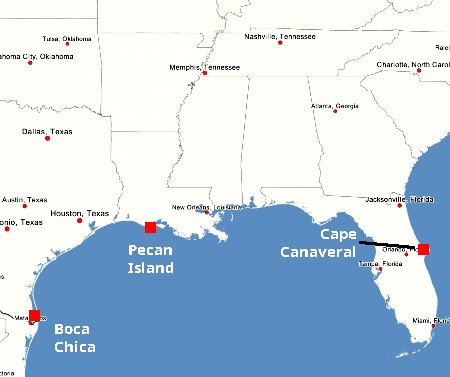
Pecan Island SpaceX facility?

I think Meink is looking at this issue backwards. Rather than proposing the Pentagon establish its own third spaceport, it should be partnering with the private and state launch providers to meet its needs. For one, if the rumors turn out to be true and SpaceX is buying that 200+ square mile plot of land at Pecan Island in Louisiana, it would make great sense for the Pentagon to demand SpaceX allow other launch providers to lease launchpads there. Not only will there be ample land for such additional launchpads, it will be the fastest and cheapest way to get what the military needs. Finding and buying its own facility will take more time and cost more.

I am of course assuming it is SpaceX that plans to buy that Louisiana land. Right now nothing is confirmed. It is even possible that it is the military itself that has been in discussions there, or if not, is about to insert itself into the mix.

6 comments

Multiple Russian, Chinese, and American satellites in maneuvering dance in orbit

Three different articles in the aerospace media today document multiple maneuvers by multiple military satellites from Russia, China, and America, either doing proximity operations near each other or moving close to another country’s satellites to spy on them.

This article in space.com describes the rendezvous operations of Russia’s Cosmos 2581, 2582, and 2583.

The satellites, known as COSMOS 2581 and COSMOS 2583, got within just 10 feet (3 meters) or so of each other on April 28, according to COMSPOC, a Pennsylvania-based space situational awareness software company. “This wasn’t a coincidental pass — COSMOS 2583 performed several fine maneuvers to maintain this tight configuration,” COMSPOC wrote in a May 1 post on X, which featured an animation of the rendezvous.

The two satellites and a third one, COSMOS 2582, launched to low Earth orbit in February 2025 atop a Soyuz rocket. According to COMSPOC, all three of them were involved in the recent rendezvous and proximity operations (RPO), as was “Object F,” a subsatellite previously deployed by COSMOS 2583.

Then russianspaceweb.com had two different articles describing different similar operations. First, a set of satellites launched in February 2026 appeared to be testing operations in very low orbit, illegally transmitting data using frequencies that the International Telecommunications Union (ITU) allocates for amateur radio operations.

Finally, the website reported a complex dance between Russian, American, and Chinese satellites in geosynchronous orbit.

Almost immediately after entering the geostationary orbit, Kosmos-2589 was “approached” by a presumed American inspector satellite, officially known as USA-325. On April 19, 2026, the US satellite, itself drifting eastward relative to the geostationary position and the Earth’s surface, seemingly overshot Kosmos-2589, but once the Russian satellite stabilized at 98 East longitude, USA-325 stopped and returned. By around April 28, 2026, … one approach under favorable lighting conditions for the “inspector” was within 13 kilometers from Kosmos-2589, according to a team of observers from Exton, PA, cited by COMSPOC.

In turn … Kosmos-2589 essentially occupied a position registered by China under designation CHNSAT-98E, with three Chinese commercial and military satellites deployed in relative vicinity of that location.

… Moreover, in April 2026, China’s presumed inspector satellite — TJS-10 — pre-positioned itself at 92.4 degrees East longitude after an easterly drift, which would put it on a rendezvous course with Kosmos-2589 at 98.0 East longitude. Instead, the Chinese satellite stopped its drift with a maneuver on May 1, 2026, which “fixed” it in a geostationary orbit at 92.4 degrees East longitude, in the vicinity of the US AEHF military satellite, which carries high-security communications of the US military and its allies.

With this last story, we have this almost absurd situation: The U.S. satellites are spying on Russian satellites, which are spying on Chinese satellites, which are spying on American satellites.

All this maneuvering however indicates once again that the ability of commercial satellites to rendezvous with other objects — either to de-orbit space junk or repair damaged satellites — is only going to get better. The military might control these capabilities now, under a veil of secrecy, but such capabilities always leak out into the private sector shortly thereafter.

2 comments

Space Force issues twelve companies Golden Dome contracts worth $3.2 billion

As part of the first phase of development of the proposed Golden Dome defensive system, the Space Force revealed this week that it has awarded twelve companies contracts worth $3.2 billion to develop the first prototype designs.

The service awarded other transaction authority (OTA) agreements — worth up to a combined $3.2 billion — to the vendors in late 2025 and early 2026, according to a Space Systems Command press release. Under the contracts, the companies will develop prototypes of a space-based architecture that can shoot down enemy missiles after they’re launched.

The companies that received OTAs are Anduril, Booz Allen Hamilton, General Dynamics Mission Systems, GITAI USA, Lockheed Martin, Northrop Grumman, Quindar, Raytheon, Sci-Tec, SpaceX, True Anomaly and Turion Space Corp.

The twelve companies have very different capabilities, suggesting the Space Force is hoping to get a lot of different ideas and proposals that will not only give it options but could also provide it multiple methods for destroying in-coming missiles.

9 comments

War Department conducts classified suborbital missile test from Cape Canaveral

The War Department yesterday launched an unidentified suborbital missile test from its Cape Canaveral Space Force Station in Florida, providing no public information about the rocket, the purpose of the launch, or who built it.

An unidentified missile launched and zoomed across the Atlantic Ocean Thursday, March 26, from Cape Canaveral Space Force Station, leaving a slim white contrail against the afternoon blue sky. None of the Space Coast’s major rocket-launch providers had missions scheduled on Thursday. The mysterious unannounced launch occurred at roughly 12:30 p.m.

The Pentagon did not respond to media requests for information.

The missile was likely a suborbital hypersonic test, but that is pure speculation. What makes it unusual is the lack of any information about launch provider. In recent years the military has relied entirely on the private sector to build its hypersonic test program. This launch suggests the War Department has moved from testing hypersonic components on private rockets, airplanes, and capsules to building and testing its own final hypersonic missile prototype.

This is also pure speculation. We will have to wait for some clarification from the Pentagon.

0 comments

Space Force shifts another ULA Vulcan launch to SpaceX

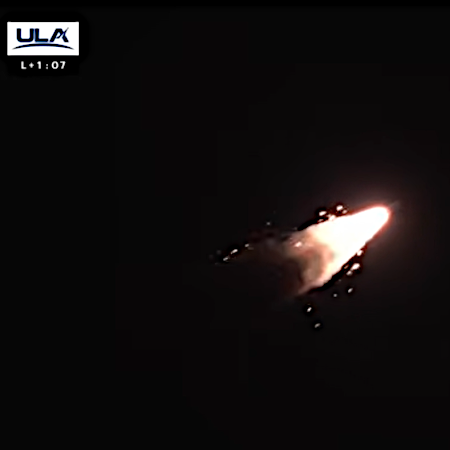
Unexpected debris falling from rocket at about T-1:00
Nozzle failure during February 12, 2026 Vulcan launch

As expected, the Space Force has taken its next GPS satellite launch from ULA’s Vulcan rocket and given it to SpaceX’s Falcon 9.

The reason for the change is the repeated problems with the solid-fueled side boosters used on Vulcan and built by Northrop Grumman. The nozzles on two different launches failed. Though the rocket’s core stage in both cases was able compensate and get the payload into the proper orbit, the Space Force decided in late February to suspend further launches on Vulcan until ULA gets the problem fixed and proves it by launching other commercial payloads.

The Space Force however is not yet reducing the number of launches it has purchased from ULA, merely delaying them.

If all goes to plan, the satellite — the 10th and final one in the GPS III line — will lift off no earlier than late April from Space Launch Complex 40 at Cape Canaveral Space Force Station in Florida [on a Falcon 9].

Vulcan Centaur, in return, will launch USSF-70, a national security mission that had been manifested on a SpaceX Falcon Heavy. USSF-70 will fly no earlier than summer 2028, according to Space Force officials.

Nonetheless, the situation is not good for ULA. This is the third such ULA launch the Space Force has shifted to SpaceX. At some point, if ULA doesn’t get the problem fixed the military it will be forced to reduce its reliance on Vulcan.

16 comments

Kratos wins $446 million contract to build/operate ground system for Space Force satellite constellation

The military contractor Kratos Defense & Security Solutions was yesterday awarded a $446 million contract by the Space Force to build and operate the ground systems used to control the military’s missile warning satellite constellation.

The contract covers ground management and integration for the service’s Resilient Missile Warning and Tracking program, according to a March 19 statement from Space Systems Command. Kratos will provide the systems used to operate the satellites after launch, including sending commands, receiving sensor data and processing that information for delivery to military operators.

The work supports a constellation being deployed in phases. The first 12 satellites, known as Epoch 1, are being built by Millennium Space Systems, a Boeing subsidiary. A second set of 10 satellites, called Epoch 2, is under contract to BAE Systems. Launches are expected over the next several years.

The method in which this entire constellation is being built and operated once again highlights the profound transformation that has occurred in how the Pentagon works in space since the formation of the Space Force. Beforehand, when the Air Force ran the military’s space operations, it would attempt to design and build everything, and the satellites built would be big and expensive, and take years to complete. Generally, little got built for a lot of money. Moreover, the upper management of the Air Force was in general not interested in space projects, and often gave these projects lower priority.

The Space Force was created during Trump’s first term to change this, giving the military an agency focused on its space needs. It was also designed to put those in charge who had been advocating going from these big gold-plated satellites that were few in number to many small satellites built quickly and cheaply by the private sector.

This new missile warning and tracking constellation demonstrates that this transition is largely complete. It is being built quickly by two different satellite companies, and will be maintained on the ground by a third.

Note: Kratos also builds the hypersonic test vehicles that Rocket Lab launches on its HASTE suborbital rocket. It will soon also fly those vehicles on a Firefly rocket.

1 comment

Space Force suspends use of ULA’s Vulcan rocket

Space Force officials yesterday made it official, that it has suspended all further military launches using ULA’s Vulcan rocket, due to the nozzle failure in one of the rocket’s solid-fueled strap-on boosters during the last launch on February 12, 2026.

The Space Force is pressing pause on all military launches on United Launch Alliance’s Vulcan rocket as officials investigate a recent anomaly they say could take “many months” to resolve.

That means launch plans for a GPS III satellite slated to fly on the brand new rocket next month are in flux, according to Col. Eric Zarybinsky, program executive officer for assured access to space. “I’m going to look for every flexibility I have to make sure that I can deliver warfighter capability as quickly as possible,” Zarybinsky told reporters at AFA’s Air Warfare Symposium here. “I’ve got a number of tools in my toolkit to do that, but until this anomaly is all over, we will not be launching National Security Space Launch missions on Vulcan.”

Though the rocket was able to get the payload to its proper orbit, despite the problem, this was the second Vulcan launch where a strap-on booster, built by Northrop Grumman, experienced a nozzle failure. In addition, another nozzle failure had occurred during a static fire test in 2025.

Prior to the February launch the Space Force had already shifted two launches from ULA’s Vulcan to SpaceX’s Falcon 9. At the moment ULA has seven military Vulcan launches scheduled for this year. Expect a considerable number to shift to SpaceX.

Blue Origin’s New Glenn rocket might also become an option, but the company must complete two more launches before the Space Force will certify it for national security launches. Considering that company’s slow pace in doing anything, it does not appear it will be able to take advantage of this situation.

ULA meanwhile had hoped to complete 18 to 22 launches in 2026, the majority using Vulcan. This decision by the Space Force likely means the company won’t complete more than five launches this year, most of which using its soon-to-be-retired Atlas-5 rocket.

2 comments

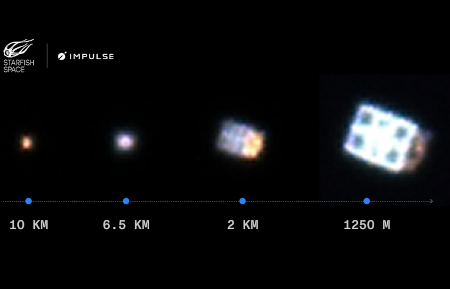
Starfish gets a second satellite servicing contract from Pentagon

The orbital tug startup Starfish has now won a second major satellite servicing contract from the military to use its Otter tug to either service or de-orbit defunct military satellites.

The first contract, announced in late January, was from the Space Force’s Space Development Agency (SDA) for $52.5 million. Under that deal, Starfish would fly an Otter in 2027 to dock with a satellite and then de-orbit it.

The new contract, announced February 7, 2026, is with the Pentagon’s APFIT program, designed to encourage “innovative technologies”. It is for an additional $54.5 million, and calls for Otter to dock with a satellite in 2028 and service it rather than de-orbit it.

The Otter is designed to autonomously dock with and maneuver national security satellites, maximizing their operational capabilities while supporting SSC’s [Space Systems Command] need for sustained space maneuver. The spacecraft leverages autonomous rendezvous, proximity operations, and docking technology, allowing it to service satellites that were not originally designed for servicing.

As I noted in January when the first de-orbit contract was announced, while a number of contracts have been issued in the U.S., Europe, and Japan to demonstrate de-orbit technology, that was the first operational de-orbit contract. As for servicing, Northrop Grumman has already succeeded several times in prolonging the life of defunct commercial geosynchronous satellites with its Mission Extension Vehicle (MEV).

Starfish’s Otter however has only successfully demonstrated rendezvous and proximity capabilities on two missions, with a third a failure. As for docking, its Otter Pup tug has flown two missions, with the first failing in 2023 when both spacecraft began spinning unexpected. The second mission is presently ongoing, and was supposed to achieve a docking by now. After completing rendezvous maneuvers in September Starfish has provided no new updates. As far as we know, the docking never occurred or was a failure.

These contracts however suggest it has succeeded. Why else would the military suddenly issue more than $100 million in contracts to the company?

0 comments

New ground-based space antenna startup raises $100 million and wins $50 million Space Force contract

In a clear sign that the space industry in space now requires increased support on the ground, the ground-based space antenna startup, Northwood Space, this week announced it has raised $100 million in private investment capital even as it simultaneously won a $50 million Space Force contract.

The funding round, announced January 27, was led by Washington Harbour Partners and co-led by Andreessen Horowitz. The financing came on the heels of a $49.8 million contract that was signed with the United States Space Force to help improve the “satellite control network,” which “handles a huge variety of consequential space missions for our government,” said Bridgit Mendler, founder and CEO.

Northwood is an end-to-end ground infrastructure provider for space missions. In other words, it manufactures and deploys antennae systems, which are smaller than older models, that allow Earth to communicate with satellites in space.

Northwood was only formed three years ago, so its success is an clear indication that there is a real need for more and better ground-based facilities.

1 comment
1 2 3 14