Caves on the Moon!

Scientists have now identified more than 200 cave pits on the Moon.

The pits range in size from about 5 meters (~5 yards) across to more than 900 meters (~984 yards) in diameter, and three of them were first identified using images from the Japanese Kaguya spacecraft. Hundreds more were found using a new computer algorithm that automatically scanned thousands of high-resolution images of the lunar surface from LRO’s Narrow Angle Camera (NAC).

This work is essentially the same as that done by James Fincannon and I back in 2011 (see links here, here, here, and here) but with much greater thoroughness.

8 comments

Europe readies its own space plane for test flight

The competition heats up: Europe ‘s Intermediate eXperimental Vehicle (IXV) is undergoing its final tests before it does a suborbital test flight in November.

IXV will be launched into a suborbital trajectory on ESA’s small Vega rocket from Europe’s Spaceport in French Guiana, the vehicle will return to Earth as though from a low-orbit mission. For the first time, it will test and qualify European critical reentry technologies in hypersonic flight, descend by parachute and land in the Pacific Ocean to await recovery and analysis. IXV is manoeuvrable and able to make precise landings—it is the ‘intermediate’ element of Europe’s path to future developments with limited risks. …

When IXV splashes down in the Pacific at the end of its mission it will be recovered by ship and returned to Europe for detailed analysis to assess the performance and condition of the internal and external structures. The actual performance will be compared with predictions to improve computer modelling of the materials used and the spaceplane’s design.

Though exciting, Europe will have to pick up the pace from its normally slow pace on these kinds of projects if it expects to be competitive. In the past, they would stretch out the development as long as they could in order to keep the cash flowing. This won’t work in the increasingly robust aerospace market that exists today.

0 comments

UrthaCast progress

The competition heats up: UrthaCast has announced the status of the commissioning of its commercial cameras on ISS for viewing the Earth.

The medium resolution camera has been commissioned and is available for commercial imaging. The high resolution camera, however, has a problem with its pointing system which is requiring troubleshooting.

The Bi-axial Pointing Platform (“BPP”), which controls the pointing of the [High Resolution camera (HRC)], is experiencing difficulties in achieving the pointing control precision needed for the HRC to meet image quality specifications. Our engineering team together with RSC Energia believes it has developed a solution to this problem using existing gyroscopes on the HRC to improve the BPP pointing control. This solution has been successfully tested on the ground. The on-orbit implementation of this solution requires software updates and the installation of additional cabling inside the Zvezda module. These new cables need to be delivered to the International Space Station (ISS). As a result, there will be a several month delay in commissioning the HRC.

0 comments

Another ISEE-3 update

The team trying to resurrect ISEE-3 had very mixed results in its attempt today to get the spacecraft’s propulsion system working.

They managed to get “several instances of thrust,” which suggests there is fuel, the system can function, and that their strategy is on the right track. They did not however get full thrust as hoped, and are not quite sure why the spacecraft only partly responded. They are analyzing the data while they apply to NASA for an extension of their license to transmit to the spacecraft.

This last point is merely a formality. What can NASA do if they continue anyway? Nothing. NASA will say yes, partly because it is good public relations and partly because most of the people at NASA are also fans of this effort.

1 comment

The UAE wants to go to Mars

The competition heats up: The United Arab Emirates (UAE) announced today that it is creating a space agency to build and launch an unmanned mission to Mars by 2021.

The announcement included this statement by his Highness Sheikh Mohammed bin Rashid Al Maktoum, Vice-President and Prime Minister of the UAE and Ruler of Dubai:

Despite all the tensions and the conflicts across the Middle East, we have proved today how positive a contribution the Arab people can make to humanity through great achievements, given the right circumstances and ingredients. Our region is a region of civilisation. Our destiny is, once again, to explore, to create, to build and to civilise. We chose the epic challenge of reaching Mars because epic challenges inspire us and motivate us. The moment we stop taking on such challenges is the moment we stop moving forward.

I wish them luck, since building spaceships and exploring the heavens is a far better occupation that trying to kill Jews. I remain skeptical however. They will have to show real achievement before I will believe this is something more than a simple feel-good public relations stunt by the UAE’s leaders.

2 comments

Another update on ISEE-3

Dennis Wingo has written a detailed report on the engineering analysis of ISEE-3, including what they plan to do on Wednesday to troubleshoot the problem and possible fix it.

The bottom line is that there is still a good chance they can get the spacecraft thrusters to fire and change the spacecraft’s trajectory. We will know more tomorrow.

0 comments

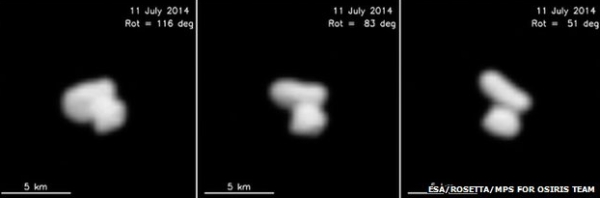
More images from Rosetta

67P

The comet that Rosetta will orbit is getting stranger and stranger, with new images suggesting that it is really two objects stuck together.

The pictures show that 67P/Churyumov-Gerasimenko appears to be not one but two objects joined together. It is what scientists call a “contact binary”. How the comet came to take this form is unknown. It is possible that 67P suffered a major fracture at some point in its past; it is also possible the two parts have totally different origins.

What is clear is that the European Space Agency (Esa) mission team now has additional and unexpected considerations as it plans how to land on the comet later this year – not least, which part of the comet should be chosen for contact?

1 comment

DARPA awards contracts for XS-1 spaceplane

The competition heats up: DARPA has announced contract awards to three companies for the construction of its experimental XS-1 spaceplane, designed to take off and land like a airplane.

The contracts go to Boeing, Northrop Grumman, and Masten Space Systems, and have them each respectively partnered with Blue Origin, XCOR, and Virgin Galactic. More details on the Boeing contract can be found here.

The description of the XS program is quite exciting:
» Read more

6 comments

Great Britain’s proposed suborbital spaceport locations

The competition heats up: More information was released today describing Great Britain’s suggested spaceport locations.

These spaceports are specifically aimed at the suborbital space tourism market, for American companies like Virgin Galactic or XCOR, or for the developing British company Skylon.

It is interesting that 6 of 8 are located in Scotland, which might very well not be part of the United Kingdom after a vote on separation this fall.

1 comment
1 1,117 1,118 1,119 1,120 1,121 1,328