
A look at the Chinese space program
A look at the Chinese space program.
A look at the Chinese space program.
Now why didn’t they think of this before? The ISS partners met today to discuss how to use the space station as a test bed for missions beyond low Earth orbit.
As I wrote in Leaving Earth, a space station is nothing more than a prototype interplanetary spaceship. This kind of research is really its main purpose, and I am glad that the governments running ISS are finally beginning to recognize it, even though their engineers have known it for decades. Note too that the press release above also gives a nice overview of some of the ongoing research on ISS that is directly related to learning how to survive in space for long periods.
Juno, the U.S.’s next Jupiter probe, headed to the launchpad on Friday for a planned August 5 launch.
In a piece today at the Huffington Post, science journalist Seth Borenstein declares the wonders of NASA’s next mission: to send astronauts to an asteroid by 2025, as declared by President Obama.
If you believe this is going to happen, then I have a bridge I want to sell you. To do it we need a spaceship in which people can live for at least a year, and a rocket to get that ship into orbit. Not only do we not yet know how to build such a spaceship, we no longer have the capability of putting it into orbit. In case you’re unaware (Borenstein acts like he is), the space shuttle no longer exists. And under this administration and Congress, any replacement we get isn’t going to be able to launch such an interplanetary spaceship anywhere in the near future, especially faced as we are with the present federal debt.
The disgraceful thing about this article, however, is the lack of skepticism shown by Borenstein.
» Read more
A public test of privately built moon lander has been delayed by gyro problem. Key quote:
One customer has already bought a ticket with Moon Express, asking them to deposit a small telescope on the dark side of the Moon. Jain says the company will also offer low cost ways for anyone to use the moon as a kind of time capsule. “If something goes to the moon it stays there forever, people will pay to sends things like photos, or maybe your hair or DNA.”
Turf war: At conference yesterday at the Johnson Space Center, NASA proposed changing how it issues its commercial space contracts so as to give it more control over their design and construction. The commercial companies are not happy.
Brett Alexander, a space industry consultant who counts among his clients the secretive aerospace startup Blue Origin of Kent, Wash., said at the July 20 briefing that industry needs to know NASA’s legal reasoning for dismissing SAAs as an option for the next CCDev round. “From an industry standpoint … we’re kind of flying blind because [NASA] has not divulged what its legal reasoning is, and I think they need to do that in writing. Not a couple charts, not things that you brief, but a legal brief that says ‘here’s why’” a traditional procurement is necessary.
My own sources say this change in contractual approach will significantly slow development of the new commercial manned space rockets and ships, possibly beyond 2017.
The only reason I can see for NASA to do this is to maintain control over manned space, even if they are not building anything. I think NASA is instead going to find out that doing anything to slow this development will be politically very dangerous for them.
The delay until early next year of the first Taurus 2/Cygnus launch was in order to install required launchpad upgrades.
Via Clark Lindsey: Orbital Sciences has announced an updated launch schedule for its cargo ship and rocket for supplying ISS.
The first test flight of Taurus II is set for late this year, with the first flight of the Cygnus cargo ship set for the first quarter of 2012.
Texas Governor Rick Perry, as well as other lawmakers from Congress, blasted Obama today over the shuttle retirement.
Bah. Perry claims to be a so-called small government conservative, yet he wants the government to spend a fortune to build and run the space program. Meanwhile, Senators John Cornyn (R-Texas) and Kate Bailey Hutchinson (R-Texas) were around in Congress when President George Bush announced the shuttle’s retirement seven years ago. Their effort since then to fund pork through NASA and thus have NASA build a giant new rocket system, either Constellation or its new Congressionally-designed replacement, has been a disaster. Right now it would be better, and far cheaper, if they stopped fighting the new commercial space companies and instead get behind them, especially since the Obama administration itself has done a very poor job of selling this new industry.
A little support from Congress could go a long way to not only reinvigorating the aerospace industry, it could speed our country’s return to manned space, with multiple competing companies.
The shuttle Atlantis has landed, ending the shuttle program.
The planning dates have been set for the first Dragon cargo mission to ISS.
Bumped: I posted this essay last July 20th on the anniversary of the Apollo 11 landing on the moon. I think it is worth rereading again, even as the shuttle is about to return to Earth for the last time.
Today, July 20th, is the anniversary of the Apollo 11 landing on the Moon, the first time ever that a human being arrived on another planet. Americans love to celebrate this event, as it symbolizes one of the finest moments in our history, when we set out to achieve something truly great and noble and succeeded far better than we could have imagined. Not only did we get to the Moon as promised, over the next three and a half years we sent another five missions, each with increasingly sophisticated equipment, each sent to explore some increasingly alien terrain. Forty-plus years later, no one has come close to matching this achievement, a fact that emphasizes how difficult it was for the United States to accomplish it.
There is one small but very important detail about the Apollo 11 mission, however, that most Americans are unaware of. In mounting the American flag, the astronauts found the lunar surface much harder than expected. They had a great deal of trouble getting the flagpole into the ground. As Andrew Chaikin wrote in his book, A Man on the Moon, “For a moment it seemed the flag would fall over in front of a worldwide audience, but at last the men managed to steady it.” Then Armstrong took what has become one of the world’s iconic images, that of Buzz Aldrin standing on the lunar surface saluting the flag of the United States of America.
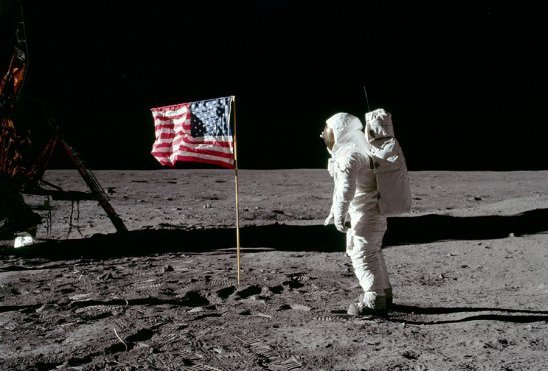
What people don’t know, however, is that when Armstrong and Aldrin blasted off from the lunar surface, the blast wave from the Lunar Module’s rocket knocked the flag over. As Chaikin also wrote, “Outside, a spray of gold foil and debris from the descent stage flew away in all directions. The flag toppled to the dust.”
Thus, for the last four decades this American flag, shown so proudly unfurled on the surface of the Moon, has actually been lying unceremoniously on the ground, in the lunar dust.
It might actually be possible to see this, though the photos at this time remain unclear and quite blurry.
» Read more