SpaceX’s manned Freedom capsule has undocked with ISS with its crew of four

SpaceX’s manned Freedom capsule tonight undocked with ISS, carrying with it the two astronauts that launched with it in September as well as the two astronauts that launched on Boeing’s Starliner capsule in June.

At 1:05 a.m. EDT Tuesday, NASA astronauts Nick Hague, Suni Williams, and Butch Wilmore, along with Roscosmos cosmonaut Aleksandr Gorbunov undocked from the space-facing port of International Space Station’s Harmony module aboard the SpaceX Dragon spacecraft.

Splashdown is scheduled for 5:57 pm (Eastern) March 18, 2025 off the coast of Florida. I have embedded the NASA live stream below.

Normally the transfer of control of the station from the old crew to the new one takes about a week. In this case NASA cut that transfer time to only three days because of the political desire to get the Starliner astronauts home more quickly. The irony is that NASA decided to leave them up there for almost seven months more than planned in order to disturb its normal ISS launch and crew schedule as little as possible. This effort now to shorten their spaceflight by a few measly days seems quite trivial in comparison.
» Read more

6 comments

Rocket Lab launches the last of five missions for French satellite company

Rocket Lab today successfully completed the last of a five missions contract for the French satellite company Kinéis, its Electron rocket lifting off from one of its two launch pads in New Zealand.

This was Rocket Lab’s second launch in only two days.

The leaders in the 2025 launch race:

31 SpaceX
13 China
4 Russia
4 Rocket Lab

SpaceX still leads the rest of the world in successfully launches, 31 to 24.

0 comments

The next time someone tells you Mars lacks water, show them this picture

Lots of near surface ice on Mars
Click for original image.

In the past decade orbital images from Mars have shown unequivocally that the Red Planet is not the dry desert imagined by sci-fi writers for many decades prior to the space age. Nor is it the dry desert that planetary scientists had first concluded based on the first few decades of planetary missions there.

No, what the orbiters Mars Reconnaissance Orbiter (MRO) and Mars Express have clearly shown is that, except for the planet’s equatorial regions below 30 degrees latitude, the Martian surface is almost entirely covered by water ice, though it is almost always buried by a thin layer of protective dust and debris. Getting to that ice will be somewhat trivial, however, as it is almost always near the surface.

The picture to the right, rotated, cropped, reduced, and sharpened to post here, is a perfect example. It was taken on January 31, 2025 by the high resolution camera on MRO. At the top it shows part of a small glacial-filled crater surrounded by blobby ground clearly impregnated with ice. That crater in turn sits on the rim of a much larger very-eroded ancient 53-mile-wide crater whose floor, also filled with glacial debris, can be seen at the bottom of this picture. The wavy ridge line at the base of the rim appears to be a moraine formed by the ebb and flow of the glacial ice that fills this larger crater.

None of these glacial features is particularly unique on Mars. I have been documenting their presence now at Behind the Black for more than six years. Yet, I find still that most news organizations — including many in the space community — remain utterly unaware of these revelations. Any new NASA or university press release that mentions the near-surface ice that covers about two-thirds of the planet’s surface results in news stories claiming “Water has been found on Mars!”, as if this is a shocking new fact from a place where little water is found.

It is very shameful that so many reporters and news organizations are so far out of touch with the actual state of the research on Mars.
» Read more

11 comments

Webb captures infrared images of five exoplanets orbiting two different stars

Four gas giants in infrared
Click for original image.

Using the Webb Space Telescope, astronomers have taken two different direct false-color infrared images of exoplanets orbiting the stars HR 8799 (130 light years away) and 51 Eridani (97 light years away.

The image of the four gas giants orbiting HR 8799 is to the right, cropped, reduced, and slightly enhanced to post here. From the caption:

The closest planet to the star, HR 8799 e, orbits 1.5 billion miles from its star, which in our solar system would be located between the orbit of Saturn and Neptune. The furthest, HR 8799 b, orbits around 6.3 billion miles from the star, more than twice Neptune’s orbital distance. Colors are applied to filters from Webb’s NIRCam (Near-Infrared Camera), revealing their intrinsic differences. A star symbol marks the location of the host star HR 8799, whose light has been blocked by the coronagraph. In this image, the color blue is assigned to 4.1 micron light, green to 4.3 micron light, and red to the 4.6 micron light.

The Webb false color infrared picture taken of one of the exoplanets orbiting the star 51 Eridani is also at the link, showing “a cool, young exoplanet that orbits 890 million miles from its star, similar to Saturn’s orbit in our solar system.”

The data from the HR 8799 image suggests these gas giants have a lot of carbon dioxide gas, and thus might be growing by pulling in material from the star’s accretion disk.

0 comments

Norway awards the German rocket startup Isar Aerospace a two-satellite contract

Proposed spaceports surrounding Norwegian Sea

In what appears to be a concerted effort by Norway to cement the establishment of its Andoya spaceport on its northwest coast, last week it awarded a two-satellite launch contract to the German rocket startup Isar Aerospace, launching from that spaceport.

The launch is scheduled until 2028 and will take place from Andøya Spaceport, Europe’s first operational spaceport on the mainland. The agreement between the Norwegian Space Agency and Isar Aerospace involves launching two Norwegian satellites as part of the AOS program, a national maritime surveillance system.

Isar is now gearing up for the very first orbital test launch of its Spectrum rocket, which will also be the very first from Andoya, and the very first from the four proposed spaceports in Europe. Regulatory filings from Norway suggest it will occur during a ten-day launch window beginning on March 20, 2025, but Isar has not yet confirmed this.

Unlike the two UK spaceports, which have been delayed years due to government red tape, Norway’s government has apparently worked hard to cut red tape and help Isar get off the ground quickly. It also appears that Norway’s government is acting to stymie Sweden’s Esrange spaceport, releasing a report last week that suggested it will not give permission for launches over its territory from Esrange.

0 comments

Varda’s third capsule begins orbital operations

Varda's space capsule, on the ground in Utah
Varda’s first capsule on the ground in Utah.

The in-space commercial company Varda on March 15, 2025 confirmed that its third capsule has successfully begun orbital operations after its launch on a Falcon 9 rocket, carrying an Air Force payload that will test measuring the capsule’s re-entry speeds in connection with military hypersonic research.

W-3’s payload is an advanced navigation system called an Inertial Measurement Unit (IMU) developed by the US Air Force and Innovative Scientific Solutions Incorporated (ISSI). This payload will be tested at reentry speeds it was designed to withstand but has never encountered before.

This payload is part of a $48 million Air Force contract awarded to Varda in December. The company also notes in the press release that it is aiming for a monthly launch rate for its capsules, which provide customers an opportunity to do all kinds of in-space testing and manufacturing. Since this launch took place only fifteen days after the landing of its second capsule, it appears Varda is moving swiftly in that direction, thus providing more business for American rocket startups.

The capsule includes a service module built by Rocket Lab, and will stay in orbit several weeks before it returns to Earth, landing at the Koonibba Test Range in South Australia, operated by the Australian commercial spaceport startup Southern Launch.

3 comments

Chinese pseudo-company launches 8 satellites

The Chinese pseudo-company Galactic Energy today successfully placed eight remote-sensing satellites into orbit, its solid-fueled Ceres-1 rocket lifting off from the Jiuquan spaceport in northwest China.

No word on where the rocket’s lower stages crashed inside China.

This was Ceres-1’s eighteenth launch, making Galactic Energy the most successful rocket pseudo-company so far in China. That its rocket uses solid-fueled shows us however that it is strongly tied to China’s military, and likely controlled tightly by it.

The leaders in the 2025 launch race:

31 SpaceX
13 China
4 Russia
3 Rocket Lab

SpaceX still leads the rest of the world in successfully launches, 31 to 23.

0 comments

Russia launches classified satellites

Early this morning Russia successfully placed three classified satellites into orbit, its new Angara-1.2 rocket lifting off from its Plesetsk spaceport in northeast Russia.

Little information about the launch was released, and none about the satellites. This was the rocket’s fourth straight launch success from Plesetsk, beginning in 2022.

The leaders in the 2025 launch race:

31 SpaceX
12 China
4 Russia
3 Rocket Lab

SpaceX still leads the rest of the world in successfully launches, 31 to 23.

0 comments

Norway questions Sweden’s plan to launch orbital rockets from Esrange spaceport

Proposed spaceports surrounding Norwegian Sea

In the capitalist competition between Norway, Sweden, and the United Kingdom to establish Europe’s prime launch site, Norway’s government has now issued a long study questioning Sweden’s plan to launch orbital rockets from its Esrange spaceport, since polar launches heading north from there will have to cross Norway.

You can read the report here [pdf]. For Esrange to conduct orbital launches it will need the permission of Norway for each launch, and it appears Norway is not satisfied with Sweden’s assessments that say launches can occur safely. The report concludes:

Norway recommends that the relevant Norwegian authorities conduct an assessment of the risks a launch will pose to the people in Norway and Norwegian interests, and determine whether this risk is acceptable, taking into account the interests and safety of the Norwegian people and the severity of the risk.

…Due to the significant economic costs associated with the impact on oil and gas production in
the Barents Sea, CAA Norway recommends that no launches be permitted in areas where there
is any risk to Norwegian oil and gas installations.

The release of this report illustrates Norway’s geographic advantages. The German rocket startup Isar is gearing up to do its first launch from Norway’s new spaceport, Andoya, possibly before the end of this month. It will have a clear path to space. Meanwhile, the American rocket startup Firefly, which wants to launch from Esrange, faces serious regulatory hurdles from neighboring countries, like Norway, because any rocket must fly over their territories.

5 comments

Four more launches, two by SpaceX, following manned launch

Following SpaceX’s successfully launch of four astronauts to ISS yesterday afternoon, the launch industry upped the pace by completing four more launches in the next few hours, two by SpaceX, one by Rocket Lab, and one by China.

Beginning with SpaceX, it first launched another one of its Transporter missions, carrying about three dozen smallsat payloads, its Falcon 9 rocket lifting off from Vandenberg. The first stage completed its thirteenth flight, landing on a drone ship in the Pacific. The two fairings completed their eighth and eleventh flights respectively.

Five hours later the company launched another 23 Starlink satellites, the Falcon 9 lifting off from Cape Canaveral in Florida, with the first stage completing its eighteenth flight, landing on a drone ship in the Atlantic.

Rocket Lab meanwhile successfully placed the first of eight commercial radar satellites into orbit for the Japanese satellite company iQPS, its Electron rocket launching from one of its two launchpads in New Zealand.

China in turn used its Long March 2D rocket to place two satellites into orbit, lifting off from its Jiuquan spaceport in northwest China. Its state-run press provided little information about either satellite. Nor did it provide any information about where the rocket’s lower stages — using very toxic hypergolic fuel — crashed inside China.

The leaders in the 2025 launch race:

31 SpaceX
12 China
3 Russia
3 Rocket Lab

SpaceX still leads the rest of the world in successfully launches, 31 to 22.

0 comments

SpaceX launches new crew to ISS

Falcon 9 first stage barreling home to Florida
Falcon 9 first stage barreling home to Florida tonight.

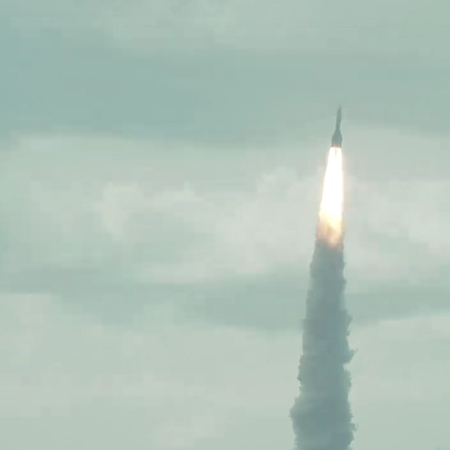
After a scrub two days ago due to a ground equipment issue, SpaceX tonight successfully launched a new crew of four to ISS, its Falcon 9 rocket lifting off from Kennedy in Florida.

The Dragon capsule is Endurance, on its fourth flight. The first stage completed its third flight, landing back in Florida.

This launch will allow the two-person crews launched by Boeing’s Starliner capsule in June and SpaceX’s Freedom capsule in September to come back home on Freedom.

When it was decided not to allow the Starliner astronauts to come home on Starliner because of thruster issues on the capsule, NASA decided to keep its ISS launch schedule as normal as possible, thus forcing that crew to complete a mission of about eight months, with a planned return in February 2025. Initially their Starliner mission was expected to last anywhere from two weeks to two months-plus, depending on how well Starliner functioned while docked to ISS.
» Read more

20 comments

Europe’s Hera asteroid probe sends back data from Mars fly-by

Deimos and Mars as seen by Hera
Click to see full movie.

The European Space Agency (ESA) Hera probe, on its way to study the Didymos/Dimorphos asteroid binary, has successfully sent back images and data obtained during its close-by of Mars yesterday.

The infrared image to the right, a screen capture from a short movie assembled from Hera’s first images, shows the Martian moon Deimos with Mars in the background. The mission scientists have compiled all of these first images taken by Hera to create a short movie, that I have embedded below. From the movie’s caption:

The car-sized Hera spacecraft was about 1000 km away from Deimos as these images were acquired. Deimos orbits approximately 23 500 km from the surface of Mars and is tidally locked, so that this side of the moon is rarely seen. Hera’s TIRI – supplied to the mission by the Japan Aerospace Exploration Agency, JAXA – sees in mid-infrared spectral bands to chart surface temperature. Because Deimos lacks an atmosphere, the side of the moon being illuminated by the Sun is considerably warmer than the planet beneath it.

Although it appears as if Deimos is passing in front of Mars from south to north, the image was actually taken as Hera passed very close to Deimos from north to south at high speed.

Deimos appears brighter than Mars. This means that the surface of airless Deimos is hotter than the surface of Mars. The material covering the surface of Deimos has low reflectivity and is pitch black. This allows it to absorb sunlight well and become hotter. In contrast, the surface of Mars is highly reflective, and its atmosphere transports heat from the warm daytime side to the cooler nighttime side. This is why there is a large temperature difference between Mars and Deimos.

These infrared images also tell us the excellent quality of the camera. Note how detailed the features are on the Martian surface. When Hera gets to Didymos/Dimorphos in December 2026 it is going to be able to document those two asteroids in remarkable detail, including the results of the Dart impact on Dimorphos in September 2022.
» Read more

0 comments
1 134 135 136 137 138 1,327