Europe targets 2031 for the first mission of its own lunar lander

The European Space Agency (ESA) has approved a target date of 2031 for the first mission of its own unmanned lunar lander, dubbed Argonaut, and launched on the most powerful version of the Ariane-6.

On 16 July, the agency published a call for Argonaut Mission 1 Phase A/B1 development aimed at demonstrating the technical and programmatic feasibility of the Argonaut mission concept. The call included a proposed launch date of 2031 for the first Argonaut mission to the Moon.

The Argonaut lunar lander will be launched aboard an Ariane 64 rocket. Once operational, ESA envisions it being used for a wide variety of applications, from cargo logistics to acting as an in-situ resource utilization plant. The agency has already completed pre-phase A studies for what it calls the European Charging Station for the Moon. This system would be launched aboard an Argonaut lunar lander and would essentially act as a gas station on the Moon that would be used to support crewed missions on the surface of the Moon.

As I’ve noted previously, ESA routinely sets a glacial pace on all its government-run projects. Do not expect this government lander to fly on this schedule. More likely by 2031 there will be many cheaper and available options from the private sector, and European companies wanting to put payloads down on the Moon will turn to those, especially because Argonaut is apparently being forced to use the expensive expendable Ariane-6 rocket. The cost for going on Argonaut is simply going to be too high.

0 comments

Martian taffy terrain

Martian taffy terrain
Click for original image.

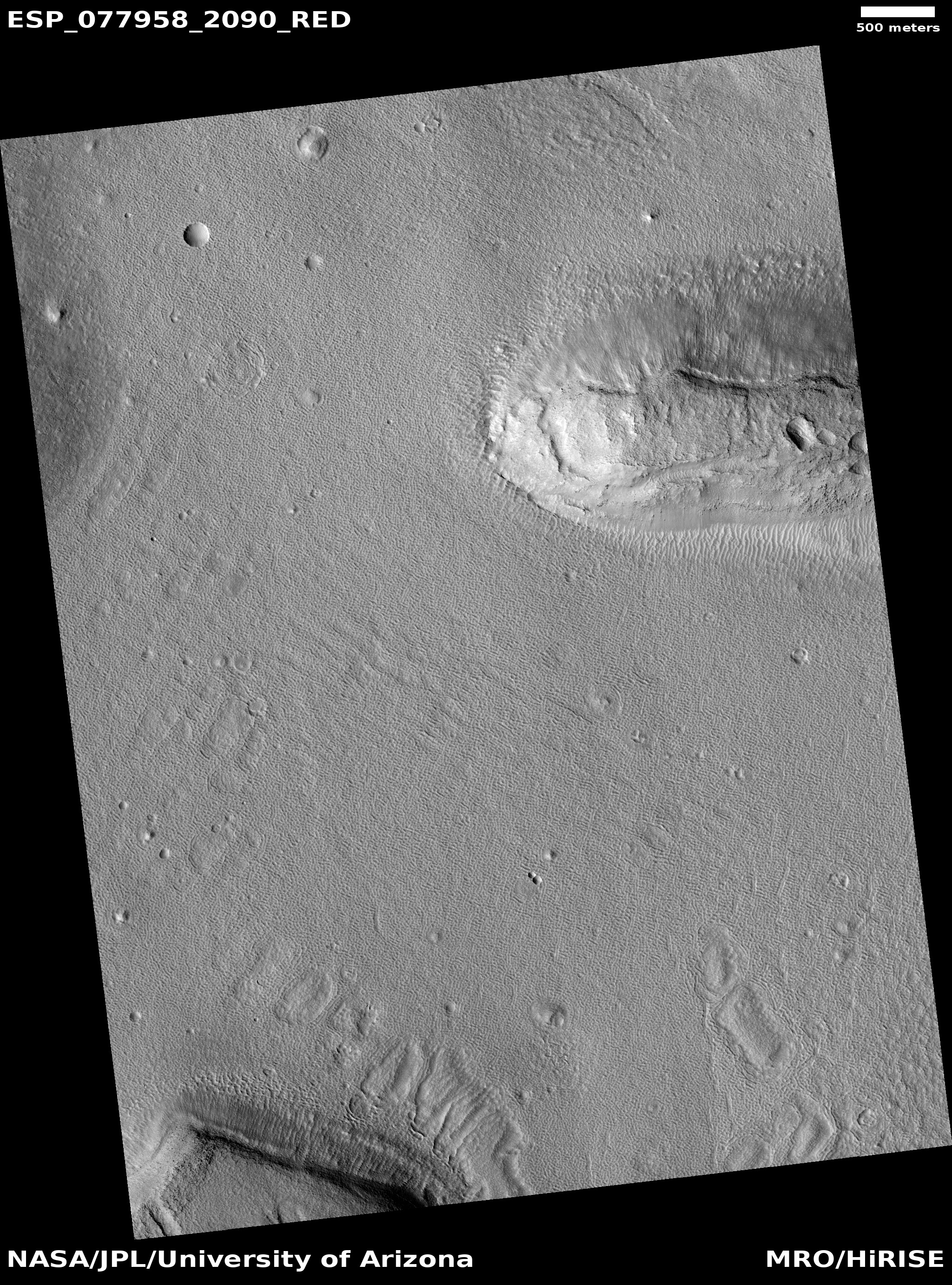
Cool image time! The picture to the right, rotated, cropped, reduced, and enhanced to post here, was taken on April 11, 2024 by the high resolution camera on Mars Reconnaissance Orbiter (MRO). It shows a typical area of what scientists have labeled “taffy terrain,” a landscape made up of strangely twisted bands that look like someone was pulling the ground repeatedly, just like taffy.

Based on the lower crater count found here, taffy terrain is thought to be relative young, formed around three billion years ago. While the exact formation process is not yet understood, scientists theorize that it was caused by some type of “viscous fluid” that settled into localized depressions.

The location is 40 degrees south latitude, so it is entirely possible we are seeing some form of glacial material, ice in these low spots that has no place to go but is warped over time by the same kind of tidal and rotational planetary effects that cause waves and tides in the oceans on Earth.
» Read more

0 comments

ESA announces asteroid mission to Apophis

Apophis' path past the Earth in 2029
A cartoon showing Apophis’s path in 2029

The European Space Agency (ESA) today announced that is beginning work on an asteroid mission, dubbed Ramses, to the potentially dangerous asteroid Apophis when it makes its next close-fly of the Earth in 2029.

Ramses needs to launch in April 2028 to allow for an arrival at Apophis in February 2029, two months before the close approach. In order to meet this deadline, ESA requested permission to begin preparatory work on the mission as soon as possible using existing resources. This permission has been granted by the Space Safety programme board. The decision whether to commit to the mission in full will take place at ESA’s Ministerial Council Meeting in November 2025.

Using a suite of scientific instruments, the spacecraft will conduct a thorough before-and-after survey of the asteroid’s shape, surface, orbit, rotation and orientation. By analysing how Apophis changes during the flyby, scientists will learn a lot about the response of an asteroid to external forces as well as asteroid composition, interior structure, cohesion, mass, density, and porosity.

Based on the track record of European space projects, which appear to always proceed at a glacial pace with late problems that cause the missions to miss their launch window (with the launch of the Franklin Mars rover as the poster child), the project is getting started far too late to meet its launch date of April 2028. We shall see if Europe surprises us this time and gets the project off the ground as planned.

Right now the only confirmed mission to Apophis is OSIRIS-APEX, which was redirected to the asteroid after it delivered its samples from Bennu to Earth. Many others have been proposed, including a commercial mission, but none appear to be confirmed or under construction.

2 comments

A blob in space

A blob in space
Click for original image.

Cool image time! The picture to the right, cropped, reduced, and sharpened to post here, was taken by the Hubble Space Telescope of the dwarf galaxy NGC 5238.

Its unexciting, blob-like appearance, resembling more an oversized star cluster than a galaxy, belies a complicated structure which has been the subject of much research by astronomers. Here, the NASA/ESA Hubble Space Telescope is able to pick out the galaxy’s countless stars, as well as its associated globular clusters — the glowing spots both inside and around the galaxy that are swarmed by yet more stars.

NGC 5238 is theorised to have recently — here meaning no more than a billion years ago! — had a close encounter with another galaxy. The evidence for this is the tidal distortions of NGC 5238’s shape, the kind produced by two galaxies pulling on each other as they interact. There’s no nearby galaxy which could have caused this disturbance, so the hypothesis is that the culprit is a smaller satellite galaxy that was devoured by NGC 5238.

Astronomers are hoping to use this image to detect the two different populations of stars within this blob that come from those once interacting galaxies.

4 comments

Webb infrared spectroscopy detects differences between morning and evening on tidally-locked exoplanet

Webb spectroscopic data
Click for original image.

Astronomers using Webb Space Telescope’s infrared spectroscopy have now detected distinct differences in the morning and evening atmosphere of a tidally-locked gas giant exoplanet.

The graph, cropped, reduced, sharpened, annotated to post here, shows the differences. From the caption:

Researchers using NASA’s James Webb Space Telescope have finally confirmed what models have previously predicted: An exoplanet has differences between its eternal morning and eternal evening atmosphere. WASP-39 b, a giant planet with a diameter 1.3 times greater than Jupiter, but similar mass to Saturn that orbits a star about 700 light-years away from Earth, is tidally locked to its parent star. This means it has a constant dayside and a constant nightside—one side of the planet is always exposed to its star, while the other is always shrouded in darkness.

Using Webb’s NIRSpec (Near-Infrared Spectrograph), astronomers confirmed a temperature difference between the eternal morning and eternal evening on WASP-39 b, with the evening appearing hotter by roughly 300 Fahrenheit degrees (about 200 Celsius degrees). They also found evidence for different cloud cover, with the forever morning portion of the planet being likely cloudier than the evening.

The actual temperatures of each terminator are quite hot, approximately 1,150 and 1450 degrees Fahrenheit respectively. Computer modeling suggests “the prevailing winds are likely moving from the night side across the morning terminator, around the dayside, across the evening terminator and then around the nightside,” with wind speeds thousands of miles per hour.

1 comment

More delays for first test hops of Europe’s Themis reusable first stage

Par for the course: The first test hops of Europe’s Themis demonstrator reusable first stage, first proposed in 2018, have now been delayed until 2025.

In a May 2024 presentation given at the International Civil Aviation Organization offices in Paris, the Swedish Space Corporation (SSC) announced that initial Themis hop tests would only begin next year. SSC is in charge of the operation of Esrange Space Centre in Sweden, where these initial tests of an integrated Themis demonstrator will begin. Once ArianeGroup moves onto higher altitude flights, the testing will be moved to the Guiana Space Centre.

The demonstrator itself is being built by a partnership of the private company ArianeGroup (Airbus and Safran) and the French space agency CNES, and was originallly supposed to begin test hops in 2022. These delays are typical of European government-run space operations. Note too that this is not a usable first stage, merely a demonstrator. For it to become operational it will have to be rebuilt.

None of this should be a surprise, since the man who runs Arianespace and is likely a key player in all this work, Stephan Israel, said in 2023 this stage would not become operational until the 2030s. Israel has been hostile to reusability from day one, and apparently is having some influence in slowing or blocking this development.

By the time this reusable first stage flies, it will be entirely obsolete and an utter waste of money, at least from a business and profit point of view. It will however have served these bankrupt companies and space agencies well as an empty jobs program, accomplishing little but make-work.

3 comments

Radar detects tiny moon of asteroid

Binary asteroid
Click for original image.

Using the Goldstone radar dish, part of NASA’s Deep Space Network normally used to communicate with planetary missions, scientists have taken radar imageray of an asteroid that flew past the Earth at a distance of about 4.1 million miles on June 27, 2024, and discovered that it has its own tiny moon.

The series of radar images are above, reduced and cropped to post here.

Passing Earth on June 27, 2024, the asteroid was discovered in 2011 by the NASA-funded Catalina Sky Survey, in Tucson, Arizona. This marked the first time it came close enough to Earth to be imaged by radar. While the nearly mile-wide object is classified as being potentially hazardous, calculations of its future orbits show that it won’t pose a threat to our planet for the foreseeable future.

In addition to determining the asteroid is roughly spherical, scientists at NASA’s Jet Propulsion Laboratory discovered that it’s a binary system: A smaller asteroid, or moonlet, orbits it from a distance of about 1.9 miles.

It is intriguing that as their ability to make high resolution images of asteroids improves, scientists are discovering that such binary asteroid systems appear to be less and less rare, and might even be quite normal. If so, these facts will reshape all theories on the initial formation processes of the solar system.

0 comments

FAA to “investigate” SpaceX launch failure

In what appears to be a perfect example of bureaucratic hubris, the FAA announced right after the Falcon 9 upper stage failure on July 11, 2024 that it “is requiring an investigation” and that it “will be involved in every step of the investigation process and must approve SpaceX’s final report, including any corrective actions.” The agency added:

A return to flight is based on the FAA determining that any system, process, or procedure related to the mishap does not affect public safety. In addition, SpaceX may need to request and receive approval from the FAA to modify its license that incorporates any corrective actions and meet all other licensing requirements.

It is difficult to count all the ways this announcement is arrogant and political.

First, why has the FAA made no such similar demands upon Boeing and its Starliner capsule, during any of its three flights, all of which have had serious issues? On the present manned flight, the failure of its thrusters during docking posed a safety issue to the crew then, and poses a clear safety issue to the public when it comes time for the capsule to return to Earth. If those thrusters don’t fire as planned Starliner could crash anywhere.

Yet the FAA has been entirely uninterested. Could it be because Boeing is not owned by Elon Musk, and the Biden administration isn’t demanding the FAA come down hard on it?

Second, does the FAA really think SpaceX wouldn’t do an investigation of the upper stage failure without an order from the FAA? If anything, left to its own devices it is more likely the FAA would do nothing — as it has done with Boeing with both Starliner and the issues that have occurred with both SLS and Orion. SpaceX however will do an investigation without question, because the company takes such incidents very seriously, and always fixes the problem so that it does not pop up again.

Third, there is absolutely no one at the FAA qualified to do this investigation, or to determine if SpaceX’s “corrective actions” are the right choice. These are bureaucrats, not cutting edge engineers. All they are going to do is watch SpaceX’s people do the work, kibitz a bit here and there, and then rubberstamp the conclusions of the company’s engineers, after making SpaceX wait while it retypes SpaceX’s report.

To claim the FAA has the ability to “approve” any engineering actions here is absurd.

Fourth, to threaten to deny SpaceX’s launch license for future Falcon 9 rockets — the most reliable and dependable rocket ever built — illustrates again the partisan nature of this action. The specificity of the agency’s demands here runs very counter to its demands after other past launch anomalies, involving both SpaceX and others. It is as if the agency has gotten orders to do whatever it can to micromanage everything SpaceX does in order to hinder its operation.

I still expect SpaceX to finish its investigation within weeks, and be ready to fly by the end of July, when the Jared Isaacman manned mission is scheduled. I also now expect the FAA to block that schedule and cause an additional several week delay as it slowly retypes SpaceX’s conclusions.

17 comments

FAA is apparently starting a new environmental impact assessment for Boca Chica

Damaged but working flap on Starship
Damaged but working flap during June 6, 2024
Starship/Superheavy test flight

Today I received the following email from the FAA:

Dear Interested Party:

The FAA is holding public meetings on the Draft Tiered Environmental Assessment (Draft EA) for SpaceX’s proposal to increase the number of launches and landings of its Starship/Super Heavy vehicle at the Boca Chica Launch Site in Cameron County, Texas. The Draft EA will analyze SpaceX’s proposal to increase its launch and landing cadence as follows:

  • Up to 25 annual Starship/Super Heavy orbital launches
  • Up to 25 annual landings of Starship
  • Up to 25 annual landings of Super Heavy

The Draft EA will also address vehicle upgrades.

There will be three public meetings, one on August 13, 2024 on South Padre Island, one on August 15, 2024 in Port Isabel, and the third a virtual zoom meeting on August 20, 2024. Anyone can register for the zoom meeting. For all the meetings, “The public will have an opportunity to submit written and oral comments during the meetings.” Expect the leftist anti-Musk, anti-SpaceX activists to come out in droves.

What is really significant about this is that SpaceX has applied to expand its operations at Boca Chica beyond the limitations set by the environmental reassessment issued in 2022. The FAA had said in that reassessment it would re-open it if and when SpaceX requested any changes. It has now done so.
» Read more

10 comments

A penguin and egg, as seen by Webb and Hubble

A penquin and egg compared
Click for original images.

Cool image time! The two pictures to the right, cropped, reduced, and sharpened to post here, were taken by both the Webb and Hubble space telescopes of the same unusual galactic object, officially called Arp 142 but nicknamed by astronomers the Penquin and the Egg.

Both of these objects are galaxies. The Penquin’s strange shape is caused by the presence of the Egg, which is an elliptical galaxy that is twisting and distorting the Penquin’s original spiral galaxy whirlpool as it flies past. From the caption:

Like all spiral galaxies, the Penguin is still very rich in gas and dust. The galaxies’ “dance” gravitationally pulled on the Penguin’s thinner areas of gas and dust, causing them to crash in waves and form stars. Look for those areas in two places: what looks like a fish in its “beak” and the “feathers” in its “tail.”

Surrounding these newer stars is smoke-like material that includes carbon-containing molecules, known as polycyclic aromatic hydrocarbons, which Webb is exceptional at detecting. Dust, seen as fainter, deeper orange arcs also swoops from its beak to tail feathers.

In contrast, the Egg’s compact shape remains largely unchanged. As an elliptical galaxy, it is filled with aging stars, and has a lot less gas and dust that can be pulled away to form new stars. If both were spiral galaxies, each would end the first “twist” with new star formation and twirling curls, known as tidal tails.

Another reason for the Egg’s undisturbed appearance: These galaxies have approximately the same mass or heft, which is why the smaller-looking elliptical wasn’t consumed or distorted by the Penguin.

The differences between the two pictures also reveal many aspects of the Penguin. The Hubble optical image at the top captures the lanes of dust in the foreground, while the Webb infrared image at the bottom looks right through this dust to better trace the now-distorted spiral arms where star formation is presently taking place.

Astronomers estimate that these two galaxies are about 100,000 light years apart, comparable to the width of the Milky Way. In comparison, the Andromeda galaxy is around 2.5 million light years away, and will not begin interacting with our galaxy in this manner for an estimated four billion years. The Egg and Penguin however began their warped dance about 50 million years ago.

4 comments

Russia arrests three Europeans this week for trespassing at Baikonur spaceport

Russia this week arrested three Europeans, two Dutch and one Belgium, for sneaking onto the Baikonur spaceport in Kazakhstan illegally.

This is the second time this year and the third time since 2022 that Russia has caught Europeans attempting to enter the spaceport illegally. In June one of those trespassers died in the attempt from dehydration. It appears it has become “a thing” to do, mostly by social media types who then post videos of their travels.

Russia and Kazakhstan however invite these trespasses because neither makes it easy or even possible to visit the spaceport and see its sights. Its inavailabiity makes it a target, and thus these illegal visits. It would be much better is both countries routinely ran public tours, at very reasonable rates, as NASA does at Cape Canaveral. India’s space agency ISRO meanwhile makes money by selling tickets to view its launches.

2 comments

China planning an asteroid collision mission similar to DART

It appears China is putting together an asteroid collision mission similar to NASA 2022 DART mission that impacted the asteroid Dimorphus.

The China National Space Administration (CNSA) mission may have already selected its target — the near-Earth object (NEO) 2015 XF261, a nearly 100-foot-wide (30 meters) asteroid.

According to the small-body database managed by NASA’s Jet Propulsion Laboratory (JPL), 2015 XF261 last came relatively close to Earth just this week, on Tuesday (July 9), when it passed within 31 million miles (50 million kilometers) of our planet. The space rock was traveling at around 26,000 mph (42,000 kph), roughly 30 times faster than the speed of sound.

Much of the information about this proposed comes from a very detailed a Planetary Society report, which said that the mission is targeting a 2027 launch and described the mission as follows:

The plan is for the observer spacecraft to reach the target asteroid first and conduct three to six months of close and orbiting observations to study the asteroid’s size, shape, composition, and orbit. Then the impactor spacecraft will perform a high-speed kinetic energy impact test with the target asteroid. The observer will monitor the entire impact process and evaluate the aftermath for 6-12 months to ascertain the effects.

As with DART, the claim is that this mission is primarily focused on planetary defense (learning how to prevent asteroid impacts of Earth). That claim however is bogus. While that component of the mission exists, it is not the primary purpose, which is to study asteroids themselves.

0 comments
1 215 216 217 218 219 1,327