One last image from Rosetta

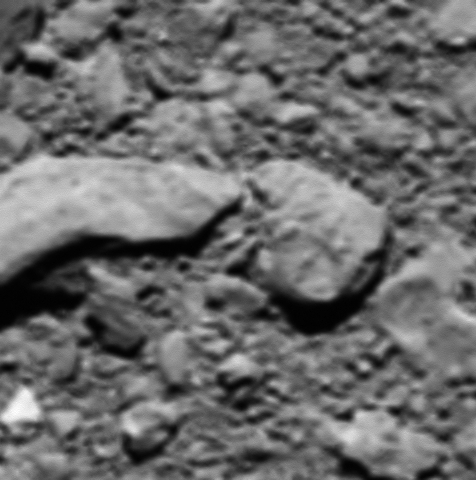
Rosetta's last image

Engineers reviewing the last bits of telemetry that was transmitted back to Earth by Rosetta just before it crashed on Comet 67P/C-G have discovered one last image of the comet’s surface.

That image is on the right. It is slightly blurred because of the limitations of Rosetta’s camera at this short range, and the incompleteness of the data received.

The image covers an area about a meter across, with a resolution of about two millimeters per pixel.

I imagine this surface is relatively soft, since the gravity holding the comet together is so slight. If you wanted to dig down, you would find it easy digging.

2 comments

NASA and Roscomos sign agreement to work together to build lunar orbiting station

Extending the pork: NASA and Roscosmos have signed an agreement agreeing to work together in the construction of what NASA calls a deep space gateway, a space station orbiting the Moon.

The goal here is to garner political support for getting funding to fly a third SLS/Orion mission, which would be its second manned flight. It is also to establish some long term justification for SLS/Orion, which presently has no mission and will disappear after its first manned test flight, presently scheduled for 2022. That single test flight will have taken 18 years and more than 40 billion dollars to build, an absurd timeframe and cost for a single mission that does not bode well for future SLS/Orion missions.

The Russian perspective can be found here. They claim that the station would be finished by 2024-2026, an absurd prediction based on the expected SLS launch rate of one launch every one to two years. For Russia, the hope is that they can use this project to get U.S. money, just like the big American space companies like Lockheed Martin (Orion) and Boeing (SLS).

10 comments

Parts 2 and 3 of “A Niche in Time”

The second and third parts of Doug Messier’s series on the history of aviation and space are now available:

Part 2 describes how the Hindenberg crash ended the lighter-than-air airship industry, while Part 3 describes how the Columbia accident led to the end of the space shuttle. He then compares them both, noting their similarities.

Not surprising to me, the main common thread that sustained both of these failed concepts was the desire of a government to build and fly them, regardless of their cost and practicality. Messier’s comparison between airships and airplanes highlights this well. Airplanes were cost effective and could easily be made profitable. Airships were neither. They existed because Hitler wanted them.

The same can be said for the space shuttles, and for Constellation and SLS/Orion today.

Anyway, read both articles above. They are nicely written, very informative, and provide important lessons about history that we would be wise to educate ourselves about before we attempt to make our own history in the future.

1 comment

UN announces proposed Dream Chaser international mission

Capitalism in space: The Outer Space office of the United Nations has announced an opportunity for member nations to express their interest in doing a science mission using Sierra Nevada’s Dream Chaser reusable spaceship.

The UN announcement states that

The purpose of this Call for Interest (CFI) is to provide a summary of the proposed mission and to solicit information from Member States interested in providing experiments, payloads, or satellites that could be flown on this mission. The CFI also has the objective of gathering information on the interested countries so that UNOOSA may better understand the demand for this type of mission.

The actual call [pdf] roughly describes a mission lasting 2 to 3 weeks and carrying about 20 experiments. This call is designed to give them a better idea of what those experiments might be, what nations wish to participate, and where the funding for the mission might come from. The actual announcement to submit experiment proposals won’t come until March 2018.

Being a UN mission, it is not surprising that it wants to focus on a variety of leftwing “Sustainable Development Goals”:
» Read more

2 comments

First meeting of National Space Council announced

A Potemkin Village: The White House has announced the date of the first public meeting of the National Space Council, set for October 5 at the Air & Space Museum.

Today, Vice President Mike Pence announced the first meeting of the National Space Council is scheduled for October 5, 2017 at the Steven F. Udvar-Hazy Center in Chantilly, Virginia. The meeting, titled “Leading the Next Frontier: An Event with the National Space Council,” will include testimonials from expert witnesses who represent the sectors of the space industry: Civil Space, Commercial Space, and National Security Space.

What this announcement tells me is that this council isn’t there to discuss and set space policy, but to sell that policy to the public. And right now, I am expecting that sales job will be trying to convince us that we must use SLS/Orion mission to build a new space station orbiting the Moon by 2023. They will use the council to pitch the idea, and then Trump will make the traditional Kennedy-like speech, with lots of astronauts standing behind him, committing this nation to putting a space station around the Moon by such-and-such a date. Whoopie!

Forgive me if I sound a bit cynical. I’ve seen this show many times before. For some reason, the opening act is great, but then it fades always away into nothingness before the second act begins.

4 comments

Rocket Lab preps for 2nd flight of Electron

Capitalism in space: Smallsat rocket company Rocket Lab is preparing for the second test flight of its rocket Electron, now set for October.

The test flight will also carry four commercial nanosats.

Both Planet and Spire — two companies that operate small satellites in orbit — will have payloads on the Electron’s second test flight, dubbed “Still Testing.” The rocket will carry two of Planet’s Dove satellites, designed to image Earth, as well as two of Spire’s Lemur-2 satellites that track weather and ship traffic.

The company also states that if this second flight is successful, they might forego a third test flight and move directly to commercial operations.

0 comments

OSIRIS-REx looks at Earth

NASA has released the images that OSIRIS-REx took as it flew past Earth last week on its way to its 2018 rendezvous with the asteroid Bennu.

The image shows the Pacific Ocean from Australia to California. Its main significance it demonstrates that the spacecraft’s camera and pointing system is working perfectly.

0 comments

Long March 5 failure to delay Chinese lunar probes and space station

The July launch failure of China’s largest rocket, Long March 5, is going to cause delays to both its lunar and space station programs.

They have not yet finished their investigation into the failure, and are now admitting that the launch of Chang’e-5, a lunar sample return mission, will not occur this year as planned, and that the launch of their space station core module will be delayed into 2019.

0 comments

Blue Origin inks deal with satellite company to use New Glenn

Capitalism in space: Blue Origin has signed a deal with the satellite company mu Space to use its as yet unbuilt New Glenn rocket to launch a satellite sometime in the next decade.

This isn’t really a contract, since I am sure that mu Space will have the option to switch to a different rocket. Nonetheless, it signals faith in Blue Origin. It also indicates that, though no price was mentioned, Blue Origin is probably providing the satellite company with a significant price break to encourage them to make the deal, thus demonstrating the growing competitiveness of today’s launch industry. This is also the third contract deal for New Glenn.

0 comments

Mangalyaan passes three years in Mars orbit

India’s Mangalyaan orbiter has passed its third anniversary operating in Mars orbit.

The spacecraft could last as long as five more years before running out of fuel. Though it has five instruments and has taken more than 700 images, its importance so far is not in the science it has done but in what it has taught Indian engineers for running future more sophisticated missions.

1 comment

Sputnik for sale!

Capitalism in space: Sputnik’s engineering test replica is going up for auction, and you can buy it!

Like the Sputnik-1 that flew into orbit on October 4, 1957, the test replica is a polished aluminum sphere 23 in (58 cm) in diameter with four spring-mounted external whip antennas. It consists of an outer shell to protect the satellite against heat and an inner pressurized shell to protect the pre-solid state electronics made up of a simple radio transmitter and a 12-V battery. The replica includes a 57-in (1,448 mm) manganese brass stand and an anti-static o-ring. All together, satellite and stand weigh about 100 lb (45 kg) and stand 78 in (1,981 mm) tall.

The Sputnik was previously part of the collection of Heinz Miller of Austria and was originally built for electromagnetic compatibility and electromagnetic interference testing. Only three of the original Sputniks remain in private hands. Of the other two, one is outside Moscow at the Energia Corporate Museum, while the other is at the Museum of Flight in Seattle.

The asking price for the Sputnik is US$100,000 to US$150,000.

1 comment

Behemoths of the Sky

Link here. This article by Doug Messier, about the German attempt to create an industry around rigid lighter-than-air airships, is the first of a five part history series that he will use to illustrate some fundamentals about new industries.

Despite the differences in time periods and technologies, there are some fundamental things that are required for all major advances in flight regardless of when they are made: imagination, daring, physical courage and financial backing. And luck. No small amount of luck.

Today, Parabolic Arc begins a five-part series looking at three different periods in powered human flight. We will compare and contrast them to see what essential lessons can be drawn from them. If the first two installments appear to have little to do with spaceflight, please be patient. All will be revealed.

11 comments

ULA successfully launches surveillance satellite

Capitalism in space: It appears that ULA’s Atlas 5 rocket has successfully launched a National Reconnaissance Office surveillance satellite into orbit.

The reason I am qualifying the success of the launch at this moment is that, because of the national security nature of the payload, they will only release details about the success of the final orbital maneuvers long after they have been completed. Right now these details are blacked out. Update: the launch was successful.

ULA has another launch of an NRO satellite scheduled for October, a date not yet determined. Right now, the U.S. has had 20 launches in 2017, far more than any other nation, with SpaceX’s 13 launches comprising the bulk.

0 comments

First manned SLS/Orion flight officially delayed to 2022

Government in action! The first manned flight of SLS/Orion has now been officially delayed one year until 2022, and that date remains questionable.

In addition, the first unmanned test flight of SLS/Orion has now also been delayed until December 2019, something that had been under consideration but is now official. Even with this delay, there are doubts whether that flight can take place then, which is why the 2022 launch of the first manned flight is questionable.

The article outlines in detail the Byzantine scheduling issues that NASA must fulfill to meet these launch dates, including a long timeline of deliveries that seems absurd when compared to how private companies operate.

Assuming that these new dates occur as announced (something I sincerely doubt), the first unmanned launch of SLS/Orion will occur almost 16 years after President Bush first proposed it, with the first manned flight occurring more than 18 years after his proposal. In that time NASA will have spent about $43 billion for this one manned mission. Let me repeat: $43 billion and almost two decades to fly one manned mission. Quite absurd.

The article also details NASA’s proposal for a third SLS/Orion mission, the second manned, to occur in 2023, which would begin assembly of a space station in lunar orbit. I suspect that this mission is going to be announced in what will be President Trump’s version of the typical Kennedy-like speech that Reagan, Bush 1, Clinton, Bush 2, and Obama have all given, announcing big plans in space by such-and-such deadline.

Whether Congress funds it remains to me an open question. Right now I would predict they would, since they love the pork that SLS/Orion provides. In two years, when Falcon Heavy has flown several times and is likely becoming operational, and New Glenn is getting close to its first test launch, I am not so sure. Both will be flying before SLS’s first flight and both will have been developed for a tenth the cost with equal if not greater capabilities. And both will be able to fly more frequently for practically nothing, when compared to SLS.

16 comments

Aerospike engine ready for ground tests

Capitalism in space: A demonstrator aerospike rocket engine being developed by ARCA Space is now ready [pdf] for ground tests.

The system will perform a series of ground tests that will ultimately qualify the engine for flight. After the ground tests, the same engine will be integrated into the Demonstrator 3 rocket that will perform a suborbital space flight up to an altitude of 120 km above the New Mexico desert. It will be the first ever flight of a linear aerospike engine and the first ever space flight of an aerospike engine.

Based on the results from these tests the company then intends to build a single-stage-to-orbit small rocket that they hope to fly by 2018.

Go to the company’s news website here to see some good images of the engine and the aerospike nozzle. It does not look like any typical rocket engine. If this effort is successful it will as significant a technological improvement to rocketry as SpaceX’s recovery and reuse of its Falcon 9 first stage.

19 comments

Private company makes first phonecall using smartphone and nanosats

Capitalism in space: The private smallsat company Sky and Space Global has successfully used its three test nanosats to transmit a phonecall and text messages sent to these satellites using an ordinary smart phone.

During the testing, Sky and Space Global engineers also sent text messages, images and voice recordings via the company’s three nanosatellites, dubbed the 3 Diamonds. The satellites, launched on June 23, circle the Earth in a sun-synchronous orbit at the altitude of 500 kilometers (310 miles).

Eventually, Sky and Space Global envisions building a constellation of 200 nanosatellites that would provide seamless communication services to people living in tropical regions where no communication capabilities currently exist.

They also plan to test the streaming of data through these nanosats from an airplane’s black box. If all goes well, their satellite constellation will be operational by 2020.

0 comments

Scientists finally image SMART-1 lunar impact site

SMART-1 impact site

Eleven years after the European SMART-1 probe was sent crashing onto the Moon’s surface, scientists have finally identified in a Lunar Reconnaissance Orbiter image that crash site.

The image is shown on the right, reduced and cropped to post here.

The images show a linear gouge in the surface, about four metres wide and 20 metres long, cutting across a small pre-existing crater. At the far end, a faint fan of ejecta sprays out to the south. Foing said: “The high resolution LRO images show white ejecta, about seven metres across, from the first contact. A north-south channel has then been carved out by the SMART-1 spacecraft body, before its bouncing ricochet. We can make out three faint but distinct ejecta streams from the impact, about 40 metres long and separated by 20-degree angles.”

Stooke said: “Orbit tracking and the impact flash gave a good estimate of the impact location, and very close to that point was a very unusual small feature. It now seems that impacts of orbiting spacecraft, seen here from SMART-1, and also in the cases from GRAIL and LADEE, will form elongated craters, most of whose rather faint ejecta extends downrange”.

0 comments

UAE announces its second student space competition

The United Arab Emirates space center in charge of its Mars mission has announced its second student competition for designing future missions to Mars.

Explore Mars Competition targets university undergraduate students in science or engineering disciplines. The students will need to propose an innovative mission design to Mars and highlight a novel approach in either engineering design or in the science mission. The competition is geared towards identifying and solving a scientific or engineering challenge in planetary exploration.

The competition is divided into two categories, the first is focused on introducing a scientific project, and the second focuses on developing an idea to design a mission to Mars. Students who are interested in the first category about Mars Science can suggest a topic related to the Martian atmosphere or Mars geology. Furthermore, in Mars mission category, topics can address unique concepts and designs for space missions to Mars, new designs for scientific instruments for Mars science, or innovative spacecraft.

This is the second year in the row they have run such a contest. The winners for the first contest are supposed to be revealed at a science conference in late September.

1 comment
1 540 541 542 543 544 799