SpaceX launches X-37B
Capitalism in space: SpaceX this morning successfully placed one of the Air Force’s X-37B mini-shuttle’s into orbit.
You can watch the launch and landing of the first stage here.
Capitalism in space: SpaceX this morning successfully placed one of the Air Force’s X-37B mini-shuttle’s into orbit.
You can watch the launch and landing of the first stage here.
Arianespace has identified an issue in the electrical system in one of the Ariane 5’s solid rocket boosters as the source of the launch abort yesterday.
This is a preliminary report. They still need to find out exactly what happened and why. However, they also announced that their objective is to launch before the end of September. Moreover, they are not going to change the schedule of any of their other launches because of this.
Capitalism in space The new private partnership led by Canon, dubbed New Generation Small Rocket Development Planning, is now searching for a location to build its own private spaceport in order to bypass restrictions placed on launches at Japan’s two government launch sites.
While JAXA can launch at any time during the year, the deal with the local fishing council limits the number of launches per year to 17, and requires JAXA to coordinate its launches for the year with that council. For New Generation, which wants to compete in the smallsat rocket business and will thus likely need to launch dozens, if not hundreds, of times per year, this arrangement won’t work.
During an attempt to launch two commercial satellites today Arianespace experienced a launch abort at t minus 0 seconds.
The Ariane 5 rocket went into safe mode and no apparent harm was done to it or its payloads. No word yet on the cause of the abort.
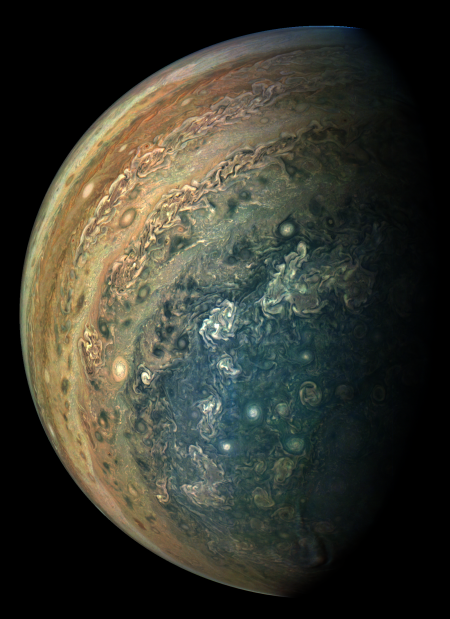
Cool image time! The raw images taken during Juno’s seventh close fly-by of Jupiter have been released. The image on the right, reduced in resolution to post here, was reprocessed by Gerald Eichstädt and shows the gas giant’s south polar region.
It is worthwhile comparing this with previous south pole images, as well as other images from this fly-by reprocessed by Eichstadt. I want to know whether anyone can identify specific storms and show how they have changed over time. Unfortunately, Juno’s orbit is large, and so it only drops in close every 53 days, allowing for these storms to change a great deal, and thus making it more difficult to link images of the same changing storm. Moreover, the images don’t necessarily show the same longitudes on Jupiter, making this even more difficult.
Nonetheless, to gain a real understanding of Jupiter’s atmosphere will require a clear understanding of the pace in which its storms and atmosphere change. These images might give us our first glimpse of this process.
Capitalsm in space: Kacific Broadband Satellites has awarded SpaceX the launch contract for placing its first satellite in orbit in 2019.
The press releases makes no mention of the launch price. Nor does it mention whether Kacific’s launch will use a reused first stage.
The two launch failures in June and July experienced by China has forced an extended pause in rocket launches, resulting in an increasing launch backlog.
The main contractor for the Chinese space programme, the China Aerospace Science and Technology Corporation (CASC), had announced plans for a national record of close to 30 launches this year, but recent failures have halted progress, putting pressure on an increasingly intense schedule.
There have been no launches since the high profile failure of the second flight of China’s largest rocket, the Long March 5, on July 2. Preceding that, a Long March 3B, used for launches to geosynchronous and medium Earth orbits, left the Zhongxing-9A telecommunications satellite in a much lower than intended orbit. This partial failure has apparently hit the schedule for launches of China’s Beidou navigation satellites, while two more launch vehicles – the Long March 2D and 4C – also suffered issues last time out.
The Chinese launch calendar typically sees the vast majority of its activity in the second half of the year, and this will need to be the case once again to prevent a large mission backlog. China was looking to launch 6-8 new satellites for its own version of the GPS constellation, starting in July, but it is unclear if the first pair, Beidou-3M3 and Beidou-3M4, will be ready for launch from Xichang in mountainous Sichuan Province.
Right now China has only completed 7 launches in 2017. The article also notes that further launches might be delayed for political reasons:
With the 19th National Congress of the Communist Party of China, a major political event that will see a once-every-five-years reshuffle of the country’s leadership, set for October, it is likely that unnecessary risks – particularly regarding a space programme regarded as a source of national pride and prestige – will be avoided.
What this article indicates is that China is undergoing the same kind of launch pressures experienced by Russia and SpaceX. Rocket science is hard, but the benefits are so great that it forces those involved to solve the problems. I expect we shall see China resume launches, at a fast pace, sometime after October.
Link here. Much of what this article discusses, the use of space to help diversify the UAE’s economy, have already been noted previously by this same site and linked to by me in an earlier post. However, the article also provides some details about the scientific mission of their Mars Hope probe, set to launch in 2020.
[Hope, or the Emirates Mars Mission (EMM)] will be the first probe to study Martian climate through the daily and seasonal cycles. It will explore the connection between the upper and lower atmosphere, study the events in the lower atmosphere such as changes in temperature and dust storms, and how they affect the upper atmosphere in the following days or weeks.
It will also seek to answer some of the key questions that we have about Mars such as why the planet is losing its atmosphere to space, by tracking the behaviour of hydrogen and oxygen, which are the building blocks of water. With the discovery of periodical water on the surface of the Red Planet, Hope will be able to answer if the source of the Martian water is from the atmosphere. This research will create the first global image of weather on Mars during the days, weeks, months, and years, adding a new dimension to human knowledge on how the Red Planet’s atmosphere really works.
Overall, it appears that the primary goal so far has been to train engineers in the building of satellites. This is a good thing, and you have to start somewhere, but the UAE nonetheless has a big hill to climb before it can compete in the global satellite market.
Note too that it appears that all the investment capital for this effort is coming from the Emirates’ leadership. If one of those newly trained engineers wanted to form their own company, would he or she be allowed to obtain capital elsewhere, thus becoming a truly independent and competing operation? I suspect not, which means that this will limit the long term diversification of this industry, despite that being the UAE’s number one goal.
The successful return from ISS today of three astronauts by a Soyuz capsule marked the end of Peggy Whitson’s record-breaking nine-month mission.
When she launched to the International Space Station as part of the Expedition 50 and 51 crews on the Soyuz MS-03 mission, her tenure aboard the Station was due to end after approximately six months, landing with the same two crewmembers she launched with.
But a realignment of the Russian crew manifest and a desire on the part of Roscosmos to reduce Russian Station personnel from three to two until the launch of their new Mini-Research Module resulted in an ability, unplanned at her launch, to allow Dr. Whitson to remain aboard the ISS for nine months instead of six. Her planned six month stay, assuming it lasted the entire duration, would have seen Dr. Whitson break an important record for NASA – that of the most cumulative time in space for any NASA astronaut in history. Dr. Whitson broke that record on 24 April 2017, when she accumulated 534 days off Earth – breaking the record set by Jeff Williams in 2016. With the conclusion of her current mission, Dr. Whitson will have amassed a cumulative time of 665 days 22 hours 54 minutes in orbit, more than shattering Jeff Williams’s record and placing her 8th on the list of total time in space for a single person.
Capitalism in space: SpaceX announced today that they have completed static fire testing of the three first stages that will be used on the first Falcon Heavy test flight, tentatively scheduled for sometime in November.
That November launch remains very tentative. The launchpad still needs to be prepped, and these stages still have to be shipped to Florida, assembled, and then undergo at least one static fire test, as a unit. Despite these caveats, it is clear that that SpaceX is getting closer to that first Falcon Heavy launch.

Cool image time! The image on the right, reduced and cropped to show here, was taken by Mars Reconnaissance Orbiter and shows just one spot in Mars’s southern polar regions. The surface only looks like bacteria because the basic structure of both is based on fractals. Scientists call this area “swiss-cheese terrain” because of the many holes that have opened up there.
The texture is very alien, bearing more of a resemblance to the universe of the very small, rather than the universe far, far away. But if this is a polar cap, then why does it not look like the polar caps on Earth? Indeed, there is no equivalent terrain observed here on Earth.
The so-called “Swiss cheese terrain,” referencing the numerous holes of the region, is a product of seasonal exchange between the surface and the Martian atmosphere. With a predominantly carbon dioxide content at 98 percent, the colder temperatures condense the gas out of the atmosphere to produce dry ice. The prevalence of water is more concentrated in the north, leaving the South polar region more carbon dioxide rich, and it’s this difference in composition that generates the unusual texture of the Swiss cheese terrain.
Be sure and take a look at the full resolution image. It is quite wild.

Cool image time! The Cassini science team has assembled a short movie from 21 images taken by the spacecraft during its August 20th dive between the rings and Saturn. That animation is to the right.
Only two weeks remain in the Cassini mission. The spacecraft dives into Saturn on September 15.
The spacecraft is expected to lose radio contact with Earth within about one to two minutes after beginning its descent into Saturn’s upper atmosphere. But on the way down, before contact is lost, eight of Cassini’s 12 science instruments will be operating. In particular, the spacecraft‘s ion and neutral mass spectrometer (INMS), which will be directly sampling the atmosphere’s composition, potentially returning insights into the giant planet’s formation and evolution. On the day before the plunge, other Cassini instruments will make detailed, high-resolution observations of Saturn’s auroras, temperature, and the vortices at the planet’s poles. Cassini’s imaging camera will be off during this final descent, having taken a last look at the Saturn system the previous day (Sept. 14).
The second link above gives a detailed moment-by-moment breakdown of the final six days.
I would have posted this earlier this week, but my limited internet access made it impossible. Sorry about that.
India’s PSLV rocket failed to put a navigation satellite into orbit yesterday when the payload fairing did not separate.
The PSLV has had an excellent launch record, so this failure is unfortunate and a surprise. Whether it will effect that rocket’s next launch, putting two Google Lunar X-prize contestants into space, remains unknown.
We are about to leave Torry and head home. Further posts will be on the road, assuming I can get service.
The new colonial movement: Angola has enacted its first space strategy, aimed at encouraging a new space industry in that nation.
The document is mostly government bureaucratic blather. More important, it seems mostly centered on what Angola’s governmental space agencies will do in the future. The policy makes nice about encouraging the private sector, but offers little to actually accomplish this.
Nonetheless, this action once again shows that more and more countries across the globe want in on the exploration of the solar system. The international competition is going to be fierce.
Capitalism in space: Sierra Nevada’s engineering test vehicle for testing the glide abilities of its planned Dream Chaser shuttle craft successfully completed a captive carry test flight today.
After a long delay following the award of their cargo contract, it appears they are finally moving forward.
Japan’s Venus orbiter Akatsuki has discovered a previously unseen equatorial jet with wind speeds that often exceed 200 miles per hour.
The winds, named “equatorial jet” by the research team, were found from July to August 2016 when an infrared camera captured images of areas about 45 to 60 kilometers above the planet’s surface. The areas are invisible at optical wavelengths due to extremely dense clouds of sulfuric acid. The camera spotted thick clouds traveling at a speed of 288 kph to 324 kph near the planet’s equator.
Based on the news reports, it appears the significance of this discovery is that they identified a particular jet stream at a specific latitude. Previous observations did not have that resolution.
This would have been posted in the morning, but the internet access here in this Torrey hotel is almost as slow as what I experienced in Glacier. I had it written, but I sinply couldn’t get it to post this morning.
Of the 72 cubesats launched by a Russian Soyuz rocket on July 14, 6 have unexpected problems.
Four of the 72 miniature satellites sent into orbit July 14 on a Russian Soyuz 2.1a rocket alongside the primary customer, the Kanopus-V-IK Russian Earth-imaging satellite, are not responding to commands from their operators and two additional cubesats are not in their intended orbits.
It appears that a variety of causes are behind the problems, not all of which are related to the Soyuz.
Posted from Torrey, Utah, just outside Capitol Reef.
Capitalism in space: Sierra Nevada’s engineering test vehicle for testing its Dream Chaser design has completed tow tests at Edward Air Force Base in California and is now being prepared for flight tests.
Posted on the back roads of Montana during our drive from Glacier to Capital Reef.
Russia and China appear ready to sign a cooperative agreement involving the joint exploration of the Moon from 2018 to 2022.
The deal is expected to be signed this October and will bring significant benefits to both nations, particularly in manned and future missions to the moon….
The bilateral agreement will cover five areas including lunar and deep space exploration, developing special materials, collaboration in the area of satellite systems, Earth remote sensing, and space debris research.
No details yet. Moreover, the deal itself has not yet been signed, so this might all vanish into the ether. It does appear however that Russia’s financial problems are forcing it to partner with others, and China presently has a very sophisticated but inexperienced space program and lots of cash. Russia’s experience would be a great help to China, until they don’t need it anymore. Thus, the logic of the agreement.
Posted from the lobby of the Swiftcurrent hotel at the Many Glacier area of Glacier National Park. Diane completed a 10 mile hike today early, so we have the afternoon to relax. Tomorrow we make the long drive south to Capital Reef.
Capitalism in space: Orbital ATK today launched an Air Force satellite using its Minotaur rocket.
The launch also reactivated a Kennedy launchpad that hadn’t been used since 1999.