Vector live streaming test launch

Capialism in space: If you want to watch today’s test launch by Vector, the company is live streaming the event.

As I post, the rocket is vertical in a small clearing surrounded by woods, with a small group of workers at its base.

Update: One minute to launch.

Update: Launch at 9:25 am. The rocket cleared the tower perfectly. We will have to wait for updates from the company to see how things went beyond that.

1 comment

Lockheed Martin begins construction of new satellite factory

Capitalism in space: Lockheed Martin has begun construction of a $350 million satellite factory in Colorado, with expected completion in 2020.

At the moment, Lockheed does not have a competitive rocket. Moreover, its only big space project is Orion, which might never fly more than twice, if that. Thus, this shift to satellites makes some sense, as it will be difficult now for the company to gain market share in the launch and manned spacecraft markets. It is too far behind. However, there is a new industry developing in smallsats, and Lockheed is well positioned to get in at the start.

Update: I do this all the time, but I made a mistake here and assigned the Delta family of rockets to Lockheed Martin. For some reason I make this mistake often, switching Atlas 5 and Delta and Lockheed Martin and Boeing. I apologize for the error.

5 comments

An explorer’s club for Mars missions

An international group based in New Zealand has put together a new organization, dubbed the Martian Trust, modeled after National Geographic as a way to privately fund space missions.

The Martian Trust is similar to the early National Geographic Society, a non-profit which funded exploration of the world’s furthest reaches through everyday members, magazine subscribers, and wealthy philanthropists. The intent is to tap into the global space-lovers, who will help fund projects in exchange for martian stories, products and experiences produced.

They are using crowd-funding to obtain funds. Trustees will be picked either by a vote from those who contributed small amounts, or because they themselves contributed more than $5 million.

1 comment

Virgin Orbit’s launch jumbo jet arrives at company’s base in California

Capitalism in space: The modified jumbo jet that Virgin Orbit is going to use as the first stage of its LauncherOne rocket, being designed to put smallsats into orbit, arrived yesterday in Long Beach to put it close to the company’s base of operations.

While some of this story is the typical hype we all should expect — and question — from a company run by Richard Branson, Virgin Orbit looks more like the real thing. Last year it was separated from Virgin Galactic, the company that has been promising and failing to fly tourists on suborbital flights now for more than a decade. I suspect this happened because the LauncherOne group did not want to be saddled any longer with the failures of the SpaceShipTwo group.

I have been predicting that LauncherOne will reach space before SpaceShipTwo, and this story only adds weight to that prediction. They have real satellite contracts, and expect their first launch to occur in 2018. While that schedule might not hold, I suspect it will not be far wrong.

3 comments

Booking service now available to rocket and satellite companies

Capitalism in space: A new company, Precious Payload, is now offering a booking service to both rocket companies and satellite manufacturers to make it easier to match them together.

In the Precious Payload concept, launch providers and brokers share and exchange their immediate and future availability of inventory with the independent Precious Payload GDS, including the status of reservations of inventory (eg. available, reserved, booked, etc.).

Anyone who wants to launch a satellite uploads their mission profile into the Precious Payload GDS. A special algorithm then analyses the data and shows the real-time availability of launchers for specific types of mission.

Launch providers, both manufacturers and brokers, can benefit from the Precious Payload GDS by being able to open another sales channel for their core businesses. They not only receive and process the booking requests from satellite companies, but also browse through the backlog of satellites waiting for launch and bid for their business. Advanced services like rebooking the launches and effectively managing client cancellations and launch failures raise the bar for customer experience in the market.

To pitch their product, they are presently offering their initial service for free.

0 comments

Next test flight of Rocket Lab’s Electron rocket delayed

Capitalism in space: Rocket Lab has revealed that the second test flight of its rocket Electron is still several months away.

Rocket Lab is in the early stages of a three-vehicle test programme and Moon Express is still developing its lander at its facilities at Cape Canaveral, from where Apollo missions were launched. Rocket Lab’s first test launch successfully made it to space in late May. The first stage performed as it should but the second stage failed to deliver the payload to orbit.

Results of data analysis from the test flight could be available some time next week.

Earlier this month Rocket Lab founder Peter Beck said the company and its investors had confidence in the programme and they had another five rockets in various stages of production.
Beck said then a second test launch was about two or three months away and the company hoped to get its commercial launches underway as soon as it was satisfied with the test programme.

The company had previously said it hoped to launch the second test flight in mid-2017. It appears now that the second launch will not happen before October.

The article is strangely focused on selling the idea that Moon Express’s Google Lunar X-Prize flight, which must occur by the end of this year, is still on track. I don’t see how, with this news. Rocket Lab must first complete its three test flights, and I don’t see how they can do this, get their results, and update their engineering and still get this first commercial flight off by December.

4 comments

Solid gold Apollo 11 lunar module replica stolen from Armstrong museum in Ohio

On Friday thieves broke into the Neil Armstrong Museum in Ohio and stole a solid gold miniature replica of the Apollo ll lunar module that had been one of three gifted to the three astronauts in Paris during their post-flight world tour.

Police responded to a burglary alarm at the Armstrong Air and Space Museum in Wapakoneta, Ohio, shortly before midnight on Friday (July 28), where the 18 karat gold, five-inch-high (13 centimeter) miniature lunar lander was found missing. “Entry to the museum was discovered and taken was a solid gold replica of the 1969 Lunar Excursion Module that landed on the moon,” Russel Hunlock, Wapakoneta police chief, stated in a release. “The piece is very rare as it was presented to Neil Armstrong in Paris, France shortly after the moon landing.”

I am not hopeful the replica will be recovered. It was obviously stolen for its gold, and I would expect the thieves to quickly break it apart and melt the gold down for sale.

7 comments

Japanese private rocket launch terminates early due of communication failure

Capitalism in space: The first launch of the first privately-built and funded Japanese suborbital rocket was terminated early today because of a communications failure.

The rocket’s developers, Interstellar Technologies, said they aborted the launch after about 80 seconds and it landed about 8 kilometers (5 miles) offshore. The aim had been to launch the rocket, called “Momo,” to an altitude of 100 kilometers (62 miles), but it only traveled about 30-40 kilometers (19-25 miles).

3 comments

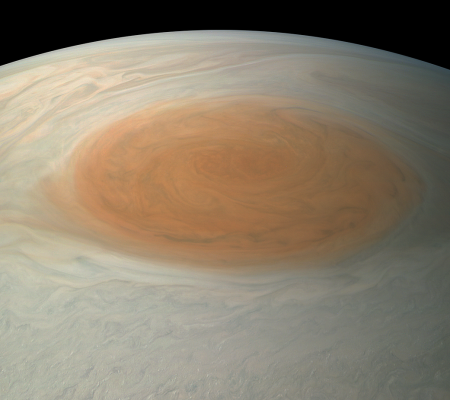
The Great Red Spot

The Great Red Spot

Cool image time! The image on the right, reduced in resolution to post here, shows one of the close-ups taken by Juno during its recent close fly-by of the Great Red Spot. What makes it different is its colors.

This image of Jupiter’s iconic Great Red Spot was created by citizen scientist Björn Jónsson using data from the JunoCam imager on NASA’s Juno spacecraft.

This true-color image offers a natural color rendition of what the Great Red Spot and surrounding areas would look like to human eyes from Juno’s position. The tumultuous atmospheric zones in and around the Great Red Spot are clearly visible.

Normally scientists enhance the colors to bring out the details. This version does not, which definitely makes it a little less dramatic but more accurate. Even so, the whirls and storms within the Spot are clearly visible.

The image was taken on July 10 from about 8,600 miles away. Note also that the entire Earth would fit inside the storm.

1 comment

SpaceX now one of the world’s most valuable companies

Data from a new round of investment capital fundraising says that SpaceX is now valued at $21 billion, placing it among the only six venture-backed companies worth more than $20 billion.

The article also notes that this new valuation is up from the $12 billion listed only two years ago.

Update: As noted by my readers, I have revised the post to note that this story refers not to all companies but to those that obtained their financing privately.

8 comments

Video of Iranian launch today

The Iranians have released video of today’s rocket launch.

I’d love a translation of what the crowd is chanting. I would also encourage the engineers in my readership to look at this and tell me if the launch looks right, and if there is any way to judge whether it is an rocket for orbital satellites or a missile. We still have no evidence the rocket successfully put anything in orbit.

Meanwhile, the Trump administration has called this launch a breach of a UN resolution forbidding Iran from developing ballistic missiles.

7 comments

Cameras on next Kepler-like exoplanet space telescope out of focus

NASA has revealed that the cameras on the Transiting Exoplanet Survey Satellite (TESS) become slightly out of focus when they are cooled to -75 Celsius, the temperature they will experience in space.

NASA has also decided that the fuzziness is not enough to require a fix, and is proceeding with the mission as is, despite concerns expressed by scientists.

Alan Boss, an astronomer with the Carnegie Institution, brought up the issue in a summary of a meeting last week of the Astrophysics Advisory Committee, of which he is a member. “That could have some big effects on the photometry,” he said of the focus problem. “This is certainly a concern for the folks who know a lot about photometry.”

TESS will use those cameras to monitor the brightness of the nearest and brightest stars in the sky, an approach similar to that used by Kepler, a spacecraft developed originally to monitor one specific region of the sky. Both spacecraft are designed to look for minute, periodic dips in brightness of those stars as planets pass in front of, or transit, them. Chou said that since TESS is designed to conduct photometry, measuring the brightness of the stars in its field of view, “resolution is less important compared to imaging missions like Hubble.” However, astronomers are concerned that there will be some loss of sensitivity because light from the stars will be spread out onto a slightly larger area of the detector.

“The question is how much science degradation will there be in the results,” Boss said. “The TESS team thinks there will be a 10 percent cut in terms of the number of planets that they expect to be able to detect.”

It could be that NASA has decided that the cost and delay required to fix this is not worth that 10% loss of data.

0 comments

Time/PBS video documentary nominated for Emmy despite factual error in title

Fake news: The Time/PBS video documentary A Year in Space has been nominated for an Emmy award, despite a blatant factual error in the show’s title.

I haven’t seen the documentary, and so it might a great achievement. Nonetheless, this mission only lasted 340 days, not a year, and to call it “a year in space” is not only false, but an outright lie. For a news organization to start out this wrong, in the title, and then for it to get an Emmy nomination, tells us a great deal about the standards of accuracy in television news.

2 comments

Breakthrough Starshot puts smallest satellites ever into orbit

Breakthrough Starshot, the privately funded $100 million effort to launch a probe to the nearest star, has put into orbit the world’s smallest satellites ever.

The six prototypes, dubbed Sprites, weigh only 4 grams and contain solar panels, computers, sensors, and radios on a surface equal to that of a U.S. postage stamp. Developed by researchers at Cornell University and transported into space as secondary payloads on a rocket built by the Europe-based company OHB System AG, the nanosatellites are being tested for electronics and communication performance in orbit.

The significance here is not so much that this advances the project’s interstellar mission, but that this technology is becoming more likely for use on both commercial and planetary spacecraft.

0 comments

Commercial lunar mission gives launch contract to ULA

Capitalism in space: Astrobotic, a private company planning to put a lander on the Moon by 2019, has awarded its launch contract to ULA.

This initial Peregrine lunar lander will fly 77 pounds (35 kilograms) of customer payloads from six nations either above or below the spacecraft’s deck, depending on specific needs. The autonomous landing will use cameras, guidance computing and five Aerojet Rocketdyne-made hypergolic engines to set the lander down on four shock-absorbing legs.

It will stand 6 feet tall (1.8 meters) and have a diameter of 8 feet (2.5 meters).Subsequent missions envision scaling up to payload masses of 585 pounds (265 kilograms). Markets range from scientific instruments to placing mementos on the Moon.

This company had been competing for the Google Lunar X-Prize, but pulled out of the competition when it realized it couldn’t launch by the end of 2018. It continued development, however, and apparently has gathered enough customers to pay for its launch in 2019.

1 comment
1 546 547 548 549 550 799