Curiosity spots cracks formed from drying mud
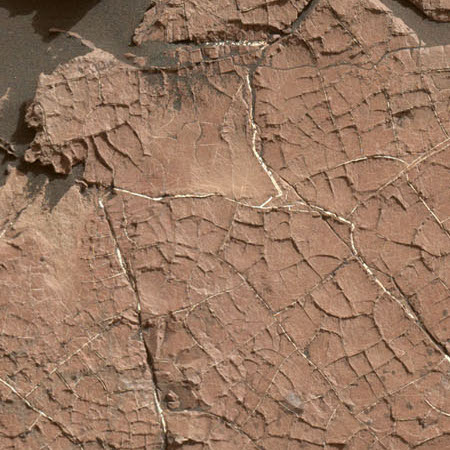
mud cracks on Mars?

As Curiosity moves across the dust-shrewn dune-filled flats at the base of Mt. Sharp it has recently taken images of surface rocks that have cracks resembling those found from drying mud.

Scientists used NASA’s Curiosity Mars rover in recent weeks to examine slabs of rock cross-hatched with shallow ridges that likely originated as cracks in drying mud. “Mud cracks are the most likely scenario here,” said Curiosity science team member Nathan Stein. He is a graduate student at Caltech in Pasadena, California, who led the investigation of a site called “Old Soaker,” on lower Mount Sharp, Mars.

If this interpretation holds up, these would be the first mud cracks — technically called desiccation cracks — confirmed by the Curiosity mission. They would be evidence that the ancient era when these sediments were deposited included some drying after wetter conditions. Curiosity has found evidence of ancient lakes in older, lower-lying rock layers and also in younger mudstone that is above Old Soaker.

The rover is no longer on the floor the crater, but in the foothills at the base of Mt. Sharp. Thus, what we are likely looking at is evidence of the slow disappearance of the giant lake that scientists think once filled Gale Crater. These mud cracks suggest that the rover is now moving up out of the lake and through its margins.

I plan to do a rover update for both Curiosity and Opportunity tomorrow, so stay tuned.
0 comments

Gene Cernan, 82, has passed away

Gene Cernan, the last Apollo astronaut to walk on the Moon, passed away today.

His words as he stepped off the lunar surface still resonate to me.

This is Gene, and I’m on the surface; and, as I take man’s last step from the surface, back home for some time to come – but we believe not too long into the future – I’d like to just (say) what I believe history will record: that America’s challenge of today has forged man’s destiny of tomorrow. And, as we leave the Moon at Taurus–Littrow, we leave as we came and, God willing, as we shall return, with peace and hope for all mankind. Godspeed the crew of Apollo 17.

At the time, I firmly believed that we would return relatively soon. It has now been almost a half century, and no human since has left Earth orbit.

5 comments

Preparing to dive into Saturn’s rings

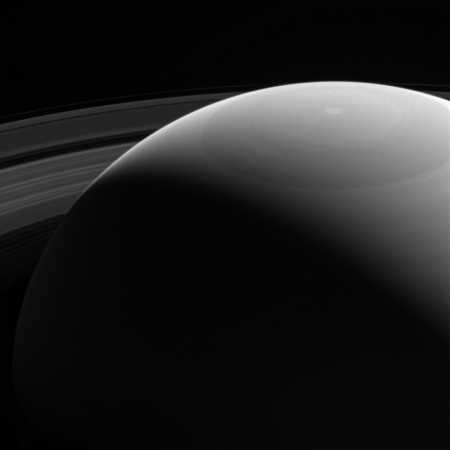
Saturn from above

Cool image time! The photo at the right, reduced to show here, was taken by Cassini on October 28, 2016 as it was shifting its orbit to prepare for the spacecraft’s last year at Saturn, where it will make repeated dives down past and even inside the gas giant’s rings. As they note at the link,

No Earth-based telescope could ever capture a view quite like this. Earth-based views can only show Saturn’s daylit side, from within about 25 degrees of Saturn’s equatorial plane. A spacecraft in orbit, like Cassini, can capture stunning scenes that would be impossible from our home planet.

It is interesting to compare this image with this July image. Comparing the two provides a sense of Cassini’s travels.

1 comment

Private Chinese rocket company gets launch contract

The competition heats up: A private Chinese rocket company, Landspace, has signed a launch contract with a Danish firm to launch an unstated number of satellites.

The article does not provide much information, but from it I suspect this is a smallsat operation, similar to Rocket Lab and Vector Space Systems. I also think that its private nature in China and the timing of its announcement, only a few weeks after China released its five year space plan which seemed to lend support to the development of a private space industry, provides confirmation of that support.

3 comments

Japan’s SS-520 launch a failure

Japan’s attempt to launch a payload into orbit with the smallest rocket ever ended in failure today.

[A]ccording to the Japan Aerospace Exploration Agency (JAXA), communication systems malfunctioned after the rocket launched, causing the ignition of the second booster to be terminated. The rocket fell into the sea southeast of Uchinoura.

My impression of Japan’s space effort in recent years is somewhat comparable to that of Russia’s: Significant quality control issues that cause too many failures. This is just one more example.

I must also note that the rocket was not a private effort, but a demo project of Japan’s government space agency, JAXA, designed to show off new technology but funded through coercive government funds, not monies provided voluntarily by customers. Thus, the pressure to succeed was much less, as no one’s job or business was at risk should it fail.

4 comments

Moon Express completes funding for Google X-Prize lunar mission

The competition heats up: Moon Express, one of the five remaining contestants vying for the Google Lunar X-Prize, announced today that it has raised an additional $20 million to complete the necessary funding needed to complete its mission.

The new round brings the total Moon Express has raised to $45 million. Richards said the company is looking to raise an additional $10 million as a “contingency” and to support future missions. “This is not a stunt,” he said. “We’re not putting all our eggs in one basket.”

The company is developing a small lunar lander called the MX-1E. The spacecraft is designed to land on the moon and then “hop” to another landing site, fulfilling the requirement of the Google Lunar X Prize to travel at least 500 meters across the surface after landing. That initial mission will carry scientific and commercial payloads from several customers. Richards said Moon Express is currently focusing on the spacecraft’s key technology, its propulsion system. The company previously tested that propulsion technology in tests at NASA’s Kennedy Space Center, but Richards said the company is making changes to improve its performance.

That additional performance is needed since the spacecraft will launch on Electron, a small launch vehicle being developed by U.S.-New Zealand company Rocket Lab, which can only take the lander into low Earth orbit. Earlier mission concepts called for launching on a larger vehicle that could place the spacecraft into a geostationary transfer orbit. “We need that extra punch from our own engine in order to get to the moon,” Richards said.

The article provides one more tidbit, this time about Rocket Lab and its Electron rocket:

The company’s current schedule calls for integrating the spacecraft in July, and then shipping it to Rocket Lab’s New Zealand launch site in October. The launch, scheduled for late this year, will be the seventh or eighth operational flight of the Electron, Richards said, shortly after a NASA mission under a Venture Class Launch Services contract Rocket Lab received in late 2015.

Although Rocket Lab has yet to launch an Electron — its first test flight is scheduled for no earlier than February — Richards believed the company would be ready in time for Moon Express, which faces a deadline of the end of this year to win the $20 million Google Lunar X Prize before the prize expires. [emphasis mine]

In other words, if things go as planned, Rocket Lab will launch Electron in February, and then do about one launch per month before it launches Moon Express. That will be an impressive start for the new rocket company, should they succeed in doing it.

3 comments

NASA asteroid redirect mission delayed again

Due to the uncertainty of its budget NASA has decided to delay the award of the contracts to begin work on its asteroid redirect mission (ARM).

The uncertainty is that Congress has never budgeted any real money for it. The mission was proposed by Obama but only vaguely, without any real support. First it was to be a manned mission to an asteroid, using Orion. Then it was to be an unmanned mission to bring a large asteroid closer to Earth to be later visited by astronauts in an Orion capsule. Then the large asteroid became a mere boulder, with the manned mission delayed until the unforeseen future.

I think NASA sees the writing on the wall here. They expect this vague unsupported mission to die with the next administration, and have decided it is better not to waste money on it now.

2 comments

SpaceX to land both Falcon Heavy first stages and Dragon at Cape Canaveral

An environmental report, prepared by SpaceX, describes in detail their plans to build landing facilities for their Dragon capsule as well as two more landing pads to facilitate the vertical landing of all three Falcon Heavy first stages at Launch Complex 13 at Cape Canaveral Air Force Station.

It is not clear when this work will go forward, though I suspect it will not be too far in the future.

6 comments

Russians complete investigation into Progress launch failure

The news is not really good.

According to Roskosmos, the accident led to the unplanned separation between the third stage of the launch vehicle and the spacecraft. Members of the commission established that the most probable cause of the accident had been the disintegration of the oxidizer tank of the third stage as a result of the failure of the 11D55 engine, following the fire and disintegration of its oxidizer pump, Roskosmos said. The fire in the pump and its disintegration could be triggered by a possible injection of the foreign particles into the pump’s cavity or by violations during the assembly of the 11D55 engine, such as a wrong clearance between the pump’s shaft and its attachment sleeve, floating rings and impellers, leading to a possible loss of balance and vibration of the rotor.

The fault, which has a production nature, manifested itself during the flight, Roskosmos said. The State Corporation promised to prepare a plan of immediate action at enterprises of the the rocket industry to ensure the safe launch of the Progress MS-05 spacecraft, Roskosmos announced. [emphasis mine]

It appears that though they have not definitely established what went wrong (due to a lack of telemetry), they have determined that all of the possible causes are related to quality control issues.

2 comments

Launch industry trends, based on recent history

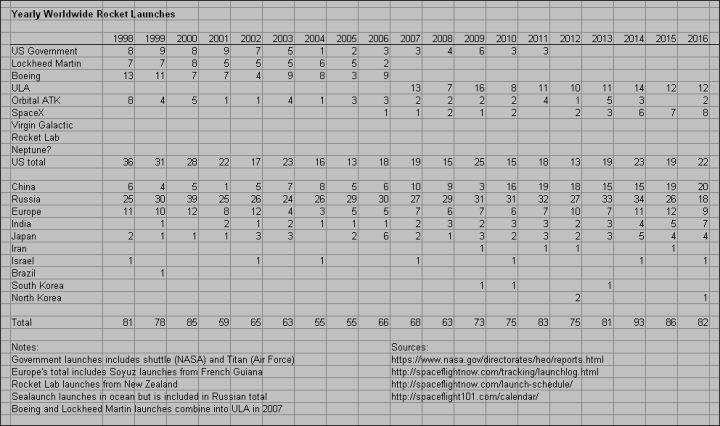
The worldwide competition to launch the most rockets each year, first noted by Doug Messier about the 2016 race that was won by a squeak by the U.S., and then augmented by my own post about the various predictions by different nations and companies about what they hope to achieve in 2017, got me to thinking. How do these numbers compare with the past? What are the launch trends? Who has been moving up and who has been moving down? And most important, what would a close look at the trends for the past two decades tell us about the future?

In order to answer these questions, I decided to compile a table of all worldwide launches since 1998.

Worldwide Launches since 1998

This table reveals some very interesting trends and facts that I had not recognized previously.
» Read more

2 comments

The X-37B flies on

The Air Force’s X-37B reusable space vessel is now approaching 600 days in orbit on its second space mission, and is only two and a half months away from setting a new record.

There is as yet no word on when it will return to Earth, though there are rumors that when it does return it will do so at the Kennedy Space Flight Center and not at Vandenberg in California.

0 comments

Japanese SS-520 rocket launch scrubbed due to weather

The launch of Japan’s new small rocket, SS-520, was scrubbed today due to bad weather.

Japanese officials announced a few minutes before the launch that the flight would be postponed due to bad weather at the space base. Authorities did not immediately set a new launch date.

The SS-520-4 will try to become the smallest rocket to ever put an object in orbit. Its sole payload is the six-pound (three-kilogram) TRICOM 1 spacecraft, a CubeSat from the University of Tokyo designed for communications and Earth observation experiments. Standing 31 feet (9.5 meters) tall and spanning around 20 inches (52 centimeters) in diameter, the SS-520-4 will blast off from a rail launch system and head east over the Pacific Ocean, dropping its lower two stages and payload enclosure into the sea in the first few minutes of the flight.

Primarily funded by a $3.5 million budget provided by the the Japanese government’s Ministry of Economy, Trade and Industry, the SS-520-4 program is a one-off demonstration by Japan’s space agency, which aims to validate low-cost technology and launch operations procedures for a future “nano-launcher” to deploy tiny satellites in orbit on dedicated rides.

The last paragraph is disappointing, but not surprising considering that this rocket is entirely owned and built by the government, which like NASA, routinely builds things and then abandons them, no matter how useful they are. I hope that some private company grabs the design here and runs with it.

9 comments

China’s Kuaizhou rocket launches first commercial payload

The competition heats up: China’s Kuaizhou solid rocket, upgraded from a military mobile-launched ballistic missile, today placed its first three commercial satellites in orbit.

The rocket is designed to quickly launch smallsats into orbit for a reasonably low cost, and is built and marketed by China’s second commercial launch company, Expace.

In the China Daily report, he added that Expace is in talks with satellite manufacturers in Asia, Europe and Latin America, and has bid for contracts to launch their spacecraft. Guo Yong, president of the CASIC Fourth Academy, told China Daily that the organization intends to capture 20 percent of the global small satellite launch market by 2020. The Kuaizhou 1A rocket can deliver satellites of up to 300 kilograms — about 660 pounds — into low-altitude orbits, according to China Daily.

Expace is China’s second commercial launch services provider after China Great Wall Industry Corp., which sells Long March rocket missions, with an emphasis on launches of large communications satellites heading for geostationary orbit.

2 comments

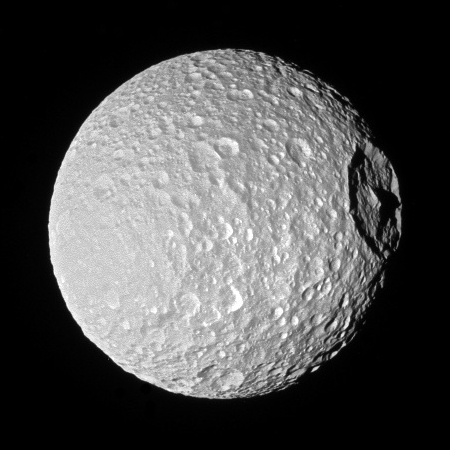
Herschel Crater on Mimas

Herschel Crater on Mimas

Cool image time! The photo on the right was taken by Cassini on October 22, 2016 when the spacecraft was about 115,000 miles away and has a resolution of about 3,300 feet per pixel. It highlights well Mimas’ most distinctive feature, its single gigantic crater, which also makes the tiny moon of Saturn one of the more distinctive planetary bodies in the entire solar system.

Named after the icy moon’s discoverer, astronomer William Herschel, the crater stretches 86 miles (139 kilometers) wide — almost one-third of the diameter of Mimas (246 miles or 396 kilometers) itself.

Large impact craters often have peaks in their center — see Tethys’ large crater Odysseus in The Crown of Tethys. Herschel’s peak stands nearly as tall as Mount Everest on Earth.

The mystery here is how did Mimas survive such an impact. One would think that the moon would be been split apart by the collision, and that it didn’t suggests the material involved was soft enough to absorb the dynamic forces, and that the speed of the impact was slow enough to reduce those forces overall.

10 comments

FAA okays SpaceX launch on Monday

As I expected, after several days of hemming and hawing, the FAA has granted SpaceX a launch license for its planned Monday launch.

The FAA license approved Friday covers all seven Falcon 9 launches planned for the Iridium Next constellation, along with landings of the Falcon 9 first stage on a barge positioned downrange in the Pacific Ocean. The $3 billion Iridium Next program aims to replace all of the company’s existing satellites, which were launched in the late 1990s and early 2000s and are now operating well beyond their design lives.

What SpaceX clearly did here was to move ahead, daring the FAA to challenge their desire to launch quickly. Government bureaucrats don’t like that, but to call SpaceX’s bluff and block the launch would have caused these bureaucrats even more problems. SpaceX knew this, and gambled that the FAA would back down. It did, and thus the launch license was issued.

5 comments

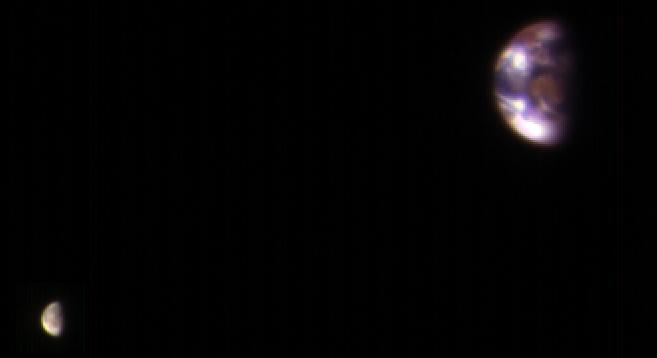
The Earth and Moon, as seen from Mars

The Earth and Moon as seen from Mars

Cool image time! The image above, a composite of four separate Mars Reconnaissance Orbiter pictures, was taken on November 20, 2016.

Each was separately processed prior to combining them so that the moon is bright enough to see. The moon is much darker than Earth and would barely be visible at the same brightness scale as Earth. The combined view retains the correct sizes and positions of the two bodies relative to each other.

The reddish region on Earth is Australia, with Antarctica the bright white area below that.

9 comments
1 569 570 571 572 573 799