A rover review of 2016

Link here. While my rover updates are focused entirely on where the rovers are, where they will be heading in the immediate future, and the present condition of the rovers themselves, this update provides a very good summary of the entire year’s events for both rovers, focused especially on the science learned by Curiosity. Definitely worth a read.

0 comments

ESA signs contract for construction of its part of ExoMars 2020

On Friday the European Space Agency signed a contract with Thales Alenia Space for the construction of the European portion of the ExoMars 2020 lander/rover mission.

The contract signed in Rome, Italy, secures the completion of the European elements and the rigorous tests to prove they are ready for launch. These include the rover itself, which will be accommodated within the Russian descent module, along with the carrier module for cruise and delivery to Mars. ESA is also contributing important elements of the descent module, such as the parachute, radar, inertial measurement unit, UHF radio elements, and the onboard computer and software. The science instruments for the rover and surface platform are funded by national agencies of ESA member states, Roscosmos and NASA following calls to the scientific community.

I had missed this last week. The Thales Alenia press release has more information.

I wish them luck, especially the Russians, whose luck with missions to Mars has been truly terrible. I suspect that the Russians will use some variation of their bouncing balloon technology for the lander, which worked on their 1960s lunar rover missions and was successfully copied by NASA for its 1997 Pathfinder/Sojourner rover mission.

0 comments

Mars rover update: December 22, 2016

Curiosity

Curiosity's location, Sol 1555

For the overall context of Curiosity’s travels, see Pinpointing Curiosity’s location in Gale Crater.

After weeks of drill diagnostics and enforced lack of travel while those diagnostics were on-going, Curiosity finally moved last weekend (Sol 1553). The traverse map to the right, cropped and reduced in resolution to show here, indicates where they went, which wasn’t far and doesn’t really tell us yet which route they plan to take to pick their way through the surrounding dune fields. Thus, the options I indicated in my November 14, 2016 rover update all remain possible. If you go to that update you can see a much better Mars Reconnaissance Orbiter (MRO) overhead image showing the upcoming terrain.

In the meantime, the Curiosity science team is preparing to take a well deserved Christmas-New Year’s break (see update for sols 1566-1568). So that Curiosity doesn’t sit idle during that time, they have uploaded to it an 8-sol plan to cover December 22 to December 30 followed by a 3-sol plan from December 31 to January 2. The rover will not move during this period, but will take lots of different observations in situ.

As they note rightly at the link above, “It’s been quite the year for our rover: we have drilled six holes, performed two scoops, driven 3 km, and climbed 85 vertical meters!” What is more significant is that the best is yet to come!

Opportunity

For the overall context of Opportunity’s travels at Endeavour Crater, see Opportunity’s future travels on Mars.
» Read more


6 comments

Lace on Mars

Lace on Mars

Cool image time! The image on the right, cropped and reduced in resolution to show here, was taken by Mars Reconnaissance Orbiter June 21, 2016. It shows a region in the high northern latitudes, 80 degrees.

Some seasonal ice on Mars is transparent so that the sunlight penetrates to the bottom of the ice. Heat from this sunlight can turn the ice directly into a gas in a process called sublimation and this gas can scour channels in the loose dirt under the ice. Channels formed by sublimation of a layer of seasonal dry ice are so dense in this area that they look like lace. Gas flow erodes channels as it escapes to the surface of the overlying seasonal ice layer seeking the path of least resistance.

The resolution of the full image is 9.7 feet per pixel. This means that if Curiosity was driving across this surface we would see it. I guarantee however that Curiosity would not find driving here very easy. The ice surface is likely very delicate, and would likely cause any vehicle to bog down. The surface is also likely very alien-looking, which makes me very much want to see what it looks like, up close. This look will unfortunately have to wait, as we as yet do not have the right technology to do it. We would need I think a drone, capable of flying in Mars’s thin atmosphere.

0 comments

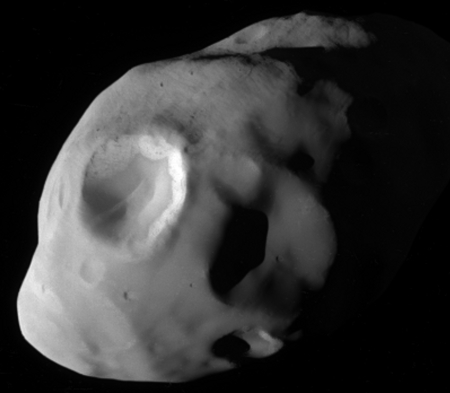
Close-up of Pandora

Pandora

Cool image time! The image on the right, cropped and reduced to show here, is that of Saturn’s small moon Pandora. The full resolution image was taken on December 18, 2016 during Cassini’s closest fly-by of the Moon ever. It was taken from a distance of 25,200 miles, and has a resolution of 787 feet per pixel.

Note the pooling of dust-like material in the crater. Note also the brighter exposed surfaces on the inner crater rim above that pooled material. It appears to my eye almost as if the dust that had coated the higher elevations of this inner rim has for some unknown reason suddenly settled into the crater’s floor.

Pandora orbits just outside Saturn’s F ring, which means it is well exposed to the material in the ring. I would also expect that much of its surface is well coated with particles from the rings.

1 comment

China and the UN open future Chinese space station to international research

China the the UN’s Office for Outer Space Affairs will soon announce a partnership for soliciting proposals from the international community for research projects to be performed on China’s upcoming space station.

UNOOSA and CMSA will work together to solicit proposals for payloads and experiments for the space station from scientists all over the world, with projects to be decided by international selection committees. UNOOSA Director Simonetta Di Pippo, in comments provided to gbtimes, stated that: “We expect that the first announcement for project proposals should come in late 2016 or early 2017. Other activities will be undertaken as the environment for their implementation becomes ready.”

The 20-tonne core module of the Chinese Space Station (CSS) is expected to be launched in 2018, with the addition of two experiment modules to complete facility around 2022. “While the space station is being made operational, UNOOSA and CMSA will prepare to call for technical proposals from entities worldwide for the design of experiments to take place on-board the station,” Ms Di Pippo said.

While open to all, the initiative will focus especially on developing nations as part of the UN’s Human Space Technology Initiative (HSTI) which aims to involve more countries in space activities and encourage non-spacefaring countries space research and to benefit from space applications.

The agreement is a good one, but its goal is not entirely altruistic on China’s part. In the article it is clear they are trying to score some propaganda points against the U.S., which by law bars China from ISS and any other U.S./China space partnership because of their bad habit of stealing technology for military purposes. With this UN partnership they are immediately claiming that they are “more open and democratic” than the U.S., as stated in the article. The claim is a lie, however. Just like the U.S. they will surely reject any international proposals they consider a security risk. They simply will, with the UN’s cooperation, be less public about it.

3 comments

What happened at SpaceX the first time they landed a first stage

Cool image time! The National Geographic Mars series is combining fiction with high quality documentary footage of real events. The clip below shows the first ever vertical landing of a used rocket first stage in December 2015, and includes footage taken of SpaceX engineers and Elon Musk during that launch and landing. The landing ranks as one of the most important events in space history. And it still gives me goosebumps. Seeing that it also caused goosebumps to those who made it happen only emphasizes the significance of the moment.

2 comments

Pressure on Trump to shift NASA transistion team towards private space

The competition heats up: Several of Trump’s most listened-to advisers are trying to convince him to put more commercial space advocates on his NASA transition team.

The appointments, which are expected to be announced shortly, partly reflect Mr. Thiel’s influence, the people said. The billionaire investor, who is Mr. Trump’s most prominent Silicon Valley supporter, is among more than two dozen people on the executive council overseeing the government-wide transition.

Along with former House Speaker Newt Gingrich and former Republican Congressman Robert Walker—two other champions of commercial space endeavors—Mr. Thiel has argued forcefully inside the transition that the original team sent to the National Aeronautics and Space Administration was skewed toward appointees closely identified with legacy space projects run by Boeing Co. and Lockheed Martin Corp., the people said.

This is good news. While my previous post, The squealing of pigs, focused on Trump’s environmental policy at NASA and elsewhere, his approach to commercial space remains unclear. These changes will help move his administration away from the pork of SLS and toward the competitive commercial space sector.

Let me add that this story reaffirms my belief that the best way to get Trump to shift to the right is to surround him with conservatives. Interestingly, it appears that Trump himself has chosen to do this. His first instincts might not be conservative, but he apparently is quite willing to take the advice of those who instincts are.

2 comments

JAXA signs agreement with private lunar mining company

The competition heats up: Japan’s space agency JAXA has signed an agreement with ispace inc, a private lunar mining company that is also behind Japan’s only competing team in the Google Lunar X-Prize competition.

It is not clear if what this agreement entails. X-Prize competitors have to announce a contract with a launch company before the end of 2016, and this announcement does not say whether JAXA will provide that service to Japan’s competitor.

2 comments

“Anomalous readings” detected during testing of Webb telescope

During standard vibration testing to simulate launch, engineers have detected what they call “anomalous readings” in the James Webb Space Telescope.

During the vibration testing on December 3, at Goddard Space Flight Center in Greenbelt, Maryland, accelerometers attached to the telescope detected anomalous readings during a particular test. Further tests to identify the source of the anomaly are underway. The engineering team investigating the vibe anomaly has made numerous detailed visual inspections of the Webb telescope and has found no visible signs of damage.

It is a good sign that they have found no damage. It is also a good thing that they detected these issues now, on the ground, where they can fix them. Webb, almost a decade behind schedule and $8 billion over budget, will be placed at a point a million miles from Earth, where no repair crew will be able to reach it.

0 comments

Japan’s Epsilon rocket launches successfully

The competition heats up: Japan today successfully launched its new Epsilon rocket on its second flight, placing in orbit a Japanese satellite designed to study the Van Allen belts.

The rocket is designed to launch Japan’s smaller satellites at a lower cost. During its first launch in 2013 JAXA made a big deal about how this rocket could be used to launch commercial satellites, but now I sense no interest in marketing it to the private sector.

1 comment

OneWeb raises $1.2 billion in investment capital

The competition heats up: OneWeb, in its effort to build a constellation of 900 satellites to provide internet services worldwide, has raised $1.2 billion.

Japan-based SoftBank invested $1 billion of the total $1.2 billion, and has also become a strategic partner, with one of its directors, Ronald Fisher, joining OneWeb’s board of directors. Combined with the $500 million OneWeb raised in June 2015, the total amount gathered now stands at $1.7 billion out of an expected total cost of $2.5 billion to $3.5 billion for the full constellation of 900 small satellites. OneWeb Founder Greg Wyler told SpaceNews that thanks to SoftBank, the company has raised more from investors than originally anticipated, allowing OneWeb to forgo a third investment round.

They plan to build a factory in Florida capable of building 15 satellites per week.

3 comments

Proton launch postponed again

The Russians have once again delayed the next Proton rocket launch, this time for an additional week to December 28.

This will be the first Proton launch since June, when the rocket’s second stage did not perform as expected. The Russians have released no information about their investigation into that launch, other than repeatedly delay the next Proton launch for almost a half year.

0 comments

Another successful ULA Atlas 5 launch

The competition heats up: ULA’s Atlas 5 rocket successfully launched a commercial communications satellite on Sunday.

In its sixty-seven flights before Sunday’s launch, the Atlas V has achieved sixty-six successes, including a stretch of fifty-seven missions going back to October 2007. The only mission which was not a complete success, June 2007’s launch of the NROL-30 mission, a pair of naval intelligence satellites for the National Reconnaissance Office – reached a lower-than-planned orbit but the satellites were able to correct for this using their own propulsion. ULA describes the launch as successful from its customer’s perspective, while independent analysts consider it a partial failure.

Though the article notes that most Atlas 5 launches have been for the government, the company has recently been aggressively courting the private sector.

0 comments

Lunar lava tubes could be big

New research now suggests that the lava tubes on the Moon have the potential to be very large, much larger than found on Earth.

On Earth, such structures max out at around 30 meters across, but the gravitational data suggest that the moon’s tubes are vastly wider. Assessing the sturdiness of lava tubes under lunar gravity, planetary geophysicist Dave Blair of Purdue University in West Lafayette, Ind., and colleagues estimate that the caves could remain structurally sound up to 5 kilometers across. That’s wide enough to fit the Golden Gate Bridge, Brooklyn Bridge and London Bridge end to end.

This isn’t really news, merely a confirmation of what other scientists have been theorizing for decades. What it tells us again is that the first permanent and successful lunar colonies will almost certainly be located in such tubes, since they provide ready-made radiation shielding as well as protection from the wild swings of temperature seen on the lunar surface. In the lava tube, the temperature will likely remain quite stable, making environmental control a much simpler problem.

14 comments

Vector successfully test fires its rocket engine

The competition heats up: Vector Space Systems has announced the successful first test firing of the first stage engine to be used on its Vector-R rocket.

The engine test, which took place in Mojave, Calif. on Dec. 8, featured a single piece, 3D AM printed injector developed in partnership with NASA’s Science, Technology, and Mission Directorate (STMD) Flight Opportunities, a program which extends research labs into space-relevant environments by partnering with small satellite launch companies. Earlier this year, NASA provided a grant to Vector to design and test the injector.

Vector continues to push the envelope by being the first in the industry to pursue the LOX/Propylene propellant combination, which created the highest thrust to date from a LOX/Propylene fueled engine. This test of the 5K-lbf on flight fuels serves as a stepping stone to Vector’s first launch of the Vector-R slated for 2017, and moves the company one step closer to its mission of connecting space startups and innovators with affordable, reliable access to space.

They have also signed the land lease for the Tucson site where they plan to build their rocket factory.

1 comment
1 571 572 573 574 575 799