Next Angara launch delayed

The competition heats up? Industry sources in Russia noted today that the next launch of Angara will be delayed until 2016.

Previously the next Angara launch was scheduled for late 2015. This delay is not a disaster for Russia, as Angara is designed to work in conjunction with the country’s new spaceport in Vostochny, and that facility won’t really be operational until 2016 either.

0 comments

X-Prize contestants team-up to create head-to-head lunar race

The competition heats up: Two Google Lunar X-Prize contestants have teamed up to use the same rocket to get to the Moon together, where they will literally race head to head to see who travels the 500 meter distance first to win the prize.

At a press conference in Tokyo on Monday, the leaders of two Lunar X PRIZE teams—Astrobotic and HAKUTO—announced a plan in which the two teams’ robotic rovers will travel to the moon together and touch down on the lunar surface at the same time. They will then race each other to cover the 500 meters required to win the first place prize of $20 million.

John Thornton, head of Pittsburgh-based Astrobotic (a Carnegie Mellon University spin-off), said in a call with reporters that the partnership with HAKUTO (a spin-off from Tokyo University) represented the first step in realizing his team’s goal of turning robotic moon missions into a viable business. That mission won’t stop with this single partnership. He said the team was in talks with more than half of the other 16 GLXP competitors to carry their rovers to the moon, too, in exchange for sharing the cost of getting there and splitting prize money.

If this happens as they propose, we could be watching as many as ten rovers line up for the race.

3 comments

How to drill rocks on Mars

Engineers have found that to properly drill on Mars, Curiosity need only use its lowest power settings.

The new drilling procedures essentially call for the rover to use its lowest energy setting right from the beginning, rather than starting with a setting a few levels up. Curiosity has six settings on its drill that have a nearly 20-fold range in energy. The drill has only been used three times before Curiosity reached Mount Sharp (Aeolis Mons), its ultimate science goal, late last year.

On those three occasions and when the drill was used once at Mount Sharp, Curiosity began its investigations at the drill’s Level 4. The first rock probed at Mount Sharp broke under this pressure. The new algorithm instead starts at Level 1 and only progresses upwards if drilling proves too slow.

The engineers have found that the rocks they have drilled into on Mars have been more fragile that expected, which actually shouldn’t be a surprise, due to the lower gravity. In fact, this one simple fact probably reveals a great deal of important information to geologists about the geology of Mars and how it formed.

5 comments

New Mexico legislature advances spaceport sale bill

A state bill to sell Spaceport America, New Mexico’s spaceport built to service Virgin Galactic’s oft-delayed space tourism business, has advanced out of its first committee.

The bill still needs to clear two more committees before it gets a floor vote, but considering the lack of progress at Virgin Galactic, I would not be surprised if it passes. The high hopes that created this spaceport a decade ago have now faded into a boondoggle that New Mexico probably can no longer afford.

3 comments

Work accelerates towards the first test flight of Falcon Heavy

The competition heats up: Design and construction of SpaceX’s Falcon Heavy is picking up in advance of the rocket’s first test flight, now tentatively scheduled sometime this summer.

It will not surprise me if that summer launch does not happen on time. Nonetheless, I expect that before 2015 is over we will see a Falcon Heavy on the launchpad being prepped for launch.

0 comments

A dozen launches for Arianespace in 2015?

The competition heats up: Arianespace’s launch manifest for 2015 predicts a busy year, with a hoped for pace of one launch per month.

What I like most in the article however is what this paragraph says:

The launch provider won nine contracts for geostationary satellites in 2014, and eight of them are the right size to ride in the Ariane 5’s lower berth, [said Stephane Israel, Arianespace’s chairman and CEO] in an interview with Spaceflight Now.

SpaceX has emerged as the chief rival to the veteran French-based launch company, which started the commercial launch business when it was founded in 1980. SpaceX and Arianespace cinched the same number of commercial launch contracts last year. Partly in response to SpaceX’s bargain prices and partly as an initiative to ensure the Ariane 5 has a steady balance of heavier and lighter payloads, Arianespace cut prices for customers with smaller satellites. [emphasis mine]

I love how competition has lowered costs while simultaneously increasing the launch rate for multiple companies. Before SpaceX arrived to challenge established companies like Arianespace the accepted wisdom in the launch industry was that it was foolish to have more rockets capable of launching at lower costs, because there simply wasn’t enough business to justify it. You’d supposedly end up with idle facilities costing money with no payloads to launch. I always thought that theory was hogwash. Elon Musk and SpaceX have definitely proven it so.

0 comments

Work stalls on Mars One robotic missions

Mars One, the company that just this week announced the 100 finalists in its competition to send 24 people on a one-way trip to Mars, has quietly suspended all work on two robotic missions heralded as precursors to that manned mission.

These facts just add weight to my conviction that the Mars One competition is at the moment nothing more than a reality television show. It is a cool idea for a television show, but journalists should stop selling it as anything more than that.

0 comments

Stratolaunch airplane 40% complete

The competition heats up: Stratolaunch has revealed that construction of the gigantic airplane — the largest ever to fly — that will take its rockets into the air is now about 40% complete.

The first flight is still scheduled for 2016. The article also includes some good analysis which indicates the competitive problems Stratolaunch faces:

Its Orbital Sciences-supplied solid-fuel rocket will be able to carry 15,000 pounds to low Earth orbit. But this is about half the lift of the competing SpaceX Falcon 9 and just 30 percent that of a Boeing-built Delta IV. Stratolaunch will be able to orbit only smaller satellites.

Nonetheless, watching this mother-ship take off will be quite breath-taking.

1 comment

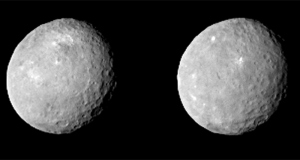
Ceres comes into focus

Ceres as since on February 12, 2015 by Dawn

Cool images! The Dawn science team has released new even sharper images of the giant asteroid Ceres, taken by Dawn on February 12 at a distance of 52,000 miles.

Though the surface appears to have many of the typical craters, scientists continue to be puzzled by the bright spots. This newest image suggests that they are ice-filled craters, but don’t hold me to that guess. For one thing, why are only a handful of craters filled with ice, and none of the others?

0 comments

South Korea unveils its own lunar rover

The competition heats up: South Korea has revealed its preliminary design for a lunar rover, set to launch in 2020 on a Korean-built rocket.

The article does not indicate whether this project has actually been approved or is merely being touted by Korea Institute of Science and Technology, which made the announcement. The cost to build it is estimated to be more than $7 billion, which seems quite exorbitant and over-priced.

Update: I had misread the conversion in the article from U.S. to Korean currency and thought the proposed cost for this mission was way more than it really is, which is about $7 million, a much more reasonable number. Thanks to Edward for the correction.

2 comments
1 646 647 648 649 650 798