Tag: spaceflight
American manned space: dependent on the Russians in more ways than you think
American manned space: dependent on the Russians in more ways than you think.
As commentators from around the country gnash their teeth at U.S. dependence upon Russia to move cargo and astronauts to the mostly U.S. built/funded International Space Station (ISS), they’ve missed the bigger boat: With one exception, all the commercial spaceflight offerings currently in the works have Soviet or Russian engines as a key part of the rockets involved.
According to Russian space officials, the next Soyuz tourist flight will be in 2014
According to Russian space officials today, the next Soyuz tourist flight to ISS will be in 2014.
The article above contradicts yesterday’s story where the head of the Russian space agency suggested that Russia is going to shift its focus from manned space. I suspect both stories reflect an underlying political battle going on within the Russian government.
Saving a failed orbiting satellite with engineering
Saving a failed orbiting satellite with engineering.
Russian space chief suggests a shift away from manned space for Russia
Remarks by the head of the Russian space agency on Thursday suggested Russia is going to shift its space effort away from manned space.
Some questions about today’s hypersonic test flight
Here are some additional stories describing today’s test flight of the Hypersonic Test Vehicle.
- Los Angeles Times: Falcon hypersonic vehicle test flight fails
- Aviation Week: Telemetry Lost During Hypersonic Test Flight
- DARPA: HTV-2 collects unique data during several phases of second flight
I have several questions, and no answers:
Contact quickly lost during third test flight of hypersonic plane
Contact was quickly lost today soon after a hypersonic glider was released by its rocket launcher during a test flight. More here.
Virgin Galactic’s suborbital shuttle: Sydney to London in 4 hours
Virgin Galactic’s suborbital shuttle: Sydney to London in 4 hours.
I’ve been told that there are engineering reasons why SpaceShipTwo could not make this flight. Nonetheless, the possibility is quite alluring.
Boeing confirms that it has chosen the Atlas 5 rocket to launch is manned capsule
Boeing has now officially chosen the Atlas 5 rocket to launch is manned capsule.
Two Russians complete spacewalk at ISS
Two Russians have completed a spacewalk today at ISS. They not only prepared the station for future Russian upgrades, they released an amateur radio microsat.
Getting to know the Atlas 5
The Atlas 5 is the rocket that Boeing, Blue Origin, and Sierra Nevada plan to use to get astronauts into orbit.
Lack of U.S. government interest in commercial refueling mission causes problems
A lack of U.S. government interest in a privately designed satellite refueling technology has caused the company to pull back its plans.
MDA had signed a contract with the communications satellite company Intelsat to refuel some of its orbiting satellites, but needed additional customers to make a go of it. It had hoped the U.S. Defense Department would show interest, but they have not.
This is exactly where the government should be investing its capital, and that it is not tells us a lot about the real lack of sincerity behind the Obama administration’s claims that it wants to encourage private space. I also suspect that the turf war with satellite companies and defense contractors helped discourage Defense Department interest.
A look at the more than 450 tourists who have paid a deposit to Virgin Galactic to fly in space
A look at the more than 450 tourists who have paid a deposit to Virgin Galactic to fly in space.
They include comedian Russell Brand, Dallas star Victoria Principal, film director Bryan Singer, designer Philippe Starck, scientist Professor Stephen Hawking, property developers the Candy brothers, and PayPal developer Elon Musk.
The state of the new commercial manned space efforts
Chris Bergin at NASAspaceflight.com today wrote a report on the four companies NASA is subsidizing to build manned capsules. The status of each company tells us something of whether they can eventually provide the United States with a replacement for the shuttle, and do it soon. Let’s take a look at each.
» Read more
Dawn begins science operations in orbit around Vesta
The Dawn science team today released what they are calling “the first full-frame image” of Vesta. The image is shown below the fold.
The picture was taken from 3,200 miles, and shows a pockmarked irregularly shaped world. While many features that resemble the Moon (the craters, the rays radiating out from those craters), that Vesta itself is not spherical makes it very much unlike the Moon. It is probably going to take scientists several months at least to decipher the data they are getting and come up with some concrete conclusions about this strange dwarf planet.
» Read more
Summer break for testing of SpaceShipTwo
Wondering why there have been no recent test flights of SpaceShipTwo? Virgin Galactic is taking a summer break.
3-D Printer Passes Zero Gravity Test to Make Space Tools
Two modified off-the-shelf 3-D printers have passed their first zero gravity tests for making tools in space.
Tiangong-1 is not a space station hub
Tiangong-1 is not a space station hub.
The Painted Desert of Mars
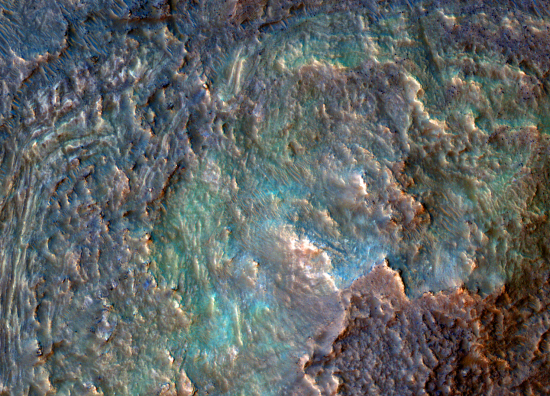
Mars Reconnaissance Orbiter released this picture yesterday of what the Orbiter’s scientists have labeled “The crazy floor of Hellas Basin.” Below you can see a cropped image of only one part of the large higher resolution image. The NASA caption says that the wild colors probably “indicate that diverse minerals are present,” meaning that any settlers of the red planet will probably take a close look at this location with the reasonable hope of finding the resources they need to colonize a planet.
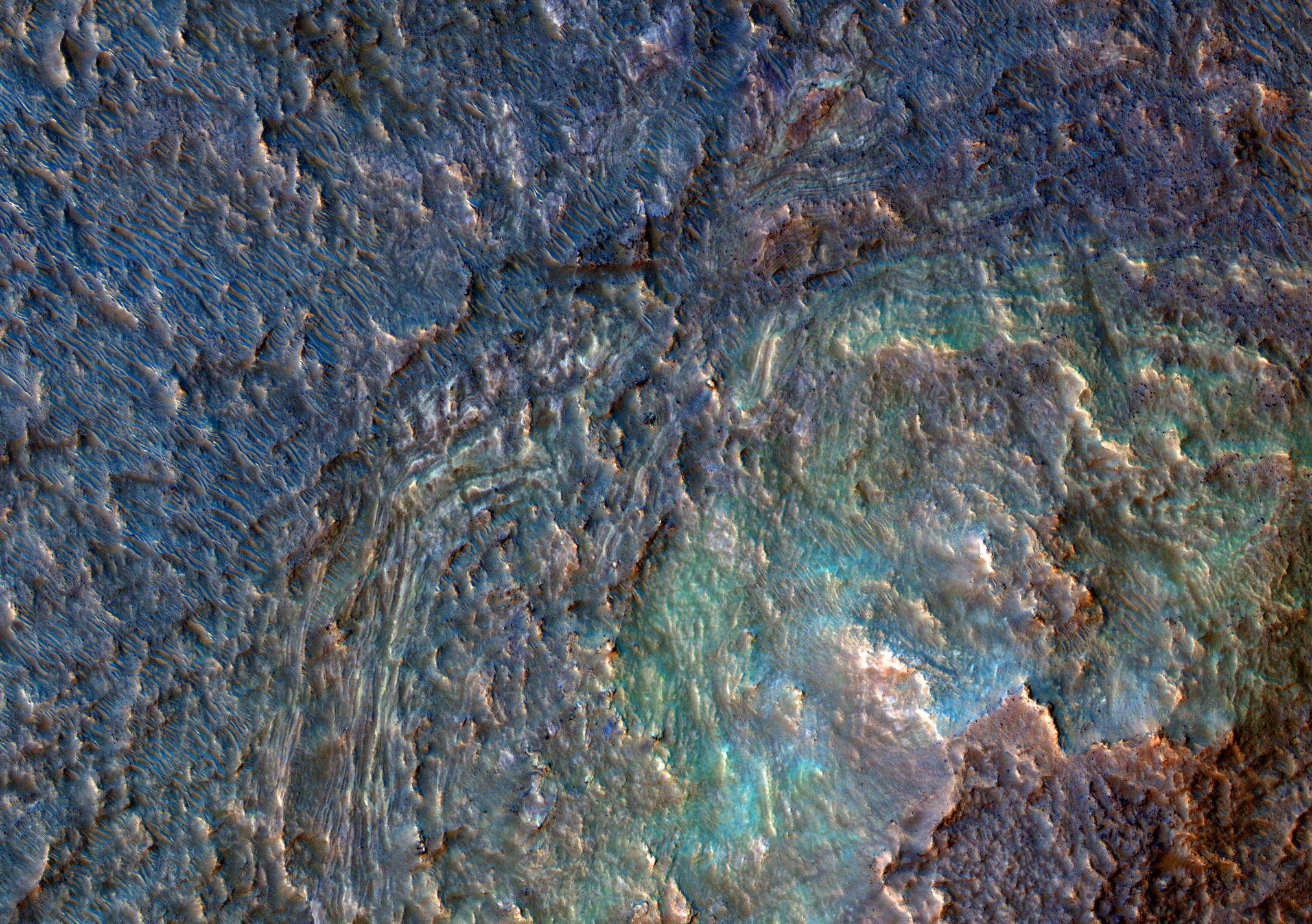
To me, these colors also indicate that this place on Mars would probably one of its most popular tourist spots. As I look at the image my eye instinctively wants to trace out the best trail route along the ridges and down into the gullies in order to give hikers the best view of this colorful terrain.