
Eta Carinae’s next big show

Astronomers are gearing up to observe the next binary fly-by of Eta Carinae’s companion star over the next few weeks.

A binary system, η Carinae has two stars that swing past one another every 5.5 years. The bigger star — some 90 times the mass of the Sun — is incredibly unstable, always seemingly on the verge of blowing up. When the smaller companion star makes its closest approach to the primary star, as is happening now, the interaction between the two triggers violent changes in the high-energy radiation pouring out of the system.

Astronomers are watching the show in the hope of learning what drives this enigmatic system. In the 1840s, η Carinae had a mysterious eruption; in recent decades, it has again brightened unexpectedly. “The star is in an awfully deranged state, and no one knows why,” says Kris Davidson, an astronomer at the University of Minnesota in Minneapolis.

Eta Carinae is also famous because it was one of the first objects imaged by Hubble after its repair in 1993, and was thus the first stellar explosion ever caught on camera in a visually sharp and clear manner. (See my book The Universe in a Mirror for that fascinating story.)
0 comments

An exoplanet that was once like a star

Astronomers, using WISE data, have discovered a strange exoplanet that is now as cool as a rocky planet, but was once as hot as a red dwarf star.

The current temperature of the object is 100-150 degrees Celsius, intermediate between that of the Earth and Venus. But the object shows evidence of a possible ancient origin, implying that a large change in temperature has taken place. In the past this object would have been as hot as a star for many millions of years.

Called WISE J0304-2705, the object is a member of the recently established “Y dwarf” class – the coolest stellar temperature class yet defined, added to the end of the sequence OBAFGKMLT (for historical reasons this is not in alphabetical order but follows a decline in temperature from O to T). Although its temperature is not far off that of our own world, the object is not like the rocky Earth-like planets and instead is a giant ball of gas like Jupiter.

As cool as this discovery is (no pun intended), I am most enlightened by the information in the second paragraph above. I had not realized that astronomers had added L, T, and Y classes to the low temperature end of their stellar classification system. For those new to astronomy, you remember the sequence of the first seven classes with the phrase “O Be A Fine Girl Kiss Me”. I wonder what how we can amend this phrase to include the L, T, Y, classes?

0 comments

Astronomers have found what they believe is the first evidence of a planet consumed by its star as the star expanded and aged.

Astronomers have found what they believe is the first evidence of a planet consumed by its star as the star expanded and aged.

Sadly, for those of you out there who like the idea of watching planets getting destroyed, the event happened a long time ago, and all the astronomers have is circumstantial evidence that is most likely explained by such an event.

0 comments

Hubble captures a necklace in space

necklace in space

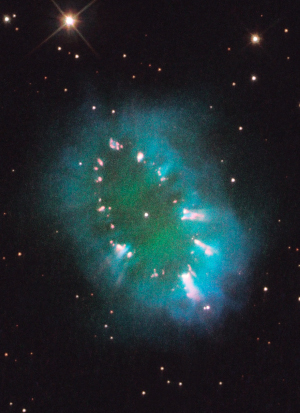
Who needs aliens and imagined cities on the moon when you have a reality that produces such strange and beautiful things as the image on the right?

On July 2, the Hubble Space Telescope took this image of a planetary nebula, aptly dubbed the Necklace Nebula. As the caption explains,

A pair of stars orbiting close together produced the nebula, also called PN G054.2-03.4. About 10,000 years ago one of the aging stars ballooned to the point where it engulfed its companion star. The smaller star continued orbiting inside its larger companion, increasing the giant’s rotation rate.

The bloated companion star spun so fast that a large part of its gaseous envelope expanded into space. Due to centrifugal force, most of the gas escaped along the star’s equator, producing a ring. The embedded bright knots are dense gas clumps in the ring.

The binary still exists, and can be seen as the star in the center of the necklace. The two stars are now only a few million miles apart and complete an orbit around each other in about a day.

0 comments
1 2