
Musk: SpaceX is now targeting late February/March for 1st orbital launch of Starship

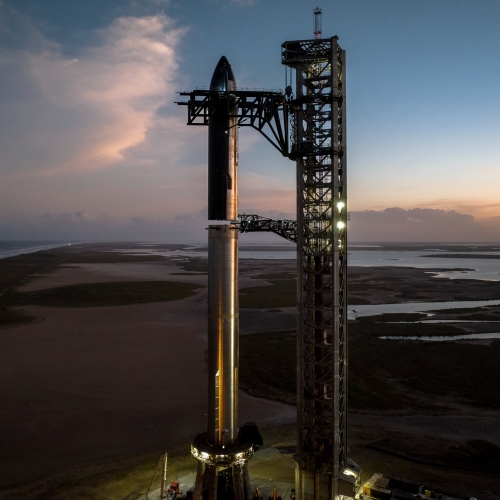
According to a tweet put out by Elon Musk on January 8, 2023, SpaceX is now targeting late February/March for 1st orbital launch of the 24th prototype of Starship and the seventh prototype of Superheavy.

The testing in 2022 has not gone as smoothly as hoped, and is the reason no launch occurred last year:

Super Heavy B7 first left SpaceX’s Starbase factory in March 2022 and has been in a continuous flux of testing, repairs, upgrades, and more testing in the nine months since. The 69-meter-tall (~225 ft), 9-meter-wide (~30 ft) steel rocket was severely damaged at least twice in April and July, requiring weeks of substantial repairs. But neither instance permanently crippled the Starship booster, and Booster 7 testing has been cautious but largely successful since the rocket’s last close call.

Following its return to the OLS [orbital launch site] in early August, Super Heavy B7 has completed six static fire tests of anywhere from one to fourteen of its 33 Raptor engines. It has almost certainly dethroned Falcon Heavy to become the most powerful SpaceX rocket ever tested. And on January 8th, 2023, SpaceX rolled the rocket back to Starbase’s orbital launch site for the seventh time. According to statements made by CEO Elon Musk and a presentation from a NASA official, the last major standalone test between Booster 7 and flight readiness is a full 33-engine static fire. Together, B7’s 33 Raptor 2 engines could produce up to 7600 tons (16.7 million lbf) of thrust at sea level, likely making Starship the most powerful rocket stage in the history of spaceflight.

I had read speculation earlier that it was impossible for SpaceX to do a full 33-engine static fire test because the OLS could not hold the rocket down. That now appears to be incorrect.

Musk’s tweet and proposed schedule should also not be taken with great seriousness. He routinely sets ambitious targets merely to keep the pace fast, even if those targets are not met.
11 comments

SpaceX raises another $750 million in private investment capital

SpaceX has just completed another round of fund-raising, gaining another $750 million in private investment capital.

This additional money now means that SpaceX has raised about $10 billion in private money, most of which is being used for the development of Starship and Superheavy. When we add the $4 billion SpaceX will get from NASA for Starship, the company now has $14 billion to build this new rocket.

5 comments

Billionaire Maezawa chooses his passengers for Starship lunar flight

Japanese billionaire Yusaku Maezawa yesterday announced the eight passengers he will take with him on his private Starship flight around the Moon, its launch date still not set.

The full list of ten (including the two back-up passengers) is a wide mixture of individuals with a wide range of disciplines coming from a wide range of countries. For those interested in space, the one name that stood out and was very familiar was Tim Dodd, created of Everyday Astronaut. He created a video describing his selection as well as Maezawa’s entire project, which I have embedded below:
» Read more

4 comments

Update on Starship/Superheavy testing at Boca Chica

Link here.

While work appears to be proceeding aggressively, it increasingly looks like no orbital launch will occur before the end of this year. SpaceX engineers appear to be preparing two different Superheavy prototypes, #7 and #9, but both are still undergoing modifications based on recent engine tests. In addition, modifications to Starship prototype #24 continue.

4 comments

SpaceX conducts successful static fire test of Superheavy

SpaceX today successful completed a 13-second static fire test of its Superheavy first stage booster at Boca Chica, Texas.

I have embedded the video of the test below, cued to just before ignition. The test fired eleven of the booster’s 33 engines, and appeared to go very smoothly.

The company is still moving steadily towards an orbital launch of Superheavy and Starship before the end of the year.

» Read more

1 comment

Superheavy prototype #7 undergoes 14 engine static fire test

SpaceX’s seventh prototype of its Superheavy first stage booster — intended to launch its Starship orbital craft on the first orbital flight — successfully completed a 10-second static fire test of 14 of its 33 engines yesterday.

I have embedded video of the test below the fold. It shows the burn repeatedly from different angles. It appears the engine test went exactly as planned, with no subsequent fires near the launch pad.

According to the article at the link, this test fire, even with only 14 engines, made this Superheavy booster the most powerful rocket on Earth, at least until tonight when NASA’s SLS launches. Once this booster fires all of its 33 Raptor-2 engines however it will then exceed SLS in power. That it hasn’t launched however makes this claim a little overstated.

Regardless, SpaceX continues to move quite smoothly towards that first orbital launch of Starship, which the company hopes to do before the end of the year.
» Read more

1 comment

Dennis Tito signs deal to fly on 2nd manned Starship mission around Moon

Capitalism in space: Dennis Tito, the first tourist to fly in space and now 82-years-old, has signed a deal with SpaceX for both him and his wife Akiko to fly on 2nd manned Starship mission around Moon.

His weeklong moonshot — its date to be determined and years in the future — will bring him within 125 miles (200 kilometers) of the lunar far side. He’ll have company: his wife, Akiko, and 10 others willing to shell out big bucks for the ride.

Tito won’t say how much he’s paying; his Russian station flight cost $20 million.

The couple recognize there’s a lot of testing and development still ahead for Starship, a shiny, bullet-shaped behemoth that’s yet to even attempt to reach space. “We have to keep healthy for as many years as it’s going to take for SpaceX to complete this vehicle,” Tito said in an interview this week with The Associated Press. “I might be sitting in a rocking chair, not doing any good exercise, if it wasn’t for this mission.”

The bottom line is that this deal, combined with the two other passenger Starship deals SpaceX has already signed, demonstrates that there is a solid market for Starship, even before its first launch. Expect that market to boom once the rocket begins operations.

1 comment

SpaceX fully stacks Starship/Superheavy in preparation for launch

Starship about to be stacked on Superheavy
Starship about to be stacked on Superheavy, using
the launch tower’s chopstick arms. Click for full image.

For the first time in six months SpaceX engineers have stacked Starship prototype #24 on top of Superheavy prototype #7, with the intention of running a dress rehearsal countdown and a full static fire test of Superheavy’s 33 engines, all in preparation for the first orbital test flight before the end of this year.

According to CEO Elon Musk, Booster 7 and Ship 24 will attempt Starship’s first full-stack wet dress rehearsal (WDR) once all is in order. The prototypes will be simultaneously loaded with around 5000 tons (~11M lb) of liquid oxygen and methane propellant and then run through a launch countdown. Diverging just before ignition and liftoff, a WDR is meant to be more or less identical to a launch attempt.

…If the wet dress rehearsal goes to plan, SpaceX will then attempt to simultaneously ignite all 33 of the Raptor engines installed on Super Heavy B7, almost certainly making it the most powerful liquid rocket ever tested. Even if all 33 engines never reach more than 60% of their maximum thrust of 230 tons (~510,000 lbf), they will likely break the Soviet N-1 rocket’s record of 4500 tons of thrust (~10M lbf) at sea level. It would also be the most rocket engines ever simultaneously ignited on one vehicle. SpaceX will be pushing the envelope by several measures, and success is far from guaranteed.

Depending on the results of these tests, the stacked rocket will either require further modifications, or could even proceed directly to launch.

We are thus seeing a true race between SpaceX’s privately developed and funded rocket and NASA’s government developed and funded SLS rocket. Which will launch first? Right now the race is neck-and-neck, though that is deceiving since SpaceX began development twelve years after NASA started work on SLS. Even if SLS launches first, SpaceX will have clearly shown that private enterprise does things faster (7 years vs 18 years) and for far less money (about $9 billion vs $46 billion).

15 comments

SpaceX to upgrade 2nd Kennedy launchpad for manned launches

In order to create some increased redundancy, SpaceX and NASA have agreed to upgrade the company’s second launchpad at Cape Canaveral, LC-40, so that both it and pad LC-39A can launch manned Dragon capsules.

This plan grew out of concern by NASA that the new Starship orbital launchpad was too close to LC-39A, and could possibly damage it during a launch. Should that happen, and no back-up launchpad was available, the agency would have no way to get astronauts up to ISS, since Boeing’s Starliner is not yet operational. Because of that concern, NASA made it clear that no Starship launches could occur in Florida until this issue was resolved.

The solution? Make LC-40 a manned launchpad too.

Nothing is known about the nature of the modifications that LC-40 will require. But more likely than not, NASA will require SpaceX to develop something similar to Pad 39A’s facilities. That would involve building a new crew access tower, crew access arm, escape system (39A uses baskets and ziplines), and an on-site bunker for astronauts.

It is also likely that no Starship launches at Kennedy will occur until this work is done and a manned launch from LC-40 takes place. Though this could delay Starship somewhat, I expect not significantly. Before SpaceX is ready to launch operationally in Florida, it still has to do a lot of testing and development of Starship/Superheavy in Boca Chica, work that could take several years. I also suspect that it will get the launchpad work done relatively quickly, especially if NASA agrees to pay for it.

12 comments

Musk: Starship orbital attempt by November, at the latest

According to a tweet yesterday by Elon Musk, SpaceX engineers will likely have the first orbital prototypes of Starship and Superheavy ready for the orbital attempt either late in October, or by November. His full tweet:

Late next month maybe, but November seems highly likely. We will have two boosters & ships ready for orbital flight by then, with full stack production at roughly one every two months. [emphasis mine]

The highlighted words are the most significant. SpaceX is not building one rocket for test, like NASA has done with SLS. It is building an assembly line of test rockets, so that it can do a fast series of test launches plus upgrades, leading to quick and reliable operations. Should any one rocket launch fail, the company will speedily move on to the next, with little or no delay.

Should SLS fail in its first test launch sometime in the next month, NASA has no back-up. The entire program will be shattered, with no easy way to recover.

12 comments

SpaceX fires seven engines on Superheavy prototype #7

Capitalism in space: SpaceX today successfully did a static fire engine test of seven engines on its Superheavy prototype #7, intended to be the lower stage of the first Superheavy/Starship orbital test.

The link takes you to the full live stream. Below I have cued that live stream to just before the test occurred. Everything seems to go as planned, with no obvious anomalies.

SpaceX continues to be moving closer and closer to that first orbital flight.
» Read more

3 comments

Update on SpaceX’s Starship and Superheavy

Link here. The article not only outlines the test program leading to the first launch of prototypes Starship #24 and Superheavy #7, it describes the status of later prototypes, as well as the construction of SpaceX’s Starship launch site in Florida. Key quote:

Booster 7’s gradual approach to static fire testing will allow the teams to fix issues as they test and fully mature procedures and software ahead of the long-awaited orbital flight of Starship. Should this gradual testing go without a hitch, it could culminate in one or perhaps even two 33-engine static fire tests of Booster 7 on the OLM [orbital launch mount].

Once this testing is completed and any issues found fixed, it’ll be cleared to proceed into another phase of testing: Ship 24 will then be stacked on top of Booster 7 for combined tests. This could include launch countdown simulations, an eventual full-up countdown, and a 33-engine static fire test.

SpaceX hopes to complete this by mid-next month and clear both vehicles for launch shortly after. However, as we’ve seen in the past few weeks, any issues encountered during this intense test campaign could well mean a slip to later into the year and, perhaps, into next year.

4 comments
1 17 18 19 20 21 27