
SpaceX successfully test fires all six engines on Starship prototype #24

Capitalism in space: SpaceX yesterday successfully completed for the first time an eight-second-long static fire test of all six engines on Starship prototype #24.

I have embedded video of the test below. The amount of power exhibited is quite impressive. In fact, it was so powerful it likely melted the concrete below the rocket, sending hot debris flying that caused a major brushfire.

Most likely, eight long seconds of blast-furnace conditions melted the top layer of surrounding concrete and shot a hailstorm of tiny superheated globules in almost every direction. Indeed, in almost every direction there was something readily able to burn, a fire started. In several locations to the south and west, brush caught fire and began to burn unusually aggressively, quickly growing into walls of flames that sped across the terrain. To the east, debris even made it into a SpaceX dumpster, the contents of which easily caught fire and burned for hours.

Eventually, around 9pm CDT, firefighters were able to approach the safed launch pad and rocket, but the main fire had already spread south, out of reach. Instead, they started controlled burns near SpaceX’s roadblock, hoping to clear brush and prevent the fire (however unlikely) from proceeding towards SpaceX’s Starbase factory and Boca Chica Village homes and residents.

The rocket itself came though the test unscathed, a major milestone on the path to its first orbital flight.

During a launch, the rocket would have quickly lifted off, and thus caused far less stress to the concrete on the ground. Nonetheless, this test suggests SpaceX needs to do more pad preparation for any tests of Superheavy prototype #7, which has 33 engines at its base.
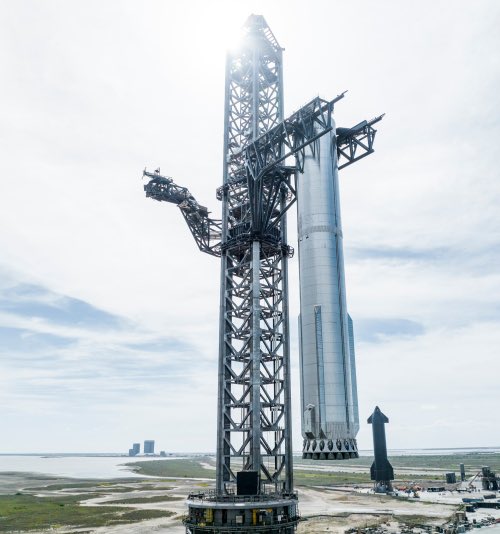
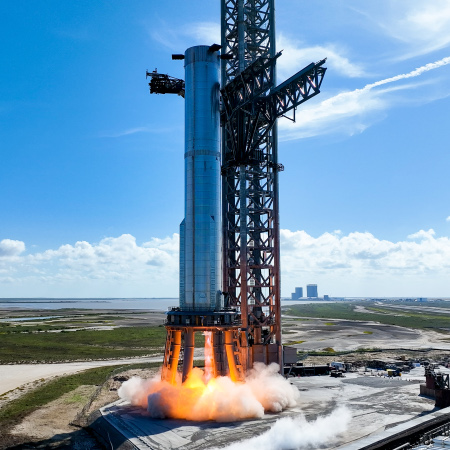
» Read more

37 comments

More static fire tests of Starship/Superheavy expected this week

SpaceX appears to be gearing up for more engine tests of both Superheavy prototype #7 and Starship prototype #24 this week, having called for road closures at Boca Chica today with additional options thoughout the week.

The article at the link mostly provides an overview of the changes in both stages that occurred because of the shift from the first version of the Raptor engine to the much more streamlined Raptor-2. The side-by-side image of both versions is quite revealing, showing once again how much SpaceX adheres to Musk’s adage that “the best part is no part.” Raptor-2 is astonishingly simpler and more compact, even though it produces about 25% more power.

0 comments

SpaceX completes static fire test of three engines on Superheavy prototype #7

Capitalism in space: SpaceX yesterday successfully completed the first static fire test of more than one engine on its Superheavy prototype #7, firing three engines for five seconds.

NASASpaceflight livestreamed the test, and its footage suggests that only two engines may have fully lit up, with the third perhaps aborting. Whether or not the third Raptor joined the party, however, it was still the first multi-engine Super Heavy static fire that SpaceX has performed.

I have embedded that footage below. Expect more such tests in the coming days. If all works as planned (something we should not expect as this remains a development program), the tests will culminate in an orbital test flight sending Starship on a one orbit mission around the Earth. At present SpaceX wants that flight to occur before the end of this year.

» Read more

3 comments

SpaceX remounts Superheavy prototype #7 on launchpad

Superheavy #7 lifted onto launchpad

Capitalism in space: Using its giant launch tower crane that Elon Musk has dubbed Mechazilla, SpaceX engineers yesterday remounted the seventh Superheavy prototype onto the orbital launchpad in preparation for more engine tests leading to its first flight.

Booster 7 has been atop this launch mount before. Earlier this month, SpaceX conducted two “static fire” tests with Booster 7, firing the vehicle up while it remained attached to the mount.

Both of those tests — which occurred on Aug. 9 and Aug. 11, respectively — lit up just a single Raptor engine (apparently, a different one each time). And Booster 7 wasn’t fully outfitted at the time, sporting just 20 of its 33 engines (opens in new tab) (the vast majority of which stayed dormant during the tests).

After the Aug. 11 test, SpaceX lifted the Super Heavy prototype off the mount and hauled it back to a processing bay at Starbase. Technicians installed the remaining 13 Raptors and got it ready for Tuesday’s move back to the pad.

The picture above was sent out by Musk on his Twitter feed. Note the number of engines at the base. The tower itself, acting as a crane, has also simplified and speeded up operations. SpaceX can now quickly move the rocket back and forth from the assembly building, without the need of separate cranes.

The company is still targeting early September for the first orbital launch, though it also still needs to stack Starship prototype #24 (seen in the background) on top of Superheavy, and then do more tests.

10 comments

NASA describes Starship’s first unmanned test lunar landing

In a briefing focused on the science that could be placed on the mission, a NASA official yesterday provided a status update of SpaceX’s first unmanned test flight by Starship to the Moon.

First, the official revealed that NASA is only requiring SpaceX to demonstrate a successful landing. Take-off will not be required. Also,

Starship is not designed to fly directly to the Moon like NASA’s Space Launch System, however. Instead, the first stage puts it only in Earth orbit. To go further, it must fill up with propellant at a yet-to-be-built orbiting fuel depot. Other Starships are needed to deliver propellant to the depot.

Watson-Morgan described the Concept of Operations for Starship’s Artemis III mission, starting with launch of the fuel depot, then a number of “propellant aggregation” launches to fill up the depot, then launch of the Starship that will go to Moon.

Previously SpaceX suggested that the ship would be directly refueled by subsequent Starships, with no middle-man fueling depot. It could be either engineering had made the depot necessary, or NASA politics have insisted upon it.

Finally, the talk outlined the elevator SpaceX is developing to lower the astronauts and equipment to the ground from Starship’s top.

6 comments

Starship gets its first communications satellite customer

Capitalism in space: Sky Perfect JSAT, a Japanese satellite communications company, today awarded SpaceX a launch contract using its giant Starship/Superheavy rocket to put its Superbird-9 communications satellite into orbit in 2024.

Superbird-9 will be launched by SpaceX’s Starship launch vehicle in 2024 to geosynchronous transfer orbit. SpaceX’s Starship is a fully reusable transportation system that will be the world’s most powerful launch vehicle. SKY Perfect JSAT and SpaceX will continue to work together ahead of the launch of Superbird-9 Satellite.

Sky Perfect is the first communications satellite company to choose Starship for a satellite launch. It is however the rocket’s fourth signed customer. Japanese billionaire Yusaku Maezawa made a deal in 2018 for a flight around the Moon, while NASA chose Starship in 2021 as the manned lunar lander in its Artemis program. UPDATE: SpaceX also has a second private manned customer, Jared Isaacman, whose present deal with SpaceX calls for two Dragon flights followed by a Starship flight.

Sky Perfect is not a new company, with sixteen satellites already in orbit providing communications, broadband, and entertainment to Japan and the Far East. It likely made this deal because it got a very good launch price, with options to back out if the rocket’s on-going development gets delayed by too much. It also made the deal because it helps to solidify Starship’s future, something Sky Perfect probably sees as a win considering the significant reduction of launch costs expected from Starship/Superheavy.

5 comments

Another and this time longer static fire tests for Superheavy prototype #7

Capitalism in space: SpaceX engineers yesterday conducted a second static fire engine test of the 7th prototype of its Superheavy first stage booster, firing a different engine for 20 seconds.

The action ramped up on Thursday (Aug. 11) for Booster 7, which conducted a much longer static fire on Starbase’s orbital launch mount. The burn, which occurred at 3:48 p.m. EDT (1948 GMT), lasted for 20 seconds, SpaceX said via Twitter (opens in new tab).

The long-duration burn aimed to “test autogenous pressurization,” according to a tweet posted by Musk (opens in new tab) shortly before Booster 7 fired up.

Expect these engine tests to occur on a regular basis over the next few weeks, as engineers ramp up their operations in preparation for the first orbital flight of both prototype #7 with Starship prototype #24 stacked on top.

6 comments

SpaceX gets FCC communications license for Starship orbital launch

Capitalism in space: The FCC yesterday approved SpaceX’s communications license for one or more Starship orbital launches, with a six month launch window beginning on September 1, 2022.

This FCC approval is not a launch license, which must be given by the FAA. It does tell us that SpaceX will not attempt the first orbital launch of Starship before the end of this month. It also tells us that the company likely plans on an aggressive test program from September ’22 through February ’23, assuming the FAA and the federal bureaucracy finally stops blocking that program.

1 comment

Superheavy prototype #7 and Starship prototype #24 undergo static fire tests

Superheavy #7's first launchpad engine test
Click for original photo.

Capitalism in space: SpaceX engineers yesterday performed static fire tests of both its Superheavy prototype #7 and its Starship prototype #24.

The Superheavy prototype fired one engine, and did so only a few weeks after that prototype experienced an explosive event the launchpad during earlier fueling/engine tests. Yesterday’s engine test was the first time any Superheavy prototype had fired its engines on the launchpad.

The Starship prototype meanwhile fired two engines on a nearby vertical test stand.

SpaceX’s plan is to stack #24 on top of #7 and attempt an orbital launch test that will have the Superheavy prototype land in the Gulf of Mexico while the Starship prototype reaches orbit and then returns to Earth in the Pacific northeast of Hawaii. Based on the company’s normal pace of operations, that flight is probably only weeks away. However, before that flight engineers will have to do a full static fire test of all 33 of #7 engines, and then like do it again with Starship #24 stacked on top.

13 comments

SpaceX raises another $250 million in investment capital

Capitalism in space: SpaceX in July raised $250 million in investment capital from five unnamed investors, bringing the total raised in 2022 to $2 billion.

Added to the amount brought in before this year, SpaceX has raised about $9 billion in private capital, most of which is focused on financing the development of Starship/Superheavy. When you add the $2.9 billion contract it won from NASA to develop Starship as a manned lunar lander, the company has raised about $12 billion to build this heavy lift rocket.

The numbers demonstrate several things. First, Wall Street is apparently very confident SpaceX will succeed in building the rocket, and then make a lot of money from it. Second, the numbers prove it shouldn’t cost $60 billion and two decades to design and build a heavy lift rocket, as NASA has done with its SLS rocket. SpaceX is doing it for less than a fifth of the cost, in a third of the time.

10 comments

Environmentalists opposed to Starship at Boca Chica appeal dismissal of their lawsuit

Environmentalists from the Sierra Club and one Texas Indian tribe have now appealed the dismissal of their lawsuit aimed at blocking further tests or launches of Starship and Superheavy by SpaceX at its Boca Chica facility.

The Sierra Club and the Carrizo/Comecrudo Tribe of South Texas jointly appealed the 445th District Court’s decision July 7 to dismiss a lawsuit concerning SpaceX testing of its next-generation Starship vehicle closing nearby Boca Chica Beach, the coalition said July 28. In the dismissal, Judge Gloria Rincones argued there is “no private right of enforcement” concerning the beach access, according to KRGV.com (opens in new tab). The dismissal took place over the appellants’ protests that closing the beach violates the Texas state constitution, along with access rights by traditional groups.

The Sierra Club’s Brownsville organizer, Emma Guevara, stated the appeal is taking place because the beach is closed weekly to allow “a billionaire [to] launch deadly rockets near homes and wildlife.”

Citing a fireball that briefly and unexpectedly engulfed Starship during testing July 12, Guevera said her family was “forced” to hear the noise, which “launched without any warning for the public.” [emphasis mine]

My my, what a horror! I suppose everyone must stop what they are doing because Guevera and his family might be inconvenienced. And who cares if the lawsuit prevents thousands of south Texas citizens from having jobs and a thriving economy? It is more important Guevera doesn’t have to hear loud noises.

The lawsuit claims that allowing SpaceX to periodically close access to the nearest beach violates the state’s constitution, despite laws passed by both the local and state legislatures allowing for these closures.

9 comments
1 18 19 20 21 22 27