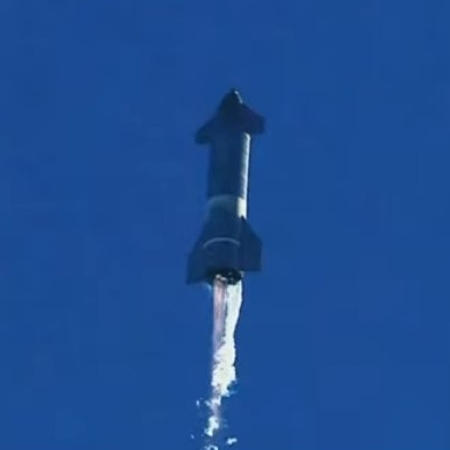
Starship prototype #25 is rolled to launchpad for static fire engine tests

Starship prototype #25 on the way to launchpad
Click for original image.

SpaceX yesterday evening rolled its 25th prototype of its Starship spacecraft to its suborbital launchpad at Boca Chica, as shown on the image to the right, for a planned static fire engine test of its six Raptor engines.

If all goes well, the company hopes to stack this prototype on top of the ninth prototype of Superheavy and complete the second test orbital flight of the entire rocket as early as June 15, 2023, with a launch window as long as six months according to the company’s FCC communications license application.

The actual launch date however remains very uncertain, for several reasons. The FAA must issue a launch license, and it won’t do that until it is satisfied the investigation into the first launch failure is complete. That launch approval will also likely be delayed because of the lawsuit against that agency for issuing the previous launch license.

8 comments

Environmentalists sue FAA, demanding it shut down Boca Chica and Starship

Starship/Superheavy at T+4:02, just after the self-destruct command was issued
Starship/Superheavy at T+4:02, just after the self-destruct command
was issued on April 20, 2023. It also appears to be the fate of SpaceX’s
entire Boca Chica operation, if the environmental radicals get their way.

A group of environmental groups as well as a non-profit corporation calling itself the Carrizo/Comecrudo Nation of Texas, Inc, today filed a lawsuit against the Federal Aviation Administration FAA), demanding it shut down SpaceX’s Boca Chica facility and block all further Superheavy/Starship launches.

You can read the lawsuit here [pdf]. Its essence is contained in these two paragraphs:

The area surrounding the SpaceX facility at Boca Chica is a biologically diverse and essential habitat area for many species, including federally protected wildlife and animals that are considered sacred to the Carrizo/Comecrudo People, such as the critically endangered ocelot. The SpaceX facility is smack in the middle of publicly owned conservation, park, and recreation lands, including a National Wildlife Refuge, two State Parks, a State Wildlife Management Area, and a State Coastal Preserve. These lands are of extraordinary conservation value for a range of federally and state lists wildlife and other protected species such as migratory birds. Bird species from both the Central and Mississippi flyways converge there, making it an essential wintering and stopover area for migratory birds as they move north and south each year.

SpaceX activities authorized in the FONSI/ROD [the environmental reassessment issued last year] have and will adversely affect the surrounding wildlife habitat and communities. In addition to harm from construction activities and increased vehicle traffic, rocket launches result in intense heat, noise, and light pollution. Furthermore, the rocket launches and testing result in explosions which spread debris across surrounding habitat and cause brush/forest fires — including one that recently burned 68 acres of adjacent National Wildlife Refuge. The FAA calls these explosions “anomalies,” but in fact they occur frequently, with at least 8 over the past 5 years. FAA acknowledged that many more such “anomalies” are expected over the next 5 years. The U.S. Fish and Wildlife Service has found that prior SpaceX rocket explosions harmed protected wildlife and designated habitat in violation of the Endangered Species Act (ESA).

In other words, rockets and launch sites should never be placed inside wildlife refuges, because such activity is detrimental to wildlife.

A more false statement cannot be made. Under this conclusion the launch facilities at Cape Canaveral, which have been operating in the middle of a wildlife refuge now for more than six decades, should be shut down immediately. All the wildlife there must certainly be dead!
» Read more

10 comments

Musk press conference on Starship/Superheavy launch

Yesterday Elon Musk held an hour-long audio press conference with a number of space reporters, broadcast over youtube. I have embedded that conference below, for those of my readers who wish to hear what Musk had to say, in his own words.

The key take-aways from Musk:

  • The launch was about what he expected
  • They will be ready to launch again in about two months
  • The debris “was really just basically sand and rock so it’s not toxic at all … it’s just like a sandstorm, essentially”
  • The biggest issue is making sure the flight termination system functions better.
  • The next flight will be a repeat, with the main goal getting to stage separation
  • He gives them an 80% chance of making orbit this year

When asked about obtaining the permit for that next flight, Musk side-stepped the question. It remains to my mind the largest obstacle for meeting his schedule.
» Read more

7 comments

With the federal bureaucracy gleefully sharpening its knives to shut down Boca Chica, SpaceX should quickly shift Starship/Superheavy operations to Florida

Superheavy still going strong, shortly after Max-Q

The results of the spectacular test launch last week of SpaceX’s Superheavy/Starship heavy lift rocket was predictable in almost all ways.

First, everyone knew that it was highly unlikely that the launch would do everything intended. This was the first time ever that SpaceX had fired all 33 Raptor-2 engines at the base of Superheavy, at full power. It was the first time ever that this firing took place with Starship stacked on top. It was the first time ever that the entire stack was fueled. It was the first time ever that this rocket — the world’s most powerful (twice as powerful as the Saturn-5 and about three times more powerful than SLS) — had every launched.

The number of unknowns were gigantic, which was exactly why SpaceX needed to do the launch. The company’s engineers needed to find out what they didn’t know about Superheavy in order to refine their engineering so that Superheavy will be more likely for success in its next launch. They also needed to find out what such a launch would do to their preliminary launchpad, in order to refine its engineering as well so that future launches could take place with little or no damage.

Thus, it is not surprising that there were surprises. The most significant was the actual amount of success. Superheavy functioned far better than anyone could have dreamed, retaining flight control through max-q and then flying for almost three minutes before Starship failed to separate and the entire stack lost control and had to be destroyed. Most of its engines worked, though discovering the reasons for the handful that failed will be a prime question in the subsequent investigation.

The second unsurprising thing about this launch is the reaction of the federal bureaucracy, run by Democrats and the Biden administration. It has quickly moved in to squelch any further launches at Boca Chica, likely for a considerable time. The FAA immediately initiated its own investigation while grounding all further launches from Boca Chica. The Fish & Wildlife Service has now begun detailing, almost gleefully, the amount of ground damage the launch caused, including ripping out the concrete base below the rocket and flinging chunks of debris hundreds of feet away as well as depositing a cloud of sand dust on everything up to 6.5 miles from the launchpad.

This quote however is significant, and tells us the real truth:
» Read more

29 comments

Starship/Superheavy did not explode!

Starship/Superheavy at T+4:02, just after the self-destruct command was issued
Starship/Superheavy at T+4:02, just after the self-destruct command
was issued

In the past twenty-four hours we have another wonderful demonstration of the utter bankruptcy of the American press in the manner in which it has decided to describe yesterday’s first test launch of Starship/Superheavy. Here are just a few headline examples:

Every single one of those headlines implies that the explosion was the launch’s failure. If you read the linked articles you find that many repeat that implication in their reports.

None are correct. » Read more

37 comments

Superheavy/Starship clears tower but fails at stage separation

Starship and Superheavy, having just cleared the tower

In a spectacular first orbital launch attempt, SpaceX’s Superheavy and Starship successfully lifted off, clearing the tower and continuing through max-Q (maximum dynamic pressure). It then reached about 24 miles altitude when the rocket began to slowly spinn just prior to main engine cutoff and stage separation. At that point, because engine cutoff and separation had not occurred as planned, the engineering team used the flight termination system to destroy it so as to eliminate any risk to anyone on the ground.

As the announcers noted repeatedly, if the rocket simply cleared the tower they would consider this a magnificent success, considering that they had never fired Superheavy before in a real countdown. That Superheavy performed exactly as it should for almost its entire flight means SpaceX is that much closer to getting Starship into orbit than one would think at this stage of testing.
» Read more

70 comments

An ordinary person’s view of the Starship/Superheavy countdown

Starship and Superheavy, stacked on the launchpad for launch

One of my readers, who wishes to go by is nickname Doubting Thomas on Behind the Black, went to Boca Chica earlier this week with the hope of seeing the live first orbital launch of Superheavy with Starship stacked on top. Unfortunately, the launch on April 17, 2023 was scrubbed, and he could not remain in Boca Chica for the now rescheduled launch early tomorrow morning on April 20th.

He sent me some pictures of that experience, however, which I post here with his permission. The best of course is the one to the right, of Starship stacked on Superheavy on the launchpad. This was taken before the roads were closed, and shows how incredibly close the general public can get to that launchpad simply by driving past on a public road.

The next few pictures give us a glimpse at the options people have for viewing future Boca Chica launches.
» Read more

10 comments

Watching the second attempt to launch Starship/Superheavy to orbit

Starship/Superheavy flight plan for first orbital flight
Click for original image.

SpaceX’s second attempt of an inaugural orbital test launch of SpaceX’s massive Superheavy first stage with its orbital Starship spacecraft stacked on top has now been rescheduled for Thursday, April 20, 2023, with a 62-minute launch window opening at 8:28 am Central.

I have embedded SpaceX’s live stream of that launch below, which will begin around 7:15 am (Central). You can also see an independent 24/7 live stream from LabPadre, showing the launchpad from many different angles and available here. NasaSpaceFlight.com also has a 24/7 live stream showing multiple angles here. For both, to see links to their many camera angles click on “more” in the text.

Though both of these independent live streams provide alternative view angles of the launch, both will rely on SpaceX’s main live stream, embedded below, for actual updates on the countdown status.

The flight plan is shown in the graphic above. Assuming all goes as planned, most of the action will occur in the first ten minutes, at which time Starship will cut off its engines and be in orbit. It will then coast for a little over an hour when it will re-enter the atmosphere to splashdown in the Pacific north of the Hawaiian Islands.

As I have noted many times, the historical significance of this rocket cannot be overstated. It is twice as powerful as NASA’s Saturn-5 rocket and almost three-times as powerful as NASA’s new SLS rocket, and went from concept to launch in about seven years. Its development was funded entirely by private investment capital, at a fraction of the cost of either of the government’s rockets. And it will be completely reusable once operational, reducing the cost exponentially of getting large 100-ton payloads into orbit.

And most important, it was developed by free Americans, following their own personal dreams.
» Read more

10 comments

Starship/Superheavy launch scrubbed

Because of “a pressurization issue”, SpaceX engineers decided to scrub today’s first test launch of Starship/Superheavy. The launch team then made this launch attempt a wet dress countdown rehearsal, ending at T-40 seconds.

Because of the amount of fuel and oxygen involved, turn-around will take 48 hours, meaning the next launch attempt will likely occur on Wednesday, April 19, 2023, probably at the same approximate time in the morning.

Stay tuned for more details.

11 comments

Watching the launch of Starship/Superheavy

Starship/Superheavy flight plan for first orbital flight
Click for original image.

UPDATE: Launch scrubbed. To get to new links for watching the live stream in the second launch attempt, now scheduled for April 20, 2023, go here.

Original post:
————-
The first orbital test launch of SpaceX’s massive Superheavy first stage with its orbital Starship spacecraft stacked on top is now scheduled for a launch in a two-and-a-half hour long launch window beginning at 8 am (Central) on Monday, April 17, 2023.

I have embedded SpaceX’s live stream of that launch below, which will begin around 7 am (Central). You can also see an independent 24/7 live stream from LabPadre, showing the launchpad from many different angles and available here. NasaSpaceFlight.com also has a 24/7 live stream showing multiple angles here. Though both of these independent live streams provide alternative view angles of the launch, both will rely on SpaceX’s main live stream, embedded below, for actual updates on the countdown status.

If the launch is scrubbed on April 17th, SpacX has backup dates on April 18th and 19th. The flight plan and time line is shown in the graphic above.

The monumental significance of this rocket cannot be overstated. It is the most powerful rocket ever built, capable of putting more mass into orbit than either the Saturn-5 or NASA’s new SLS rocket.

It took less than seven years from concept to launch. Compare that to SLS, which was proposed in 2004 and only launched last year, two decades later.

It has been been entirely developed with private funds. Though SpaceX does have a NASA contract for building a Starship lunar lander, little of that contract’s funds have yet been distributed to the company. From private funds SpaceX has raised about $10 billion, most of which has been channeled into this rocket’s development, with a small unknown amount used to develop Starlink. Compare that once again to SLS, which has cost about $60 billion to build.

Finally, it is being designed to be completely reusable, thus reducing the cost exponentially for putting large 100-ton payloads into orbit. If successful, Starship/Superheavy will very quickly make the human exploration and colonization of the solar system possible.

And it will do so not as a government project that is part of a government program, but as a private sector product, conceived by individual Americans freely following their dreams, and developed for profit, quickly and efficiently.

Let freedom ring!
» Read more

26 comments

FAA issues Starship launch license; SpaceX schedules launch for April 17th

Starship stacked on top of Superheavy
Starship prototype #24 stacked on top of Superheavy prototype #7

FAA just sent out an email notice announcing that it has issued SpaceX the launch license for the first orbital test launch of Superheavy/Starship.

After completing an evaluation of all applicable Vehicle Operator License requirements, the Federal Aviation Administration (FAA) issued a commercial Vehicle Operator License to SpaceX for launches of the Starship/Super Heavy Launch Vehicle Program in Cameron County, TX.

The affected environment and environmental impacts of Starship/Super Heavy operations at the Boca Chica Launch Site had been analyzed in the 2022 Final Programmatic Environmental Assessment for the SpaceX Starship/Super Heavy Launch Vehicle Program at the SpaceX Boca Chica Launch Site in Cameron County, Texas. Since the 2022 Programmatic Environmental Assessment (PEA), SpaceX provided the FAA with additional information regarding Starship’s planned landing, Super Heavy’s planned soft water landing, and the Launch Pad Detonation Suppression System. In accordance with FAA Order 1050.1F, Environmental Impacts: Policies and Procedures, the FAA prepared the Written Re-evaluation of the 2022 Final Programmatic Environmental Assessment for the SpaceX Starship/Super Heavy Launch Vehicle Program at the Boca Chica Launch Site in Cameron County, Texas to describe and evaluate this additional information.

Based on the Written Re-Evaluation, the FAA concluded that the issuance of a vehicle operator license for Starship/Super Heavy operations conforms to the prior environmental documentation, that the data contained in the 2022 PEA remains substantially valid, that there are no significant environmental changes, and all pertinent conditions and requirements of the prior approval have been met or will be met in the current action. Therefore, preparation of a supplemental or new environmental document is not necessary to support the Proposed Action.

In plain English, the FAA (and other federal agencies) have finally agreed that this launch will do nothing to change the conclusions of the environmental reassessment report that was approved in June 2022. That these agencies decided apparently decided to rehash that approved environmental reassessment for a launch that was also approved in that reassessment suggests that there are individuals in these agencies salivating for an opportunity to squelch SpaceX.

SpaceX has now set April 17, 2023 as the launch date, with its live stream going live in two days. I will embed that live stream late on April 16, 2023, for those who wish to watch it here.

18 comments

SpaceX announces it will be providing a webcast for Starship’s first orbital flight

Starship/Superheavy flight plan for first orbital flight
Click for original image.

SpaceX today revealed the details for its live stream of the first orbital launch of Superheavy/Starship, now targeting a launch date around April 21, 2023, depending on when the FAA issues the launch license.

A live webcast of the flight test will begin ~45 minutes before liftoff. As is the case with all developmental testing, this schedule is dynamic and likely to change, so be sure to stay tuned to our social media channels for updates.

I will embed that live stream here on Behind the Black. Stay tuned for more information.

The flight plan is shown above. The website also provides a detailed timeline. If launch manages to pass through Max-Q and get to stage separation, Superheavy will do a flip to do a soft targeted landing in the Gulf of Mexico. Starship will continue into orbit, and then fire its engines to return to Earth to do a soft targeted landing in the Pacific northeast of the Big Island of Hawaii.

That is the plan. Much can go wrong along the way, considering Superheavy has never flown once, no less with Starship stacked on top. Furthermore, Starship has never flown in its present iteration. Previous suborbital tests were using much earlier prototypes vastly different that this prototype, #24 in the series.

Regardless whether all goes perfectly or some things fail, the launch will be a success because it will provide SpaceX data for future test flights, which are waiting in the wings.

17 comments
1 15 16 17 18 19 27
