
Part 2 of Elon Musk’s most recent tour of Starbase
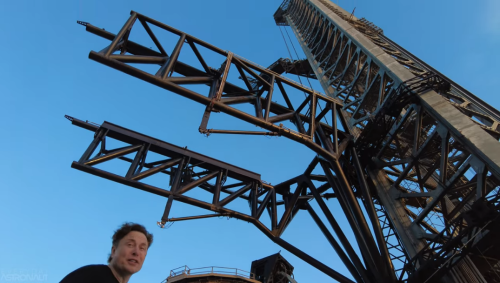
Looking up from the bottom of the tower
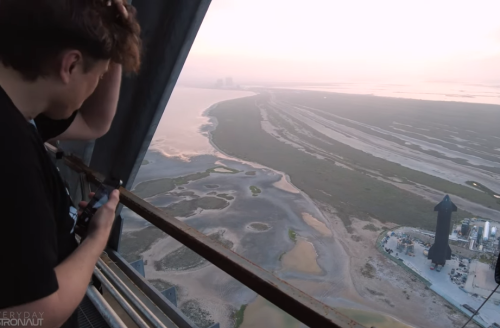

Looking down from the top of the tower

Tim Dodd of Everyday Astronaut has now posted part two of his long and most recent tour of Starbase at Boca Chica with Elon Musk. This section is 33 minutes long, and takes us to the top of the new orbital launch tower that SpaceX will use to launch Starship and Superheavy, as well as eventually catch Superheavy upon its return.

Part 1 can be viewed here.

The two images to the right are screen captures from today’s tour.

I have embedded Part 2 below. It has the following interesting take-aways:

  • Musk: “At SpaceX, we specialize in converting the impossible into late.”
  • Musk and his engineers spent several minutes describing in detail how the tower’s chopsticks will work in conjunction with Superheavy as it comes down and the chopsticks grab it.
  • Musk also provided some details about the Starlink-2 satellites, explaining that it is impractical to launch them on Falcon 9, and thus Starship must become operational to fly them.
  • The tour not only stopped near the top of the tower to get a close look at the attachment points for the chopsticks, it went to the tower’s top, at 469 feet in the air, 106 feet taller than the Saturn-5 rocket.
  • In discussing how the economy is not zero sum, Musk revealed why he is at heart a conservative, and is slowly finding this out. That he still leaves out that forgotten word that makes this all possible, freedom, shows his journey is not quite complete.
  • Musk also added his thoughts on the importance of making human civilization multi-planetary. For him, it is really a question of survival.
» Read more

11 comments

SpaceX seeking another $1.725 billion in investment capital

Capitalism in space: SpaceX has begun another private funding round, now asking for $1.725 billion in new investment capital.

The space venture is looking to bring in up to $1.725 billion in new capital, at a price of $70 per share, according to a company-wide email on Friday obtained by CNBC. Notably, SpaceX split its stock price 10-for-1 in February, which reduced the common stock to $56 a share – with the new valuation representing a 25% increase.

When added to past funding rounds — and including the $2.9 billion provided by NASA for turning Starship into a manned lunar lander — SpaceX will have raised approximately $12 billion total for building Starship.

Sounds like a lot, doesn’t it? Well, compared to what NASA has spent for its expendable SLS rocket (about $60 billion), $12 billion is chicken feed, especially because Starship will not be expendable, but entirely reusable.

If this contrast doesn’t illustrate the strength of freedom, competition, and private enterprise over government, I don’t know what does. Government, not caring about making a profit, produces a disposable rocket costing many billions, and takes two decades to do it. Private enterprise in comparison also wants a big rocket, but it also doesn’t look kindly on throwing away its investment with each launch. It instead insists the cost to build it be constrained, as well as the time to do it.

The result: Government accomplishes little and wastes a lot. Private enterprise makes it happen, and quickly for a reasonable cost.

7 comments

Elon Musk gives another tour of Starbase

Tim Dodd of Everyday Astronaut has posted another 44 minute long interview with Elon Musk that took place as Musk gave him a recent tour at Boca Chica, walking around the base of the Starship and Superheavy boosters being prepared for that first orbital launch.

I have embedded the interview below. It has the following interesting take-aways:

  • In describing their decision to eliminate completely a separate attitude thrust system for Starship and instead use the fuels in the main tanks using controllable vents, Musk once again demonstrated his engineering philosophy that “the best part is no part.”
  • The company is definitely planning to test the deployment of some Starlink satellites on that first orbital test flight.
  • Musk once again emphasized that there is a high expectation that this first orbital flight will fail, but they are unbothered by this because this first ship is considered a prototype anyway that must be redesigned. Whether it completes its flight or not, the flight will tell them what needs to be done for future iterations.
  • They are aiming with Starship to reduce to cost to bring a ton to the surface of Mars from $1 billion to $100K. Musk called this improvement “insane” but entirely possible.
  • Musk also noted how the design of Starship is not like a plane, which wants to develop lift. Starship instead is designed to fall, but do so as “draggy” as possible. The goal is to shed as much velocity as possible, as soon as possible.

Dodd also notes this video is the first of a new series.
» Read more

15 comments

SpaceX CEO: Starship could launch as early as June

Capitalism in space: SpaceX’s CEO and president Gwynne Shotwell revealed today that Starship could be ready for its orbital test flight from Boca Chica as early as June, though government regulatory obstacles make that launch more likely three to six months from now.

It appears that the delays in getting FAA approval for launch have not been the only issues that have delayed that first launch attempt. Though SpaceX would have likely tried a launch months ago with earlier prototypes had the approval arrived as originally promised, that launch would have likely failed based on ground tests the company has been doing during the delay.

When Musk tweeted his “hopefully May” estimate, SpaceX was nowhere close to finishing the Starship – Ship 24 – that is believed to have been assigned to the orbital launch debut. However, SpaceX finally accelerated Ship 24 assembly within the last few weeks and ultimately finished stacking the upgraded Starship on May 8th. A great deal of work remains to truly complete Ship 24, but SpaceX should be ready to send it to a test stand within a week or two. Even though the testing Ship 24 will need to complete has been done before by Ship 20, making its path forward less risky than Booster 7’s, Ship 24 will debut a number of major design changes and likely needs at least two months of testing to reach a basic level of flight readiness.

A more likely launch date is probably late July at the earliest, though of course that will also depend on the government’s approval, something that presently appears difficult to get.

5 comments

Fish & Wildlife documents now reveal its objections to SpaceX Boca Chica facility

We’re here to help you! Documents obtained by CNBC under a Freedom of Information request have revealed the specific objections of Fish & Wildlife that has helped delay the approval of the FAA’s environment reassessment of SpaceX’s Boca Chica facility for Starship launches.

SpaceX must take steps to track and mitigate its impact on endangered species and their habitat in order to gain approvals for testing and commercial launches of its Starship Super Heavy lift-launch vehicle in Boca Chica, Texas, according to documents from the U.S. Fish and Wildlife Service obtained by CNBC.

The documents, released by the federal agency in response to a Freedom of Information Act request, show that recent declines in an endangered bird species, the piping plover, have already been correlated with SpaceX activity at the South Texas facility.

The documents also reveal that SpaceX is, for now at least, reducing the amount of energy it plans to generate at a utility-sized natural gas power plant on the 47.4-acre launch site there.

According to a lawyer from the radical environmentalist organization the Center for Biological Diversity who was interviewed for the article, Fish & Wildlife’s demands are not tremendously restrictive, and might actually allow the project to go forward, since they appear to only require SpaceX to “monitor affected animal populations carefully, limit construction and launch activity to specific seasons or times of day and night, and use shuttles to reduce vehicle traffic of workers on location.”

I see it differently. I think Fish & Wildlife bureaucrats are struggling to come up with reasons to block SpaceX. They know that decades of data in Florida prove that rocket launches have no negative impact on wildlife. To claim such a thing in Texas is thus not justified. They are trying to do it anyway.

10 comments

Surprise! FAA delays SpaceX approval at Boca Chica another month

As I have been predicting now for months, the FAA today announced that it is once again delaying approval of its environmental reassessment of SpaceX’s Boca Chica facility one more month, to May 31, 2022.

This is the fifth time since December that the FAA has delayed the release of the environmental assessment. When the first delay was announced in December 2021, I predicted that this stone-walling by the government will likely continue for many months, and delay the first orbital launch of Starship “until the latter half of ’22, if then.”

Since then it has become very clear that the other federal bureaucracies at NOAA and Fish & Wildlife which must sign off on the approval are hostile to Elon Musk, SpaceX, and Starship, and are acting to block this approval, with this stone-walling having the unstated support of the Biden administration. When the third delay was announced at the end of February, I predicted no approval would ever occur, that the Biden administration wants to reject the reassessment and force the issuance of a new environmental impact statement, a process that could take years. To do this before the November election however will cost votes, so the administration would instead delay the approval month by month until November.

This prediction has been dead on right, unfortunately. Expect more month-by-month delays until November, when the Biden administration will then announce — conveniently just after the election — the need for a new impact statement requiring years of study.

The one hope to stop this government intransigence will be a complete wipe-out of the Democratic Party in Congress in those November elections. A strong Republican Congress with large majorities in both houses could quickly force the Biden administration to back down on many issues, including this effort to shut SpaceX down in Texas.

22 comments

SpaceX goes full speed ahead on construction of Starship launchpad in Florida

Capitalism in space: Faced with regulatory delays caused by the Biden administration that are preventing further Starship launches from Boca Chica, SpaceX has accelerated construction of a new Starship launchpad at its facility in Florida.

Compared to SpaceX’s Starbase tower assembly [in Boca Chica], Florida Starship work appears to be proceeding at a similar pace. SpaceX began assembling the fourth Florida tower section about 30 days after starting the first, while Starbase took about 25 days to reach the same point. However, SpaceX does appear to be taking a slightly different approach for Pad 39A. On top of tower section assembly, SpaceX is constructing an extra four sets of the small concrete foundations and steel frames each tower section is assembled on, implying that Starship’s Florida launch tower could be almost entirely prefabricated before SpaceX begins to combine those sections.

Meanwhile, Boca Chica remains blocked. While the FAA says it will issue approval of its environment reassessment by the end of this month, SpaceX would be foolish to believe this. It has become very clear that the Biden administration has so far allowed the federal bureaucracy free rein to obstruct SpaceX. For the company to think things will suddenly change now is to be living a fantasy. It must move forward to satisfy its investors.

Worsening the situation in Texas was the decision by the Army Corps of Engineers to suspend the permit process on a request by SpaceX to expand its Boca Chica facility. It appears SpaceX failed to provide the Corps some required information, possibility because the company sees no reason now to complete this expansion if the Biden administration is going to ban Starship launches from Texas.

Faced with this political situation, Texas governor Greg Abbott yesterday claimed he is fighting the stonewalling by the Biden administration, but provide no specifics:

“What I am going to do if Biden interferes with the ability of SpaceX to launch from Boca Chica; I am going to be working every step of the way to make sure that they are going to be able to launch from Boca Chica. We heard the vision from Mr. Patel himself about what they are working on and our job is to make sure they are able to achieve their vision. And I have worked with Elon Musk very closely with regard to Tesla and the Giga factory in Austin, Texas. And we will be working with him very closely, every step of the way in Boca Chica for the future of SpaceX. We want that future and that vision to come from Boca Chica, from Brownsville, Texas.”

Allow me to translate this political blather into plain English: “I can’t or won’t do anything, but I am now going to make a superficial claim of action so my Texas constituents won’t get angry at me.”

It appears more and more that the first orbital test flight of Starship will take place in Florida, not Texas. And if so, it will be delayed for at least another six months because of this government interference.

8 comments

Update on SpaceX’s Starship/Superheavy operations at Boca Chica

Link here. Though the permitting process for launching Starship from Boca Chica is stalled or maybe even blocked, SpaceX is continuing to use this waiting time to upgrade and improve the design of both Starship and its giant booster, Superheavy, abandoning earlier prototypes for newer versions incorporating those upgrades.

[Superheavy] Booster 4 and [Star]Ship 20, having served as articles to test the ground systems and verify the major design outlines of booster and ship, have now been phased out, with Elon Musk confirming on Twitter that these wouldn’t perform the long-awaited orbital velocity test flight.

Instead, it is now expected that Booster 7 and Ship 24 will be the duo performing this duty. For that same reason, SpaceX cleared the way for Booster 7 by removing Booster 4 from the OLM on March 24.

The company has been doing tank tests and stack tests of these new prototypes at a fast pace, even as it is assembling even newer prototypes.

1 comment

Breaking: Army Corp of Engineers suspends SpaceX’s Boca Chica permit process

We’re here to help you! According to this very short Bloomberg news report today, the Army Corp of Engineers has entirely suspended SpaceX’s Boca Chica permit process for expanding the facility.

The reason given is that SpaceX “failed to provide requested information.”

Though not yet confirmed, this permit appears to be separate from the environmental reassessment process being led by the FAA to approve Starship launches from Boca Chica. Instead, this appears to have an application to add an additional launchpad and other facilities to the site.

Assuming this distinction is true, then launches from Boca Chica of Starship might still be approved. The action however once again indicates the growing hostility to SpaceX within the federal bureaucracy, apparently aided and abetted by the Biden administration.

7 comments

The most valuable real estate on the Moon

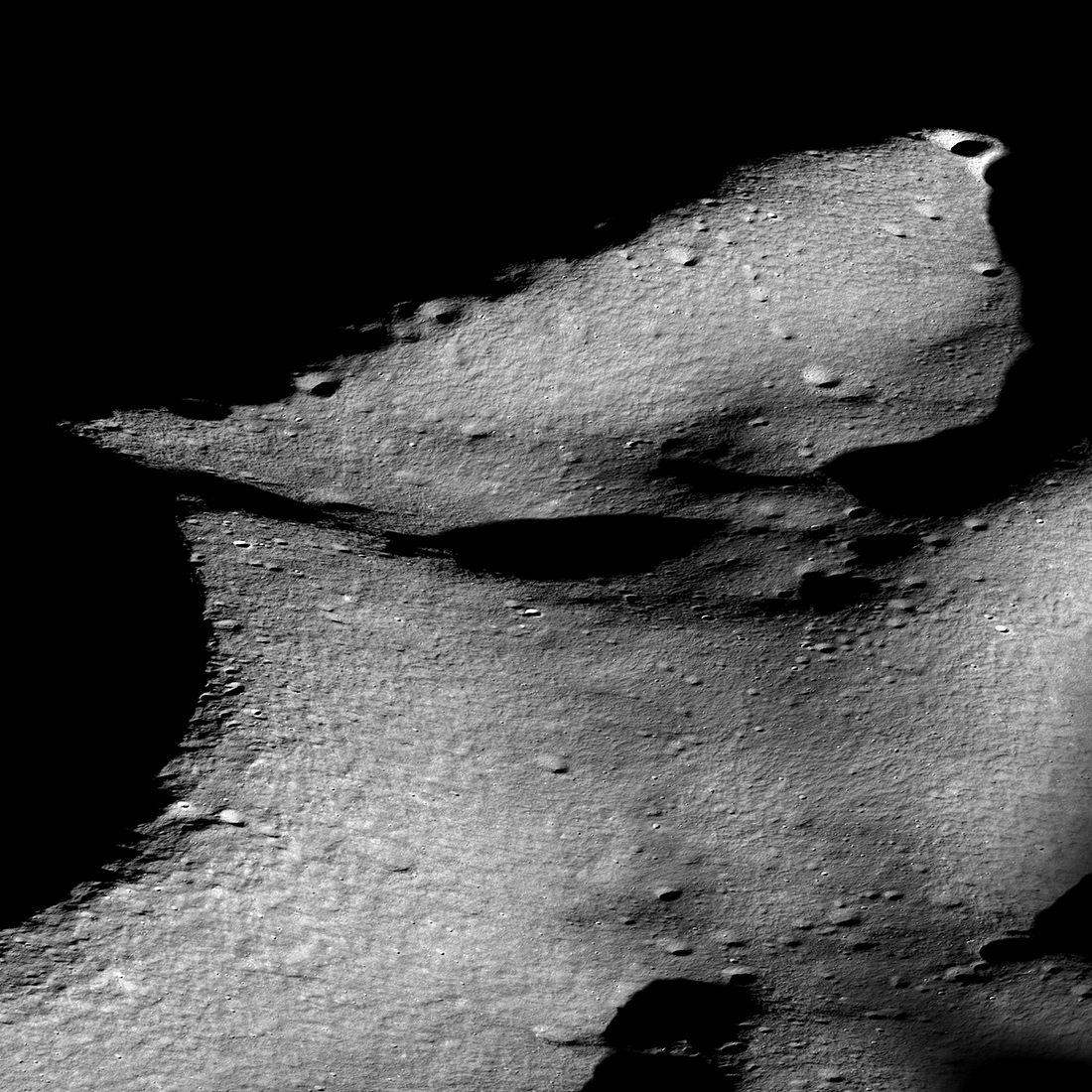
The most valuable real estate on the Moon
Click for full image.

Cool image time! The photo to the right, reduced and annotated to post here, is an oblique view of the terrain near Shackelton Crater and the Moon’s south pole, taken by Lunar Reconnaissance Orbiter (LRO) and released today.

Shackleton-de Gerlache ridge, about 9 miles long, is considered one of the prime landing sites for both a manned Artemis mission as well as the unmanned Nova-C lander from the commercial company Intuitive Machines. To facilitate planning, scientists have created a very detailed geomorphic map [pdf] of this region. As explained at the first link above,

Going back to time-proven traditions of the Apollo missions, geomorphic maps at a very large scale are needed to effectively guide and inform landing site selection, traverse planning, and in-situ landscape interpretation by rovers and astronauts. We assembled a geomorphic map covering a candidate landing site on the Shackleton-de Gerlache-ridge and the adjacent rim of Shackleton crater. The map was derived from one meter per pixel NAC image mosaics and five meters per pixel digital elevation models (DEM) from Lunar Orbiter Laser Altimeter (LOLA) ranging measurements.

Such geology maps guide planning and exploration, but actual images tell us what the first explorers will see. Below is a close-up overhead view of small area at the intersection of the ridge and the rim of Shackleton.
» Read more

5 comments

FAA again delays decision on environmental reassessment of SpaceX’s Boca Chica facility

Surprise, surprise! According to an FAA email sent out today, the agency has once again, for the fifth time, delayed its decision on the environmental reassessment of SpaceX’s Boca Chica Starship launch site.

From the email:

The Federal Aviation Administration (FAA) is updating the release date for the SpaceX Starship/Super Heavy Final Programmatic Environmental Assessment (PEA) on the Federal Infrastructure Permitting Dashboard (Permitting Dashboard) and project website. The FAA plans to issue the Final PEA on April 29th. The planned April 29, 2022 release date will allow the FAA to review the Final PEA, including responses to comments, and complete consultation and coordination with agencies at the local, State, and Federal level. All consultations must be complete before the FAA can issue the Final PEA.

This date is now listed on the FAA’s SpaceX-Starship webpage. Nor is the decision a surprise. Expect the FAA to continue this charade month-to-month until after the November election, when the Biden administration will then feel free to block SpaceX’s effort in Boca Chica completely.

17 comments

SpaceX switches to newer Starship and Superheavy for orbital test

Capitalism in space: According to Elon Musk, SpaceX has decided that the company will no longer use Starship prototype #20 and Superheavy prototype #4 for the rocket’s first orbital test flight.

Instead, the company will fly two more recently built and upgraded prototypes, rumored to be numbers #24 for Starship and #7 for Superheavy. The company has also decided to switch from the first generation Raptor engines to Raptor-2s.

All these changes likely explain Musk’s announcement that the first orbital launch will not happen sooner than May. The changes also further suggest that SpaceX has realized federal permission to launch from Boca Chica will be further delayed, and thus it might has well push forward in other ways as it waits for the right to launch.

I suspect that if the federal government hadn’t moved in to block operations, it would have flown prototypes 20 and 4 two months ago, just to get some data. Now such a flight seems pointless, as more advanced prototypes are now almost ready to fly.

This decision also reinforces my prediction that no orbital flights will occur out of Boca Chica before summer, and are more likely blocked through November. It also increases my expectation that the first orbital flight might not occur at all in Texas. The longer the Biden administration delays SpaceX’s operations there, the greater the chance the entire Starship/Superheavy launch program will shift to Florida.

6 comments
1 20 21 22 23 24 27