
Chemistry Simplified – A sunken treasure of logs
An evening pause: Believe it or not, this strange underwater treasure find actually explains (and duplicates) how Antonio Stradivari made his magnificent violins in the 1700s.
Hat tip Cotour.
An evening pause: Believe it or not, this strange underwater treasure find actually explains (and duplicates) how Antonio Stradivari made his magnificent violins in the 1700s.
Hat tip Cotour.
An evening pause: This 1940 short film won an Academy Award for best one-reel short. It provides a nice and witty demonstration of the first technology that allowed very high speed slow motion movies to be made.
Hat tip Wayne DeVette.
An evening pause: “There is fun and there is stupid fun.”
Hat tip Cotour.
An evening pause: Built fast and cheaply, despite real cutting edge engineering challenges, at the turn of the 19th century.
Hat tip Cotour.
An evening pause: Some more fascinating human technology.
Hat tip Cotour.
An evening pause: It always amazes me the level of engineering sophistication that one finds in all human endeavor, even from centuries past.
Hat tip Cotour.
An evening pause: According to this website, this documentary was “made by General Electric between 1928 and 1929 to commemorate the completion of this monumental [8-mile-long] tunnel which took 1800 workers and three years to construct.”
Three years! Today that’s how long it would take just to get the environmental assessment written and approved.
Hat tip Blair Ivey.
Link here. The point the op-ed makes is fundamental: AI cannot add anything to the information it has. It might be able to compile that information well, but its analysis is always going to be limited because it has no true creative spirit. It is merely a software program, albeit a very sophisticated one.
This quote from the essay will give you the sense:
Maybe you just use AI to clarify your thoughts. Turn the mottle of ideas in your head into coherent communicable paragraphs. It’s OK, you say, because you’re reviewing the results, and often editing the output. You’re ending up with exactly what you want to say, just in a form and style that’s better than any way you could have put it yourself.
But is what you end up with really your thoughts? And what if everyone started doing that?
Stripping the novelty and personality out of all communication; turning every one of our interactions into homogeneous robotic engagements? Every birthday greeting becomes akin to a printed hallmark card. Every eulogy turns into a stamp-card sentiment. Every email follows the auto-response template suggested by the browser.
We do this long enough and eventually we begin to lose the ability to communicate our inner thoughts to others. Our minds start to think in terms of LLM prompts. All I need is the gist of what I want to say, and the system fills in the blanks. [emphasis in original]
Comments are of course welcome. But please read the full essay before doing so.
An evening pause: So, what will you be doing this weekend?
Hat tip Cotour.
A evening pause: The subject of watches and time, possibly linked to astronomy, seems fitting on this first day of the new year, when we start a new number in our lives.
Hat tip Cotour.
An evening pause: I think we all take for granted the amount of sophisticated engineering that goes into modern construction. No English, but you don’t need it.
Hat tip Cotour.
An evening pause: Some early American technology, still in use.
Hat tip Wayne DeVette.
An evening pause: From a series of podcasts about one particular type of art, dubbed David’s Choice.
Hat tip Cotour.
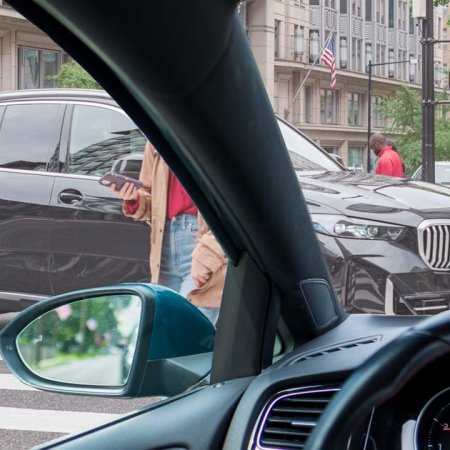
The view out of a modern car
Our present dark age: According to a study by the Insurance Institute for Highway Safety (IIHS), in the past two decades the design of cars has drastically decreased the visibility for drivers so that blindspots are larger, resulting in an increase in accidents.
Puzzled by traffic accident data showing that fatalities for cyclists and pedestrians had risen over the past 25 years, while car passenger deaths had come down, IIHS researchers wondered whether drivers might be finding it harder to see those more vulnerable road users.
And they discovered that successive versions of long-running popular cars had obstructed, more and more, a driver’s view of the 10 meters (33 ft) of space they were about to drive into. That near-car view, from the eye point of the average male driver, had shrunk on every one of six long-running models tested, IIHS testing showed, when an early (1997-plus) version was compared with the version on sale in 2023.
In the case of traditional cars, the near-car viewable area had contracted only slightly, the 7-8% reductions from the Honda Accord and Toyota Camry possibly even attributable to measurement error.
When it came to SUVs, however, the shrinkage was dramatic. The driver of a 1997 Honda CR-V could see 68% of a forward half-circle whose perimeter was 10 meters (33 ft) from their eye point – slightly more, in fact, than from the sedans that were tested. The driver of a 2023 CR-V could see just 28% of that semi-circle. In relative terms, the driver of the 2023 CR-V could see only 42% of what they would see from a 1997 model.
You can read the IIHS study here.
Why are designers doing this? One theory is that they are increasingly relying on cameras and software to replace the driver’s sight, and thus feel free to add obstructions to the car body that make it look cool. The problem is that these mechanical non-human solutions simply don’t work as well as the human brain, and thus drivers are hitting things more often.
But don’t worry. Soon AI will soon make it possible for cars will drive themselves! We will even be able to eliminate the windows entirely so that car travel will be an utterly private thing!
An evening pause: Hat tip Willi Kusche.
An evening pause: From the Bowes Museum in northern England, east of the Lake District.
Hat tip Cotour.
An evening pause: Some engineering to start your weekend.
Hat tip Judd Clark.
An evening pause: The art of glass blowing.
Hat tip Judd Clark.
An evening pause: This is really one man using tools to play music creatively, but then the video transitions to something that simply might not be real. Or is it?
Enjoy your weekend!
Hat tip Rex Ridenoure.