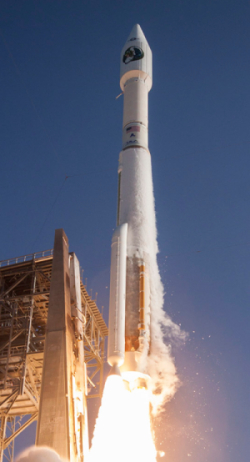
Blue Origin delivers its first BE-4 rocket engine

Capitalism in space: Blue Origin this week delivered its first BE-4 rocket engine to ULA, for use in ULA’s new Vulcan rocket.

This engine is still a test article and is not yet flight-worthy.

“The engine delivered is the first pathfinder engine to be mated with the Vulcan Centaur and will support ULA’s testing,” a Blue Origin spokesperson told SpaceNews. “We are planning on delivering the second engine in July.” A pathfinder is a development engine. Blue Origin has not said when a flight-qualified engine will be delivered.

…ULA set a 2021 target to fly its first Vulcan Centaur mission and needs two production-quality engines to build the launch vehicle for that mission. Flying Vulcan Centaur in 2021 is an imperative for ULA as it tries to win one of two contracts that the U.S. Space Force will award this summer to launch dozens of national security satellites between 2022 and 2027.

According to sources, frustration has been mounting at ULA as the company’s future is tied to the success of Vulcan Centaur and there is no room for error when it comes to the main engine.

I empathize with ULA’s frustration. The pace of development at Blue Origin has seemed incredibly slow in the past two years. They had begun static fire tests in 2018, and then — beginning with ULA’s decision to buy the BE-4 for Vulcan in May 2018 — for more than a year there was no news. It wasn’t until August 2019 that they announced completion of the first full power test. Even then, it took another whole year before they got to this point now, where they were willing to deliver a first test engine to ULA.

Building a new rocket engine is not simple, so these delays could be entirely reasonable. At the same time, the company’s overall pace in accomplishing anything has been glacial. For example, in the past three years it has repeatedly not delivered on its promises to start flying humans on its New Shepard suborbital capsule. Four months ago, in their most recent promise, they said they would need three more unmanned test flights of New Shepard before they’d put humans on it, and that all those flights (including the manned one) would occur this year. Yet nothing has happened since.

While I truly want Blue Origin to succeed, one must cast a cold eye on what is really happening. If they wish to really compete with SpaceX they have got to pick up their pace.

9 comments

Perseverance launch delayed to July 30, 2020

Not good: Because of an issue with the Atlas 5 rocket, NASA and ULA have decided to delay again the launch of the next Mars rover Perseverance from July 22nd to July 30th.

“Due to launch vehicle processing delays in preparation for spacecraft mate operations, NASA and United Launch Alliance have moved the first launch attempt of the Mars 2020 mission to no earlier than July 30,” NASA said. “A liquid oxygen sensor line presented off-nominal data during the Wet Dress Rehearsal, and additional time is needed for the team to inspect and evaluate.”

ULA performed the Wet Dress Rehearsal on June 22. The exercise involved rolling the Perseverance rover’s Atlas 5 launcher out of its vertical integration hangar to Cape Canaveral’s Complex 41 launch pad, then loading the rocket with kerosene, liquid hydrogen, and liquid oxygen propellants. The launch team practiced countdown procedures, testing the Atlas 5’s systems before halting the pre-launch sequence seconds before ignition of the rocket’s RD-180 main engine.

Their official launch window extends to August 11th, though they could still launch as late as August 15th and get to their landing site in Jezero Crater on Mars.

This is the third delay. The first involved a faulty crane and the second contamination issues in the rover’s clean room. Now an issue with an oxygen sensor. Let us hope their are no more, and that the weather then cooperates. It they don’t launch by August 15th the launch will then be postponed for two whole years.

1 comment

Perseverance launch delayed two days

NASA and ULA have agreed to delay the launch of the new Mars rover Perseverance two days, from July 20th to July 22nd, because of “a contamination concern.”

NASA’s Mars rover Perseverance was scheduled to launch toward the Red Planet on July 20 from a pad at the Cape Canaveral Air Force Station in Florida. But a problem cropped up as engineers worked to encapsulate the rover in the nosecone of its Atlas V rocket, which was built by United Launch Alliance.

“NASA and United Launch Alliance are now targeting Wednesday, July 22, for launch of the Mars 2020 mission due to a processing delay encountered during encapsulation activities of the spacecraft,” NASA officials said in an update. “Additional time was needed to resolve a contamination concern in the ground support lines in NASA’s Payload Hazardous Servicing Facility (PHSF).”

This contamination likely relates to their effort to keep the rover free from Earth biology.

The official launch window closes on August 11th, though they can still launch as late as August 15th and get to their targeted landing site in Jezero Crater on Mars.

0 comments

ULA on schedule for maiden flight of Vulcan in early 2021

Capitalism in space: According to ULA, the development program for its new Vulcan rocket remains on schedule, and will make its maiden flight in early 2021 as initially planned.

The launch will send Astrobotic’s privately built Peregrine lander to the Moon, carrying NASA science instruments.

The article provides a good overview not only of the status of construction, but also the political history that forced the development of Vulcan, that being the insistence by Congress that ULA stop using Russian engines in its rockets.

4 comments

Atlas 5 launches X-37B spacecraft

Capitalism in space: ULA’s Atlas 5 rocket this morning successfully launched one of the military’s two X-37B reusable mini-shuttles into orbit.

I have embedded the video of the launch below the fold, with the launch occurring at 23:50.

As has been standard procedure during all previous X-37B missions, only a few details about the payloads have been released, though the military has said it wishes to be a bit more open this time.

“This sixth mission is a big step for the X-37B program,” said Randy Walden, director and program executive officer for the Air Force Rapid Capabilities Office. “This will be the first X-37B mission to use a service module to host experiments. The incorporation of a service module on this mission enables us to continue to expand the capabilities of the spacecraft and host more experiments than any of the previous missions.” The service module is attached to the aft end of the X-37B spaceplane, providing additional capacity for experiments and payloads. The X-37B itself, measuring more than 29 feet (8.9 meters) long, also has a cargo bay inside its fuselage.

Secretary of the Air Force Barbara Barrett said Wednesday that the Air Force’s Rapid Capabilities Office is partnering with the U.S. Space force and the Air Force Research Laboratory on the next X-37B mission. … “This important mission will host more experiments than any prior X-37B flight, including two NASA experiments,” Barrett said Wednesday. “One is a sample plate evaluating the reaction of select significant materials to the conditions in space. The second studies the effect of ambient space radiation on seeds.”

The X-37B also carries a space-based solar power experiment. “A third experiment designed by the Naval Research Laboratory transforms solar power into radio frequency microwave energy, then studies transmitting that energy to Earth,” Barrett said.

Once in orbit, the X-37B will also release a small satellite named FalconSat 8. Developed by Air Force Academy cadets in partnership with the Air Force Research Laboratory, the small satellite carries five experimental payloads. It will be operated by by the Air Force Academy’s Cadet Space Operations Squadron

They have not said how long this X-37B will remain in orbit.

The leaders in the 2020 launch race:

8 China
6 SpaceX
6 Russia
6 Europe (Arianespace)
3 ULA

The U.S. now leads China 11 to 8 in the national rankings, and will likely increase that lead very early tomorrow in the next day or so when SpaceX completes its next scheduled Falcon 9 Starlink launch. (Because of weather they have pushed back one day.
» Read more

17 comments

Blue Origin to deliver first BE-4 engines to ULA this summer

Capitalism in space: Development of Blue Origin’s BE-4 engine, to be used in both its New Glenn rocket as well as ULA’s new Vulcan rocket, appears to be finally reaching its conclusion with the planned delivery this summer of two operational engines to ULA.

The bulk of the article at the link is mostly a summary of stuff that had already been revealed about the development of the New Glenn rocket. The only new piece of information that I could glean was this engine delivery date. It is significant, however, because no rocket company can ever really design its rocket before it has finished building the rocket’s engines. With the BE-4 now complete, I would expect the development of both New Glenn and Vulcan to proceed with great speed.

0 comments

ULA’s Atlas 5 rocket successfully launches military satellite

Capitalism in space: United Launch Alliance’s Atlas 5 rocket today successfully placed into orbit the first military satellite officially under the U.S. Space Force’s command.

The satellite is the fifth of a constellation designed to provide communications for all military operations.

The leaders in the 2020 launch race:

6 China
5 SpaceX
4 Russia
2 Europe (Arianespace)
2 ULA

The U.S. now leads China 9 to 6 in the national rankings.

2 comments

First launch of ULA’s Vulcan on schedule for 2021

Capitalism in space: According to ULA’s CEO, Tory Bruno, the company is on track to transition as planned from its Atlas 5 and Delta rockets to its new Vulcan rocket.

Just five Delta IV Heavy launches remain on the manifest, all NRO launches procured under the block buy Phase 1 methodology. Bruno expects the final Delta launch to occur in 2023 or 2024.

The workhorse of the ULA fleet, Atlas V, is expected to retire on a similar timeframe. Bruno says the launcher could be “done as early as 2022, or as late as 2024.” Atlas V will have to continue operations until its replacement, Vulcan, can be human-rated to launch the Boeing Starliner spacecraft.

…The first flight of Vulcan Centaur is on track for early 2021, with the first flight vehicle under construction, and more vehicles in flow, in ULA’s factory in Decatur, Alabama. Vulcan’s debut launch will carry the Astrobotic Peregrine lander to the moon for NASA’s Commercial Lunar Payload Services (CLPS) program. A second launch is currently planned for later that year, which will satisfy the Air Force certification requirement for Vulcan to launch military missions.

Bruno’s report is also good news for Blue Origin’s New Glenn rocket, since both will use Blue Origin’s BE-4 engine in their first stage. If ULA is on schedule, than Blue Origin also likely to be on schedule, meaning that come 2021 or so the U.S. will have at least three companies (including SpaceX) capable of putting large payloads into orbit. Moreover, Northrop Grumman is developing its OmegA rocket, which will compete for the same business.

The article also talks about the military’s launch procurement program, which supposedly will pick two of these launch companies to provide all military launches through the 2020s. That program however is certain to fail, as it will blacklist all other viable companies from bidding on military launches. I expect those companies will successfully sue and force the Space Force to accept bids from more than two companies.

And that is as it should be. Why the military wishes to limit bidding makes no sense, and is probably illegal anyway. As long as a company has a qualified rocket, its bids should be welcome.

13 comments

Blue Origin opens rocket engine factory

Capitalism in space: Blue Origin yesterday cut the ribbon on its main rocket engine factory in Huntsville, Alabama, while also announcing that production of their BE-4 engine for both ULA’s new Vulcan rocket and their own New Glenn rocket will begin in a few months.

In the meantime, made-in-Kent engines are being tested at Blue Origin’s West Texas site. Smith said two flight readiness engines will be delivered in May to United Launch Alliance. They’ll be used for integrated tests of ULA’s Vulcan first-stage booster, which is taking shape not far from Huntsville in Decatur, Ala.

This is excellent news. For the past year and a half the company has released little information about their progress with the BE-4 engine, suggesting that they might be experiencing issues. Yesterday’s news bursts that pessimistic balloon, indicating that both the Vulcan and New Glenn rockets will be flying, maybe as soon as next year.

0 comments

ULA’s Atlas 5 launches Solar Orbiter

Capitalism in space: ULA tonight successfully launched a new solar science spacecraft Solar Orbiter.

For more information about Solar Orbiter, which will take the first high resolution images of the Sun’s poles, see the link above or video I’ve embedded below the fold.

Earlier today Northrop Grumman aborted the launch of its Cygnus cargo freighter to ISS only three minutes before launch because of an issue with a ground support sensor. Right now they are are targeting a new launch date of February 13, 2020.

The status in the 2020 launch race:

3 China
2 SpaceX
1 Arianespace (Europe)
1 Rocket Lab
1 Russia
1 Japan
1 ULA

In the national ranking, the U.S. now leads China 4-3. If Northrop Grumman had launched, that lead would have been 5-3, and the U.S. total would have been comprised of four different and completely independent competing launch companies, all capable of topping the efforts of entire nations. If that doesn’t illustrate the power of freedom, capitalism, competition, and private ownership, I don’t know what does. Moreover, this is only the start. The U.S. right now has numerous other new launch companies rushing to join the competition.

Even more startling, the way we do things is freely available to every other nation in the world. All they have to do is to embrace freedom and the reduction of control and power by their governments. Sadly, very few in these times are willing to do this. In fact, even the U.S. resisted this concept for the entire last half of the 20th century. Only in the past decade have we returned to our roots, and that decision is now beginning to bear abundant fruit.
» Read more

0 comments

Starliner lands safely after failed orbital insertion

Capitalism in space:Boeing’s Starliner capsule successfully landed today in New Mexico, returning to Earth prematurely because of its failure to reach its proper orbit after launch two days ago.

The article quotes extensively from both NASA and Boeing officials touting the many successful achievements of this flight, while trying to minimize the failure that prevented the capsule from docking with ISS properly. And that failure?

The mission elapsed timer issue that cut short Starliner’s planned eight-day mission started before the spacecraft lifted off Friday from Cape Canaveral aboard a United Launch Alliance Atlas 5 rocket, according to Chilton. “Our spacecraft needs to reach down into the Atlas 5 and figure out what time it is, where the Atlas 5 is in its mission profile, and then we set the clock based on that,” Chilton said in a press conference Saturday. “Somehow we reached in there and grabbed the wrong (number). This doesn’t look like an Atlas problem. This looks like we reached in and grabbed the wrong coefficient.”

“As a result of starting the clock at the wrong time, the spacecraft upon reaching space, she thought she was later in the mission, and, being autonomous, started to behave that way,” Chilton said. “And so it wasn’t in the orbit we expected without the burn and it wasn’t in the attitude expected and was, in fact, adjusting that attitude.”

I read this and find myself appalled. While I agree that overall the mission proved the capsule capable of launching humans to ISS (which is why NASA is considering making the next Starliner mission manned despite this failure), this failure suggests a worrisome lack of quality control at Boeing. I can’t even imagine how the Starliner software could be mis-configured to “grab the wrong number.” This explanation makes no sense, and suggests they are spinning the failure to avoid telling us what they really did wrong.

Either way, I suspect that NASA will approve a manned launch for Starliner’s next orbital flight, but will do so only after dwelling on the problem for at least six months.

14 comments
1 14 15 16 17 18 36