Parker images the surface of Venus

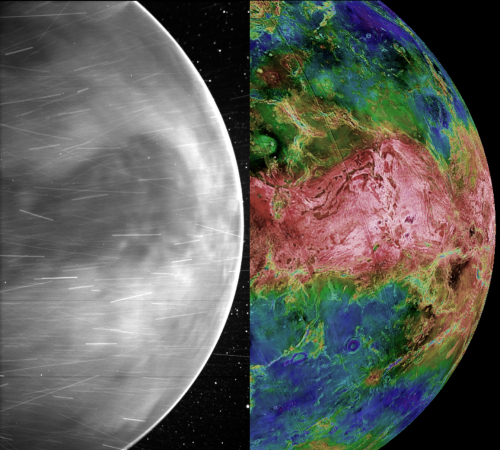
Parker image compared to radar maps of Venus
For original images go here and here.

During its flybys of Venus in July 2020 and February 2021 the Parker Solar Probe used its wide field camera to take images of the night side of Venus in red optical and near infrared wavelengths, essentially measuring the heat (in the range of 863 degrees Fahrenheit) being emitted by the planet’s surface.

The resulting images, the first orbital photos of Venus’ surface in the optical, showed continent-sized surface details that matched previously made radar maps, and confirmed as expected that the higher altitudes are cooler than the lower.

The paper outlining these results can be read here.

The two pictures to the right compare previous radar maps (on the right) with the new Parker image (on the left). The central dark and cooler area is a region called Aphrodite Terra, which like Earth’s continents sits higher than the surrounding terrain.

Note that though cooler, the surface at these dark areas is still hellishly hot, more than 800 degrees Fahrenheit. Exploring the surface of Venus is going to be a far far far more challenging task that going to Mars.

11 comments

Parker probe completes fifth Venus flyby

The Parker Solar Probe on October 16th successfully completed its fifth flyby of Venus, designed to lower its solar orbit around the Sun.

At just after 5:30 a.m. EDT, moving about 15 miles (24 kilometers) per second, the spacecraft swooped 2,370 miles (3,814 kilometers) above Venus’ surface. Such gravity assists are essential to the mission to bring Parker Solar Probe progressively closer to the Sun; the spacecraft counts on the planet to reduce its orbital energy, which in turn allows it to travel closer to the Sun and measure the properties of the solar wind near its source.

This was the fifth of seven planned Venus gravity assists. The flyby reduced Parker Solar Probe’s orbital speed by about 6,040 miles per hour (9,720 kilometers per hour), and set it up for its 10th close pass (or perihelion) by the Sun, on Nov. 21.

Parker Solar Probe will break its own distance and speed records on that closest approach, when it comes approximately 5.3 million miles (8.5 million kilometers) from the Sun’s surface — some 1.2 million miles (1.9 million kilometers) closer than the previous perihelion on Aug. 13 – while reaching 101 miles (163 kilometers) per second, or 364,621 miles per hour. Assisted by two more Venus flybys, in August 2023 and November 2024, Parker Solar Probe will eventually come within 4 million miles (6.2 million kilometers) of the solar surface in December 2024.

That speed record, 364,621 miles per hour, is the fastest any human built object as ever traveled.

4 comments

Two flybys of Venus set by two spacecraft on August 9th and 10th

Two European planetary probes, one launched to study the inner solar enviroment and the second to study Mercury, are going to fly past Venus only 33 hours apart on August 9th and 10th.

Solar Orbiter, a partnership between ESA and NASA, will fly by Venus on 9 August with a closest approach of 7995 km at 04:42 UTC. Throughout its mission it makes repeated gravity assist flybys of Venus to get closer to the Sun, and to change its orbital inclination, boosting it out of the ecliptic plane, to get the best – and first – views of the Sun’s poles.

BepiColombo, a partnership between ESA and JAXA, will fly by Venus at 13:48 UTC on 10 August at an altitude of just 550 km. BepiColombo is on its way to the mysterious innermost planet of the solar system, Mercury. It needs flybys of Earth, Venus and Mercury itself, together with the spacecraft’s solar electric propulsion system, to help steer into Mercury orbit against the immense gravitational pull of the Sun.

The two spacecraft will zip past a different side of Venus. For a variety of reasons, the imagery gathered will not of high resolution, though both spacecraft will gather data that will eventually be correlated with similar data being gathered by Japan’s Akatsuki probe, in orbit around Venus since 2015.

0 comments

Study: Venus’ atmosphere too dry for life

The uncertainty of science: A new study has found that the amount of water in Venus’ atmosphere is too low to support the possibility of life.

On Earth, Hallsworth said, microorganisms can survive and proliferate in droplets of water in the atmosphere when temperatures allow. However, the findings of the new study, based on data from several Venus probes, leave zero chance of anything living in the clouds of Venus, he said.

“Living systems including microorganisms are composed mainly of water and without being hydrated, they can’t be active and are unable to proliferate,” Hallsworth said.

Studies on microorganisms living in extreme conditions on Earth found that life can exist at temperatures as cold as minus 40 degrees Fahrenheit (minus 40 degrees Celsius). For water activity, which is measured on the scale from 0 to 1, the lowest survivable value is 0.585. The water activity level found in the molecules in the Venusian clouds was merely 0.004.

NASA Ames astrobiologist Chris McKay, one of the co-authors of the paper, said in the news conference that the findings of the study were conclusive and the new fleet of space missions currently being prepared for Venus will not change anything about the hope for life on Earth’s closest neighbor.

McKay can be as “conclusive” as he wants, but that really isn’t how science works. While this data is very strong evidence that there is no life on Venus, a result that should be expected given its harsh environment, it can’t preclude for certain the possibility. You can’t prove a negative in science.

At the same time, this paper puts another nail in the coffin of that very weak result, since found even weaker, in September 2020 that suggested the presence of phosphine in the atmosphere that suggested the possibility of life.

5 comments

Europe to fly mission to Venus to study its volcanoes

The European Space Agency yesterday announced that it will fly an orbiter to Venus in 2031, dubbed EnVision, to study the estimated million volcanoes on the surface of that hellish planet.

EnVision will use an infrared spectrometer to seek out hot spots on the surface that could indicate active volcanoes. It will use radar to map the surface, looking for signs of lava flows. Ultraviolet and high-resolution infrared spectrometers will then look for water vapor and sulfur dioxide emissions, to see whether smoldering volcanoes are driving cloud chemistry today.

This data will help determine exactly geologically active Venus’s volcanoes are. Several studies in the past decade using archival data (see here, here, and here) have suggested as many as 37 of those volcanoes are active, but this data remains uncertain.

10 comments

NASA picks two missions to fly to Venus later this decade

NASA today announced two new missions to go to Venus to study its atmosphere and surface, both scheduled to launch sometime between 2028 and 2030.

One, dubbed DAVINCI+, send a probe into Venus’s atmosphere, both to measure its gases as well as taken the first high resolution images of a unique Venusian geological called “tesserae.” On radar images tesserae regions appear to be high plateaus cross-cut with many sharp ridges.

The second, dubbed VERITAS, will be a radar-orbiter designed to map the planet’s surface at higher resolution than the earlier Pioneer and Magellan radar orbiters. It will also do this:

VERITAS also will map infrared emissions from Venus’ surface to map its rock type, which is largely unknown, and determine whether active volcanoes are releasing water vapor into the atmosphere.

That data will help tell us whether there are now active volcanoes on Venus. The data we presently have suggest it is a planet of many volcanoes, numbering in the millions. That data has also hinted at the possibility that some are active. VERITAS will attempt to find out.

4 comments

Parker makes course correction

On May 15th the Parker Solar Probe made the first of three small adjustments to its orbital path in order to refine its path during an October 16th fly-by of Venus, which in turn will make more precise its next three Venus fly-bys and thus bring it closer and closer to the Sun.

[The] Parker Solar Probe just completed its eighth close approach to the Sun, coming within a record 6.5 million miles (10.4 million kilometers) of the Sun’s surface on April 29. It’ll pass the Sun from about the same distance again on Aug. 9, before using Venus’ gravity on Oct. 16 to swing it even closer to the surface — about 5.6 million miles (9 million kilometers) — on Nov. 21. Assisted by the remaining three Venus flybys, Parker Solar Probe will eventually come within 4 million miles (6.4 million kilometers) of the solar surface.

The spacecraft remains healthy and continues to gather data with each fly-by of the both the Sun and Venus.

0 comments

Parker looks at Venus

Venus as seen by the Parker Solar Probe
Click for full image.

During its July 2020 fly-by of Venus, the Parker Solar Probe used its wide field camera to snap a picture of the planet, cropped and reduced to post here on the right.

The photo surprised the scientists in that it apparently was able to detect some major surface features through Venus’ thick cloud cover.

WISPR is designed to take images of the solar corona and inner heliosphere in visible light, as well as images of the solar wind and its structures as they approach and fly by the spacecraft. At Venus, the camera detected a bright rim around the edge of the planet that may be nightglow — light emitted by oxygen atoms high in the atmosphere that recombine into molecules in the nightside. The prominent dark feature in the center of the image is Aphrodite Terra, the largest highland region on the Venusian surface. The feature appears dark because of its lower temperature, about 85 degrees Fahrenheit (30 degrees Celsius) cooler than its surroundings.

That aspect of the image took the team by surprise, said Angelos Vourlidas, the WISPR project scientist from the Johns Hopkins Applied Physics Laboratory (APL) in Laurel, Maryland, who coordinated a WISPR imaging campaign with Japan’s Venus-orbiting Akatsuki mission. “WISPR is tailored and tested for visible light observations. We expected to see clouds, but the camera peered right through to the surface.”

“WISPR effectively captured the thermal emission of the Venusian surface,” said Brian Wood, an astrophysicist and WISPR team member from the U.S. Naval Research Laboratory in Washington, D.C. “It’s very similar to images acquired by the Akatsuki spacecraft at near-infrared wavelengths.”

This surprising observation sent the WISPR team back to the lab to measure the instrument’s sensitivity to infrared light. If WISPR can indeed pick up near-infrared wavelengths of light, the unforeseen capability would provide new opportunities to study dust around the Sun and in the inner solar system. If it can’t pick up extra infrared wavelengths, then these images — showing signatures of features on Venus’ surface — may have revealed a previously unknown “window” through the Venusian atmosphere.

The streaks in the picture come from cosmic rays.

3 comments

New analysis: It wasn’t even phosphine detected at Venus

The uncertainty of science: A new analysis of the data used by scientists who claimed in September that they had detected phosphine in the atmosphere of Venus has concluded that it wasn’t phosphine at all but sulfur dioxide, a chemical compound long known to be prevalent there.

The UW-led team shows that sulfur dioxide, at levels plausible for Venus, can not only explain the observations but is also more consistent with what astronomers know of the planet’s atmosphere and its punishing chemical environment, which includes clouds of sulfuric acid. In addition, the researchers show that the initial signal originated not in the planet’s cloud layer, but far above it, in an upper layer of Venus’ atmosphere where phosphine molecules would be destroyed within seconds. This lends more support to the hypothesis that sulfur dioxide produced the signal.

When the first announcement was made, it was also noted as an aside that phosphine on Earth is only found in connection with life processes, thus suggesting wildly that it might signal the existence of life on Venus.

That claim was always unjustified, especially because we know so little about Venus’s atmosphere and its alien composition. Even if there was phosphine there, to assume it came from life is a leap well beyond reasonable scientific theorizing.

It now appears that the phosphine detection itself was questionable, which is not surprising since the detection was about 20 molecules out of a billion. And while this new analysis might be correct, but what it really does is illustrate how tentative our knowledge of Venus remains. It might be right, but it also could be wrong and the original results correct. There is simply too much uncertainty and gaps in our knowledge to come to any firm and confident conclusions.

None of that mattered with our modern press corps, which ran like mad to tout the discovery of life on Venus. As I wrote quite correctly in September in my original post about the first results,

The worst part of this is that we can expect our brainless media to run with these claims, without the slightest effort of incredulity.

We live in a world of make believe and made-up science. Data is no longer important, only the leaps of fantasy we can jump to based on the slimmest of facts. It was this desire to push theories rather than knowledge that locked humanity into a dark age for centuries during the Middle Ages. It is doing it again, now, and the proof is all around you, people like zombies and sheep, wearing masks based not on any proven science but on pure emotions.

2 comments

India’s first mission to Venus delayed a year

The new colonial movement: During a NASA planetary science conference on November 10th, an official of India’s space agency ISRO revealed that they have been forced to delay their first mission to Venus, dubbed Shukrayaan, till 2024.

T. Maria Antonita of the Indian Space Research Organisation (ISRO) detailed the status of the mission to scientists drafting a new 10-year plan for NASA’s planetary science program. Shukrayaan will be India’s first mission to Venus and will study the planet for more than four years.

ISRO was aiming for a mid-2023 launch when it released its call for instruments in 2018, but Antonita told members of the National Academies’ decadal survey planning committee last week that pandemic-related delays have pushed Shukrayaan’s target launch date to December 2024 with a mid-2026 backup date (optimal launch windows for reaching Venus occur roughly 19 months apart).

It appears they are using this extra time to consider a larger launch rocket, which would allow them to increase the orbiter’s capabilities.

0 comments

Venus results suggesting life downgraded

Surprise! Surprise! Further research and review of the recent results that said phosphine existed in Venus’s atmosphere — which for some immediately suggested the presence of life — has found that the phosphine probably doesn’t exist.

[A]lmost immediately, other astronomers began to criticize the results, with four independent studies pointing out questionable methods or failing to reproduce the results.

Now, after reanalyzing their data, the original proponents are downgrading their claims. Even the most favorable interpretation of their data now suggests phosphine levels are at least seven times lower than first reported, making it a much more tentative finding, the authors reported in a preprint posted on 17 November to arXiv.

Also, observations in other wavelengths detected no phosphine, even though it should have been there if the first study was correct. Furthermore, other scientists have noted that the spectrum features detected might not be caused by phosphine. The sulphur dioxide in Venus’s atmosphere could instead be their source.

Even if phosphine is eventually confirmed, that is not the discovery of life on Venus, as so many in the mainstream press claimed. As I noted when this result was first announced, phosphine isn’t life, it is merely a specific inanimate molecule. That on Earth it only exists in connection with life-processes means nothing. Venus is a very alien place, and there could be any number of inanimate chemical processes that we have no experience with or knowledge of that could produce it there. To claim its discovery suggests the existence of life, or even the possibility of life, is simply junk science.

3 comments

Tiny amount of rare chemical found on Venus; it is NOT a sign of life

The coming dark age: Scientists today announced that they had detected a tiny amount of the rare chemical phosphine in the upper atmosphere of Venus, and immediately jumped to the absurd conclusion that this was a sign of life.

The international team, which includes researchers from the UK, US and Japan, estimates that phosphine exists in Venus’s clouds at a small concentration, only about twenty molecules in every billion. Following their observations, they ran calculations to see whether these amounts could come from natural non-biological processes on the planet. Some ideas included sunlight, minerals blown upwards from the surface, volcanoes, or lightning, but none of these could make anywhere near enough of it. These non-biological sources were found to make at most one ten thousandth of the amount of phosphine that the telescopes saw.

To create the observed quantity of phosphine (which consists of hydrogen and phosphorus) on Venus, terrestrial organisms would only need to work at about 10% of their maximum productivity, according to the team. Earth bacteria are known to make phosphine: they take up phosphate from minerals or biological material, add hydrogen, and ultimately expel phosphine. Any organisms on Venus will probably be very different to their Earth cousins, but they too could be the source of phosphine in the atmosphere.

To leap from finding twenty molecules out of a billion of a single rare chemical to claiming this is a sign of life is absurd. And yet, this is what these scientists do, in the European Space Agency (ESA) press release at the link above, as well as this Royal Astronomical Society press release.

This discovery is not giving us “a hint of life on Venus.” All these scientists have done is detect a chemical whose formation in Venus’ very alien environment is a mystery. Yes, on Earth this chemical comes from life related activities, but to claim that the presence of biology must explain it on Venus is not science, but witchcraft and the stuff of fantasy. We know practically nothing about the full make-up of Venus’ atmosphere, its chemistry and environment, which makes it impossible to hint at any theories, no less life.

The worst part of this is that we can expect our brainless media to run with these claims, without the slightest effort of incredulity.

We live in a world of make believe and made-up science. Data is no longer important, only the leaps of fantasy we can jump to based on the slimmest of facts. It was this desire to push theories rather than knowledge that locked humanity into a dark age for centuries during the Middle Ages. It is doing it again, now, and the proof is all around you, people like zombies and sheep, wearing masks based not on any proven science but on pure emotions.

57 comments

Rocket Lab planning private Venus mission

Capitalism in space: According to its founder and CEO Peter Beck, the smallsat rocket company Rocket Lab is now planning a private Venus mission to be launched in 2023.

The 2023 mission will employ Rocket Lab’s two-stage Electron booster and Photon satellite bus. The 57-foot-tall (17 meters) Electron is a viable option for interplanetary missions now, thanks to recent advances in battery technology that boost the performance of the rocket’s Rutherford engines. With that improvement, Electron is now capable of lofting up to 660 lbs. (300 kilograms) of payload to low-Earth orbit instead of 500 lbs. (225 kg), Rocket Lab representatives have said.

“It opens the window for Venus, and it opens the window for recovery,” Beck said. (The company is working to recover and reuse the Electron’s first stage. Returning boosters will make guided re-entries to Earth’s atmosphere, which will require more fuel, which in turn will require more powerful engines to get the added weight off the ground.)

Photon, which has yet to make its spaceflight debut, won’t descend into Venus’ sulfurous skies on the coming mission. The current plan calls for the spacecraft to deploy one or more smaller probes into the planet’s atmosphere, Beck wrote in a Twitter post on Aug. 4.

There is a certain irony here, if Beck launches a private interplanetary science mission ahead of Elon Musk. Musk created the rocket company SpaceX expressly because he wanted to do a private science mission to Mars and needed an affordable rocket to do it. Since then he has been so focused on making that rocket company succeed he has not devoted any effort to that initial science mission concept. Beck, who came much later, now appears set to beat Musk to this first milestone.

12 comments

Active volcanoes on Venus?

Using computer models and past radar images from orbiters, scientists now believe that Venus could have as many as 37 active volcanoes.

The type of feature on Venus they think might still be active is called a coronae, circular features detected by radar and distinct to this planet that have been thought to be inactive ancient volcanic features.

In the new study, the researchers used numerical models of thermo-mechanic activity beneath the surface of Venus to create high-resolution, 3D simulations of coronae formation. Their simulations provide a more detailed view of the process than ever before.

The results helped Montési and his colleagues identify features that are present only in recently active coronae. The team was then able to match those features to those observed on the surface of Venus, revealing that some of the variation in coronae across the planet represents different stages of geological development. The study provides the first evidence that coronae on Venus are still evolving, indicating that the interior of the planet is still churning.

Lots of uncertainty here, but nonetheless this is good science. It also reinforces other evidence in recent years that has suggested active volcanism on Venus.

1 comment

Scientists fine tune the cause of the super-rotation of Venus’ atmosphere

Scientists using data collected from the Japanese Venus orbiter Akatsuki have now refined their theories on the atmospheric processes that cause that atmosphere to rotate sixty times faster than the planet.

This super-rotation increases with altitude, taking only four Earth days to circulate around the entire planet towards the top of the cloud cover. The fast-moving atmosphere transports heat from the planet’s dayside to nightside, reducing the temperature differences between the two hemispheres.

What they found was that at equatorial latitudes the heat transfer is generated by what they call “atmospheric tidal waves”, generated by the dayside solar heat. At high latitudes the transfer is instead caused by atmospheric turbulence.

From what I can gather, they are calling these tidal waves because the Sun’s heat causes the atmosphere to expand upward on the day side, much as the Moon’s gravity pulls the ocean upward on Earth. It then is quickly drawn to the colder night side, driven I think in one direction because of the planet’s slow rotation.

As always, we must recognize the uncertainties. The data here is somewhat limited because there have been so few atmospheric orbiters so far sent to study Venus. While several future missions are under study in the U.S. and Russia, only India appears to have one targeted for launch, though the date has been pushed back from 2020 to 2023.

3 comments

A look at future missions to Venus

Link here. The article gives a nice summary of what we presently know about Venus, as well as outlining the various proposed missions to it.

First off the starting line, and as far as I know the only mission actually approved, is an orbiter from India, scheduled for launch in 2023. After this are a number of proposals in the U.S. Europe, and Russia.

It appears that the discovery of many exoplanets with features somewhat similar to Venus is one of the factors generating the new interest in going back there.

3 comments

India wants international instruments for its Venus mission

The new colonial movement: India has requested science instruments proposals from the international community for its planned Venus orbiter, set to launch in 2023.

ISRO has already selected 12 instruments, proposed by Indian scientists, including cameras and chemical analyzers to study the atmosphere. Now, it’s hoping other scientists will join. “Planetary exploration should be all about global partnerships,” says Kailasavadivoo Sivan, a rocket scientist and ISRO’s chair. (The deadline for submitting proposals is 20 December.)

For me, the big news with this article is that it is the very first I have seen that actually spells out Sivan’s first name. Since he became head of ISRO in January 2018, he has only been listed as “K. Sivan” in every single article, even those describing his background when he was appointed. Now that I have learned what a tongue-twister that first name is, I can understand why they abbreviate it.

On a more serious note, this article indicates the growing maturity of India’s space effort. They not only are planning a mission to Venus, they will fly missions to the Moon in January and Mars in 2022, and intend to launch their first manned mission in that same time period.

0 comments

Parker completes first Venus fly-by

Early this morning the Parker Solar Probe successfully completed its first fly-by of Venus, skimming within 1,500 miles of the planet.

There is not much more to report, at this time, as it will take the engineers several days to review the data to determine precisely the change in the spacecraft’s orbit around the Sun. It is also not clear whether the spacecraft did any science as it flew by.

1 comment

Failed Soviet-era Venus probe to crash to Earth between 2023-2025

A failed Soviet-era probe to Venus that never left Earth orbit is now predicted to crash to Earth sometime between 2023-2025.

The Kosmos 482 interplanetary station, which was unsuccessfully sent towards Venus in 1972 by the USSR, may crash land on Earth between 2023 and 2025, astronomer and cosmonautics historian Pavel Shubin told Sputnik. He couldn’t pinpoint the exact location of the future crash site, but noted that it would be between 52 degrees north and 52 degree south latitude.

The astronomer has studied the data on Kosmos 482 orbit as well as its deterioration and detected that it started to degrade faster due to it getting closer to Earth and experiencing increased gravitational pull.

He also expressed confidence that the station would successfully reach the surface since it was adapted for entering the much harsher atmosphere of Venus so is able to endure stress of 300g and 100 atmospheres. The astronomer is anxious to study the station after it lands in order to analyze how prolonged exposure to open space affected its materials.

It is not likely that this probe will land anywhere where it can be recovered, as most of the Earth is ocean. However, the scientist’s hopes are not unreasonable, as it is always worthwhile for future engineering designs to study how the environment of space effects materials over long periods of time.

2 comments

Identifying the mysterious dark bands in Venus’s atmosphere

The uncertainty of science: Scientists have now proposed two new best candidates for the unknown major component in Venus’s upper atmosphere that was first identified in 1974 when Mariner 10 took the first good close-up images.

We have analyzed spectra taken during the second Venus flyby of MErcury Surface, Space ENvironment, GEochemistry, and Ranging (MESSENGER) spacecraft on its route to Mercury, in 2007. Using a numerical code, we have reproduced the light reflected by the equatorial atmosphere of the planet and retrieved the distribution of particles in the upper atmosphere of Venus, with a cloud top of some 75 km above the surface. We have also retrieved the absorption spectrum of the puzzling absorber and compared it with some previously proposed candidates. While no perfect match is found, sulfur-bearing species (S2O and S2O2) provide the best agreement. There is still a long way to undoubtedly identify Venus’s UV absorber, but this work provides substantial spectral constraints.

The dark absorber shows up as dark streaks in the upper atmosphere, and allows images to track wind and cloud movement. No one has been able to firmly identify it.

S2O and S2O2 are disulfur monoxide and disulfur dioxide respectively, both of which are unstable on Earth. The first is thought to have been detected in Io’s numerous volcanic eruptions, with it settling as a solid around at least one volcano, Pele. The second has already been suggested as the dark absorber. This research helps confirm that earlier research.

Note however that other research says there is too little sulfur in Venus’s atmosphere for this to be its dark absorber. The science here therefore remains decidedly unsettled.

0 comments
1 2 3 4 5