Scientists: We think the little red dots in the early universe are supermassive stars

The uncertainty of science: Using the Webb Space Telescope, scientists now believe that the mysterious little red dots that Webb had previously detected in the early universe are actually supermassive stars, the predicted first stars to form after the Big Bang that also might produce the universe’s first black holes.

In 2022 the first deep images from Webb, a telescope designed to see longer wavelengths of light, revealed little red dots in the distant universe. The new results gave scientists more context into what these mysterious, compact, and very old objects could be. Past theories explaining little red dots required complicated explanations involving black holes, accretion disks and dust clouds, but the new model shows that a single massive star can also naturally produce all of the key signatures in little red dots: extreme brightness, a distinctive V-shaped spectrum, and the rare combination of one bright hydrogen emission.

Now, for the first time, astronomers have created a detailed physical model of a rare, metal-free, rapidly growing supermassive star about a million times the mass of the Sun, and showed that its unique features are a perfect match for little red dots.

Models outlining the early stages of the universe had predicted that the first stars formed after the Big Bang would be much more massive than the stars seen today. This hypothesis fits that model.

At the same time, no one should take any theory to the bank. The data remains very slim, so that all conclusions remain based on a very weak foundation.
1 comment

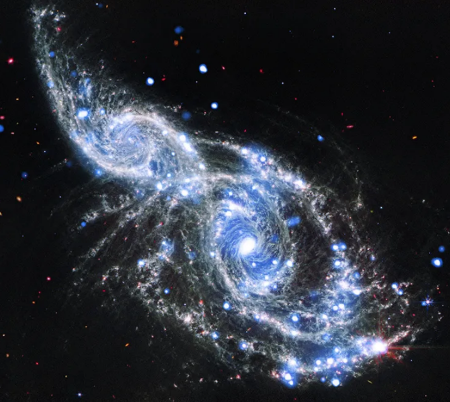
Colliding galaxies, as seen in the infrared and X-rays

Colliding galaxies in the infrared and X-rays
Click for original image.

Today’s cool image illustrates how beautiful images of heavenly objects don’t always have to be in wavelengths our eyes can see. With the wonders of modern technology, we can now see wondrous things in wavelengths that are invisible to us.

The picture to the right, cropped and reduced to post here, is a perfect illustration. It was released on December 1, 2025, and combines X-ray data from the Chandra X-ray Observatory with infrared data from the Webb Space Telescope. From the caption:

This view of NGC 2207 and IC 2163 takes a James Webb mid-infrared image (white, gray, and red) and adds the X-ray view from Chandra (blue). Together, it is quite an eye-catching result.

…Here, both spirals are shown face on, with the smaller of the two galaxies, IC 2163, at the upper left of the larger galaxy, NGC 2207, which dominates the center and lower right of the image. Both galaxies have long, spiraling, silver blue arms, dotted with specs of blue and red. Toward our upper left, the curving arms overlap, and bend toward their neighbors’ core.

In optical wavelengths the gossamer lines of structure would be lost, overwhelmed by the light of each galaxy’s stars.

0 comments

Astronomers detect another galaxy that shouldn’t be there, so soon after the Big Bang

A spiral galaxy too early in the universe
Click for original.

Using the Webb Space Telescopes astronomers have detected another galaxy that shouldn’t be there, so soon after the Big Bang.

The image to the right comes from figure 1 of the peer-reviewed paper. The galaxy’s two spiral arms form a backward “S” emanating out from the galaxy’s nucleus. From the press release:

Using JWST, researchers Rashi Jain and Yogesh Wadadekar spotted a galaxy remarkably similar to our own Milky Way. Yet this system formed when the cosmos was barely 1.5 billion years old—roughly a tenth of its present age. They named it Alaknanda, after the Himalayan river that is a twin headstream of the Ganga alongside the Mandakini—fittingly, the Hindi name for the Milky Way.

…It already has two sweeping spiral arms wrapped around a bright, rounded central region (the galaxy’s ‘bulge’), spanning about 30,000 light-years across. Even more impressively, it is annually churning out new stars, their combined mass roughly equivalent to 60 times the mass of our Sun. This rate is about 20 times that of the present-day Milky Way! About half of Alaknanda’s stars appear to have formed in only 200 million years—a blink in cosmic time.

This galaxy underlines the difficulty for cosmologists by much of Webb’s data of the early universe. Present theories of galaxy formation say it should take billions of years to form such a spiral galaxy, meaning it shouldn’t exist as yet so soon, only 1.5 billion years after the Big Bang.

Either the theories have to be revised substantially, or they are simply wrong entirely. Or we are missing or lacking in some fundamental information about the early universe that skews all our theories.

2 comments

Webb captures spiraling shells around massive binary star system

Webb's false color image of shells
Click for original.

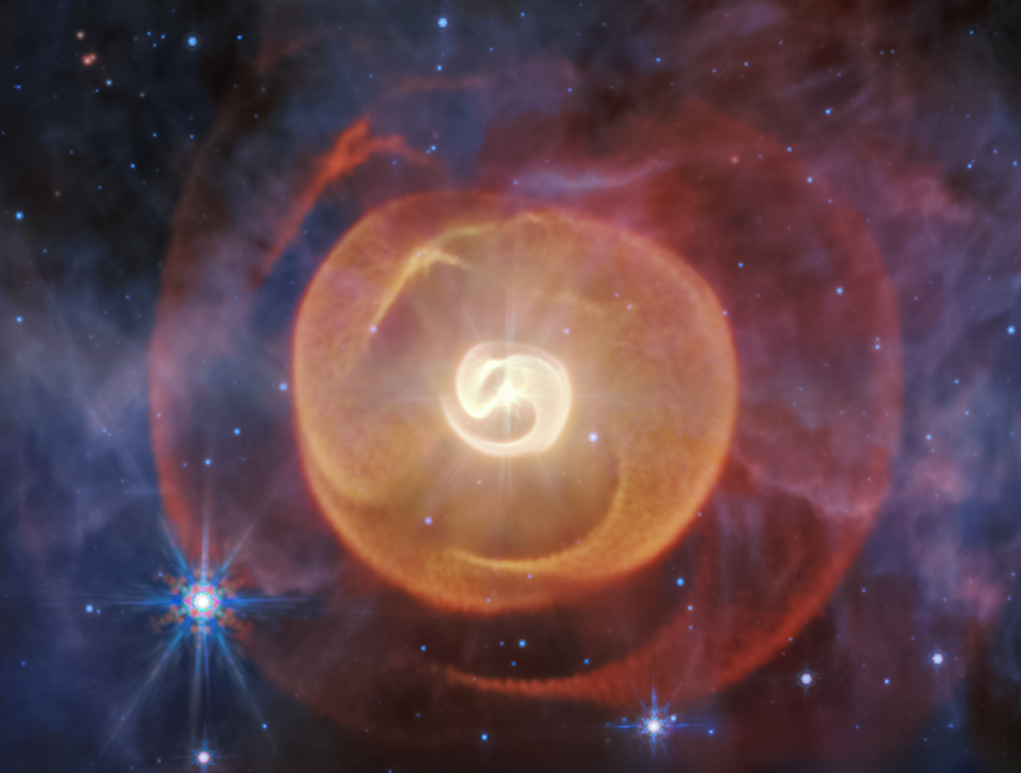
Using the Webb Space Telescope, astronomers have been able to produce a reasonably detailed map of the four shells that surround a triple-star system of two massive Wolf-Rayet (W-R) stars and an as-yet unseen supergiant, produced by the interaction of the winds that come off the two W-R stars combined with the interaction of the third.

The image to the right is that Webb false-color infrared image, combined with the data from the ground-based Very Large Telescope in Chile. It has been reduced to post here. The researchers have also produced a 3D simulation mapping out those shells, which you can view here.

The scientists have dubbed this system Apep after the Egyptian god of chaos. From the conclusion of the research paper [pdf]:

We imaged the colliding-wind W-R binary Apep with [Webb] and [the Very Large Telescope]. The JWST images detected four concentric dust shells with highly regular and detailed structures surrounding Apep. The mean expansion speed of the dust shells is 90 ± 4 mas yr−1 and the mean spacing between neighboring shells is 17.30″ ± 0.17″ [in degree seconds]. The shell spacing and expansion speed together suggest an orbital period of 193 ± 11 years, which is independent of uncertainties on the distance, and that the dust structure observed was produced over the past 700 years.

It is believed that Wolf-Rayet stars are primary candidates to eventually go supernova. The data for this system also suggests this system could produce a gamma ray burst as well. At present the astronomers estimate the distance to this system to be about 15,000 light years, which means such an explosion would likely poses no risk to us. It would however give scientists a great view of the event, better by many magnitudes compared to previous such explosions.

0 comments

Webb tracks volcanic eruptions on Io

Different Webb infrared detections of Io over time
Click for original image.

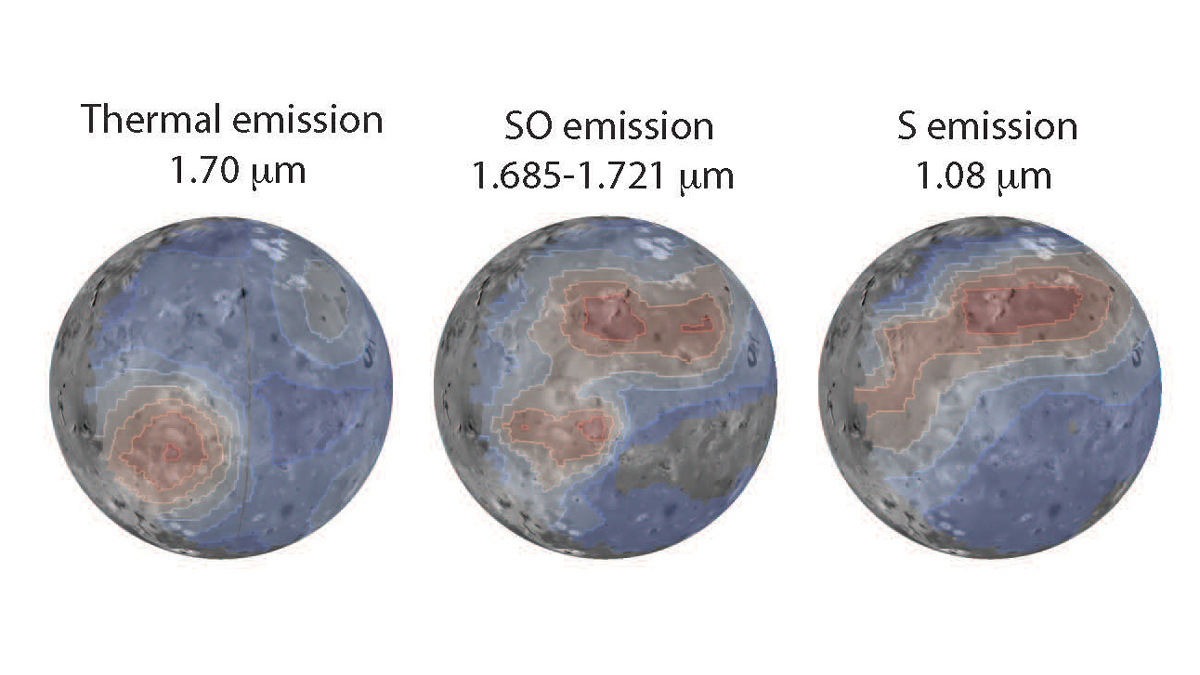
Using the Webb Space Telescope, scientists have tracked two different volcanic eruptions on Io that too place from 2022 to 2023, detecting sulfur monoxide both from those eruptions as well as sulfur from the magnetic plasma torus produced as the planet travels through Jupiter’s strong magnetic field. From the paper’s abstract:

Volcanic thermal emission was detected from Loki Patera and Kanehekili Fluctus [two volcanic vents]. The main changes in the shape of the thermal emission spectra since [Webb] observed Io in November 2022 were consistent with the continued cooling of emplaced lava flows in the Kanehekili Fluctus region, and the crust that had formed on the surface of the lava lake in Loki Patera. Images of Io in the SO 1.707 μm emission band [sulfur monoxide] show a concentration above Kanehekili Fluctus and in two regions in the northern hemisphere. The emissions are sourced from SO molecules ejected from volcanic vents. We further detected, for the first time, sulfur line emissions at 1.08 and 1.13 μm. These emissions are distributed homogeneously across a band in Io’s northern hemisphere. They are mainly produced through excitation by electrons from the plasma torus, penetrating Io’s atmosphere.

The top image to the right shows the heat signature above the two volcanoes, one to the southwest and the second to the northeast. The middle image shows the sulfur monoxide emissions detected by Webb above those volcanoes from their on-going eruptions. The bottom image shows the more diffuse sulfur emissions, mostly in the northern hemisphere, believed produce by interactions with the plasma torus.

This research also relied on data obtained by both the Keck telescopes in Hawaii and the Hubble Space Telescope.

There are of course uncertainties with these results. For example, the conclusion that the more diffuse sulfur is produced by interactions with the plasma torus is not as certain. First, those sulfur emissions still appear closely linked to the volcanoes, which suggests this still could be a source.

Second, the observations also cover only two data points in time, in 2022 and 2023. To get a more precise map of the activity on Io we really need an orbiter there observing the planet on a continuous basis, something that is at this time impossible, not only because no mission is planned but because the hostile radiation environment this close to Jupiter makes the engineering quite challenging. It is this reason why Europa Clipper is not going into orbit around Europa when it arrives there in 2031. Better to orbit Jupiter and only periodically dip into that harsh radiation environment.

2 comments

Webb captures spectacular false-color image of planetary nebula

The Red Spider Nebula
Click for original image.

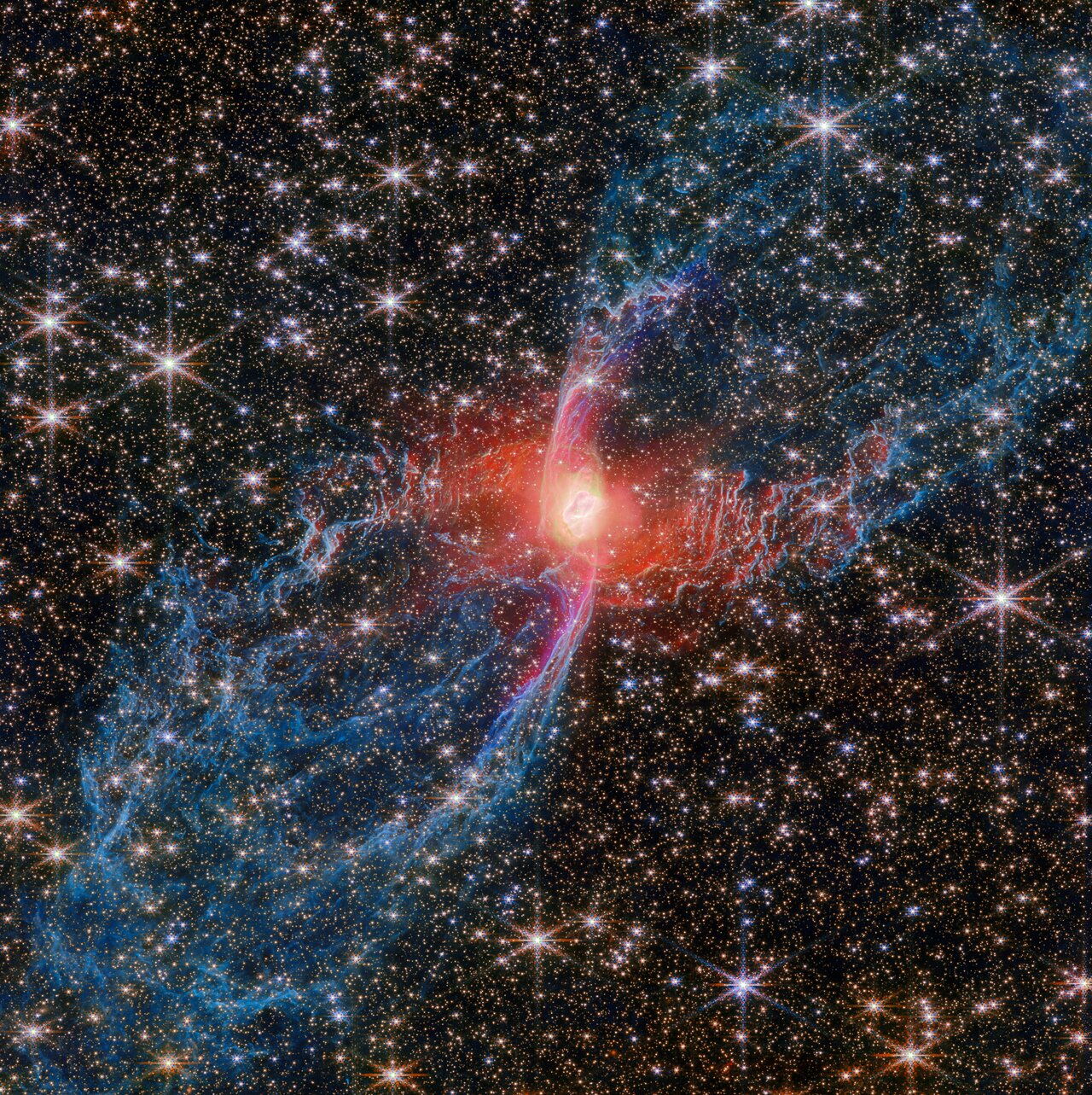
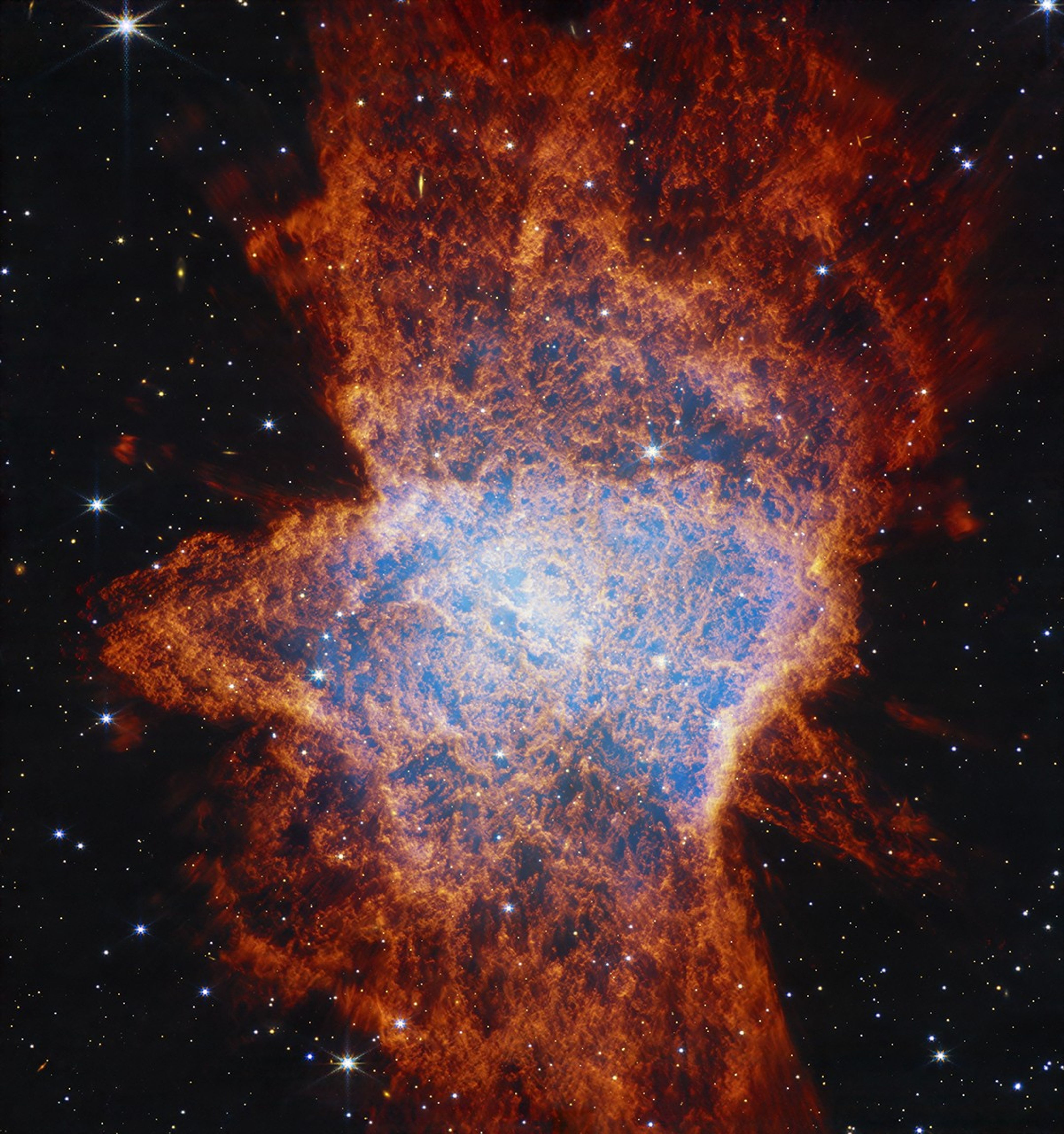
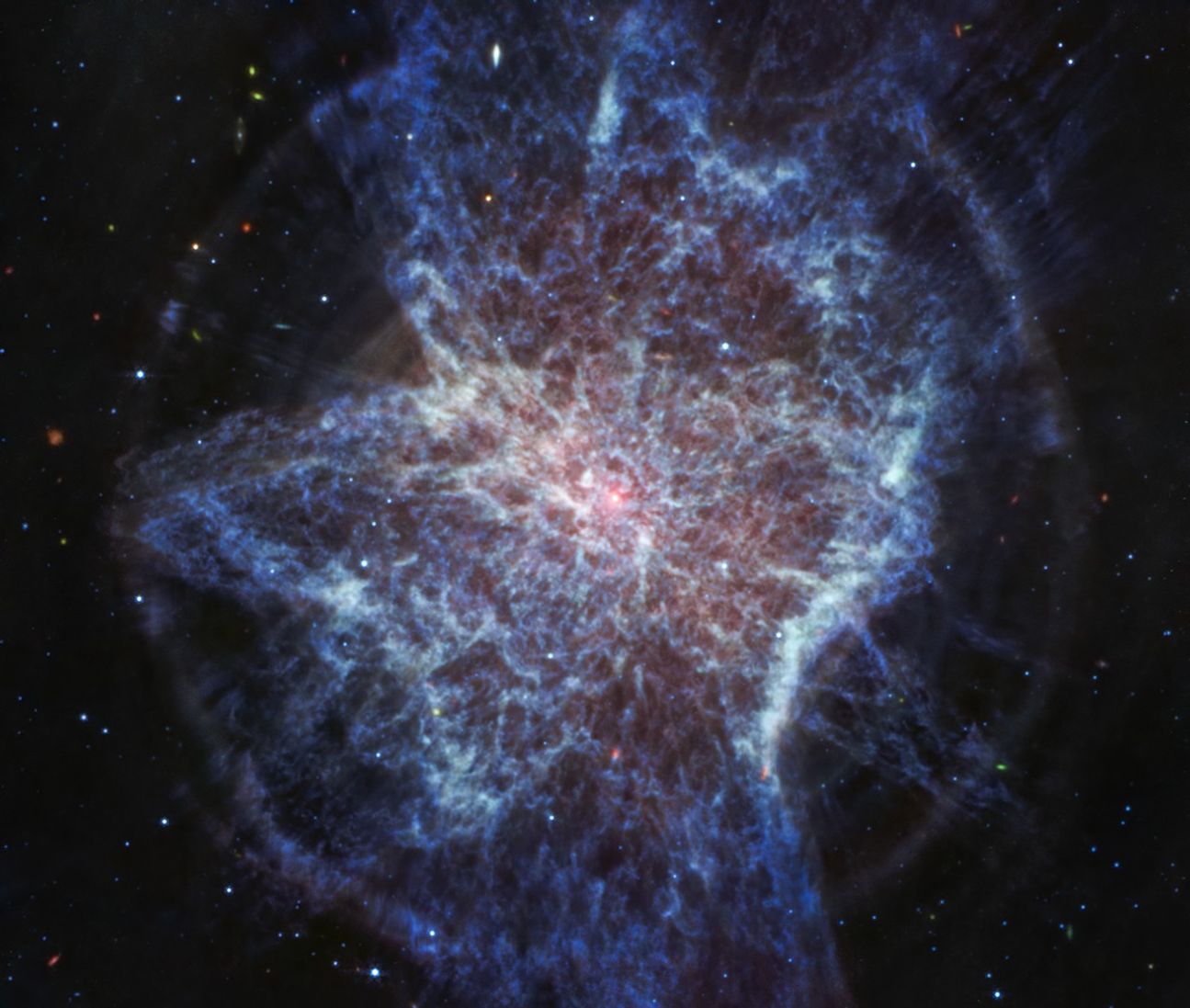
Cool image time! The picture to the right, reduced to post here, was taken by the Webb Space Telescope and released this week by the European Space Agency (ESA). It shows in the near-infrared what the scientists have labeled “The Red Spider Nebula”, a planetary nebula of eruptive gases formed near the end of a star’s life.

Webb’s new view of the Red Spider Nebula reveals for the first time the full extent of the nebula’s outstretched lobes, which form the ‘legs’ of the spider. These lobes, shown in blue, are traced by light emitted from H2 molecules, which contain two hydrogen atoms bonded together. Stretching over the entirety of NIRCam’s field of view, these lobes are shown to be closed, bubble-like structures that each extend about 3 light-years. Outflowing gas from the centre of the nebula has inflated these massive bubbles over thousands of years.

Gas is also actively jetting out from the nebula’s centre, as these new Webb observations show. An elongated purple ‘S’ shape centred on the heart of the nebula follows the light from ionised iron atoms. This feature marks where a fast-moving jet has emerged from near the nebula’s central star and collided with material that was previously cast away by the star, sculpting the rippling structure of the nebula seen today.

It is theorized that a not yet detected second star circles the primary, with both acting as the blades in a blender to mix the gases and help produce these shapes.

Be sure to click on the image to see the full resolution version. It shows the details in the central region much more clearly.

4 comments

The growing mystery of the little red dots in the early universe

The uncertainty of science: A review of the population of what scientists call “Little Red Dots” (LRDs) — discovered in the early universe by the Webb Space Telescope — has found that 30% do not appear to be compact objects when viewed in ultraviolet wavelengths.

The team studied 99 LRDs, and found that about 30% are not simply compact dots when observed in the ultraviolet.Instead, they reveal disturbed or clumpy structures, in stark contrast to their smooth, point-like appearance at optical wavelengths. Because these galaxies are so far away, their optical light is stretched, or “redshifted,” into the long-wavelength channel of JWST, where the resolution is not sharp enough to see structure, so they look like simple dots.

Rinaldi: ‘But their ultraviolet light is shifted into JWST’s short-wavelength channel, where the telescope has much finer resolution, and there we suddenly see clumps, asymmetries, and signs of interaction. On top of this, in the spectra of some of our LRDs we directly detect the fingerprints of active black holes, with gas moving at thousands of kilometres per second.’ This shows that at least part of this population is powered by growing black holes, while others seem to be dominated by star formation, making LRDs a mixed and diverse family of sources. This is a crucial clue, suggesting that mergers and galaxy interactions may be the trigger for the “LRD phase”.

In other words, astronomers don’t really know what these dots are at present. If some are supermassive black holes, this poses a problem for Big Bang cosmology, as there should not have been enough time since the Big Bang for these black holes to have formed.

That 70% still appear to be compact single objects might mean that’s what they are, but it could also mean that our present observations tools don’t yet have the ability to resolve them.

1 comment

Inexplicable very large patterns found in Saturn’s upper atmosphere

Beads and arms in Saturn's upper atmosphere
Click for original image.

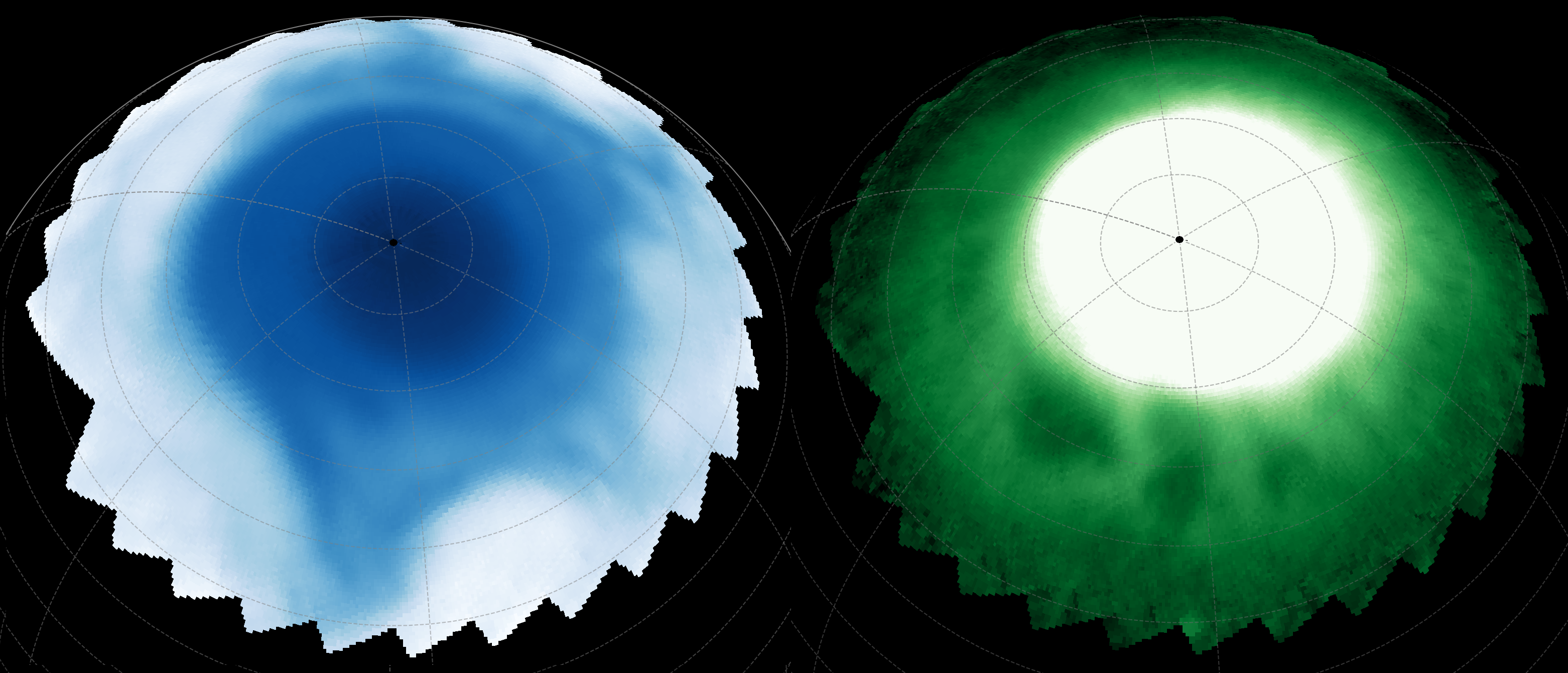
Using the Webb Space Telescope’s infrared capabilities, scientists have detected several different and inexplicable large atmospheric structures linked somehow to the gas giant’s north pole aurora.

The two images to the right, cropped, reduced, and annotated to post here, show both types of newly discovered features.

The international team of researchers, comprising 23 scientists from institutions across the UK, US and France, made the discoveries during a continuous 10-hour observation period on 29 November 2024, as Saturn rotated beneath JWST’s view. The team focused on detecting infrared emissions by a positively charged molecular form of hydrogen, H3+, which plays a key role in reactions in Saturn’s atmosphere and so can provide valuable insights into the chemical and physical processes at work. JWST’s Near Infrared Spectrograph allowed the team to simultaneously observe H₃⁺ ions from the ionosphere, 1,100 kilometres above Saturn’s nominal surface, and methane molecules in the underlying stratosphere, at an altitude of 600 kilometres.

In the electrically-charged plasma of the ionosphere, the team observed a series of dark, bead-like features embedded in bright auroral halos. [top picture] These structures remained stable over hours but appeared to drift slowly over longer periods.

Around 500 kilometres lower, in Saturn’s stratosphere, the team discovered an asymmetric star-shaped feature [bottom picture]. This unusual structure extended out from Saturn’s north pole towards the equator. Only four of the star’s six arms were visible, with two mysteriously missing, creating a lopsided pattern.

A more accurate word for the “beads” I think would be “patches”, as they are not small but major dark regions that appear to rotate with the planet, as do the arms. Both also seem to be related to each other as their rotations match, though one sits about 300 miles lower in the atmosphere. As noted in the press release, “the processes that are driving the patterns may influence a column stretching right through Saturn’s atmosphere.”

All guesses. All we have at this point is a truly intriguing observation.

1 comment

A glittering false-color image from Webb

A glittering false color image from Webb
Click for original image.

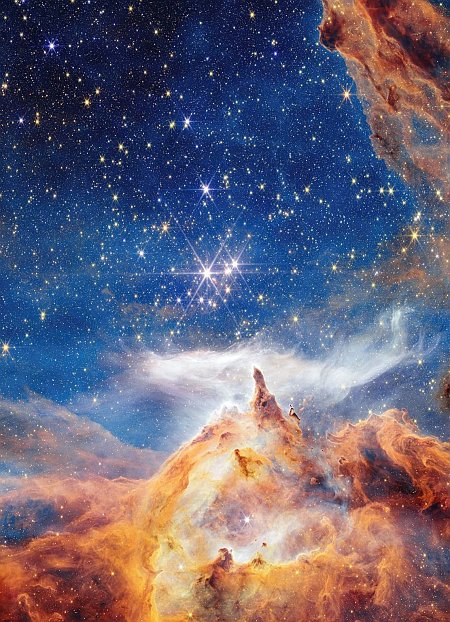
Cool image time! The picture to the right, reduced and sharpened to post here, was released today by the science team of the Webb Space Telescope. It shows in infrared false colors a spectacular star-forming region about 5,500 light years away, surrounded by glowing clouds.

Called Pismis 24, this young star cluster resides in the core of the nearby Lobster Nebula, approximately 5,500 light-years from Earth in the constellation Scorpius. Home to a vibrant stellar nursery and one of the closest sites of massive star birth, Pismis 24 provides rare insight into large and massive stars. Its proximity makes this region one of the best places to explore the properties of hot young stars and how they evolve.

At the heart of this glittering cluster is the brilliant Pismis 24-1. It is at the center of a clump of stars above the jagged orange peaks, and the tallest spire is pointing directly toward it. Pismis 24-1 appears as a gigantic single star, and it was once thought to be the most massive known star. Scientists have since learned that it is composed of at least two stars, though they cannot be resolved in this image. At 74 and 66 solar masses, respectively, the two known stars are still among the most massive and luminous stars ever seen.

…Super-hot, infant stars –some almost 8 times the temperature of the Sun – blast out scorching radiation and punishing winds that are sculpting a cavity into the wall of the star-forming nebula. That nebula extends far beyond NIRCam’s field of view. Only small portions of it are visible at the bottom and top right of the image. Streamers of hot, ionized gas flow off the ridges of the nebula, and wispy veils of gas and dust, illuminated by starlight, float around its towering peaks.

The universe is truly beautiful, if we look at it the right way.

0 comments

A baby star and its protoplanetary disk

A baby star and its protoplanetary disk
Click for originial.

Cool image time! The picture to the right, cropped, rotated, reduced, and sharpened to post here, is the Webb picture of the month from NASA and the European Space Agency (ESA), released today. It shows a baby star about 525 light years away.

IRAS 04302+2247, or IRAS 04302 for short, is a beautiful example of a protostar – a young star that is still gathering mass from its environment – surrounded by a protoplanetary disc in which baby planets might be forming. Webb is able to measure the disc at 65 billion km across – several times the diameter of our Solar System. From Webb’s vantage point, IRAS 04302’s disc is oriented edge-on, so we see it as a narrow, dark line of dusty gas that blocks the light from the budding protostar at its centre. This dusty gas is fuel for planet formation, providing an environment within which young planets can bulk up and pack on mass.

When seen face-on, protoplanetary discs can have a variety of structures like rings, gaps and spirals. These structures can be signs of baby planets that are burrowing through the dusty disc, or they can point to phenomena unrelated to planets, like gravitational instabilities or regions where dust grains are trapped. The edge-on view of IRAS 04302’s disc shows instead the vertical structure, including how thick the dusty disk is. Dust grains migrate to the midplane of the disc, settle there and form a thin, dense layer that is conducive to planet formation; the thickness of the disc is a measure of how efficient this process has been.

The dense streak of dusty gas that runs vertically across this image cocoons IRAS 04302, blotting out its bright light such that Webb can more easily image the delicate structures around it. As a result, we’re treated to the sight of two gauzy nebulas on either side of the disc. These are reflection nebulas, illuminated by light from the central protostar reflecting off of the nebular material.

As this is a baby star, the cones above and below the disk indicate the original spherical cloud, with the upper and lower halves now being pulled downward into a spinning disk, where the solar system is forming.

This image is not simply an infrared Webb image. The Hubble Space Telescope provided the optical view, which the Atacama Large Millimetre/submillimetre Array (ALMA) in Chile provided data in those wavelengths. Note also the many background galaxies. The universe is not only infinite, it is infinitely populated.

1 comment

Using Webb astronomers have for the first time identified the source of a fast radio burst

Fast Radio Burst source

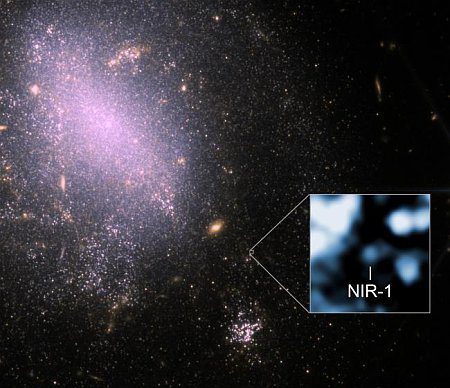
Astronomers using the Webb Space Telescope have now successfully pinpointed a specific object that appears to be the source for a fast radio burst (FRB), extra-galactic short bursts of radio energy whose cause and origin have up-to-now been unexplained.

Blanchard and his team used a discovery of an FRB in a nearby galaxy made with the CHIME Outriggers array, a radio telescope in Canada, which was recently upgraded to enable FRB detections with precise positions. The researchers then turned to NASA’s James Webb Space Telescope to look for an infrared signal from the same location.

…The infrared data revealed an object, dubbed NIR-1, that is likely a red giant star or possibly a middle-aged massive star. A red giant is a Sun-like star near the end of its life that has expanded and brightened, while the other possibility is a star much more massive than the Sun.

Although these stars are unlikely to directly produce FRBs, the scientists say, they may have an unseen companion, such as a neutron star, pulling material away from the red giant or massive star. This process of transferring mass

The burst itself occurred on March 16, 2025 about 130 million light-years away in the galaxy NGC 4141. You can read the discovery paper here [pdf].

There remain of course great uncertainties. For one, NIR-1 is itself not likely the cause of the FRB, but related to its source in some manner. The scientists posit a number of explanations, from either an unseen magnetar (a pulsar with a powerful magnetic field), or a flare from this massive star reflecting off that unseen magnetar.

Regardless, this discovery helps narrow the theories considerably.

0 comments

Webb discovers another “oldest black hole”

The uncertainty of science: Using the Webb Space Telescope, astronomers now claim they have detected a super-massive black hole at a new record-setting distance that puts it far closer to the Big Bang that cosmologists have predicted.

A global team of astronomers, led by The University of Texas at Austin’s Cosmic Frontier Center, has confirmed the discovery of the most distant black hole ever observed. This black hole resides within a galaxy known as CAPERS-LRD-z9, which existed only 500 million years after the Big Bang.

In other words, the light we see from it has traveled 13.3 billion years, revealing the universe at just 3% of its current age.

The black hole, estimated to have the mass of 300 million suns, sits in the center of one of the mysterious “little red dots” that Webb has discovered in the early universe that remain a mystery. This black hole suggests each is an early galaxy with its own super-massive black holes.

I must note that there is great uncertainty in the claim of a black hole discovery. It is based on the spectroscopic emissions detected by Webb, which had features generally seen only in super-massive black holes in the recent universe. Thus, the scientists are making some large assumptions in concluding those emissions also indicate a super-massive black hole in this little red dot.

We must also note that if this black hole really exists, it confounds the theories of cosmologists as to the formation of the universe. It is too soon after the Big Bang for such a black hole to have formed, according to those theories.

0 comments

Webb: Evidence of gas giant exoplanet orbiting the central star of Alpha Centuri

Webb infrared data
Click for original image.

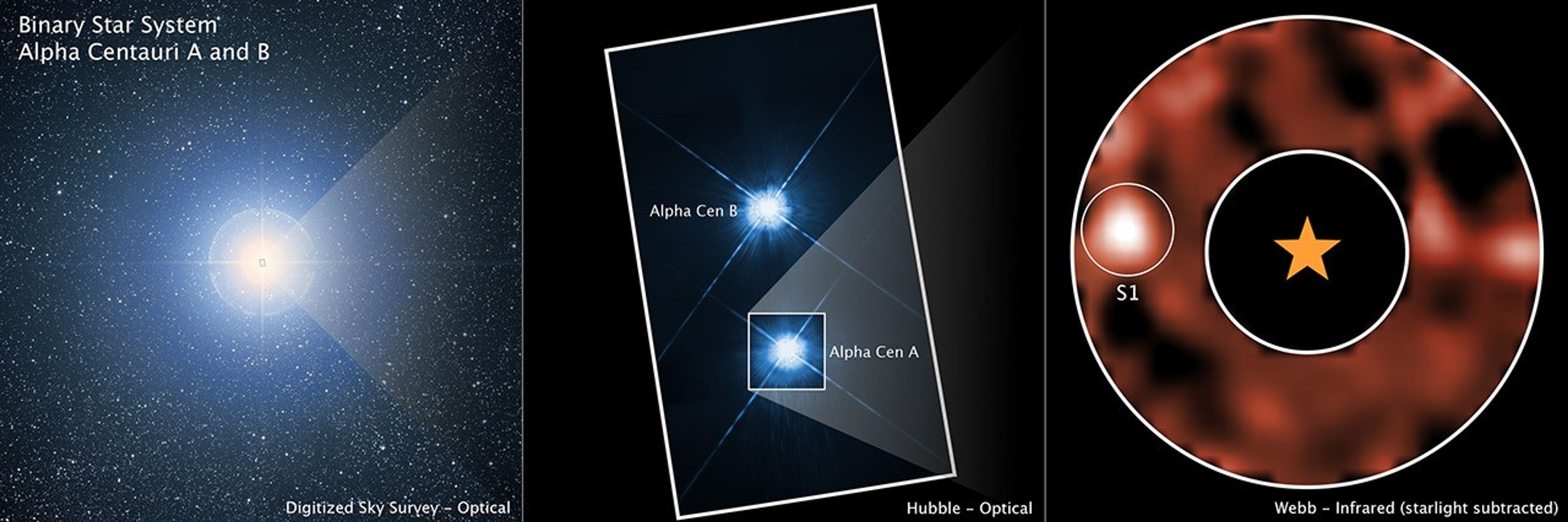
The uncertainty of science: Astronomers using the Webb Space Telescope now think they have detected a gas giant exoplanet orbiting the central star of the Alpha Centuri triple star system, the closest star to our Sun at only four light years distance.

The false-color image to the right shows the candidate exoplanet labeled as S1, with the light of the central star blocked out but indicated by the star at the center. A lot of processing was required to bring out this bright blob, including eliminating optical effects that normally act to hide such objects.

Alpha Centauri, located in the far southern sky, is made up of the binary Alpha Centauri A and Alpha Centauri B, both Sun-like stars, and the faint red dwarf star Proxima Centauri. Alpha Centauri A is the third brightest star in the night sky. While there are three confirmed planets orbiting Proxima Centauri, the presence of other worlds surrounding Alpha Centauri A and Alpha Centauri B has proved challenging to confirm.

Now, Webb’s observations from its Mid-Infrared Instrument (MIRI) are providing the strongest evidence to date of a gas giant orbiting Alpha Centauri A. …Based on the brightness of the planet in the mid-infrared observations and the orbit simulations, researchers say it could be a gas giant approximately the mass of Saturn orbiting Alpha Centauri A in an elliptical path varying between 1 to 2 times the distance between Sun and Earth.

If confirmed the exoplanet would be orbiting the star within the habitable zone, though as a gas giant life as we know it would likely be impossible. The location, only four light years away, makes this exoplanet and the entire system a prime target for further observations.

Hat tip to BtB’s stringer Jay.

3 comments

New data raises doubts about exoplanet having chemicals that on Earth come from life

The uncertainty of science: Using new data from the Webb Space Telescope, scientists now conclude that the identification on an exoplanet in April 2025 of the molecules dimethyl sulfide (DMS) and/or dimethyl disulfide (DMDS) — both of which on Earth are only associated with the presence of life — is now uncertain and that these molecules likely aren’t there.

The new work uses [Webb] data to better qualify what is going on. The work confirms the presence of an ocean on this peculiar exoplanet, although it can’t confirm if there is a thick or thin atmosphere. They couldn’t find water vapor in the atmosphere, suggesting that there is an efficient cold trap, keeping evaporation to a minimum on this temperate sub-Neptune world.

Those potential biosignatures were all below the threshold for an undeniable detection, and their model suggests that a possible presence of DMS could be explained by sources unrelated to life. They advise considering more and different molecules to use as biosignatures. Astronomers are studying worlds that are very different from our own, and the chemical signatures that seem obvious here on Earth might not fit well with those exoplanets.

In other words, they simply don’t have enough data to know, one way or the other. No surprise, The science of studying exoplanets is in its infancy, and right now can only tease out the smallest of details based on our limited technology and the distances involved.

You can read the new paper here [pdf]. It notes further that using these molecules as a sign of life is also a mistake, as they can be created in other ways having nothing to do with biology.

0 comments

A Webb false color image of a planetary nebula

A Webb false color image of a planetary nebula
Click for original image.

Cool image time! The picture to the right, reduced and sharpened to post here, was released today by the science team of the Webb Space Telescope, showing the planetary nebula NGC 6072 in infrared false color.

This particular image was one of two taken by Webb, and looked at the nebula in the near infrared.

[I]t’s readily apparent that this nebula is multi-polar. This means there are several different elliptical outflows jetting out either way from the center, one from 11 o’clock to 5 o’clock, another from 1 o’clock to 7 o’clock, and possibly a third from 12 o’clock to 6 o’clock. The outflows may compress material as they go, resulting in a disk seen perpendicular to it. Astronomers say this is evidence that there are likely at least two stars at the center of this scene. Specifically, a companion star is interacting with an aging star that had already begun to shed some of its outer layers of gas and dust.

The central region of the planetary nebula glows from the hot stellar core, seen as a light blue hue in near-infrared light. The dark orange material, which is made up of gas and dust, follows pockets or open areas that appear dark blue. This clumpiness could be created when dense molecular clouds formed while being shielded from hot radiation from the central star. There could also be a time element at play. Over thousands of years, inner fast winds could be ploughing through the halo cast off from the main star when it first started to lose mass.

The second image, taken in the mid-infrared, shows expanding dust shells, with some forming an encircling ring around the central nebula.

It is believed that the two stars at the center of this nebula act to churn the expanding material to form this complex shape. Imagine them functioning almost like the blades in a blender.

0 comments

Third star destroying part of expanding shells surrounding binary Wolf-Rayet stars

Apep system.
From figure 3 of the paper.

Using the Webb Space Telescope, astronomers think they can now disentangle the strange spiral shape of the expanding dust shells caused by the colliding powerful winds flowing from a binary pair of giant aging Wolf-Rayet stars, dubbed the Apep system.

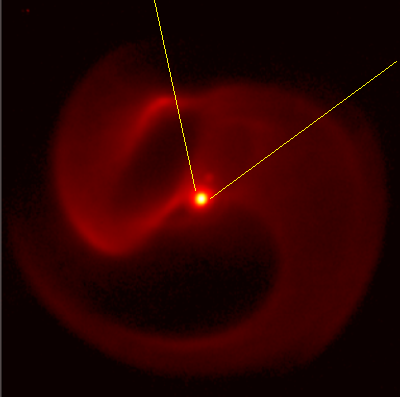
Apparently, a third smaller O-type star sits in the system, and is acting to block the winds and destroy the dust within them, carving out a large cavity in the spiral shells. The image to the right, produced by the Very Large Telescope in Chile, shows the spiral dust shells shaped by the strong solar winds flowing and colliding from the binary Wolf-Rayet stars (the bright dot in the center). The O-type star can be seen just above them. The yellow lines indicate the empty cone. Without the O star computer models had predicted a very bright shell north of the binary, and its non-existence in VLT images caused these further Webb observations.

From the paper’s [pdf] conclusion:

The JWST observations of Apep reveal luminous circumstellar dust that support[s] … our finding that the O supergiant ‘northern companion’ is dynamically associated with the binary WR stars in Apep; this is the first time that dust destruction has been observed by a tertiary star in a colliding wind nebula, and marks Apep as part of a rare class of triple colliding wind binaries.

The dust produced by Wolf-Rayet stars is thought to be a major component in seeding the formation of later stars, such as our own Sun. Finding that a third star in the system can destroy that dust suggests (as always) that this process can be far more complicated that first believed.

Hat tip to BtB’s stringer Jay.

2 comments

Webb spots aftermath of collision of two galaxies

colliding galaxies
Click for source.

Using the Webb Space Telescope, astronomers have discovered the collision of two spiral galaxies that appears to have caused a supermassive black hole to collapse in its wake.

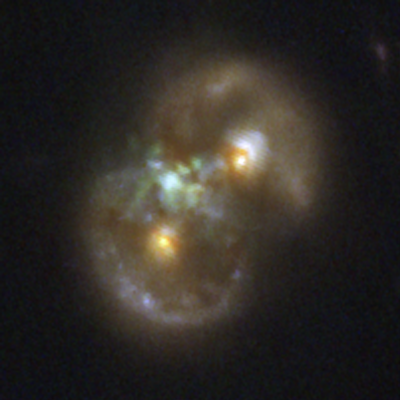
The Webb false-color infrared image to the right shows the two galaxies as the red dots, both surrounded by a ring, with the supermassive black hole the bluish spot in between but offset somewhat to the left. Follow-up radio observations suggested that this bluish spot was a supermassive black hole, having a mass of a million suns and sucking up matter from the giant gas cloud that surrounds it.

The team proposes that the black hole formed there via the direct collapse of a gas cloud – a process that may explain some of the incredibly massive black holes Webb has found in the early universe.

This hypothesis however has enormous uncertainties, and requires a lot more observations to confirm. The black hole could simply exist unrelated to the galaxy collision, having come there from elsewhere. Or it could be from a third galaxy in this group that these initial observations have not yet detected.

The image however is quite cool.

0 comments

Webb detects unexpected “little red dots” in the early universe

The uncertainty of science: Using the Webb Space Telescope astronomers have begun to compile a small catalog of what they call “little red dots” [LRDs], objects in the very early universe that are very small, too small to be galaxies and are thus a mystery.

A team of astronomers recently compiled one of the largest samples of LRDs to date, nearly all of which existed during the first 1.5 billion years after the big bang. They found that a large fraction of the LRDs in their sample showed signs of containing growing supermassive black holes.

“We’re confounded by this new population of objects that Webb has found. We don’t see analogs of them at lower redshifts, which is why we haven’t seen them prior to Webb,” said Dale Kocevski of Colby College in Waterville, Maine, and lead author of the study. “There’s a substantial amount of work being done to try to determine the nature of these little red dots and whether their light is dominated by accreting black holes.”

The present most popular theory to explain the dots, based on the available data, is that the dots are newly formed black holes, their red light caused by material falling into the hole at millions of miles per hour. That theory has of course problems. For example, it doesn’t explain why we don’t see these dots in more recent times. Nor does it explain why the dots are dim in X-rays, a radiation expected from accreting black holes.

As always, the press release claims that this discovery does not “break” the present cosmological theories for the formation of the universe, but at the same time, it does illustrate our overall lack of knowledge about that early universe. We really don’t know very much, which means any theories we have are likely wrong simply due to our present ignorance.

3 comments

Webb takes infrared image of exoplanet

Webb's image of exoplanet

Using the Webb Space Telescope astronomers have now successfully taken an infrared false-color image of Saturn-sized exoplanet orbiting a young star about half the mass of the Sun and about 111 light years away.

The image is to the right, cropped and reduced to post here. The star, its light blocked out, is indicated by the circle with the star in the middle. The exoplanet is the orange blob to the upper right, sitting inside the blue accretion disk that surrounds the star, photographed in optical light by the Very Large Telescope in Chile.

You can read the paper here. The scientists rejected the possibility that this was a background galaxy after doing computer modeling, based on the data available. From their paper:

Dedicated N-body simulations were conducted for a planet with a mass of 0.34 [mass of Jupiter], located at 52 au [astronomical units] around the 0.46 [solar mass] central star. This value is consistent with the measured projected separation, assuming that the planet and the ≈13°-inclined disk are coplanar. The simulation also included a disk of 200,000 planetesimals, distributed between 20 and 130 au. These parameters were selected to roughly match the boundaries of the observed disk.

Note too that the picture to the right has been significantly enhanced by the press department at JPL, based on the actual data shown in the paper itself. These fact underline the uncertainties involved in this discovery.

Nonetheless, it is a good result, and suggests we are looking at the formation process of a new solar system surrounding a very young baby star.

2 comments

Scientists increase the odds asteroid 2024 YR4 will impact the Moon in 2032

Asteroid 2024 YR4 in 2032
Click for original image.

Using additional data obtained by the Webb Space Telescope, scientists have now refined the orbit of potentially dangerous asteroid 2024 YR4 and confirmed that while it will almost certainly not hit the Earth in 2032, the odds of it impacting the Moon have increased.

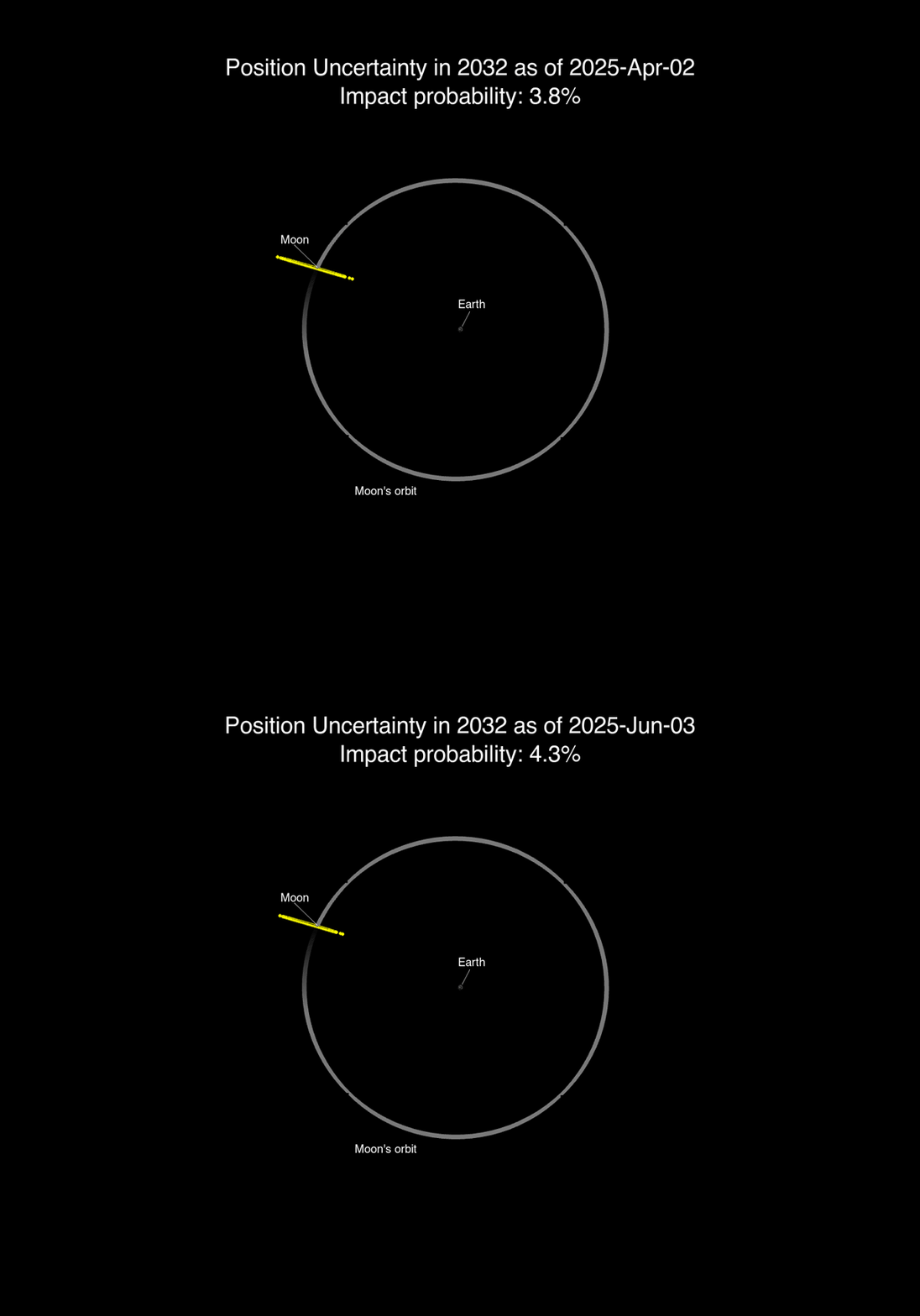
With the additional data, experts from NASA’s Center for Near-Earth Object Studies at the agency’s Jet Propulsion Laboratory in Southern California further refined the asteroid’s orbit. The Webb data improved our knowledge of where the asteroid will be on Dec. 22, 2032, by nearly 20%. As a result, the asteroid’s probability of impacting the Moon has slightly increased from 3.8% to 4.3%. In the small chance that the asteroid were to impact, it would not alter the Moon’s orbit.

The yellow line in the image to the right shows the present range of positions the asteroid could be in as it passes the Moon on that date. It is expected this range will be narrowed further when the asteroid flies past the Earth harmlessly in 2028.

If the asteroid should hit the Moon, the impact will provide scientists a great opportunity to learn more about asteroids and the Moon. If it should miss, it will then be essential to recalculate its orbit to see what will happen on later near approaches, whether the fly-by increased or decreased the chances of a later Earth impact.

9 comments
1 2 3 4 7