
Animal mummies
Want to know what museum holds that mummy of a fish found in Egypt in 1905? Check out Animal Mummies, the largest animal mummie database in the world.
Want to know what museum holds that mummy of a fish found in Egypt in 1905? Check out Animal Mummies, the largest animal mummie database in the world.
After a very long winter where the Arctic Oscillation has been deeply negative, setting records and resulting in very cold conditions in the northern hemisphere, the oscillation has finally entered its positive phase in the last month.
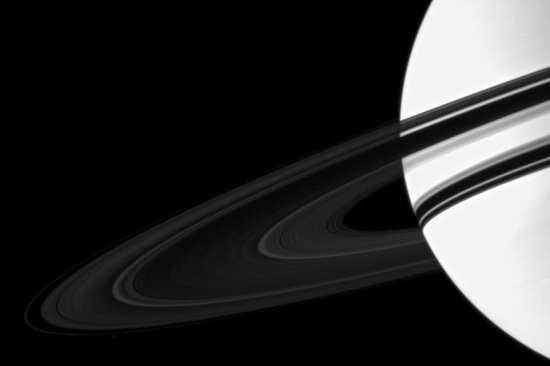
This stunning image of Saturn, taken by Cassini on June 24, 2010, shows the ring’s widening shadow across the planet. As the planet orbits the Sun the tilt of its rings relative to the Sun changes with time. In August 2009 the tilt was essentially zero, so that the shadow was very narrow. Since then the tilt has been increasing, as has the width of the shadow.
An evening pause: From the movie Topsy-Turvy (2000), Shirley Henderson singing.
This long and fascinating interview about the Israeli-Arab conflict is quite eye-opening. Key quote:
Most Israelis are here because they fled from Muslim and European countries. They don’t feel that either of those blocs have the right to lecture them about anything. Why should a country where your parents were expelled or killed have the right to tell you how to conduct yourself in a war against people who are trying to kill you today? This is something hardly any non-Israelis understand. They don’t understand how galling we find this.
Israelis are often accused of being arrogant, but they find it extremely arrogant for Europeans and Arabs to lecture them about morals, especially during a war. What has Israel ever done that is as brutal as what Europe did to the Jews, or what Arabs routinely do to even each other during armed conflicts?
Read it all.
The state-owned Ukrainian company, building the first stage of the rocket Orbital Sciences intends to use for ferrying cargo to and from ISS, announced today that there will be two to three month delay in delivery. No explanation for the delay was offered.
The recent history of NASA illustrates a fundamental problem with how our political class thinks.
In 2004 George Bush announced that NASA would have a new goal, that of the exploration of the solar system. The shuttle would complete construction of the International Space Station and then be retired in 2010. NASA would meanwhile build a replacement for the shuttle, designed to return to the Moon and beyond, and have it flying by 2014.
Notice the gap? The shuttle retires in 2010, four years before its replacement is available. Notice also that the plan insisted that ISS would be finished, fully occupied, and in need of significant resupply and maintenance during this entire time, when neither the shuttle or its replacement would be on hand.
Yet, as obvious as this seems, no one at NASA, in the Bush administration, or in Congress, seemed to notice this gap. The Bush plan was implemented exactly as described, so that today we are about to be left with a space station in orbit and no way to reach it for at least four years. (That other countries can reach the station changes nothing: the United States has been left hanging, lacking a method for transporting its crews to its own space station.)
It was as if, among the political and elite class that runs the government, there was great disconnect between the fantasy of the intended plan and the reality of its implementation. » Read more
Correction.Regular reader James Fincannon emailed me to say that he thinks the image below is an artist’s impression. He is correct. I should have looked more closely at the press release. In reading the actual research paper [pdf] on the results it seems that the VLT did some very sophisticated spectroscopy, thereby measuring the uneven distribution of the velocity and density of the gas around the star. The image below was then created, based largely on Hubble images combined with the new data. In other words, this ground-based telescope did not match the abilities of a space-based telescope in any way. Had the Hubble images not existed the astronomers would have struggled to interpret their spectroscopic data.
Some important astronomy news: The European Southern Observatory’s Very Large Telescope (VLT) has released this spectacular image of supernova 1987a, the first and so far only supernova visible to the naked eye since the invention of the telescope.
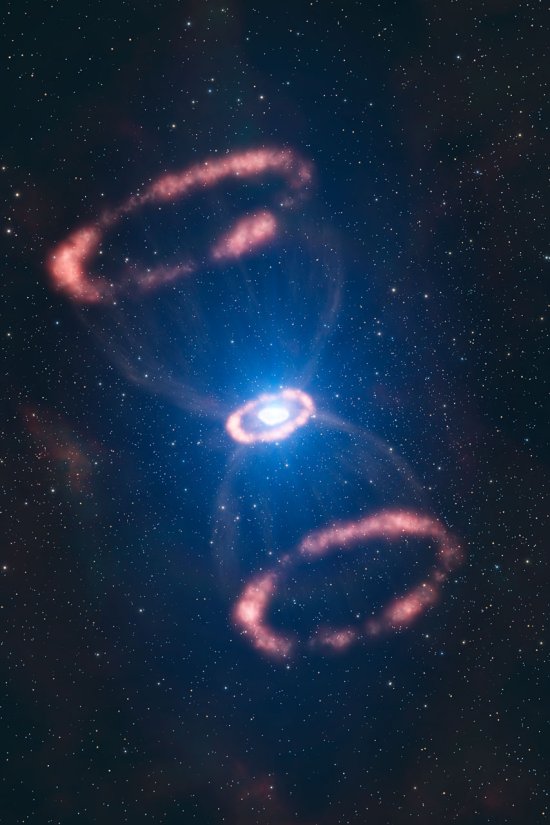
This image is important for two reasons. First, The data shows that the supernova explosion was not symmetrical, with more material being thrown outward in some directions than in others. This fact confirms what astronomers in recent years have increasingly come to believe: Supernovae explosions are not simple spherical bursts, but chaotic events ripping stars apart in a lopsided manner.
Second, this image demonstrates that ground-based telescopes are becoming amazingly good at doing what the Hubble Space Telescope has done routinely for the past two decades. Five years ago, no telescope on the ground could have resolved the inner ring of supernova 1987a. Only Hubble in space had that capability. Now, VLT can do it, almost as well as Hubble. Though a space-based telescope can still beat any ground-based telescope, it is great news that the technology for ground-based telescopes has improved so much, especially since there presently are no plans to replace Hubble.
Archeologists have uncovered a previously unknown tunnel and several chambers under the Temple of Quetzacoatl north of Mexico City. Key quote:
Experts say a tomb discovery would be significant because the social structure of Teotihuacan remains a mystery after nearly 100 years of archaeological exploration at the site, which is best known for the towering Pyramids of the Moon and the Sun. No depiction of a ruler, or the tomb of a monarch, has ever been found, setting the metropolis apart from other pre-Hispanic cultures that deified their rulers.
Waking up is hard to do. Today NOAA’s Space Weather Prediction Center once again published its monthly graph, showing the progress of the sun’s sunspot cycle in comparison with the consensis prediction made by the solar science community in May 2009.
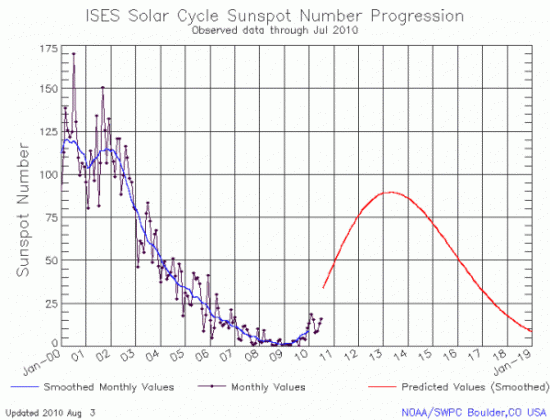
As I noted when I posted the July graph, the data continues to show that the Sun’s ramp up to solar maximum is far slower and weaker than predicted, despite the stories this week about how Sunday’s coronal mass ejection demonstrates that the sun is “waking up.”
WhiteKnightTwo was in the air today, doing another test flight, this time without SpaceShipTwo attached.
That coronal mass ejection thrown out by the Sun on Sunday is expected to energize the aurora tonight and again on Thursday. Look up at night if you live in the high northern latitudes.
Some evening silliness:
Steve Goddard notes the state of ice at the North Pole, both then and now, with pictures.
Using sonar equipment Canadian archeologists have detected the underwater remains of the British ship Investigator, abandoned in the Canadian archipelago of islands by Captain Robert McClure and his crew in 1853. McClure had been sent out to both find the Northwest Passage as well as locate the missing Franklin expedition. As winter had set in in September 1851, however, McClure had anchored the ship for refuge in a bay he named Mercy Bay on the coast of Banks Island. As Pierre Berton noted in his wonderful history of the exploration of the Arctic in the 1800s, The Arctic Grail, Mercy Bay was not a refuge but “a cul-de-sac in which the crew would be confined for the next two years and from which the ship itself would never be freed.” Now, that ship has been rediscovered after almost 150 years.
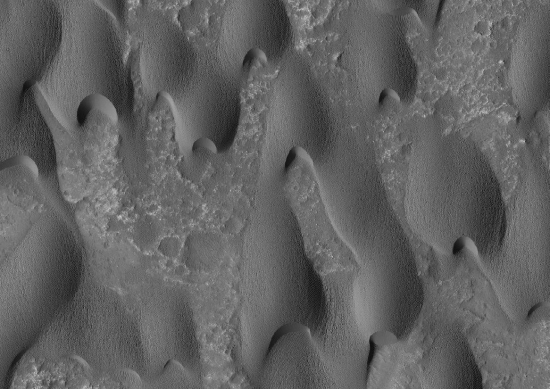
Sand dunes on Mars, from the HiRise camera on Mars Reconnaissance Orbiter:
Fun quote:
These dunes are “barchan” dunes, which are also commonly found on Earth. Barchan dunes are generally crescent-shaped, with their “horns” oriented in the downwind direction. They have a steep slip face (the downwind side of the dune). Barchan dunes form by winds that blow mostly in one direction and thus are good indicators of the dominant wind direction. In this case, the strongest winds blow approximately north to south.
Two new predictions of the upcoming solar maximum were published today on the Los Alamos astro-ph preprint webpage. Both call for a weak solar maximum, with one expecting a sunspot number of 92 at maximum while the other predicting a number of 72.
Three citizens of the United Arab Emirates are now the first non-American citizens to train at the NASA Ames Research Center, with more to come, suggesting that NASA Administrator Charles Bolden really meant it when he said his foremost priority was Muslim outreach.