
Prison for collecting rain water in Oregon
We’re here to help you: An Oregon man is now serving a 30 day jail sentence for collecting rain water on his own land.
We’re here to help you: An Oregon man is now serving a 30 day jail sentence for collecting rain water on his own land.
On Monday NOAA posted its monthly update of the solar cycle, showing the sunspot activity for the Sun in June. As I do every month, I am posting it here, below the fold, with annotations to give it context.
The decline in sunspots continued for the fourth month in a row, increasing the likelihood that the peak of solar maximum has finally come and gone and that we now seeing the beginning of the ramp down to solar minimum. This resulting solar maximum comes close to matching the science community’s final prediction (indicated by the red line), though that prediction was not detailed enough to include the distinct and unusual double peak for this maximum.
» Read more
Feel the love: Watch a pro-choice supporter get violent against pro-life demonstrators with whom she disagrees.
Video below the fold. Be warned that the pro-choice woman uses very graphic language.
She tells us a great deal about herself and the social community that she belongs to when she says, “No uterus, no right to talk about it. Understand?” From her perspective, she has the right to dictate who has freedom of speech and who doesn’t. Worse, she very clearly has had this totalitarian belief confirmed by the people she socializes with.
The Planetary Society announced today that its solar sail experiment, LightSail, will be launched in 2016 on a Falcon Heavy.
It will be a secondary payload on what might be one of Falcon Heavy’s early demo flights. They also say the launch date is scheduled for April 2016, but since the rocket has not yet been tested I wouldn’t take that date too seriously.
The private effort to resurrect the 1980s research probe ISEE-3 has been stymied by a non-working propulsion system.
Before the July 9 attempt, the ISEE-3 Reboot Project thought it had a chance of completing its planned trajectory correction maneuver. The spacecraft’s small hydrazine thrusters were spun up July 3, and systems appeared nominal, Cowing said. On July 8, the spacecraft even managed to perform one of the six multipulse burns that would have set it up for a return to the orbit into which it was launched in 1978.
But further attempts to activate the thrusters July 8 proved unsuccessful, as were all attempts the following day. After eliminating a malfunctioning valve as the cause of the problem, the ISEE-3 Reboot Project was forced to conclude that the satellite’s hydrazine fuel simply was not being pushed through its plumbing at the right pressure to conduct a burn.
The spacecraft is in science mode and will gather data as long as it is in communication range, which will only be for another three months.
A new astronomical mystery: The Arecibo radio telescope has confirmed the existence of fast radio pulses.
Fast radio bursts (FRBs) are bright flashes of radio waves that last only a few thousandths of a second. Scientists using the Parkes Observatory in Australia have recorded such events for the first time, but the lack of any similar findings by other facilities led to speculation that the Australian instrument might have been picking up signals originating from sources on or near Earth. The discovery at Arecibo is the first detection of a fast radio burst using an instrument other than the Parkes radio telescope. The position of the radio burst is in the direction of the constellation Auriga in the Northern sky. …
“Our result is important because it eliminates any doubt that these radio bursts are truly of cosmic origin,” continues Victoria Kaspi, an astrophysics professor at McGill University in Montreal and Principal Investigator for the pulsar-survey project that detected this fast radio burst. “The radio waves show every sign of having come from far outside our galaxy – a really exciting prospect.”
Exactly what may be causing such radio bursts represents a major new enigma for astrophysicists. Possibilities include a range of exotic astrophysical objects, such as evaporating black holes, mergers of neutron stars, or flares from magnetars — a type of neutron star with extremely powerful magnetic fields.
Be warned: All of the above theories could also be wrong. These fast radio flashes could just as easily turn out to be something entirely unpredicted.
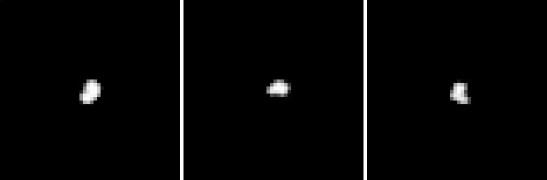
Rosetta’s new images of Comet 67P/Churyumov-Gerasimenko show the very irregular shape and rotation of its nucleus.
These images were taken on July 4 from a distance of only 23,000 miles. The rendezvous is expected in early August, with the touchdown of Rosetta’s landing probe Philae sometime in November after they have done a reconnaissance of the nucleus to pick a landing spot.
The competition heats up: Bigelow Aerospace hired two former NASA astronauts today as part of a broader expansion of the company in anticipation of .the completion of its first two private space modules in 2017.
Bigelow said the smallest space station his company plans to fly will require two BA330 modules, each of which has 330 cubic meters of internal space. The company expects to finish building the first two BA330s by 2017, Bigelow said.
Ham and Zamka are former military aviators who have piloted and commanded space shuttle missions. Their NASA and military credentials are part of the appeal for Bigelow, who plans to put both former space fliers to work as recruiters. “I would like to see us have half a dozen astronauts onboard by the end of the year,” Bigelow said.
Each Bigelow Aerospace space station would require about a dozen astronauts, including orbital, ground and backup personnel. The 660-cubic-foot stations would host four paying clients, who would be assisted by three company astronauts responsible for day-to-day maintenance, Bigelow said. Initially, clients and crews would cycle in and out of the stations in 90-day shifts, Bigelow said. Eventually, the company hopes to shorten that cycle to 60 days.
The company had laid off many of its workers several years ago and was essential dormant, waiting for the development of some sort of affordable commercial manned spacecraft capability. It now appears they are expecting SpaceX, Boeing, or Sierra Nevada to succeed in providing this service in the next few years.
Friday’s Cygnus launch to ISS has been delayed 24 hours because of a threat of thundershowers in Florida. Virginia.
Thanks to Dick for spotting my error. I typed Florida out of habit. This launch will be at Wallops Island on the Eastern Shore of Virginia.
The competition heats up: The FAA today approved SpaceX’s application to establish a spaceport near Brownsville, Texas.
The engineers trying to resurrect ISEE-3 think their engine burn yesterday ended prematurely because the spacecraft’s supply of nitrogen needed for such a burn has been depleted.
They have still not given up hope, but it sounds like it is increasingly unlikely that they will be able to shift the spacecraft’s orbit as needed.
A newly released 2013 email from Lois Lerner reveals that she made a conscience effort to hide what she was doing from Congressional investigators.
Realizing that her emails at that time were being saved in some manner (this is long after her computer crash that supposedly destroyed her correspondence from 2011), she writes “we need to be cautious about what we say in emails”.
Really? Is that what an honest government worker does? I don’t think so.
Update: This good analysis of these new revelations notes that her email comment above was made only about six weeks before she took the fifth in House hearings. How interesting.
The International Astronomical Union (IAU), faced with challenges to its authority in naming astronomical objects, is instituting a contest allowing the public to name the 305 most studied exoplanets.
The engineers trying to resurrect the 1980s ISEE-3 spacecraft have posted an update describing what happened with yesterday’s partly successful engine burn.
The bottom line:
Thruster firings were planned to done in groupings – or “segments” – of 63 firings per segment. The first chart is annotated to show the three firing attempts. The first segment was full duration but only partially successful. The second and third attempts failed. Possible causes (under investigation) include valve malfunction and fuel supply issues.
This doesn’t sound hopeful, but stay tuned as they continue to assess the situation.
A new array of seismometers, combined with a series of planned explosions, will be used to map the interior of the Mt. St. Helens volcano to a depth of eighty kilometers or fifty miles.
To get the job done, starting next week roughly 65 people will fan out across the mountain to deploy 3,500 small seismometers along roads and back-country trails. They will drill 24 holes some 25 metres deep, drop in industrial explosives used for quarrying, and refill the holes (see ‘Under the dome’). The plan is to detonate the explosives in separate shots over four nights. Each blast will shake the ground as much as a magnitude-2 earthquake.
Results from the active blasts will be combined with the passive seismic part of the experiment, which is already under way: 70 larger seismometers around the mountain are measuring how long waves from natural earthquakes take to travel through the ground. Their data can be used to probe as far as 80 kilometres down, says Vidale.
The competition heats up: The first test launch today of Russia’s new Angara rocket was a success, according to Russian reports.
According to the Russian Ministry of Defense, the first stage of the rocket separated four minutes after the liftoff, while the vehicle was flying in the projected area over the southern Barents Sea and in the range of the Russian ground control network. The main engine of the second stage was shut down as planned at 16:08 Moscow Time and the stage along with a payload mockup fell in the projected area of the Kura impact range on the Kamchatka Peninsula 5,700 kilometers from the launch site, 21 minutes after liftoff.
Russia will obviously have to conduct further test launches, including the first orbital test, before it declares Angara operational. Nonetheless, this success gets them closer to replacing the Proton and Zenit rockets and allowing them to decrease their reliance on rockets, spaceports, and components under the control of independent countries that were formerly part of the Soviet Union.
More details about the Angara rocket family can also be found here.
New data from Voyager 1 has confirmed that it entered interstellar space in August 2012.
This is just an example of good science. The data last year had suggested this conclusion, which was announced with great fanfare. The new data merely confirms it again.
The major course correction burn for ISEE-3 was only partially successful today.
We managed to conduct the first segment (composed of 63 thruster pulses) but encountered problems with the second and halted the remainder of segment firings. Today’s burn was supposed to be 7.32987 m/s. We’re looking at data and formulating a plan for tomorrow. Our window tomorrow (Wednesday) at Arecibo opens at 12:39 pm EDT and extends to 3:26 pm EDT.
Finding out what’s in it: According to a new report, half the insurance brokers nationwide plan to leave the healthcare industry because of Obamacare.
Link fixed!
As part of a major upgrade of its Soyuz rocket family, Russia is also ending its partnership with Ukraine in building those rockets.
The older Soyuz rockets rely on a Ukrainian control system — a relic of the rocket family’s Soviet heritage that in the aftermath of Russia seizure of Crimea from Ukraine in March looks like a threat to Russia’s space program. The rockets are based on the same core design that launched Sputnik and Yury Gagarin into space at the dawn of the space age. “The Soyuz-U and Soyuz-FG control systems are analog [systems] made in Ukraine,” Alexander Kirilin, CEO of the Progress Rocket and Space Center in the Volga city of Samara told Interfax on Monday.
However, the Soyuz 2 rockets use a Russian-made digital control system. Aside from further moving Russia’s space industry away from its reliance on Ukrainian components, the digital control system allows the rockets to handle a wider variety of payloads — making the tried-and-tested Russian rocket more versatile than ever before.
It is Russia’s plan to complete the transition to the new wholly Russian Soyuz 2 rockets for ISS missions within the next three years.