ULA completes its 100th successful launch

The competition heats up: In a rare private commercial launch, ULA’s Atlas 5 rocket put a Mexican communications satellite in orbit on Friday, the 100th successful launch for the company.

The company still faces the same problems it did before this launch: It is running out of Russian engines for the Atlas 5, Congress is not willing to give them permission to use more, and the cost competition from SpaceX is not going to let up.

0 comments

Lockheed Martin eliminated from ISS cargo contract competition

The competition heats up: NASA has eliminated Lockheed Martin’s bid for the second round of ISS cargo contracts.

This leaves SpaceX, Boeing, Sierra Nevada, and Orbital ATK in the running. While dropping Lockheed Martin reduces the number of competitors for the contracts, it increases the competition between them. The decision is now expected in November.

2 comments

Moon Express buys launch contract

The competition heats up: The leading private effort to win the Google Lunar X-Prize, Moon Express, has signed a contract with the smallsat launch company Rocket Labs for three launches.

Mountain View, California-based Moon Express plans to use the launches to send to the moon new, smaller versions of its MX-1 lunar lander. Two of the launches will take place in 2017, with a third to be scheduled. All three will use Rocket Labโ€™s Electron small launch vehicle, whose first flight is scheduled for no earlier than late 2015 from New Zealand. – See more at: http://spacenews.com/moon-express-buys-rocket-lab-launches-for-lunar-missions/#sthash.J1hEuCp3.dpuf

Rather than piggyback on the major launch of big payload, which would deny them any control over launch dates, they have signed with a new and as yet unproved small rocket company. The result? Not only do we have the chance of getting our first privately built lander on the Moon, the contract jumpstarts a new rocket company designed to put small payloads into space.

0 comments

It wasn’t just an asteroid that killed the dinosaurs

Scientists have now obtained enough solid data to confirm that the large extinction of the dinosaurs 65 million years ago was caused not just by the Yucatan asteroid impact but also by the gigantic volcanic event in India called the Deccan Traps.

The researchers said the asteroid strike occurred 66.04 million years ago, plus or minus about 30,000 years. They said eruptions in a region called the Deccan Traps were already underway at a lower intensity but dramatically accelerated after the asteroid strike as if the powerful impact triggered it. The dating method they used found this acceleration began within 50,000 years of the impact, but it could have been in the mere days, months or years afterward. “Within measurement error, they’re simultaneous,” said volcanologist Loรฟc Vanderkluysen of Philadelphia’s Drexel University. “The two processes in tandem caused the extinctions,” added Paul Renne, director of the Berkeley Geochronology Center and a University of California, Berkeley geologist, who led the study in the journal Science.

Though many planetary scientists have discounted the Deccan Traps for decades, paleontologists have tended to favor it as a major factor in the extinction. This new study suggests that both were involved, which was the theory held by most of the more reasonable scientists in both fields. While many liked to push one or the other theory in the press, the better scientists considered both a possible factor and have been working to determine this possibility.

0 comments

Charon in color

Charon

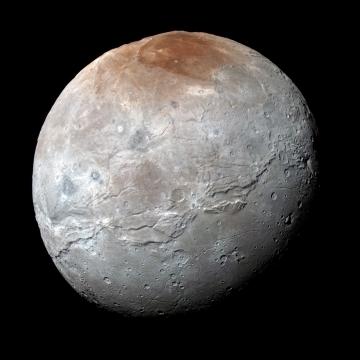
The New Horizons science team has released new high resolution images of Pluto’s moon Charon, including the global enhanced color view on the right.

High-resolution images of the Pluto-facing hemisphere of Charon, taken by New Horizons as the spacecraft sped through the Pluto system on July 14, and transmitted to Earth on Sept. 21, reveal details of a belt of fractures and canyons just north of the moonโ€™s equator. This great canyon system stretches across the entire face of Charon, more than a thousand miles, and probably around onto Charonโ€™s far side. Four times as long as the Grand Canyon, and twice as deep in places, these faults and canyons indicate a titanic geological upheaval in Charonโ€™s past. โ€œIt looks like the entire crust of Charon has been split open,โ€ said John Spencer, deputy lead for GGI at the Southwest Research Institute in Boulder, Colorado. โ€œIn respect to its size relative to Charon, this feature is much like the vast Valles Marineris canyon system on Mars.โ€

The team has also discovered that the plains south of the canyon, informally referred to as Vulcan Planum, have fewer large craters than the regions to the north, indicating that they are noticeably younger. The smoothness of the plains, as well as their grooves and faint ridges, are clear signs of wide-scale resurfacing.

In many ways these images remind me of an upside-down Mars, with the smooth lower plains in the south instead of the north. Obviously, the causes on Charon are going to be significantly different than those on Mars.

0 comments

A new map of Ceres

The Dawn science team has released several new false color maps of Ceres, showing the dwarf planet’s topographic and compositional differences.

They have also assigned names to many of the features that Dawn has discovered, including Ysolo Mons for that large peak near the north pole.

0 comments

Vostochny launch building built to the wrong size

Government marches on! The Russians have just discovered that their Soyuz 2 rocket does not fit in the building just finished at their new spaceport at Vostochny.

The cutting-edge facility was meant be ready for launches of Soyuz-2 rockets in December, but an unidentified space agency of a of a told the TASS news agency of a of a late Thursday that the rocket would not fit inside the assembly building where its parts are stacked and tested before launch. The building “has been designed for a different modification of the Soyuz rocket,” the source said, according to news website Medusa, which picked up the story from TASS.

The rocket had just been delivered to Vostochny for assembly, so this report, though unconfirmed at this time, fits well with current events.

1 comment

NASA pulls funding from private asteroid hunter

Because of a failure to meet its developmental deadlines, NASA has cut its ties with the privately funded Sentinel satellite, designed to spot 90% of all near Earth asteroids that might pose a threat to the Earth.

The problem for the B612 Foundation, the private company committed to building Sentinel, is that they haven’t clearly laid out a way any investors could make money from the satellite. Thus, they have so far raised only $1.6 million from private sources. They need almost half a billion to build it, according to their own budget numbers.

1 comment

Congress places additional limits on Russian rocket engine use

Bad news for ULA and the Atlas 5: A defense bill approved by the Congressional negotiators has placed further limits on the number of Russian rocket engines ULA can use in future Atlas 5 government launches.

The bill, which still faces an Obama veto, only allows ULA to use 9 more Russian engines. The company however says it needs to have at least 18 available to keep its ability to launch government payloads while it develops its new Vulcan rocket.

Read the whole article. The political complexity of this whole situation does not bode well for ULA or its Vulcan rocket. Too many players with too many conflicting goals appear to make it difficult for the company to push the development forward efficiently.

1 comment

Smallsat company buys its own Falcon 9 rocket to launch 20 satelites

The competition heats up: Spaceflight Industries has purchased a single dedicated Falcon 9 rocket launch to launch 20 small satellites sometime in 2017.

Buying a dedicated launch, rather that seeking excess capacity on other launches, provides Spaceflight with more than just additional payload capacity. Secondary or โ€œrideshareโ€ payloads are subject to the schedule of the primary capability, and can be bumped off the launch if the mass of the primary payload grows. With a dedicated mission, Spaceflight is in greater control. โ€œIt helps us establish a regular cadence of launches,โ€ Blake said. โ€œWe can book all kinds of rideshare passengers onto something that is going to be there at a certain time to a certain orbit.โ€

This purchase also indicates the growing strength of the smallsat industry. These companies are beginning to gain the investment capital to buy their own launches rather than fly as secondary payloads.

0 comments

Development of Blue Origin’s BE-4 rocket engine moves forward

The competition heats up: Blue Origin has completed more than 100 development tests of its new BE-4 rocket engine, being developed for ULA.

Much of this announcement sounds like public relations blather. However, it contained this nugget of information that is crucial to understanding why this engine is likely to get built quickly:

The BE-4 engine is also the leading candidate to be used in the first stage of ULAโ€™s Vulcan vehicle. Speaking to reporters after the Sept. 15 Florida event, Blue Origin founder Jeff Bezos said that while he was aware of competing engines for the Vulcan, like the AR-1 under development by Aerojet Rocketdyne, he was focused on completing the BE-4. โ€œWeโ€™re going to build the best 21st century engine that we can for ULA,โ€ he said. โ€œUltimately they will make the decision about what they want to do.โ€

Bezos also noted that, unlike the AR-1 or other concepts, Blue Origin was not seeking funding from the U.S. Air Force to help pay for development of the BE-4. โ€œThe most unique feature of the BE-4 engine is that itโ€™s fully funded,โ€ he said. โ€œItโ€™s not something you see in rocket engine programs very often.โ€ [emphasis mine]

Aerojet Rocketdyne wants the government to pay for its new AR-1 engine. To get that done, they need to lobby Congress for funds that are simply unreliable in these days of budget-cutting. Moreover, it means that Aerojet Rocketdyne is not fully committed to the engine: if the funds don’t arrive they won’t build it.

Blue Origin is going forward, fully committed, and will likely deliver, if only because they can’t get their investment back until they do.

0 comments

Creeping towards commercial and private weather satellites

Link here. The editorial at Space News outlines the effort in Congress to force NOAA to buy weather data supplied by private commercial satellite companies rather than build its own satellites. It also outlines what might be the major reason private companies have never been able to make a profit in the field:

The agency [NOAA] is obliged as a member the World Meteorological Organization [WMO] to share weather data openly and freely with other nations. If that obligation applies to commercially procured data, as NOAA insists, it could dramatically shrink the addressable global market for commercial weather data โ€” to the point that it could shatter business models. – See more at: http://spacenews.com/editorial-inching-toward-a-commercial-weather-policy/#sthash.vG9fs3Sj.dpuf

In other words, private companies can’t sell their data because of the U.S.’s membership in the WMO, which requires that data to be made available for free. To make the commercialization of weather work, the U.S. is going to have to pull out of WMO, something I think will be difficult to sell to Congress.

0 comments

Virgin Galactic tests new rocket engine

The competition heats up? Virgin Galactic has released video of a test burn of a new engine designed to work with its LauncherOne rocket.

I put a question mark above because I have become very skeptical of any press announcements out of Virgin Galactic. They might have made progress on this new engine, and it also appears that they are doing engine work first for developing LauncherOne, a wise plan. However, their track record with SpaceShipTwo makes me doubtful about their ability to follow through. They need to produce to make me a believer once again.

0 comments

Back from the Grand Canyon

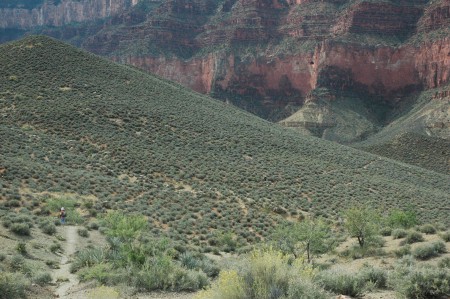
Diane and Gang on the Tonto Plateau

Diane and I just got home and are in the process of catching up. Posting shall resume this weekend, maybe tonight! Meanwhile, I was pleasantly surprised that even with my absence, my thoughtful readers (even ones I sometimes disagree with) have been keeping things lively here with some intelligent debate. Kudos to you all!

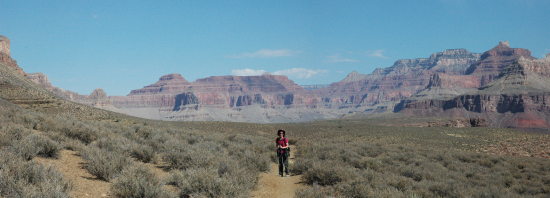
And as always, the Canyon was what it always is, magnificent and awe-inspiring. The picture on the right shows us hiking on the Tonto Plateau, about 4000 feet down from the rim but above the Colorado River 1000 feet below. If you look real close you can see the tiny figures of Diane and others on the trail.

4 comments

Back to the Grand Canyon

Hiking in the Grand Canyon

Diane and I are about to leave for our annual hike to the bottom of the Grand Canyon. Though I might be able to post during the drive north today and from the hotel on the rim tonight, from Tuesday until Thursday I will be out of touch with the world of computers, a welcome break that I do need periodically.

Unlike previous trips, this time we are going with a bunch of friends. Last year I obtained a reservation for a 10-person cabin at Phantom Ranch in the Canyon so that we could all be together. Should be a lot of fun!

4 comments

SpaceX test fires its Falcon 9 upgraded first stage

The competition heats up: SpaceX has successfully test-fired its Falcon 9 upgraded first stage.

The link shows the video of the test. Though not confirmed, I am pretty sure this upgrade will be used on the next Falcon 9 launch in November, which will put an communications satellite into geosynchronous orbit while also attempting to vertically land that first stage on a barge.

1 comment

Comet 67P/C-G was formed by a soft collision

Scientists, using data from Rosetta, have concluded that Comet 67P/C-G’s double lobed shape was caused by the slow-motion collision of two distinct comets.

By using high-resolution images taken between 6 August 2014 and 17 March 2015 to study the layers of material seen all over the nucleus, they have shown that the shape arose from a low-speed collision between two fully fledged, separately formed comets. โ€œIt is clear from the images that both lobes have an outer envelope of material organised in distinct layers, and we think these extend for several hundred metres below the surface,โ€ says Matteo Massironi, lead author from the University of Padova, Italy, and an associate scientist of the OSIRIS team. โ€œYou can imagine the layering a bit like an onion, except in this case we are considering two separate onions of differing size that have grown independently before fusing together.โ€

While erosion continues to eat away at the comet’s surface, changing its shape, the two lobes formed separately, though in much the same way.

4 comments
1 18 19 20 21 22 89