Astronomers confirm Kepler discovery of near twin of Earth

Worlds without end! In the release today of another set of Kepler data, astronomers have announced the discovery in that dataset of a new twin of Earth.

The newly discovered Kepler-452b is the smallest planet to date discovered orbiting in the habitable zone — the area around a star where liquid water could pool on the surface of an orbiting planet — of a G2-type star, like our sun. The confirmation of Kepler-452b brings the total number of confirmed planets to 1,030. …

Kepler-452b is 60 percent larger in diameter than Earth and is considered a super-Earth-size planet. While its mass and composition are not yet determined, previous research suggests that planets the size of Kepler-452b have a good chance of being rocky. While Kepler-452b is larger than Earth, its 385-day orbit is only 5 percent longer. The planet is 5 percent farther from its parent star Kepler-452 than Earth is from the Sun. Kepler-452 is 6 billion years old, 1.5 billion years older than our sun, has the same temperature, and is 20 percent brighter and has a diameter 10 percent larger.

While this exoplanet is certainly not identical to Earth, it is close enough that the possibility of alien life — really alien life — could very likely exist upon it.

The dataset also included 11 other Earth twin candidate exoplanets that still need to be confirmed.

0 comments

More problems at Virgin Galactic?

The story outlines what appear to significant problems at Virgin Galactic:

  • Some sources say the company has shelved LauncherOne in favor of a bigger launcher that would be deployed from the bottom of a 747, not WhiteKnightTwo.
  • The company however says LauncherOne is still under development.
  • The company admits that they recently had a LauncherOne test rocket engine explode during testing.

It appears that they have discovered that LauncherOne is not cost effective for meeting their contract with OneWeb to launch 39 satellites. It would only be able put up one satellite at a time. A more powerful launcher however would be too heavy for WhiteKnightTwo.

Thus, after 10 years of development, nothing they have built to date is useful for a profitable operation, and they apparently have to start over.

2 comments

Russians confirm their commitment to ISS through 2024

Even as a new crew arrived at ISS, the head of Roscosmos confirmed that the Russians are now committed to sticking with ISS through 2024, as requested by the U.S.

I’ll make a prediction: The station’s life will be extended beyond 2024, but not necessarily under the control of its present international partnership. If the governments involved consider backing out at that time, there will be private companies then capable of taking it over, and will demand that the U.S. transfer ownership to them. This will in turn act to pressure the governments to continue the station’s operation.

Either way, ISS will continue.

Meanwhile, quality control issues continue to pop up with the Russians. One of the solar panels on the Soyuz capsule that delivered crew to ISS yesterday had failed to open when commanded, then decided to pop open unannounced during the docking. They had enough power to get to the station with only one panel, and the panel opening at the wrong time fortunately did not cause any problems, but for the panel to open as it did is without doubt worrisome.

0 comments

Hackers demonstrate they can remotely take over moving vehicle

Does this make you feel safer? In a demonstration of the vulnerability of modern cars that are linked to the internet, two hackers took over the operation of an unmodified moving Jeep Cherokee.

A pair of Missouri-based hackers have put on an extraordinary demonstration by logging into a Jeep Cherokee remotely, while it was being driven by a Wired reporter Andy Greenberg, and systematically taking over the car’s functionality. First, they hit him with cold air through the air-con system, then they blasted Kanye West through the stereo at full volume, rendering the volume knob completely useless. They flashed up a picture of themselves on the car’s console and set the windscreen wipers going full blast, squirting cleaning fluid onto the windscreen and making it difficult to see.

But these were just warmups to the main event – next, they took over the engine and shut it off completely, leaving the driver powerless and coasting on the freeway as traffic flashed past around him. Then, once he was off the highway, they showed how they could completely disable the brakes, and take over the steering of the car – only at slow speeds and in reverse, but they’re working on unlocking new abilities every day.

This suggests to me that linking any car directly to the internet is probably a very bad idea.

5 comments

Robotic servicing demo resumes on ISS

After a two year hiatus, engineers have resumed experiments on ISS to demonstrate robotic servicing of satellites in space.

Known by its creative team as the “little ISS experiment that could,” RRM broke uncharted ground in 2011-2013 with a set of activities that debuted robotic tools and procedures to refuel the propellant tanks of existing satellites. Its second phase of operations, which took place in April and May and will resume again later in 2015, offers something entirely different and just as disruptive, says Reed. “We’ve outfitted the RRM module with new hardware so we can shift our focus to satellite inspection, instrument life extension, and even techniques for instrument swap-out,” says Reed. Such servicing technologies could open new possibilities for owners of spacecraft in low and geosynchronous Earth orbit, he says.

Many of the designs of this demo project are based on actual research satellites that need refueling or repair. Thus, if the robot can do the work on ISS, it is likely it can also do the work at the satellite itself.

2 comments

Haze spotted over Ceres’ double bright spot

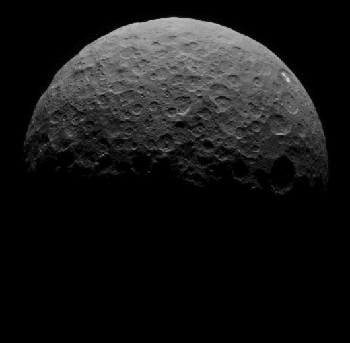
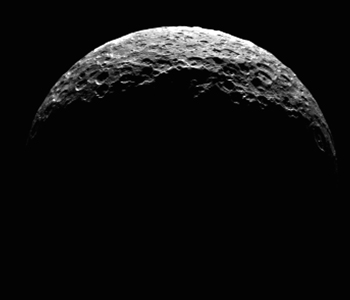
Dawn, in orbit around Ceres, has detected a haze above the dwarf planet’s double bright spot, suggesting that the tiny asteroid/planet is still geologically active.

Haze on Ceres would be the first ever observed directly in the asteroid belt. In 2014, researchers using the European Space Agency’s Herschel Space Observatory reported seeing water vapour spraying off Ceres, which suggested that it was geologically active1. At least one-quarter of Ceres’s mass is water, a much greater proportion than seen in most asteroids.

Bright spots pepper Ceres’s surface, but the haze has so far been seen in only one location — a crater named Occator, which has a large bright area at its centre and several smaller spots nearby. Mission scientists have been trying to work out whether the bright spots are made of ice, evaporated salts or other minerals, or something else entirely.

Some team members had been leaning towards the salt explanation, but the discovery of haze suggests the presence of sublimating ice. “At noontime, if you look at a glancing angle, you can see what seems to be haze,” Russell says. “It comes back in a regular pattern.” The haze covers about half of the crater and stops at the rim.

0 comments

Mountains and craters on Pluto?

The edge of Tombaugh Regio

Cool image time! Even as they download new images for a press conference on Friday, the New Horizons’ science team has released a new close-up of Tombaugh Regio, showing both a new mountain range within it as well as its sharply defined western contact with the dark whale feature, which now appears to be heavily cratered and old.

“There is a pronounced difference in texture between the younger, frozen plains to the east and the dark, heavily-cratered terrain to the west,” said Jeff Moore, leader of the New Horizons Geology, Geophysics and Imaging Team (GGI) at NASA’s Ames Research Center in Moffett Field, California. “There’s a complex interaction going on between the bright and the dark materials that we’re still trying to understand.” While Sputnik Planum is believed to be relatively young in geological terms – perhaps less than 100 million years old — the darker region probably dates back billions of years. Moore notes that the bright, sediment-like material appears to be filling in old craters (for example, the bright circular feature to the lower left of center).

Make sure you click through to see the full resolution image. It is quite astonishing. They have also released a new image each of two of Pluto’s moons.

1 comment

John Kerry doesn’t understand the words “Death to America!”

Peace in our time! In one of his first speeches following the announcement of a deal with Iran,  Iranian Supreme Leader Ali Khamenei said, to chants of “Death to American” and “Death to Israel”, that the policies of Iran and the U.S. were “180 degrees” opposed.

When asked his thoughts on this speech and its hostility, Secretary of State John Kerry (former Demcratic Presidential candidate) was baffled.

“I don’t know how to interpret it at this point in time, except to take it at face value, that that’s his policy,” he said in the interview with Saudi-owned Al Arabiya television, parts of which the network quoted on Tuesday. “But I do know that often comments are made publicly and things can evolve that are different. If it is the policy, it’s very disturbing, it’s very troubling,” he added.

Reminds me of the reaction of many appeasers to both Hitler and Stalin. No matter how plainly these tyrants expressed the desire to conquer the world and destroy their enemies, these appeasers, most of whom were on the left, would continually come up with excuses for their plain words. I however take Khamenei at his word. When he gets the bomb, he plans on using it.

15 comments
1 57 58 59 60 61 148