July 7, 2016 Zimmerman/Batchelor podcast
Embedded below the fold. John Batchelor was especially thrilled by the Curiosity image of the balanced rock.
» Read more
Embedded below the fold. John Batchelor was especially thrilled by the Curiosity image of the balanced rock.
» Read more
The competition heats up: A new report estimates the market for small satellites will exceed $22 billion in the next decade.
According to Euroconsult’s latest report, Prospects for the Small Satellite Market, we are on the cusp of a major revolution for the space sector and overall space ecosystem, as more than 3,600 smallsats are expected to be launched over the next ten years, a significant increase from the previous decade. The total market value of these satellites is anticipated to be $22 billion (manufacture and launch), a 76% increase over that of 2006-2015. This rate of growth is unprecedented for the space sector and will bring about fundamental changes as both new and established industry players attempt to increase their capabilities in order to gain market share.
What I expect is a splitting of the space industry, with unmanned smallsats launched by smaller rockets on one hand and big spaceships and payloads launched by big rockets on the other hand. In both cases, the competition will likely force prices down, so that more customers will find space affordable.
The coming dark age: The children’s book series, Curious George, has just released a new book, in which the playful monkey celebrates Islam and its friendly holiday of Ramadan.
US author Hena Khan “wanted to focus on the celebratory aspects” of Ramadan, so George attends family gatherings and accompanies his friend Kareem to a mosque to put together charity baskets, she told AFP. …
Khan said the publisher granted her freedom to shape the project, and that she focused on making the holiday approachable. “It was really a reflection of the way Americans that I know celebrate and observe Ramadan, in a very simple way that’s understandable for children,” the mother of two said.
The book’s release coincides with a particular rise in anti-Islamic rhetoric, she noted. “There’s a very dangerous narrative being spread about Muslims and inaccurate things being said,” the author said. The book “comes at the right time in terms of trying to promote understanding and tolerance.”

Source: TheReligionofPeace.com
Gee, I wonder why there is a “rise in anti-Islamic rhetoric.” Could it be because of the more than two hundred attacks and more than 1,800 people killed during the just completed Ramadan holiday? Note also the hordes of murders (none) committed during this same time period by all other religions. What a shame we have this negative opinion of Islam.
I should add that my negative opinion of Islam was only reinforced by this bullying effort by an Islamic apologist to use a children’s book to make believe her religion has no track record of violence and hate. That she can’t deal with this issue, and wants to wish it away, makes me even more fearful and distrustful of anything any Islamic supporter says.
An evening pause: The robots shown in this video are almost frighteningly good at what they do, which might be one of the many reasons Google is apparently trying to sell the company.
Hat tip Tim Vogel.
The Obama State Department announced today that they are reopening their investigation into Hillary Clinton’s private email server and the mishandling of classified material by her and her aides.
Don’t be fooled by this. The only reason the State Department is announcing that they are reopening this investigation is to deflect criticism of the Obama administration before the election. Nothing will ever come of it, as long as the Democrats control the executive branch.
And there is no guarantee anything will come of it should Trump win, though the odds for a real investigation do increase.
The coming dark age: More than fifty American universities do not require history majors to take a course in United States history.
This bears repeating: The universities allow history majors to get a degree in history without having to study American history. The article also includes lots of interviews from lots of academic types, all making excuses for this dismal policy.
No wonder no one seems to know what the Bill of Rights is. Our universities, run almost exclusively by leftwing hacks, have sent it down the memory hole to be forgotten and ignored.
Astronomers, using instruments on the Very Large Telescope in Chile, have discovered an exoplanet that orbits around three suns.
Located about 340 light years from Earth in the constellation Centaurus, HD 131399Ab is believed to be about 16 million years old, making it one of the youngest exoplanets discovered to date, and one of very few directly imaged planets. With a temperature of 850 Kelvin (about 1,070 degrees Fahrenheit or 580 degrees Celsius) and weighing in at an estimated four Jupiter masses, it is also one of the coldest and least massive directly imaged exoplanets.
“HD 131399Ab is one of the few exoplanets that have been directly imaged, and it’s the first one in such an interesting dynamical configuration,” said Daniel Apai, an assistant professor of Astronomy and Planetary Sciences who leads a research group dedicated to finding and observing exoplanets at the UA.
“For about half of the planet’s orbit, which lasts 550 Earth-years, three stars are visible in the sky, the fainter two always much closer together, and changing in apparent separation from the brightest star throughout the year,” said Kevin Wagner, a first-year PhD student in Apai’s research group and the paper’s first author, who discovered HD 131399Ab. “For much of the planet’s year the stars appear close together, giving it a familiar night-side and day-side with a unique triple-sunset and sunrise each day. As the planet orbits and the stars grow further apart each day, they reach a point where the setting of one coincides with the rising of the other – at which point the planet is in near-constant daytime for about one-quarter of its orbit, or roughly 140 Earth-years.”
The orbit of the planet remains somewhat uncertain, and thus it might not be stable.
The law is such an inconvenient thing: According to a new report, the Obama administration has been illegally funding Obamacare, and stonewalling Congress when it tries to exercise its constitutional required fiscal responsibility.
Among the report’s seemingly endless list of bad behavior by the Obama administration, it noted that multiple federal agencies withheld or redacted documents from Congress, “without any valid legal basis to do so.”
Hey, who cares about the law? That’s just some silly piece of paper that some old white guys wrote some 240 years ago. We are liberal, we are Democrats, and we know best. Now shut up and do as you are told!
Government in action! A new report has found that the billions in increased funding given to the Veterans Administration to fix its problems apparently only made things worse.
The report, obtained by CNN but slated for public release Wednesday, highlights a variety of “deficiencies” that contribute to health care issues within the agency, including flawed governance, insufficient staffing, inadequate facilities, antiquated IT systems and inefficient use of employees. The commission also criticized changes that have been implemented since the scandal became known, including the VA’s Choice Program. The system was set up in 2014 to alleviate wait times by enabling veterans experiencing month-long delays or more to seek private care. The report states the program has only “aggravated wait times and frustrated veterans” due to confusing eligibility requirements and conflicting processes for coordinating with private health care providers.
As a solution, the commission recommends establishing a “VHA Care System,” which would function as a network of VA, Department of Defense and VA-approved private healthcare providers available to all enrolled veterans.
First, notice that the solution of this government report is a new layer of bureaucracy. That should fix things, eh? Second, note that the VA is really nothing more than what the left likes to call a “single-payer” system, whereby healthcare is entirely run by the federal government, which is the system the left still sees as the only solution to the failures of Obamacare. That should fix things too, eh?
Finally, the report demonstrates again that giving more money to a failed federal program will not fix it. The real solution is to kill the program entirely and start fresh.
At least someone in Washington wants to defend the Bill of Rights: The House Freedom Caucus has announced that it would oppose the effort by the Republican leadership to pass a gun control law that would allow the federal government to deny citizens their second amendment rights.
The effort will probably kill the Republican proposal, which would have allowed the federal government to block a gun sale to someone on the no-fly list for three days, during which the Attorney General would to go to court to prove that the individual is a suspected terrorist.
Gee, what’s wrong with that? Doesn’t the Attorney General as well as the courts always enforce the law fairly and objectively? Who could imagine them teaming up to squelch a citizen’s rights, merely because that citizen might have opinions these federal officials don’t like?
The law is only there to crush the little people: The FAA has issued a subpoena against a father and son who posted youtube videos showing off their modifications to a drone, equipping it first with a gun and then with a flame thrower.
They are fighting the subpoena, noting that the FAA lacks any authority to regulate the use of recreational drones.
The Haughwouts’ attorney, Mario Cerame, told CBS News that the decision could potentially set an important precedent about the FAA’s power to regulate recreational drone use. Cerame added, the FAA should not be using airplane regulations to seek information about “a kid playing in his backyard…. They shouldn’t use airplane regulations,” Cerame told CBS News. “They should go get the authority from Congress. It’s about keeping the government in check as to what Congress said they can do.”
Hey, we know they never intended to do anything wrong! And besides, no reasonable prosecutor would ever consider bringing charges, right?

Cool image time! Prior to going into safe mode Curiosity’s mast camera took a series of images of its surroundings, as is routine as the rover travels. Among those images was the image above, though I have cropped it and reduced its resolution to show here. It reveals a balanced rock on the horizon. It also shows, as do the other survey images, how increasingly rough the terrain is becoming that Curiosity is traveling through.
The Curiosity science team has no intention of getting too close to this rough terrain, but they do hope to get better views of this rock as they continue the rover’s journey uphill.
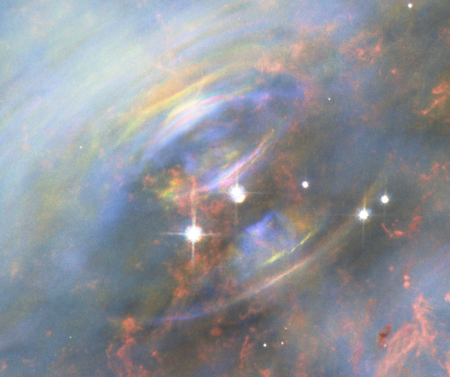
Cool image time! Scientists have released a new Hubble Space Telescope image taken of the innermost regions of the Crab Nebula, the remains of a supernova explosion that took place a thousand years ago in 1054.
On the right is a reduced resolution version of this new image. I have also cropped it to focus on the nebula’s center, where the pulsar is located. The circular concentric rings are exactly what they appear to be, ripples of energy spreading out from the pulsar. Back in 2002 Hubble took a series of images of the Crab Nebula over several days, which scientists then assembled into a movie showing these waves as they emanated out from the nebula’s center.
My only complaint with this beautiful new image is that they did not take a longer series of new exposures to create a longer movie, to better show the actual daily changes that the nebula undergoes. It seemed obvious to do then, and obvious to do now. Yet, it hasn’t happened.
The image download page for today’s release is here.
The competition heats up: An upgraded manned capsule, dubbed Soyuz-MS, successfully reached orbit today, carrying a new three person crew to ISS.
As part of the vehicle’s checkout during its first manned flight they have decided to fly it on the older two-day rendezvous approach rather than the fast six hour route.
Embedded below the fold. Not only did we talk about Juno and other recent science news, we also discussed the absurd banning of Doug Messier from the NasaSpaceFlight.com website.
» Read more
Madness: A hotel clerk who called 911 because a Muslim man was behaving strangely about getting a room during the Republican convention in Cleveland has been fired and might be prosecuted by the local authorities.
Read the whole article. The Muslim man was asking odd questions, refused to accept the fact that all the rooms were booked, and had multiple cellphones. The article also includes the transcript of the clerk’s 911 call, which clearly shows she was not trying to profile unfairly but thought it wise to let the police know about what was happening.
In a sane world, the hotel and the police would simply drop things. Instead, the hotel fired the clerk, and the police are considering prosecuting her. And people wonder why Islamic mass murderers can literally announce on social media what they intend to do and no one reports it.
An evening pause: From a 1974 live performance.
Hat tip Wayne DeVette.
For the first time in three years, Curiosity has entered safe mode.
On July 2, Mars rover Curiosity ceased science operations on the slopes of Mount Sharp after a fail safe was tripped, forcing the nuclear-powered robot into a low-power “safe mode.” According to a NASA Jet Propulsion Laboratory report, preliminary information communicated by Curiosity suggests an “unexpected mismatch between camera software and data-processing software in the main computer” may have been the culprit and the rover’s automated systems took over, preventing any permanent damage from being caused.
They are in communications with the rover, and expect a full recovery.

Cool image time! The image on the right, cropped and reduced in resolution to fit here, shows an area of inexplicable dark dunes located in Mars’ high northern latitudes. Located in a circular depression (whose outline can be seen across the top and left side of the image), geologists only partly understand the processes producing these dunes. As the noted on the release webpage:
However, a circular depression (probably an old and infilled impact crater) has limited the amount of sand available for dune formation and influenced local winds. As a result, the dunes here form distinct dots and dashes. The “dashes” are linear dunes formed by bi-directional winds, which are not traveling parallel to the dune. Instead, the combined effect of winds from two directions at right angles to the dunes, funnels material into a linear shape. The smaller “dots” (called “barchanoid dunes”) occur where there is some interruption to the process forming those linear dunes. This process is not well understood at present and is one motivation for HiRISE to image this area.
Be sure to look at the full image, as it covers a wider area and shows dunes that travel in all directions, forming mazelike patterns that no theory presently explains.
Got some spare cash? On July 13, the auction house Christies in London will be selling a first edition of the first book ever published describing Copernicus’ theory that the Earth orbited the Sun.
De Libris Revolutionum Eruditissimi Viridoctoris came not from Nicolaus Copernicus, but from his only student, Georg Joachim Rheticus, and when published in 1540, provided the momentum needed for Copernicus to finally have his landmark De revolutionibus orbium coelestium published in 1543.
Rheticus (1514-1574) published this first book on the subject based on his studies under Copernicus, all the while imploring his master to finally publish the master work which had been finished for 25 years. Copernicus resisted publishing De revolutionibus orbium coelestium for 30 years due to his fear of the Catholic Church, but when Rheticus published this book in 1540, Copernicus finally gave Rheticus the go ahead to publish the major work for him.