
Elvis Presley – Love Me Tender
An evening pause: Performed on televsion, 1956.
Hat tip Edward Thelen, who added, “per LocalFluff’s request.”
An evening pause: Performed on televsion, 1956.
Hat tip Edward Thelen, who added, “per LocalFluff’s request.”
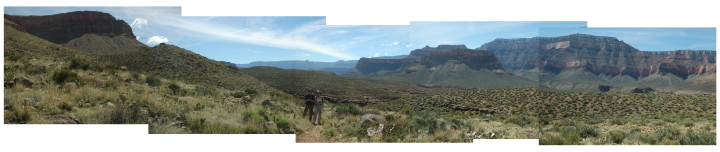
Because I live in southern Arizona, I take advantage of this location to make an annual trip to the Grand Canyon. On my previous trips I’ve talked about the right way to hike the canyon (slowly!) and then provided some suggestions for proper preparation.
This time I am simply going to suggest two hikes. One is very easy and should be done by every visitor to the south rim. The other hike is for those who go to the bottom, and reserve themselves one day there for a day hike.
» Read more
Fascists: An angry mob of around 250 at Claremont McKenna College blocked access to a speech while threatening violence to the speaker and forcing her to end the speech early.
A throng of angry protesters converged at Claremont McKenna College on Thursday and effectively shut down a pro-police speech as they surrounded the building, forcing the speaker to give the talk via livestream to a near-empty room as they yelled “F*ck the police” and “Black Lives Matter” and banged on windows.
Heather Mac Donald, a Manhattan Institute scholar and author of the 2016 book “The War on Cops,” even gave her talk earlier than originally planned at the preppy and private Southern California campus because of the rowdy crowd estimated at more than 250 protesters, she told The College Fix via email Thursday. Thirty minutes into the speech, police officers told her to cut it short, and she was given a four-officer escort through a side door and safely through some surprised protesters who had flanked that exit, Mac Donald said.
These leftist protesters at all these universities nothing but brown-shirted jack-booted thugs, using violence to silence any dissent to their way of thinking. Worse, it increasingly appears they are going to succeed, as it appears most college administrations and their faculty agree with their violent tactics, while the general public seems uninterested in stopping the oppression being imposed here.
Capitalism in space: In order to compete with SpaceX ULA announced this week that it will cut its launch price for the Atlas 5 rocket by one third.
United Launch Alliance has dropped the price of its workhorse Atlas 5 rocket flights by about one-third in response to mounting competition from rival SpaceX and others, the company’s chief executive said on Tuesday. “We’re seeing that price is even more important than it had been in the past,” Tory Bruno, chief executive of United Launch Alliance, or ULA, said during an interview at the U.S. Space Symposium in Colorado Springs. “We’re dropping the cost of Atlas almost every day. Atlas is now down more than a third in its cost,” Bruno said.
It appears that they have discovered that the prime reason they lost their bid of an Air Force GPS satellite launch to SpaceX was because their price was too high.
Capitalism in space: The head of the Air Force’s space division said yesterday that they would be willing to launch satellites using Falcon 9 used first stages.
“I would be comfortable if we were to fly on a reused booster,” General John “Jay” Raymond told reporters at the U.S. Space Symposium in Colorado Springs. “They’ve proven they can do it. … It’s going to get us to lower cost.”
After being promoted on an Australian tv show an effort to use public help to plow through Kepler’s vast archives discovered four new exoplanets within two days.
In three days, the Australia iteration of astronomy TV show Stargazing Live brought us #SpaceGandalf and now its viewers have discovered four planets. After it was promoted on the show, citizen scientists and fans of the program came together to contribute to a crowd-sourcing project, stalking around 100,000 stars on the Zooniverse website, which displays recent data from the Kepler Space Telescope.
And you betcha, in just 48 hours, around 10,000 volunteers discovered scores of potential new planet candidates, with scientists confirming the discovery of four “super-Earth” planets orbiting a star in the constellation of Aquarius.
Worlds without end: Astronomers have detected an atmosphere around an Earth-sized exoplanet 39 light years away.
The researchers pored over measurements from the European Southern Observatory in Chile and found that at one wavelength band of light, the planet looked larger than at others, as it crossed the face of its parent star. “These things don’t pop up in the way you expect,” said John Southworth, an astronomer at Keele University in the UK. “We found evidence for the atmosphere at one wavelength band and that wasn’t what we were expecting.”
The observations point to an atmosphere that is rich in water or methane, but it will take more measurements with other telescopes to identify the chemicals present.
The planet is about 16% larger than Earth. There remain a lot of uncertainty here with this result, so we should not yet take it too seriously.
Embedded below the fold. This was the podcast last week where I reported on SpaceX’s success at reusing a first stage. I am posting this a bit late, as I was in the Grand Canyon when John Batchelor posted it online.
» Read more
An evening pause: I like this verse, which they reprised, with the chorus, which all people should echo.
When Britain first, at Heaven’s command
Arose from out the azure main;
This was the charter of the land,
And guardian angels sang this strain:
“Rule, Britannia! rule the waves:
“Britons never will be slaves.”
Hat tip Jim Mallamace.
Using Kepler astronomers think they have discovered a twin of Venus orbiting a M dwarf star 219 light years away.
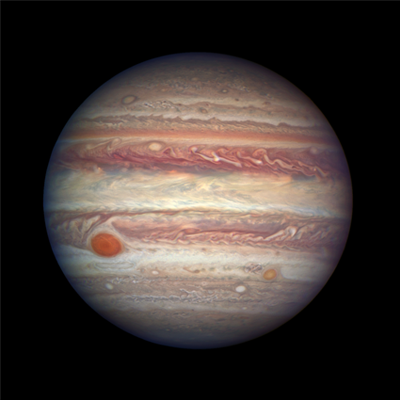
Cool image time! The Hubble Space Telescope has taken a magnificent global view of Jupiter. The image on the right is only a thumbnail. Make sure to go to the link to see the full image, which amazingly compares quite favorably with the images being sent down by Juno in orbit around the gas giant.
This Hubble image once again demonstrates the remarkable advantages of an optical telescope in space. Equipped with the right instruments, it could do much of the research now being done by the planetary missions, and do it from Earth orbit.The research possibilities and the knowledge revealed from the ability to see things clearly in the optical bands is truly endless.
Even more important, we are wired to what we see. Give us a good visual image and many questions can immediately be answered.
Capitalism in space: Two stories today highlight the contrasts that presently exist within the still unborn suborbital tourist industry:
In the first, Richard Branson made another one of his bold predictions, the same kind of prediction he has been making about Virgin Galactic now for almost a decade. Again and again he claims, based on nothing, that his spaceship will be carrying people into orbit in mere months. It never happens. It won’t happen here.
In the second, Jeff Bezos announces that he hopes to fly people on his New Shepard suborbital spacecraft by 2018, but at the same time he also announces that the program is delayed.
Bezos, speaking in front of the company’s exhibit at the 33rd Space Symposium here that features the New Shepard propulsion module that flew five suborbital spaceflights in 2015 and 2016, backed away from earlier statements that called for flying people on test flights later this year. “We’re going to go through the test program, and we’ll put humans on it when we’re happy,” he said. “I don’t think it’s going to be 2017 at this point. It could be.”
Bezos has been very careful, from the beginning, to make no bold or specific predictions about when his spacecraft will fly manned. Here, he is once again making it clear that any previously announced schedules were very tentative, and should not be taken too seriously.
Which person would you trust with your life on a suborbital flight?
The labor strike that has shut down Arianespace’s French Guiana spaceport has taken to turn for the worse with an attempt by about 30 strikers to occupy the spaceport.
The article provides almost no details. We also have had no recent updates on the state of the labor negotiations. At the moment it appears this strike could last a while.
Capitalism in space: ULA’s CEO Tory Bruno announced at a space conference this week that should Blue Origin’s BE-4 engine pass its testing phase his company will be prepared to select it for their Vulcan rocket.
Bruno also said that no decision has yet been made, and that Aerojet Rocketdyne’s AR1 engine remains an option, though it is 18 to 24 months behind in development.
The head of Roscosmos said at a space conference this week that his nation is open to extending its ISS partnership with the U.S. beyond 2024 to 2028.
Russia has several good and bad reasons for wanted to do this.
I will let my readers decide which of these reasons are the good reasons, and which are bad.
Capitalism in space: Orbital ATK is developing a new rocket, based on the solid rocket technology it provided for the space shuttle, to compete with SpaceX and ULA.
Two versions of the rocket are planned. The medium-lift variant will have a two-segment, solid-fuel first-stage motor and a single-segment, solid second. The heavy lifter will have a four-segment first stage and a single-segment second. Both versions can be outfitted with strap-on boosters for extra lift capacity, Orbital representatives said.
To complete the rocket’s development the company says it needs to win a follow-up contract that the Air Force has been issuing to help ween the U.S. from the use of Russian rocket engines.
Capitalism in space: In an effort to save costs ULA is reducing its workforce at Vandenberg by 48.
The company has been aggressively trying to streamline its operations to better compete against SpaceX. This reduction was expected, and based upon what I saw when I toured Vandenberg a few years ago, entirely justified. While SpaceX’s operations then looked lean and simple, ULA’s set up appeared a bit inefficient.
Capitalism in space: A new commercial satellite company, Global-IP Kayman, has purchased a Falcon 9 rocket to launch its first Boeing-built satellite late in 2018.
No word on whether the launch will use a reused first stage.
Since flying past Pluto in July 2014 New Horizons has now flown halfway to its next target, Kuiper Belt Object 2014 MU69.
The fly-by will take place on January 1, 2019.
Posted from the South Rim after hiking out today from the bottom of the Grand Canyon. Since Saturday I did about 40 miles of hiking, both near and inside the Canyon. I hope to post some details in the coming days.
ULA has finally scheduled the much delayed Atlas 5 launch of Orbital ATK’s Cygnus ISS freighter for April 18.
Posted from Maswik Lodge on the south rim of the Grand Canyon.