The Great Red Spot

The Great Red Spot

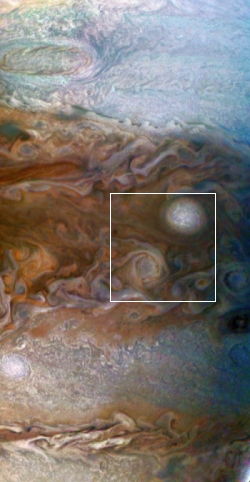
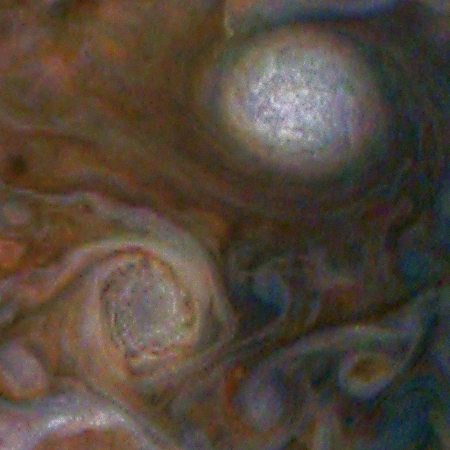
Cool image time! The image on the right, reduced in resolution to post here, shows one of the close-ups taken by Juno during its recent close fly-by of the Great Red Spot. What makes it different is its colors.

This image of Jupiter’s iconic Great Red Spot was created by citizen scientist Björn Jónsson using data from the JunoCam imager on NASA’s Juno spacecraft.

This true-color image offers a natural color rendition of what the Great Red Spot and surrounding areas would look like to human eyes from Juno’s position. The tumultuous atmospheric zones in and around the Great Red Spot are clearly visible.

Normally scientists enhance the colors to bring out the details. This version does not, which definitely makes it a little less dramatic but more accurate. Even so, the whirls and storms within the Spot are clearly visible.

The image was taken on July 10 from about 8,600 miles away. Note also that the entire Earth would fit inside the storm.

1 comment

Have astronomers using Kepler discovered the first exomoon?

The uncertainty of science: Using data from Kepler astronomers think they have spotted the first exomoon, orbiting a star 4,000 light years away.

They think it might be the size of Neptune, and orbits a planet about ten times more massive than Jupiter.

All this is unconfirmed, however, especially because their conclusions are based on data from only three transits. They plan to use the Hubble Space Telescope to do more observations and hopefully confirm the discovery.

4 comments

SpaceX now one of the world’s most valuable companies

Data from a new round of investment capital fundraising says that SpaceX is now valued at $21 billion, placing it among the only six venture-backed companies worth more than $20 billion.

The article also notes that this new valuation is up from the $12 billion listed only two years ago.

Update: As noted by my readers, I have revised the post to note that this story refers not to all companies but to those that obtained their financing privately.

8 comments

Republican Senate committee restores all cuts to NASA climate budget

Failure theater: The Senate Appropriations Committee today marked up NASA’s budget, restoring almost all of the proposed cuts, including cuts to the agency’s climate programs that both the Trump administration and the House had proposed.

The only program it appears the Senate cut was NASA’s planetary program, which they trimmed by almost 25%.

This only provides more evidence that the large number of the Republicans in the Senate are not really Republicans. They certainly aren’t conservative. And it sure appears that they aren’t very smart either, considering that NASA’s planetary program is one of its most successful endeavors.

We shall see how this budget shakes out in the coming months. Overall I am not hopeful. It appears to me that this Republican Congress wants to spend big bucks, and is hell bent on doing it.

3 comments

Video of Iranian launch today

The Iranians have released video of today’s rocket launch.

I’d love a translation of what the crowd is chanting. I would also encourage the engineers in my readership to look at this and tell me if the launch looks right, and if there is any way to judge whether it is an rocket for orbital satellites or a missile. We still have no evidence the rocket successfully put anything in orbit.

Meanwhile, the Trump administration has called this launch a breach of a UN resolution forbidding Iran from developing ballistic missiles.

7 comments

Iran launches satellite

According to its state news services, Iran today successfully launched a satellite into orbit.

Iranian state television described the launch as involving a “Simorgh” rocket that is capable of carrying a satellite weighing 550 pounds. The state media report did not elaborate on the rocket’s payload. “Simorgh” means “phoenix” in Farsi.

The website YJC.ir, which is affiliated with Iranian state television, as well as the semi-official Fars news agency, also reported the launch on Thursday, saying it was successful.

No information as yet on the payload. That the launch itself has not yet been recognized by websites that track these things, it is possible the launch was not successful, but they do not want to admit it.

0 comments

FBI arrest former IT staffer for many Democrats in Congress

A real Washington scandal: The FBI on Tuesday arrested a former Congressional IT staffer as he was trying to flee the country.

The man, Imran Aran, had run the computer systems for many Democrats in Congress, including former DNC head Debbie Wasserman Schultz. And while most Democrats fired Aran when he came under investigation months ago, Wasserman Schultz had kept in on her payroll until his arrest this week.

Several details that give some important political context to this story, and are not mentioned in the CNN article above:

The last story above includes other details about how Aran also threatened the renter of his home for cooperating with police. As the renter (a Marine and apparently a Democrat) noted, “He’s dangerous. This is a crime syndicate that has successfully infiltrated Congress,” he said. “If Donald Trump and the Republicans had hired foreign nationals to be their top IT guys and somehow their congressional files had been compromised, this would have been all over the news.”

Update: The correction above is because the news article linked to had mistakenly said that the hard drives were taken from Wasserman Schultz’s home. There were instead recovered from the Marine above when he found them in Aran’s former home, which he was now renting.

25 comments

Cameras on next Kepler-like exoplanet space telescope out of focus

NASA has revealed that the cameras on the Transiting Exoplanet Survey Satellite (TESS) become slightly out of focus when they are cooled to -75 Celsius, the temperature they will experience in space.

NASA has also decided that the fuzziness is not enough to require a fix, and is proceeding with the mission as is, despite concerns expressed by scientists.

Alan Boss, an astronomer with the Carnegie Institution, brought up the issue in a summary of a meeting last week of the Astrophysics Advisory Committee, of which he is a member. “That could have some big effects on the photometry,” he said of the focus problem. “This is certainly a concern for the folks who know a lot about photometry.”

TESS will use those cameras to monitor the brightness of the nearest and brightest stars in the sky, an approach similar to that used by Kepler, a spacecraft developed originally to monitor one specific region of the sky. Both spacecraft are designed to look for minute, periodic dips in brightness of those stars as planets pass in front of, or transit, them. Chou said that since TESS is designed to conduct photometry, measuring the brightness of the stars in its field of view, “resolution is less important compared to imaging missions like Hubble.” However, astronomers are concerned that there will be some loss of sensitivity because light from the stars will be spread out onto a slightly larger area of the detector.

“The question is how much science degradation will there be in the results,” Boss said. “The TESS team thinks there will be a 10 percent cut in terms of the number of planets that they expect to be able to detect.”

It could be that NASA has decided that the cost and delay required to fix this is not worth that 10% loss of data.

0 comments
1 71 72 73 74 75 164