
October 23, 2018 Zimmerman/Batchelor podcast
Embedded below the fold in two parts.
» Read more
Embedded below the fold in two parts.
» Read more
An evening pause: Hat tip Jim Mallamace.
The hate grows: Several suspicious packages, mailed to important Democrats, have been intercepted and are now being investigated by FBI.
The packages were mailed in manila envelopes with bubble wrap interior. The packages were affixed with computer-printed address labels and six Forever stamps. All packages had a return address of “DEBBIE WASSERMAN SHULTZ” [sic] in Florida. Packages identified to date were addressed to:
- George Soros
- Former Secretary of State Hillary Clinton
- Former President Barack Obama
- Former CIA Director John Brennan, care of CNN
- Former Attorney General Eric Holder
The package addressed to former Attorney General Holder did not reach its intended destination, but was rerouted to the return address in Florida.
The FBI also notes that additional packages may have been mailed as well.
Now that Democrats are being threatened with violence, the press — and the Democrats — are going to go nuts about the lack of civility in our society, having ignored and sometimes even encouraged the same kind of incivility and violence against conservatives for the past two years. No matter. Actions like this against anyone are vile and criminal, and should be condemned and stopped at every opportunity. One cannot have a civilized society where people are threatened with violence merely for expressing dissenting views.
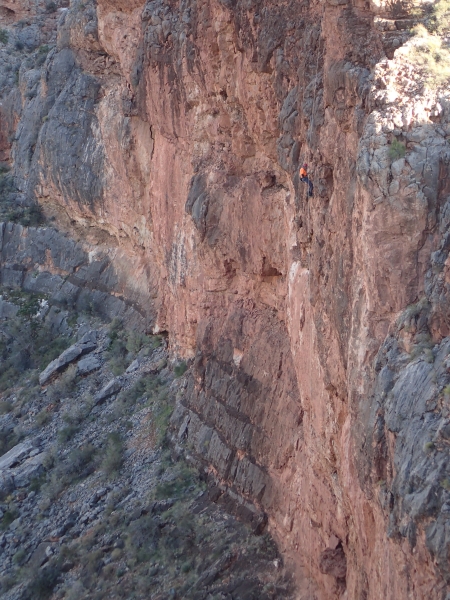
This past weekend I was completely out of touch with the rest of the world as I led a group of eight cavers hunting for new caves within the Grand Canyon. This was the fourth trip we’ve done to this part of the canyon, and on previous trips we were either mapping known caves, or scouting with binoculars the cliffs on the mesa’s walls, looking for potential openings. This trip we focused on rappelling down to the most likely candidate openings.
Overall we checked about a dozen potential caves, all of which turned out to be dead ends, mere alcoves. Oh well. Though this might sound disappointing, when you have to rappel off a cliff in the Grand Canyon, dropping out into nothing at heights ranging from 100 to 200 feet, who can complain? The image on the right, taken by Jeff Watkins, shows me (in the orange shirt) in the midst of one of these journeys. I am rappelling about 160 feet down to the top of the alluvial fill that you can see on the left that slopes down another few hundred feet to the canyon floor. In this image I am about a third of the way down, and am about to reach the spot where I will be hanging completely free of the wall.
Yowza! Though you can’t see it in this picture, behind me and opposite the cliff face the canyon extends out several miles to its opposite rim, with the Inner Gorge of the Colorado River cutting across in between. Once I reached the bottom I then rearranged my gear, using it to climb the rope back up 160 feet.
Nor was I the only one to do this. During the weekend we each got to do at least one rappel, each of which was as stunning and as breath-taking in its own right.
To say the experience was exhilarating is for sure a significant understatement. I used to do rappels this deep routinely when I was caving back east, but then the drop was underground, in the dark, with cave walls relatively nearby. Though that had a majesty of its own, doing this in the outdoors, in the Grand Canyon, is a far different thing.
Using data produced by Cassini while orbiting Saturn scientists have discovered long narrow stripes on the moon Dione.
Dione’s linear virgae are generally long (10 to 100s of kilometers), narrow (less than 5 kilometers) and brighter than the surrounding terrains. The stripes are parallel, appear to overlie other features and are unaffected by topography, suggesting they are among the youngest surfaces on Dione.
“Their orientation, parallel to the equator, and linearity are unlike anything else we’ve seen in the Solar System,” Patthoff said. “If they are caused by an exogenic source, that could be another means to bring new material to Dione. That material could have implications for the biological potential of Dione’s subsurface ocean.”
That they cut across the topography implies strongly that they were laid down from above, after the surface irregularities were created.
An analysis by scientists of the orbital mechanics surrounding Pluto and Charon, combined with the use of an ion engine similar to that used by the asteroid probe Dawn, suggests that an orbiter sent to Pluto could also break from from that planet to travel out into the Kuiper Belt and explore additional objects there.
The team first discovered how numerous key scientific objectives can be met using gravity assists from Pluto’s giant satellite, Charon, rather than propellant, allowing the orbiter to change its orbit repeatedly to investigate various aspects of Pluto, its atmosphere, its five moons, and its solar wind interactions for up to several years. The second achievement demonstrates that, upon completing its science objectives at Pluto, the orbiter can then use Charon’s gravity to escape the system without using fuel, slinging the spacecraft into the Kuiper Belt to use the same electric propulsion system it used to enter Pluto orbit to then explore other dwarf planets and smaller Kuiper Belt bodies.
“This is groundbreaking,” said Stern. “Previously, NASA and the planetary science community thought the next step in Kuiper Belt exploration would be to choose between ‘going deep’ in the study of Pluto and its moons or ‘going broad’ by examining smaller Kuiper Belt objects and another dwarf planet for comparison to Pluto. The planetary science community debated which was the right next step. Our studies show you can do both in a single mission: it’s a game changer.”
The key here is a willingness to make increased use of the ion-type engine used by Dawn in its journey from the asteroids Vesta and Ceres. Such a probe could spend decades traveling from one Kuiper Belt object to the next.
While NASA will continue to listen for activity from Opportunity for many more months, its active effort to signal the Mars rover is about to end.
After more than a month, Opportunity has not responded to those commands, and that active listening effort will soon end. “We intend to keep pinging Opportunity on a daily basis for at least another week or two,” said Lori Glaze, acting director of NASA’s planetary science division, during a presentation Oct. 22 at the annual meeting of the American Astronomical Society’s Division for Planetary Sciences here.
Glaze said that a factor in ending the active listening campaign is to prepare for the landing of the InSight spacecraft on Mars Nov. 26. “We want to wind that down before InSight gets to Mars and make sure all our orbital assets are focused on a successful landing of InSight,” she said.
That schedule is consistent with previous plans for attempting to restore contact with Opportunity. NASA said Aug. 30 that, once skies cleared sufficiently, it would attempt active listening for 45 days. “If we do not hear back after 45 days, the team will be forced to conclude that the sun-blocking dust and the Martian cold have conspired to cause some type of fault from which the rover will more than likely not recover,” John Callas, Opportunity project manager, said in a statement outlining those plans.
I would not be surprised if they do try to signal the rover a few more times, in January after the busy fall period when there are a lot of planetary probes needing access to the Deep Space Network. Even so, it appears the rover’s life is finally at an end, fourteen years past its originally planned lifespan of only 90 days.
In a speech by Mike Pence yesterday the Trump administration outlined its continuing plans to moves forward with a new military branch focused on space as well as a reorganization of the bureaucracies that regulate commercial space into a single Commerce Department agency.
Pence said the National Space Council and National Security Council will review space operational authorities “to ensure that our warfighters have the freedom and flexibility they need to deter and defeat any threat to our security in the rapidly evolving battlefield of space.” A lack of centralized leadership and accountability threatened U.S. ability to “advance our national security in space,” Pence said. “The time has come to stop studying the problem and start fixing it.”
The Trump administration in August announced an ambitious plan to usher in a new “Space Force” as the sixth branch of the military by 2020. Such a change, which the Defense Department has estimated would cost $13 billion in the first five years, must first be approved by Congress. Pence said at an earlier Washington Post forum that China and Russia have established similar space forces. “This is what our competitors are already doing. And the president is determined to make sure that America leads in space, as well, from a military standpoint,” he said.
…The proposed bill would also create the Bureau of Space Commerce under the U.S. Department of Commerce to liaise with industry representatives and organizations, according to a copy provided to Reuters. It also calls for $10 million per year for five years starting in 2020 to fund the commerce arm.
I am traveling up to Phoenix as I write this to be a talking head on a Science channel television show, so I haven’t yet reviewed carefully this proposal. Based on the quote above, the cost for the Space Force is absurd. This is an office, not a military force. At $13 billion it looks more like gold-plated pork.
Meanwhile, the proposed Commerce agency makes sense only if it truly replaces other bureaucracies. I am not yet sure that will happen.
An evening pause: The closing song and credits from one of the greatest musicals every put on film, The Music Man (1962).
It reminds us that there is always magic in the air, if only we look for it.
Hat tip Edward Thelen.
A new study has found a correlation between the strength of the monsoon season in India and the number of hurricanes that make landfall in North America.
According to Kelly, La Niña and the Indian monsoon are correlated, but the strength of the monsoon influences the steering of hurricanes independently of La Niña fluctuations, which are responsible for changes in hurricane frequency. In other words, La Niña fluctuations may result in more Atlantic hurricanes, but strong Indian monsoons steer them further westward, making it more likely they will make landfall in the Americas.
It’s important to account for the correlation when studying hurricane steering and landfall probability.
In reading the article, ignore the propaganda promoting global warming, as the research has zero to do with that subject. It instead now provides meteorologists another clue to predicting the frequency and paths of hurricanes in the Atlantic.
Capitalism in space: The smallsat rocket company Vector has successfully raised an additional $70 million in investment capital.
The increased funds bodes well for the company, but I am becoming increasingly concerned the company is more sizzle than steak. From the article:
With this round of funding, Vector plans to expand its sales and marketing teams. And the goal is to double its footprint in Silicon Valley. Vector is also expecting to break ground on a new state-of-the-art factory in Tucson. And Vector is advancing towards a first orbital attempt set to take place from the Pacific Spaceport Complex-Alaska soon.
Their original plan was to complete five test launches leading up to their first orbital try. Only two of those launches have flown, and it appears they are aiming to make the third launch orbital, with no clear schedule indicated. More significantly, it appears that they are not using the additional money for rocket development but for “sales and marketing.” Shouldn’t that come after the rocket is operational?
Link here. The article describes in detail SpaceX’s schedule of launches through the end of 2018, which appears now to be firming up. Several take-aways:
A look at the overall launch schedule shows that the two Falcon Heavy launches that have been pending and were originally set for the last quarter of 2018 are now set for “early 2019.” This full schedule also lists the first unmanned flight of the Dragon manned capsule for January.
Engineers have apparently pinpointed and fixed the issue that was causing the Hubble Space Telescope’s last back up gyroscope to operate incorrectly, making it likely that the telescope will return to full normal operations shortly.
In an attempt to correct the erroneously high rates produced by the backup gyro, the Hubble operations team executed a running restart of the gyro on Oct. 16. This procedure turned the gyro off for one second, and then restarted it before the wheel spun down. The intention was to clear any faults that may have occurred during startup on Oct. 6, after the gyro had been off for more than 7.5 years. However, the resulting data showed no improvement in the gyro’s performance.
On Oct. 18, the Hubble operations team commanded a series of spacecraft maneuvers, or turns, in opposite directions to attempt to clear any blockage that may have caused the float to be off-center and produce the exceedingly high rates. During each maneuver, the gyro was switched from high mode to low mode to dislodge any blockage that may have accumulated around the float.
Following the Oct. 18 maneuvers, the team noticed a significant reduction in the high rates, allowing rates to be measured in low mode for brief periods of time. On Oct. 19, the operations team commanded Hubble to perform additional maneuvers and gyro mode switches, which appear to have cleared the issue. Gyro rates now look normal in both high and low mode.
This is wonderful news, in that it means the telescope will once again be able to point accurately enough to continue to take sharp images across the entire sky. It also highlights how close we are now to the telescope’s demise, since it no longer has a back-up gyroscope. With the next failure, which will occur eventually, Hubble will descend into one gyroscope operations, holding off its second working gyro as a backup.
An Arianespace Ariane 5 rocket successfully launched the joint European/Japanese BepiColumbo mission to Mercury this weekend.
BepiColombo consists of two orbiters: Japan’s Mercury Magnetospheric Orbiter (MMO) and ESA’s Mercury Planetary Orbiter (MPO), both of which will be carried together by the Mercury Transport Module (MTM).
While MPO will go into an approximately 400 x 1500 km mapping orbit around Mercury, MMO will enter a highly elliptical orbit to study the planet’s enigmatically strong magnetic field.
The leaders in the 2018 launch race:
28 China
17 SpaceX
8 Russia
8 ULA
7 Europe (Arianespace)
China still leads the U.S. in the national rankings 28 to 26.
One of the two MarCO cubesats launched with the InSight Mars lander has successfully taken its first picture of Mars, the first such image ever taken by an interplanetary cubesat.
The image itself is not that interesting, with Mars not much more than a dot. What makes this significant is that it proves that a small, inexpensive cubesat can be built with the capability to accurately point and take photographs during an interplanetary mission. This means that the entire field of interplanetary probes is prime for major changes, shifting from big expensive and rarely launched spacecraft to small inexpensive cubesats launching frequently and it large numbers.
Embedded below the fold in two parts.
» Read more
An evening pause: Hat tip Danae.
An evening pause: Listen to the words.
Hat tip Kyle Kooy.
I am off to the Grand Canyon again for a caving expedition. We drive up and hike in today, and hike out and drive home on Monday.
I am not bringing a laptop this time to post on the drives. Posting, except for evening pauses, will thus have to wait until I return.
There is one scheduled launch this weekend, the late lift-off tonight of BebiColumbo, a joint European-Japanese mission to Mercury, by a Ariane 5 rocket. I will catch up on this, and other news, once I return.
An evening pause: What I want to know is this: How did he get the baby to work on cue?
Hat tip Edward Thelen.